
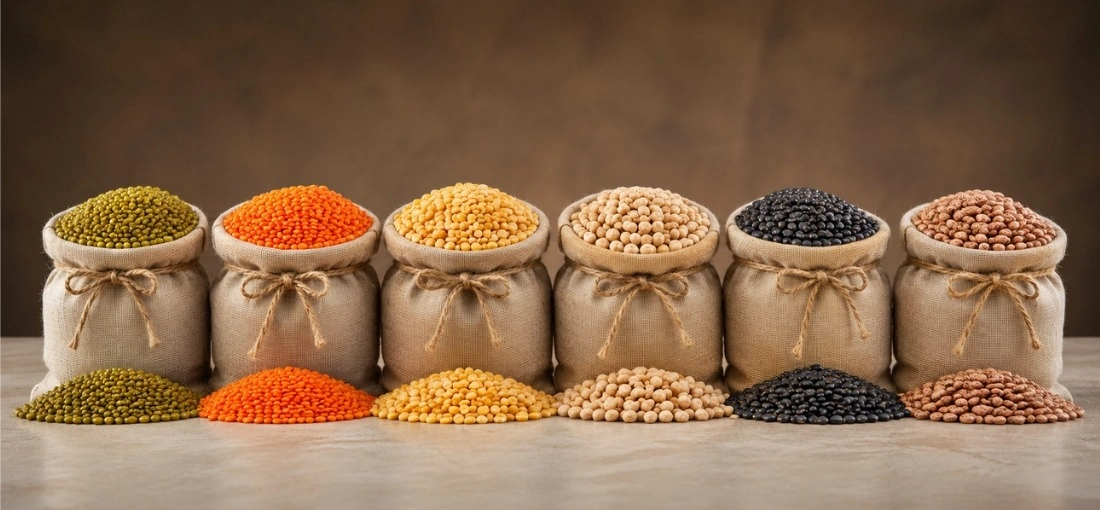
Pulses are a very critical part of global food commodity trade and in extremely high demand by global pulses importers . They are one of the most widely vegetarian sources of protein that are a critical part of dietary habits in many countries. Right from lentil, chickpeas, kidney beans, etc., you will find different varieties being traded globally by traders.
According to OECD FAO reports, the global pulses rate reached 20.7 million tons in the year 2024 and the projections clearly indicate that it can reach around 23 million tons by 2034.
Tradologie offers a cleaner way to work. We link genuine pulse processors, millers, and originators straight with verified bulk pulses importers worldwide, giving you direct access to get pulses export orders on clear, protected terms.

Trade requirements shift depending on whether a shipment is heading to an industrial dehusking mill, a commercial canning line, or a supermarket packaging plant.
Lentils: Red, Green, and Brown
If you're shipping red lentils (Masoor), most of that tonnage goes straight to mills across South Asia and the Middle East to be split for everyday dal. At the same time, the Green lentils are an entirely different game. Bulk pulses buyers in Europe and Latin America are buying Lairds and Richleas for grocery shelves, so they'll check every batch for clean skin, uniform size, and zero wrinkling before signing off.
Chickpeas: Caliber vs. Volume
If you're moving red lentils (Masoor), the bulk of that volume heads straight to splitting mills across India, Bangladesh, and the UAE to supply everyday dal. Green lentils are an entirely different market. Bulk pulses importers in Spain, Italy, Colombia, and Mexico buy whole Large Green (Laird) and Medium Green (Richlea) varieties for retail grocery packs, which means they will inspect every container for clean seed coats, zero wrinkling, and consistent caliber before clearing payment.
Dry Yellow & Green Peas
Yellow peas remain one of the biggest movers in international agri-bulk. A massive portion feeds basic kitchen demand across South Asia, but an equally aggressive volume now flows into modern protein fractionation plants in China and North America for isolate and starch manufacturing. Green peas follow right alongside for canning lines and split-pea processing.
Pigeon Peas (Tur) & Black Gram (Urad)
These are foundational pantry staples across the Indian subcontinent. When harvest windows open across East Africa (Tanzania, Mozambique, Malawi) and Myanmar, container lines and bulk holds load up fast to supply processing mills before the next regional harvest.
Dry Beans & Kidney Beans
The demand, from Dark Red Kidney Beans to Navy and Pinto beans, is majorly influenced by industrial canners, big frozen meal producers, and grocery packers that deal in private labels across Europe and the Americas. These are the markets where cooking time and visual uniformity make or break a contract.

Targeting the right buyer means knowing where local harvest shortfalls create consistent import windows.
| Destination | Primary Varieties in Demand | What Shapes the Market |
|---|---|---|
| India | Yellow Peas, Lentils, Desi Chana, Tur, Urad | The biggest consumer base globally. Import pace often pivots around monsoon outcomes, local buffer stocks, and tariff adjustments. |
| China | Yellow Peas, Mung Beans, Broad Beans | Driven heavily by industrial processors rather than table consumption, turning raw bulk into vermicelli starch and plant protein. |
| Middle East & North Africa (UAE, Egypt, Algeria, Turkey) | Kabuli Chickpeas, Fava / Broad Beans, Red Lentils | High daily consumption for staples like ful and falafel, paired with active re-export processing in regional trade hubs. |
| European Union & UK | High-Gauge Kabulis, Green Lentils, Specialty Beans | Strictest documentation requirements in the trade, focused on clear non-GMO status, low pesticide residues, and retail presentation. |
| Bangladesh & Pakistan | Red Lentils, Yellow Peas, Whole Chickpeas | High-density wholesale demand with active port-side splitting mills working to keep urban food supplies steady. |
| Latin America (Mexico, Colombia, Brazil) | Black Beans, Pinto Beans, Whole Lentils | Core everyday food culture. Buyers prioritize quick-soaking varieties that hold their color and texture through cooking. |
Because commercial pulse farming is concentrated in specific agricultural zones, international outflows rely heavily on a small group of high-capacity grain and container terminals:
Nobody enjoys sending expensive product samples abroad only to have the conversation go cold, or dealing with payment disputes once cargo has already left the berth. Tradologie provides a transparent framework built specifically for bulk trade:
Ready to find active pulses buyers and expand your export reach?
Create your seller account on Tradologie today, explore live procurement tenders, and start closing verified international contracts.
Tradologie is the main hub for major pulses importers from all over the world. Our platform is currently being used by high-volume pulses buyers who are looking to lock in bulk pulses shipments right now.
Whether you want to enter the large markets in the Middle East or premium retail segments in the West, we already have the connections in place for you to export pulses in bulk.
| South Asian High-Volume Marketss | Middle Eastern & Mediterranean Trade Hubs | Premium Western Consumption Markets |
|---|---|---|
| The large-scale consumption and processing centers driving consistent pulses demand. | The strategic import-driven hubs for food trade and regional redistribution. | The premium retail and foodservice destinations with growing plant-protein demand. |
|
You can find verified pulses buyers on B2B trade platforms such as Tradologie, where global importers are vetted for business legitimacy before participating in procurement. This allows pulses exporters to connect directly with genuine procurement heads.
Some of the major pulses buying markets include India, China, the Middle East and North Africa, the European Union and UK, Bangladesh, Pakistan, and Latin America. Each market has different requirements for lentils, chickpeas, peas, beans, and other pulses.
Global pulses buyers commonly source lentils, chickpeas, yellow and green peas, pigeon peas, black gram, kidney beans, navy beans, pinto beans, and other dry pulses. Demand varies depending on local consumption, processing requirements, and retail applications.
The content identifies India, China, the Middle East and North Africa, the EU and UK, Bangladesh and Pakistan, and Latin America as key pulses import markets. India has a particularly large consumer base, while China has strong demand from industrial processors.
Pulses exporters can create a seller account on Tradologie, explore live procurement tenders, submit competitive quotes, and negotiate directly with verified international buyers. The platform provides live price discovery during active negotiations.
Requirements depend on the destination and application. Buyers may assess factors such as variety, caliber, seed-coat quality, color, cooking performance, pesticide residues, non-GMO status, and retail presentation.
Tradologie connects pulse processors, millers, originators, and exporters with KYC-verified bulk pulses importers. Sellers can participate in live negotiations, compare competing quotes, and use LC and escrow-backed payment structures for international transactions.