
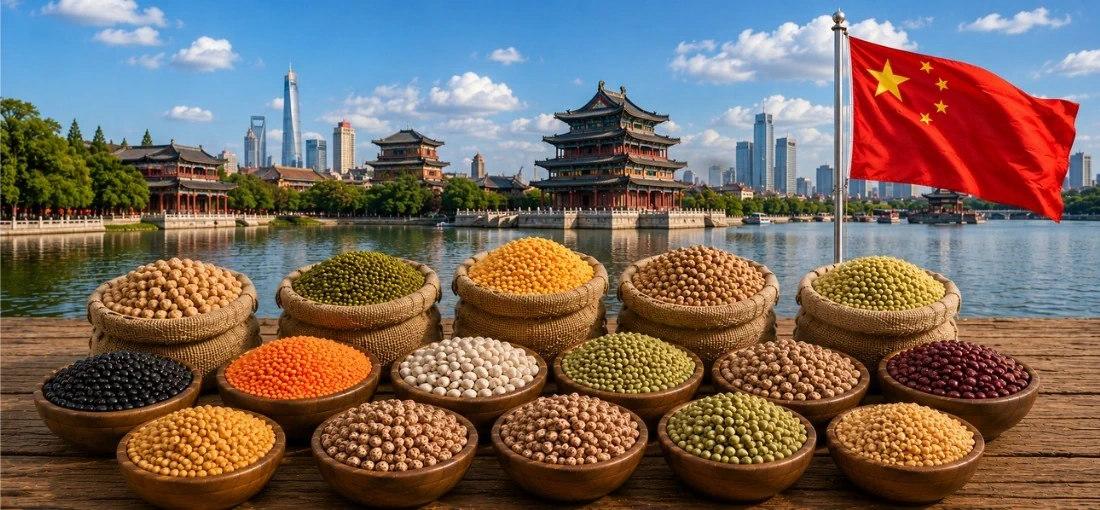
The Chinese market represents a massive frontier for global agricultural exporters, commanding an increasingly central position in the international legume trade. For global pulses suppliers , navigating the procurement networks of pulses importers in China sectors is an intensive exercise in supply chain discipline, volume reliability, and rigid regulatory adherence. Walk through the automated container offloading zones at the Port of Qingdao, or evaluate the manufacturing intakes at large-scale ingredient processing hubs across the eastern coastal provinces. The industrial demand for continuous, multi-ton volume lines of premium dry peas, mung beans, lentils, and chickpeas is accelerating at a historic pace. Establishing recurring supply agreements with institutional pulses buyers in China grids requires far more than matching a spot price; it demands a deep alignment with specialized manufacturing specifications.
According to industry data published by Deep Market Insights, the China pulses market reached a standalone valuation of USD 2,589.4 Million in 2024 and is projected to expand to USD 3,656.06 Million by 2033. Driven by a strategic structural shift in domestic agricultural policies—incentivizing higher-value domestic feed crops while relying heavily on bulk imports to satisfy national human consumption—the market is accelerating at a steady CAGR of 3.87%. The younger urban demographic across major consumer grids is aggressively driving a demand shift toward fast-cooking pre-made meals, vermicelli production lines, and high-protein plant formulations. To protect your corporate margins when negotiating with premium pulses importers in China operations or pitching your lines to active pulses buyers in China trading desks, your processing setups must deliver flawless quality metrics from the initial cleaning sieve to final customs clearance.
Tradologie provides the direct digital gateway needed to navigate this dense, high-volume environment. We deliver an advanced, AI-enabled trade solution where international suppliers can interface directly with prominent pulses buyers in China and state-backed distribution groups, ensuring a completely transparent process that prioritizes direct communication, live buying requirements, and secure capital clearing.
How Tradologie Facilitates Trade with China

The Chinese pulse infrastructure relies on massive, vertically integrated state-backed trading corporations, high-capacity ingredient millers, and prominent wholesale brokers positioned near major maritime transport terminals.
| Rank | Company Name | Headquarters | Market Focus | Unique Market Position |
|---|---|---|---|---|
| 1 | COFCO Oils & Oilseeds | Beijing | Bulk Agro Trading & Processing | The premier state-owned agricultural giant; controls massive national logistics, storage elevators, and processing lines for bulk inputs. |
| 2 | Yantai Shuangta Food Co., Ltd. | Shandong Hub | Pea Protein & Vermicelli | The absolute titan of pea processing, absorbing immense bulk volume cycles of imported dry peas for protein extraction and starch lines. |
| 3 | Shandong Jianyuan Bioengineering | Jinan | Food Ingredient Formulation | A massive industrial player utilizing imported legumes to manufacture advanced dietary fibers, clean-label pulse flours, and isolates. |
| 4 | Qingdao Spring Agricultural Co., Ltd. | Qingdao | Wholesale & Export/Import | Strategically located near major maritime terminals; manages extensive cleaning, color-sorting, and distribution infrastructure. |
| 5 | Dalian Green Capital Agricultural | Liaoning | Bulk Specialty Grains | Prominent northern trading house handling high-volume container networks of raw lentils, chickpeas, and premium beans. |
| 6 | Shanghai Liangyou Group | Shanghai | Foodstuffs & Processing | Major integrated food enterprise sourcing significant volumes of imported pulse variations to supply regional retail and industrial networks. |
| 7 | Yulin Spice & Agro Trading Capital | Guangxi Hub | Regional Distribution | A vital distribution powerhouse managing heavy-volume inflows of tropical commodities and seeds for southern culinary networks. |
| 8 | Anhui Cereals, Oils & Foodstuffs | Hefei | FMCG & Bulk Distribution | Prominent state-backed trading group managing large-scale, high-yield container pipelines of agricultural inputs for consumer grids. |
| 9 | Xiamen C&D Inc. | Xiamen | Supply Chain Logistics | A massive supply chain conglomerate facilitating automated customs clearing and volume sourcing for industrial food plants. |
| 10 | Guangdong Foodstuffs Imp. & Exp. | Guangzhou | Southern Retail & Wholesale | Strategic distributor moving containerized import lines of single-origin pulses directly into southern manufacturing zones. |
Building a profitable, recurring export lane into China requires moving past old-school spot market interactions and prioritizing absolute regulatory transparency. The entry parameters enforced across the country are completely rigid. Every international production facility planning to fulfill contracts for pulses importers in China networks must maintain an active, valid registration under the General Administration of Customs of China (GACC Decree 248 framework). Should an incoming container arrive at a maritime terminal without a matching, pre-approved GACC code, or if random port sampling detects trace heavy metal deviations or unauthorized pesticide residues, customs inspectors will freeze the entire manifest instantly. Conversely, an exceptional commercial upside awaits global suppliers who can validate the biological and physical cleanliness of their crops.
Procurement patterns across Chinese manufacturing hubs show a massive structural reliance on whole raw seeds and split variations that can integrate smoothly into automated processing lines. According to market reports, lentils represent the largest and fastest-growing segment within the crop category, commanding a major portion of the import volume due to expanding applications in functional foods and home cooking. Traditional, slow-moving physical brokerage loops are quickly giving way to digitized B2B logistics channels. By supplying bulk raw materials to active pulses importers in China that feature immaculate grading sheets, uniform grain sizes, and stable moisture contents—carefully managed to avoid tropical transit risks—your enterprise can confidently secure the stable, long-term supply agreements that form the bedrock of sustainable B2B trade.

Navigating Chinese customs entry requires precise alignment with high-capacity maritime gateways to optimize customs processing windows and completely avoid expensive container detention overheads.
Aligning your shipping allocations, container configurations, and vessel selections directly with the maritime gateway closest to your buyer's central sorting or protein-extraction layout is an operational necessity. It remains the most effective strategy to completely wipe out unexpected terminal handling fees and insulate your underlying export margins.
China is one of the fastest growing pulse consumption markets globally, driven by rising demand for plant based proteins, processed foods, vermicelli production, and industrial food manufacturing.
Exporters increasingly use AI enabled trade ecosystems like Tradologie to connect directly with pulses importers in China, access live procurement requirements, and negotiate bulk contracts with verified industrial buyers.
Dry peas, lentils, mung beans, chickpeas, split pulses, pulse flours, and protein extraction raw materials are among the most demanded categories in China’s industrial food sector.
China requires all international food exporters to maintain active registration under the GACC Decree 248 framework. Shipments without approved registration or compliant documentation can face customs rejection.
Major companies include COFCO Oils & Oilseeds, Yantai Shuangta Food, Shanghai Liangyou Group, Xiamen C&D Inc., and Qingdao Spring Agricultural along with several state backed trading enterprises.
China combines large scale institutional procurement with highly automated food manufacturing systems. Buyers prioritize stable quality, moisture consistency, grading precision, and long term supply capability over short term spot pricing.
Port of Qingdao, Port of Shanghai, Port of Dalian, and Port of Tianjin are among the most important maritime gateways handling bulk pulse imports into China’s processing and manufacturing hubs.