
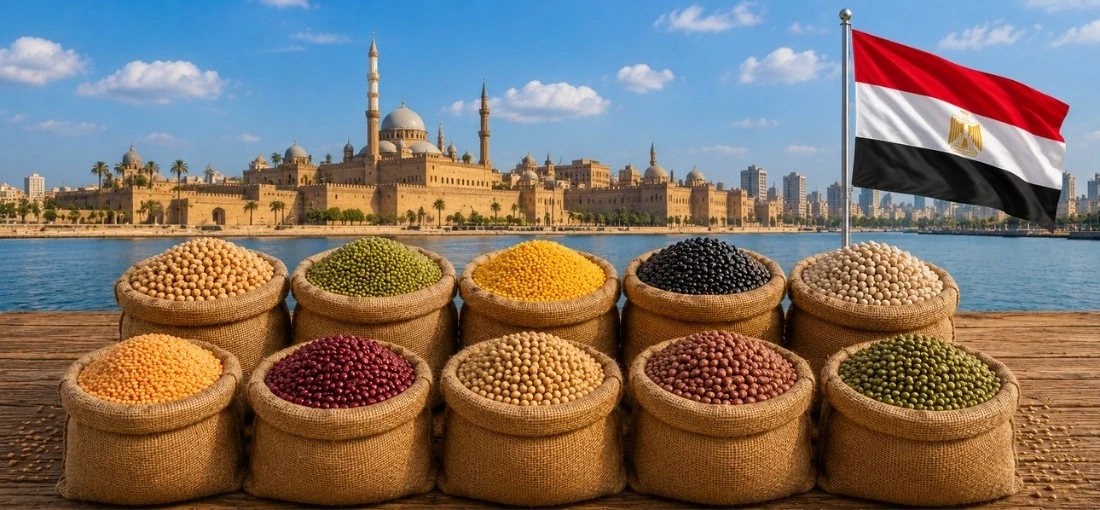
The Arab Republic of Egypt stands as one of the most critical, volume-driven consumer arenas for the international legume trade across North Africa and the Mediterranean. Sourcing your products directly to active pulses importers in Egypt corporations means stepping onto a high-velocity, deeply specialized agricultural runway. If you observe the container offloading workflows across the bustling docks of the Port of Alexandria or track raw cargo intakes heading toward high-capacity packing complexes near Cairo, the commercial scale is unmistakable.
The Egyptian marketplace relies on a continuous, non-stop stream of bulk agricultural imports to feed its massive, rapidly expanding population. However, securing long-term agreements with institutional pulses buyers in Egypt grids requires far more than just matching a spot market price; it demands complete process transparency, flawless quality metrics, and immediate alignment with strict national biosecurity protocols enforced by local food authorities.
According to global trade data published by the Food and Agriculture Organization (FAO) and international market analysis tracking platforms, Egypt's institutional pulse import values have experienced positive growth at a CAGR of 7.1%, positioning the country firmly as a Top 10 global importer of dry legumes. Driven by rapid urbanization, a rising national population, and a deep-rooted cultural reliance on plant-based proteins as daily dietary foundations, the industry operates at an institutional scale.
Tradologie streamlines the manual complexities of cross-border trade through a direct, AI-driven trade solution. Our specialized B2B trade platform enables global agricultural suppliers to connect and negotiate directly with leading pulses importers in Egypt and regional enterprise distributors. This ecosystem offers a transparent and efficient way to manage live trade inquiries, submit digital phytosanitary documentation, and finalize secure payment terms while minimizing the common delays caused by conventional, multi-layered broker networks.
How Tradologie Assists You to Export Pulses in Bulk to Egypt?

The Egyptian pulse distribution framework relies heavily on vertically integrated food manufacturing conglomerates, prominent state-backed procurement desks, and strategic agricultural brokers located near major maritime import gateways.
| Rank | Company Name | Headquarters | Market Focus | Unique Market Position |
|---|---|---|---|---|
| 1 | Edita Food Industries | Cairo | FMCG & Industrial Baking | A massive public industry giant and market leader operating ultra-modern manufacturing lines, processing ingredient inputs for regional distribution grids. |
| 2 | Juhayna Food Industries | Giza Hub | Mass Consumer FMCG | A premier corporate household name dominating the packaged food grid, absorbing immense bulk volume cycles of plant proteins and starches. |
| 3 | Faragalla Group | Alexandria | Packaging & Food Processing | An absolute industrial powerhouse managing state-of-the-art milling, packaging, and canning lines for ambient agricultural staples. |
| 4 | Wadi Group | Giza | Agro-Industrial Sourcing | Dominant market force managing extensive grain elevators, logistics operations, and bulk raw commodity processing facilities nationwide. |
| 5 | Al-Doha For Food Industries | Cairo | Premium Retail Packing | High-profile premium food brand controlling consumer retail lines with highly traceable, Sortex-cleaned pulse and rice variations. |
| 6 | Regina Company | Cairo Hub | Pasta & Food Processing | Major integrated food enterprise utilizing significant volumes of imported pulse powders and starches to engineer customized culinary mixtures. |
| 7 | Americana Group Egypt | Cairo | Foodservice & Manufacturing | Strategic institutional supplier moving vast multi-ton container loads of raw legumes directly into regional hospitality and catering networks. |
| 8 | Harvest Foods | Alexandria | Automated Canning Lines | Powerhouse canning specialist manufacturing premium canned faba beans and chickpeas for domestic supermarket distribution. |
| 9 | Mansour Group (Metro Markets) | Cairo | Organized Mega-Retail | The nation's largest organized retail network, absorbing direct container lines of single-origin retail pulses for private-label packaging. |
| 10 | Egyptian Mediterranean Sourcing | Alexandria Hub | Bulk Agro Commodities | Strategic maritime commodity broker managing continuous, high-yield container pipelines of agricultural inputs for regional wholesale markets. |
Building a profitable, recurring export lane into Egypt requires moving past standard commodity trading methods and prioritizing absolute compliance with shifting regulatory frameworks and foreign exchange structures. The entry parameters enforced by local border authorities and the National Food Safety Authority (NFSA) are entirely rigid. Every international production facility planning to fulfill cargo contracts for pulses importers in Egypt networks must successfully clear strict physical and microbiological safety checks conducted at port laboratories.
For instance, customs sampling enforces zero-tolerance thresholds regarding moisture limits (typically capped strictly below 13-14%) and unauthorized chemical residues to prevent insect activity or transit spoilage. Should an incoming container of bulk red lentils or faba beans fail random sampling at the maritime gate, border inspectors will freeze the entire manifest immediately. Conversely, an exceptional commercial upside awaits global suppliers who can validate absolute biological and physical purity, as local manufacturing plants actively pay a premium to protect their automated sorting grids from damage.
Procurement patterns across modern Egyptian manufacturing and wholesale hubs show a severe, structural reliance on whole raw seeds that can be split, polished, and processed locally to align with traditional recipes. Split red lentils and broad beans command a dominant portion of the import volume due to their essential role in daily household dishes. Traditional, slow-moving physical brokerage loops are quickly giving way to digital procurement networks. By supplying bulk raw materials to active pulses buyers in Egypt channels that feature immaculate grading sheets, uniform grain sizes, and verified trace-element profiles, your enterprise can confidently secure the stable, long-term supply agreements that form the bedrock of sustainable B2B trade.

Navigating Egyptian customs entry requires precise coordination with world-class maritime complexes to optimize customs processing windows and completely avoid expensive container detention overheads.
Aligning your shipping allocations, container configurations, and vessel selections directly with the maritime gateway closest to your buyer’s central processing
Egypt is one of North Africa’s most important pulse consumption markets, driven by strong demand for lentils, faba beans, chickpeas, and other plant based protein products across retail and industrial food sectors.
Exporters increasingly use AI enabled trade ecosystems like Tradologie to connect directly with pulses importers in Egypt, access live procurement requirements, and negotiate bulk contracts with verified buyers.
Split red lentils, faba beans, chickpeas, yellow peas, and whole raw pulses are among the most demanded products across Egypt’s wholesale, retail, and food processing sectors.
Port of Alexandria, Port of Damietta, and Port Said are among the most important maritime gateways handling bulk pulses imports into Egypt’s food manufacturing and wholesale distribution networks.
According to FAO linked trade insights, Egypt’s institutional pulse import sector has been growing at a CAGR of around 7.1%, positioning the country among the Top 10 global importers of dry legumes.
Major companies include Edita Food Industries, Juhayna Food Industries, Faragalla Group, Wadi Group, Al Doha Foods, Regina Company, and Americana Group Egypt.
Egypt combines high volume consumer demand with strong reliance on imported agricultural commodities. Buyers focus heavily on moisture controlled cargo, physical purity, and stable supply consistency.




