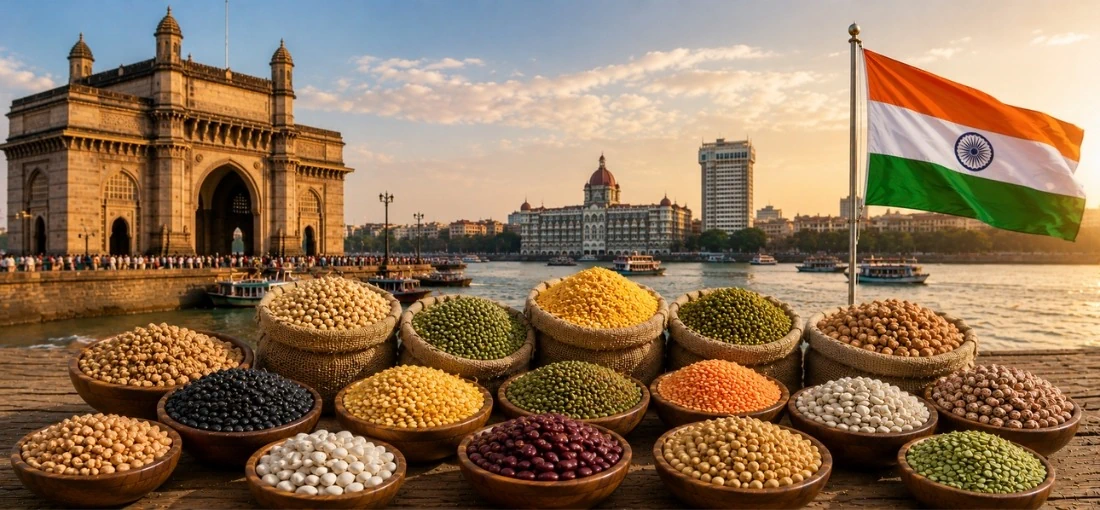
The Republic of India occupies an unrivaled, dual-track position in the global agricultural ecosystem, operating simultaneously as the world's largest producer, consumer, and institutional importer of leguminous crops. For international commodity suppliers, breaking into the procurement networks of pulses importers in India sectors is a high-volume, precision-driven exercise. The commercial demand for non-stop, multi-ton volume lines of premium lentils, pigeon peas (tur), yellow peas, and black gram (urad) operates at an absolute peak to fulfill the consumption needs of a massive population. Establishing recurring supply agreements with institutional pulses buyers in India grids requires far more than matching a spot price; it demands a deep alignment with volatile regulatory updates and stringent quality parameters.
According to comprehensive industry statistics published by IMARC Group, the India pulses market size reached an institutional volume of 37.98 Million Tons in 2025. Driven by rapid economic expansion, a profound cultural reliance on pulses as the primary source of affordable protein, and a growing domestic processing sector, the market is projected to reach 60 Million Tons by 2034, accelerating at a steady volume CAGR of 5.28%.
To protect your corporate margins when negotiating bulk deals with volume-driven pulses importers in India corporations or pitching your crop lines directly to elite pulses buyers in India trading desks, your processing lines must maintain absolute purity from the initial sorting grid to the final vessel hold.
Tradologie addresses the manual bottlenecks of cross-border trade by delivering a direct, AI-enabled digital trade solution. Our specialized B2B trade platform lets global agricultural suppliers negotiate directly with prominent pulses importers in India and regional enterprise distributors. This setup gives you a transparent path to manage live trade demands, submit digital phytosanitary documents, and lock in secure payment terms while eliminating the standard delays caused by traditional, multi-layered broker systems.
How Tradologie Facilitates India Trade

The Indian pulse distribution and processing matrix relies heavily on vertically integrated agricultural conglomerates, high-capacity milling giants (dal mills), and dominant trading desks located near major maritime import gateways.
| Rank | Company Name | Headquarters | Market Focus | Unique Market Position |
|---|---|---|---|---|
| 1 | Adani Wilmar Limited | Ahmedabad | FMCG & Bulk Processing | An absolute heavyweight giant and market leader operating ultra-modern milling facilities, packaging grids, and the iconic Fortune brand. |
| 2 | ITC Limited | Kolkata | FMCG & Branded Retail | A massive corporate distribution house dominating the premium packaged grocery grid with highly traceable, Sortex-cleaned pulse variations under the Aashirvaad banner. |
| 3 | Tata Consumer Products Ltd. | Mumbai | Premium Consumer FMCG | Elite packaged food powerhouse absorbing immense volume cycles of high-purity pulses for its unpolished consumer lines under the Tata Sampann brand. |
| 4 | Ruchi Soya Industries (Patanjali) | Haridwar | Mass FMCG & Aggregation | A dominant market force managing massive distribution networks and state-of-the-art milling infrastructure for consumer food products across India. |
| 5 | Dalmia Bharat Group | New Delhi | Industrial Bulk Trading | A legendary institutional commodity trading powerhouse managing massive multi-ton maritime transit cargo lines of lentils and chickpeas. |
| 6 | Agro Tech Foods Ltd. | Gurugram | Food Ingredient Formulation | Prominent food enterprise specializing in manufacturing value-added plant proteins and nutritional snack components derived from high-purity pulses. |
| 7 | Hindustan Unilever Limited (HUL) | Mumbai | Consumer Packaged Goods | Powerhouse consumer staple giant sourcing significant volumes of certified, premium pulse inputs for its regional culinary product lines. |
| 8 | Mother Dairy Fruit & Vegetable | Noida Hub | Organized Retail & Supply | Strategic institutional cooperative supplying packaged ambient staples and fresh produce directly to urban consumer networks. |
| 9 | Capital Foods Private Limited | Mumbai | Savory Seasonings & Mixes | Specialized food processor utilizing premium pulse powders and starch derivatives to formulate instant snack lines and ethnic sauce bases. |
| 10 | Reliance Retail (Consumer Brands) | Mumbai | Mega-Scale FMCG & Retail | The nation's largest organized retail engine, moving thousands of tons of bulk and private-label packaged pulses through nationwide storefronts daily. |
Building a profitable, recurring export lane into India requires moving past basic spot-market tactics and embracing an absolute commitment to shifting regulatory landscapes and tariff frameworks. The entry criteria enforced by local customs authorities and the Food Safety and Standards Authority of India (FSSAI) are entirely rigid. Every international production facility planning to fulfill cargo contracts for pulses importers in India networks must successfully clear strict biological and physical safety checks conducted at port laboratories. For instance, customs sampling enforces zero-tolerance measures regarding unauthorized chemical pesticide residues or foreign organic matter. Should an incoming container of bulk red lentils or yellow peas fail random sampling at the maritime gate, border inspectors will freeze the entire manifest immediately. Conversely, an exceptional commercial upside awaits global suppliers who can validate absolute physical purity, as Indian mega-mills actively pay a premium to protect their high-velocity processing lines from transit damage.
Procurement behaviors across primary Indian processing hubs show a massive structural focus on whole raw seeds that can be split, polished, and de-husked locally to match regional culinary preferences (split dals). According to industry analysis, lentils command the largest share of the crop type import volume, accounting for approximately US$1.3 billion in value, driven by widespread daily consumption across both rural and urban households. Traditional, slow-moving physical brokerage loops are quickly giving way to digital procurement setups. By supplying bulk raw materials to active pulses buyers in India channels that feature immaculate grading sheets, uniform grain sizes, and stable moisture contents—carefully managed to avoid tropical transit risks—your enterprise can confidently secure the stable, long-term supply agreements that form the bedrock of sustainable B2B trade.

Navigating Indian customs entry requires precise coordination with high-capacity maritime gateways to optimize customs processing windows and completely avoid expensive container detention overheads.
Aligning your shipping allocations, container configurations, and vessel selections directly with the maritime gateway closest to your buyer’s central processing, milling, or distribution layout is an operational necessity. It remains the most effective strategy to completely eliminate unexpected terminal handling fees and insulate your underlying export margins.
India operates as the world’s largest producer, consumer, and institutional importer of pulses, creating massive recurring demand for lentils, chickpeas, yellow peas, pigeon peas, and black gram.
Exporters increasingly use AI enabled trade ecosystems like Tradologie to connect directly with pulses importers in India, access live procurement requirements, and negotiate bulk contracts with verified buyers.
Red lentils, yellow peas, tur dal, urad, chickpeas, mung beans, and split dals are among the most demanded products across India’s FMCG, dal milling, and institutional food sectors.
According to IMARC Group estimates, India’s pulses market reached around 37.98 million tons in 2025 and is projected to approach nearly 60 million tons by 2034.
Major companies include Adani Wilmar, ITC Limited, Tata Consumer Products, Patanjali Foods, Dalmia Bharat Group, Agro Tech Foods, and Reliance Retail.
India combines massive consumer demand with large scale dal milling infrastructure. Buyers prioritize stable quality, moisture controlled shipments, and uniform grain sizes suitable for local splitting and polishing operations.