Key Highlights
- Malabar black pepper import requires buyers to evaluate geographical origin, GI authenticity, physical quality, processing standards and destination-market regulations.
- Malabar Pepper has a recognised geographical identity covering specified areas of Kerala, Karnataka and Tamil Nadu. Not all Indian black pepper automatically qualifies as GI-registered Malabar Pepper.
- Important traditional Kerala cultivars include Karimunda, Kottanadan, Neelamundi, Kuthiravally, Aimpiriyan, Balankotta, Kalluvally and Narayakodi. Improved varieties include Panniyur-1, Panniyur-2, Sreekara, Subhakara, IISR Sakthi and IISR Thevam.
- Buyers can source black pepper in whole, crushed, ground and organic forms, depending on their intended application and certification requirements.
- India's black pepper exports under HS 090411 and HS 090412 reached a combined US$112.27 million in 2024, covering 19,795.08 MT.
- Major quality parameters include moisture content, bulk density, berry size, foreign matter, damaged berries, piperine content, volatile oil, microbiological quality and pesticide residues.
- Essential import documents may include a commercial invoice, packing list, certificate of origin, bill of lading, phytosanitary certificate, laboratory report and applicable GI-related documentation.
Introduction
Malabar Black Pepper is one of India's recognised spice products, valued for its distinctive aroma, pungency and traditional cultivation history along the country's southwestern coast. For international buyers considering Malabar black pepper import, understanding its geographical origin, physical characteristics, quality specifications and export documentation is essential before finalising a purchase. Whether a buyer intends to import Malabar black pepper for spice distribution, food manufacturing, seasoning blends or retail packaging, the product's quality must match the requirements of the destination market.
India has a long history of black pepper cultivation, and the Malabar region has played an important role in the international spice trade for centuries. However, buying Malabar pepper involves more than selecting a country of origin. Importers need to evaluate the pepper's density, moisture, cleanliness, pungency, processing method and consistency between consignments.
This guide explains what buyers should know about Malabar pepper imports, how to approach Malabar black pepper sourcing, which specifications to discuss with suppliers and what to verify before importing.
What Is Malabar Black Pepper?
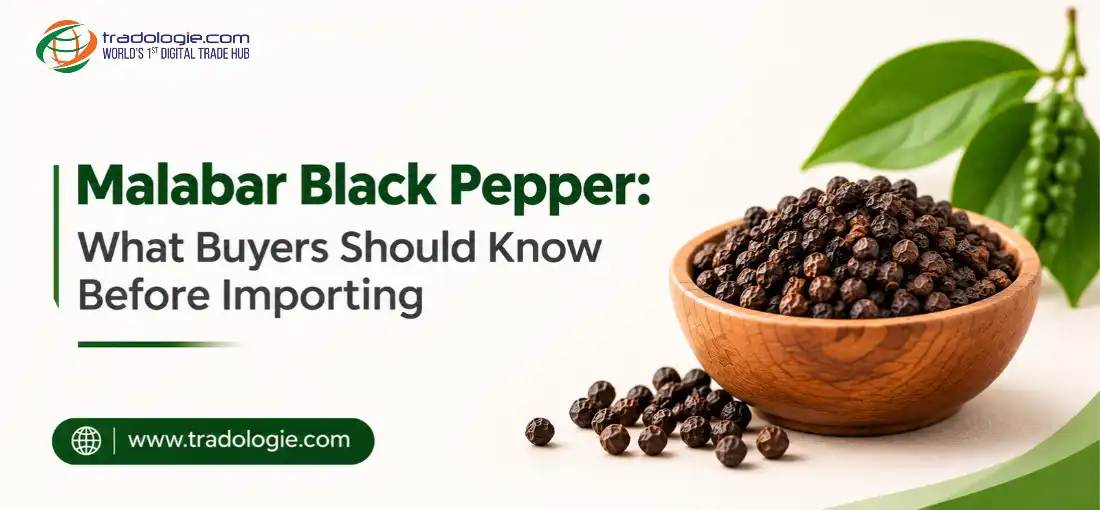
Malabar Black Pepper is obtained from the dried berries of Piper nigrum, a flowering vine cultivated in tropical climates. The pepper is harvested when the berries are mature but not fully ripe, after which they are separated from the spikes and dried. During drying, the outer skin develops its characteristic dark, wrinkled appearance.
The name Malabar refers to the traditional pepper-growing region along India's southwestern coast, particularly Kerala and adjoining areas. The geographical indication (GI) registration for Malabar Pepper covers specified geographical areas in Kerala, Karnataka and Tamil Nadu. It is registered under India's Geographical Indications framework, with the Spices Board of India as the applicant.
Malabar pepper is recognised for its traditional regional identity and distinctive spice characteristics. Its commercial appeal comes from its aromatic profile, pungency and suitability for whole-spice and processed-food applications.
An important distinction for importers is that not every black pepper shipment originating from India automatically qualifies as GI-registered Malabar Pepper. Buyers seeking the GI product should verify the origin, applicable GI specifications and authenticity documentation rather than relying only on a supplier's product description. This distinction is particularly important when evaluating suppliers offering Malabar pepper for international markets.

What Makes Malabar Black Pepper Different?
Malabar Black Pepper is valued for several characteristics that influence its suitability for international markets.
- 1. Distinctive aroma: Properly processed Malabar pepper has a strong, characteristic pepper aroma. This makes it suitable for seasoning blends, spice mixes, sauces and food manufacturing.
- 2. Pungency: Black pepper's pungency is primarily associated with piperine, a naturally occurring alkaloid. Its concentration can vary according to variety, maturity, cultivation conditions and post-harvest handling.
- 3. Dark, wrinkled appearance: Whole dried Malabar pepper berries generally have a dark brown to black exterior with a characteristic wrinkled surface.
- 4. Essential oil content: Volatile oils contribute to black pepper's aroma and flavour. Their retention depends partly on drying, storage and handling conditions.
- 5. Regional identity: GI registration gives Malabar Pepper a recognised geographical identity. For buyers supplying premium spice markets, this origin distinction can be commercially relevant.
These characteristics make Malabar pepper suitable for buyers looking for Indian-origin black pepper with a defined regional identity.
Important Malabar and Kerala Black Pepper Varieties
Kerala has a diverse collection of traditional black pepper cultivars, developed and maintained through generations of cultivation. These varieties differ in their geographical distribution, yield potential, berry characteristics, maturity periods and chemical composition. Some are particularly valued for their productivity, while others are recognised for their oleoresin, piperine or essential oil content.
For buyers interested in Malabar black pepper sourcing, understanding these differences provides useful agricultural and commercial context. The following are some of the important traditional cultivars and improved varieties associated with Kerala's black pepper-growing regions.
1. Karimunda
Karimunda is one of the most widely cultivated traditional black pepper varieties in Kerala and is considered an important cultivar across several pepper-growing districts. It is known for its adaptability to different growing conditions and its ability to perform well under partial shade, making it suitable for cultivation in traditional homestead gardens as well as organised plantations.
The cultivar is recognised for its relatively consistent bearing habit and good yield potential. Agricultural references report an average fresh berry yield of approximately 2–3 kg per vine, with dry recovery of around 35% under the reported cultivation conditions.
In terms of quality, Karimunda has recorded approximately 4.4% piperine, 4% essential oil and 11% oleoresin in published cultivar evaluations. These constituents contribute to the pungency, aroma and extractable flavour compounds of black pepper.
Karimunda is also commercially important because it has served as the parent material for improved selections such as Subhakara and Sreekara. Its widespread cultivation and established agricultural identity make it one of the important traditional cultivars associated with Kerala's pepper production.
2. Kottanadan
Kottanadan is a traditional black pepper cultivar primarily associated with southern Kerala. It is recognised for its strong yield potential, drought tolerance and high oleoresin content.
Agricultural evaluations have reported an average fresh yield of approximately 5 kg per vine, making it one of the productive traditional cultivars in the region. Its oleoresin content has been recorded at around 17.8%, which is particularly notable among the traditional varieties documented in cultivar studies.
Piperine content has been reported at approximately 6.6%, while essential oil content is around 2.5% in the cited evaluation. These chemical characteristics make Kottanadan an interesting cultivar from a spice-quality and processing perspective.
Its comparatively high oleoresin content is relevant to buyers and processors interested in pepper extracts, seasoning formulations and value-added spice products. PLD-2, an improved selection developed from Kottanadan, is another example of how this traditional cultivar has contributed to black pepper improvement programmes.
3. Neelamundi
Neelamundi is a traditional black pepper cultivar associated particularly with the Idukki region of Kerala. It is recognised for its good yield potential and reported tolerance to Phytophthora-related infection, an important consideration in pepper cultivation because foot rot and related diseases can significantly affect plantation productivity.
The cultivar has recorded an average fresh yield of approximately 2 kg per vine, with dry recovery in the range of 33–34% in published evaluations.
Its reported chemical composition includes approximately 4.6% piperine, 3.3% essential oil and 13.9% oleoresin. These characteristics indicate its relevance as a cultivar with a notable oleoresin profile.
Neelamundi is particularly relevant to growers operating in regions where disease pressure and plantation conditions influence cultivar selection. Its cultivation history in Idukki also makes it an important part of Kerala's traditional pepper diversity.
4. Kuthiravally
Kuthiravally is a traditional black pepper cultivar associated with Kozhikode and parts of Idukki. It is recognised for its long spikes, good yield potential and desirable quality characteristics.
The cultivar has recorded an average fresh yield of approximately 3 kg per vine, with a dry recovery of around 35% in published agricultural evaluations.
Its reported chemical composition includes approximately 6% piperine, 4.5% essential oil and 15% oleoresin. The combination of these quality attributes makes Kuthiravally an interesting cultivar for growers and processors looking for pepper with good pungency and extractable flavour components.
One cultivation characteristic associated with Kuthiravally is alternate bearing, meaning that the crop yield may fluctuate between successive seasons. This is relevant for growers planning annual production and for buyers assessing the consistency of supply from a particular growing area.

5. Aimpiriyan
Aimpiriyan is a traditional black pepper cultivar associated with the Wayanad region of Kerala. It is particularly recognised for its suitability for higher-elevation cultivation and its relatively good quality characteristics.
The variety is known as a late-maturing cultivar, which distinguishes its production cycle from some other traditional selections. Published evaluations have reported an average fresh yield of approximately 4–5 kg per vine, with dry recovery of around 34%.
Aimpiriyan has also recorded approximately 15–15.7% oleoresin, 4.7% piperine and 2.6% essential oil in cultivar studies. Its comparatively high oleoresin content makes it relevant to the processing segment, where extractable flavour compounds are important.
For growers in suitable elevated pepper-growing areas, Aimpiriyan represents a traditional selection with a combination of productive potential and recognised quality attributes.
6. Balankotta
Balankotta is a traditional black pepper cultivar associated with northern Kerala. It is recognised for its cultivation history and has also contributed to the development of improved varieties.
The cultivar generally produces moderate yields, with published evaluations reporting approximately 1–2 kg of fresh berries per vine and dry recovery of around 35%. Its bearing habit is described as irregular or alternate, which means production may vary from one season to another.
Balankotta has recorded approximately 4.2% piperine, 5.1% essential oil and 9.3% oleoresin in a published cultivar evaluation.
Its importance extends beyond traditional cultivation because Panniyur-2 was developed from open-pollinated progeny of Balankotta. This connection highlights the role of local cultivars in developing improved black pepper varieties suited to commercial cultivation.
7. Kalluvally
Kalluvally is a traditional black pepper cultivar associated with northern Kerala. It is recognised for its relatively good dry recovery and tolerance to drought conditions.
Agricultural evaluations report an average fresh yield of approximately 1–2 kg per vine, with dry recovery ranging from 35% to 38%. This recovery characteristic is relevant because it indicates the proportion of dried pepper obtained from harvested fresh berries.
Its reported chemical composition varies across evaluations, with piperine recorded in the range of approximately 2.5–5.4%, while essential oil content is around 3% and oleoresin content ranges from approximately 8.4% to 11.8%.
Kalluvally is therefore of interest to growers operating in areas where moisture availability can influence crop performance. Its comparatively good dry recovery also makes it a cultivar worth considering in discussions of post-harvest yield.
8. Narayakodi
Narayakodi is a traditional black pepper cultivar associated with central Kerala, although it is also reported in other regional cultivation references. It is generally described as a moderate-yielding variety with medium-quality characteristics.
Published agricultural evaluations report an average fresh yield of approximately 1–2 kg per vine, with dry recovery of around 36%.
Its reported chemical composition includes approximately 5.4% piperine, 4% essential oil and 11% oleoresin. These values provide an indication of its pungency and flavour-related constituents.
Although Narayakodi is not generally highlighted for exceptional yield, it forms part of Kerala's traditional cultivar diversity and remains relevant to understanding the different black pepper selections maintained by local growers.
9. Panniyur-1
Panniyur-1 is an improved black pepper hybrid developed at the Pepper Research Station, Panniyur, under Kerala Agricultural University. It was developed through a cross between Uthirankotta and Cheriyakaniyakadan.
The variety was introduced to improve productivity and cultivation performance. It is known for its suitability to relatively open growing conditions, although it does not perform well under excessive shade.
Published agricultural evaluations report a dry yield of approximately 1,242 kg per hectare, with around 11.8% oleoresin, 5.3% piperine and 3.5% essential oil.
Panniyur-1 is an important milestone in black pepper improvement programmes because it demonstrated the potential of hybrid breeding to improve yield and quality characteristics. Its cultivation suitability, however, needs to be assessed against the shade conditions and management practices of the plantation.
10. Panniyur-2 (Krishna)
Panniyur-2, also known as Krishna, was developed from open-pollinated progeny of Balankotta at the Pepper Research Station, Panniyur.
Unlike Panniyur-1, this variety is recognised for its appreciable tolerance to shade, making it suitable for pepper-growing areas where light availability is relatively limited.
It has recorded a dry yield of approximately 2,570 kg per hectare in published agricultural evaluations. Its reported chemical composition includes around 10.9% oleoresin, 6.6% piperine and 3.4% essential oil.
The combination of yield potential and shade tolerance has made Panniyur-2 an important improved variety in Kerala's black pepper cultivation system.
11. Sreekara
Sreekara is an improved black pepper variety developed through clonal selection from Karimunda by the Indian Institute of Spices Research (IISR), Kozhikode.
It is recognised for its high yield potential and quality characteristics. Published agricultural data report an average dry yield of approximately 2,677 kg per hectare, with 13% oleoresin, 5.1% piperine and 7% essential oil.
The variety is considered adaptable to different climatic conditions across major pepper-growing areas, including Kerala, southern Karnataka and Tamil Nadu.
Its relatively high essential oil content makes Sreekara particularly interesting from an aroma and flavour perspective. It is also an example of how traditional cultivars such as Karimunda have contributed to the development of improved commercial planting material.
12. Subhakara
Subhakara is another improved black pepper variety developed through clonal selection from Karimunda at IISR, Kozhikode.
It is known for its high yield potential and adaptability to different pepper-growing conditions. The variety is also considered suitable for intercropping and cultivation at higher elevations.
Published evaluations report an average dry yield of approximately 2,352 kg per hectare, with around 12.4% oleoresin, 3.4% piperine and 6% essential oil.
Its medium-maturing characteristics and adaptability make it a useful option for growers seeking an improved cultivar with a combination of productivity and quality attributes.
13. IISR Sakthi
IISR Sakthi is an improved black pepper variety developed by the Indian Institute of Spices Research. One of its most important characteristics is its tolerance to Phytophthora foot rot, a major disease that can cause considerable losses in black pepper plantations.
The variety is relevant to growers looking for planting material with improved disease tolerance, particularly in humid pepper-growing environments where disease management is an important part of plantation operations.
Its significance is primarily associated with cultivation resilience and the management of disease-related production risks. Buyers should not assume that disease tolerance alone guarantees a particular berry quality or chemical composition; those parameters should be established through the supplier's product specifications and laboratory analysis.
14. IISR Thevam
IISR Thevam is another improved black pepper variety developed by the Indian Institute of Spices Research. It is recognised for its tolerance to Phytophthora foot rot and is included among the improved varieties recommended for cultivation.
Like IISR Sakthi, its relevance lies in helping growers manage one of the major disease challenges associated with black pepper production.
For commercial cultivation, disease tolerance can contribute to plantation stability and reduce the risk of losses under suitable management conditions. However, actual yield and pepper quality will depend on the growing environment, agricultural practices and post-harvest handling.
Comparison of Important Kerala Black Pepper Cultivars
| Cultivar | Regional association or origin | Notable characteristic |
|---|---|---|
| Karimunda | Across Kerala | Adaptable, shade tolerant and productive |
| Kottanadan | Southern Kerala | High yield potential and high oleoresin |
| Neelamundi | Idukki | Good yield and reported Phytophthora tolerance |
| Kuthiravally | Kozhikode and Idukki | Long spikes and good quality |
| Aimpiriyan | Wayanad | Suitable for higher elevations and late maturing |
| Balankotta | Northern Kerala | Traditional cultivar and parent material of Panniyur-2 |
| Kalluvally | Northern Kerala | Good dry recovery and drought tolerance |
| Narayakodi | Central Kerala | Moderate yield and medium quality |
| Panniyur-1 | Kerala Agricultural University | Improved hybrid suited to relatively open conditions |
| Panniyur-2 | Kerala Agricultural University | Shade tolerant and high yielding |
| Sreekara | IISR, Kozhikode | High yield and high essential oil content |
| Subhakara | IISR, Kozhikode | Adaptable, productive and suitable for intercropping |
| IISR Sakthi | IISR | Tolerance to Phytophthora foot rot |
| IISR Thevam | IISR | Tolerance to Phytophthora foot rot |
Note: Yield and chemical-composition figures are drawn from published agricultural evaluations. They are cultivar-study results, not guaranteed commercial specifications for every consignment. Actual performance varies with location, crop management, season and post-harvest processing.
Commercial Forms of Malabar Black Pepper
Before arranging Malabar black pepper sourcing, buyers should identify the form of pepper required for their intended application.
Whole black pepper: These are dried, intact pepper berries. Whole pepper is commonly purchased by spice wholesalers, food manufacturers, distributors and processors. It can be sold directly or ground according to the buyer's requirements.
Crushed black pepper: Crushed pepper consists of broken or coarsely processed pepper particles. It is used in seasoning blends, marinades, sauces and food preparations where a coarse texture is preferred.
Ground black pepper: This is produced by grinding dried pepper berries into a powder. It is widely used in packaged spices, ready-to-eat foods, processed meat products and seasoning formulations.
Organic black pepper: Organic black pepper is produced and certified according to the applicable organic production standards. Importers should verify certification, traceability and compliance with the destination market's organic regulations.
The product form influences pricing, packaging, storage requirements and the applicable customs classification.
Quality Parameters Buyers Should Check Before Importing Malabar Black Pepper
A supplier's product description is not sufficient to establish whether a shipment meets commercial requirements. Buyers should agree on measurable quality parameters before confirming a purchase. This is especially important for businesses evaluating different Malabar pepper imports, as specifications and processing standards can vary between suppliers.
| Quality parameter | What buyers should examine |
|---|---|
| Moisture content | Should meet the agreed specification and destination-market requirements |
| Bulk density | Indicates the weight of pepper occupying a specified volume |
| Berry size | Should be consistent with the contracted grade |
| Foreign matter | Dust, stones, stalks and other unwanted materials should remain within agreed limits |
| Light berries | Immature or poorly developed berries should be controlled |
| Damaged berries | Insect-damaged, mouldy or defective berries should be restricted |
| Piperine content | Relevant when pungency is an important purchasing criterion |
| Volatile oil | Helps assess aromatic quality |
| Microbiological quality | Should comply with applicable food-safety requirements |
| Pesticide residues | Must comply with the maximum residue limits of the importing country |
What Is Malabar Garbled Black Pepper?
The term garbled is used in the spice trade to describe pepper that has undergone cleaning and sorting to remove unwanted materials, defective berries and impurities.
Garbled pepper is generally preferred by buyers who require a cleaner, more consistent product for retail packaging or food processing. Ungarbled pepper may contain a higher proportion of foreign matter and therefore requires additional cleaning.
Importers should clarify whether the quotation is for garbled or ungarbled pepper. The distinction affects both the usable quantity and the economics of processing.
Understanding Black Pepper Grades: FAQ, Density and Other Specifications
Black pepper is commercially graded using physical and quality parameters. FAQ, or Fair Average Quality, is a commonly used commercial description, but it should not be treated as a universal grade with identical specifications across every origin and supplier.
Two important specifications that buyers should understand are:
1. Bulk density: Bulk density is commonly expressed in grams per litre (g/L). Higher-density pepper generally contains a greater proportion of well-developed berries, although density alone does not establish the full quality of a shipment.
2. Mesh size: Mesh size is relevant to crushed and ground pepper. It indicates the particle-size distribution of the processed product and should be specified according to the intended application.
Buyers should request a complete specification sheet rather than relying on descriptions such as premium, special or export quality. The contract should clearly state the acceptable limits for moisture, density, foreign matter, damaged berries and other relevant parameters.
India's Black Pepper Export Trade: HS Codes and Trade Value
International trade statistics provide useful context for buyers assessing India's position in the black pepper export market. However, it is important to distinguish between general Indian black pepper exports and shipments specifically identified as Malabar Pepper.
Under the Harmonized System, black pepper is classified according to its processing form:
- HS 090411: Pepper of the genus Piper, dried, neither crushed nor ground.
- HS 090412: Pepper, crushed or ground.
According to World Bank WITS data based on UN Comtrade, India's exports in calendar year 2024 were as follows:
| HS code | Product description | Export value (2024) | Export quantity |
|---|---|---|---|
| 090411 | Dried pepper, neither crushed nor ground | US$55.62 million | 8,992.48 MT |
| 090412 | Pepper, crushed or ground | US$56.66 million | 10,802.60 MT |
| Combined | Both product categories | US$112.27 million | 19,795.08 MT |
Source: World Bank WITS / UN Comtrade, India's reported exports for calendar year 2024. The combined figure is the arithmetic sum of the two HS categories.
These statistics cover India's exports of black pepper in the respective customs categories. They do not isolate Malabar Pepper, GI-certified shipments or individual cultivars such as Karimunda and Panniyur.
Major Destinations for Indian Whole Black Pepper
In 2024, the United States was India's largest destination for dried pepper under HS 090411. Other important destinations included Sweden, Germany, the United Arab Emirates and Canada
| Destination | Export value (2024) |
|---|---|
| United States | US$14.39 million |
| Sweden | US$7.65 million |
| Germany | US$4.81 million |
| United Arab Emirates | US$3.74 million |
| Canada | US$3.45 million |
Major Destinations for Indian Crushed or Ground Pepper
For crushed or ground pepper under HS 090412, the United States was also India's leading export destination in 2024, followed by Canada and the United Kingdom.
| Destination | Export value (2024) |
|---|---|
| United States | US$30.09 million |
| Canada | US$5.07 million |
| United Kingdom | US$4.89 million |
| Australia | US$2.65 million |
| Philippines | US$1.08 million |
These destination figures provide a broader picture of Indian pepper exports. They should not be interpreted as country-wise Malabar Pepper sales because customs records under these HS codes do not identify the geographical indication or individual pepper varieties.
Where to Source Malabar Black Pepper in India
For buyers planning to import Malabar black pepper, identifying the right sourcing region and supplier is an important part of procurement.
Kerala
Kerala is historically associated with Malabar Pepper and remains an important black pepper-growing state. Districts such as Idukki, Wayanad and Kozhikode are recognised for pepper cultivation.
The state's traditional cultivation network and established spice-processing ecosystem make it an important sourcing base for buyers looking for Indian-origin black pepper.
Karnataka
Karnataka is another significant black pepper-producing state. Pepper cultivation is associated with districts such as Kodagu, Chikkamagaluru and Shivamogga.
Buyers sourcing from Karnataka should verify the exact growing origin and whether the product meets the applicable geographical requirements if it is being sold as GI-registered Malabar Pepper.
Tamil Nadu
Tamil Nadu also has black pepper cultivation in suitable Western Ghats areas. The state is included in the registered geographical area for Malabar Pepper.
As with other origins, buyers should check the product's traceability and GI eligibility rather than assuming that all pepper sourced from the state qualifies.
What Importers Should Verify Before Placing an Order
A successful import transaction depends on more than the quoted price per metric tonne. Buyers should assess the supplier, product specification, documentation and delivery terms before committing to a shipment.
1. Supplier credentials: Verify the exporter's business registration, relevant export credentials, processing facilities and experience in supplying international markets.
2. Product origin: If the purchase is specifically for Malabar Pepper, ask for documentation supporting the declared geographical origin and applicable GI claims.
3. Sample approval: Request a representative sample and assess its aroma, appearance, berry size, cleanliness, moisture and other agreed specifications before confirming bulk procurement.
4. Laboratory testing: Obtain a certificate of analysis from a competent laboratory. Depending on the destination and buyer's requirements, testing may cover moisture, piperine, volatile oil, pesticide residues, heavy metals and microbiological parameters.
5. Packaging: Confirm whether the pepper will be packed in food-grade bags, lined sacks or other agreed packaging. Packaging should protect the product from moisture, contamination and physical damage during transit.
6. Quantity and shipment terms: Clearly establish the net weight, packing configuration, shipment schedule, port of loading, destination port and applicable Incoterms.
7. Payment terms: Agree on the payment method, payment milestones and required banking documentation before the transaction is finalised.
8. Inspection and claims: Define the inspection procedure, acceptable tolerances and process for handling quality discrepancies or shortages after delivery.
Import Documentation and Regulatory Requirements
Food and spice imports are subject to the regulations of the destination country. Requirements can vary considerably between markets, so buyers should confirm the applicable rules before arranging shipment.
For Malabar black pepper sourced from India, exporters commonly prepare the following documents, depending on the transaction and destination:
- Commercial invoice
- Packing list
- Bill of lading or airway bill
- Certificate of origin
- Phytosanitary certificate, where required
- Certificate of analysis or laboratory test report
- Fumigation certificate, where applicable
- GI-related supporting documentation, when making a protected Malabar Pepper origin claim
- Other certificates or declarations required by the importing country
Food Safety Requirements
Importers should pay particular attention to pesticide residue limits, microbiological contamination and other food-safety parameters.
For shipments entering the European Union, for example, pesticide residues must comply with the applicable EU maximum residue levels. Certain food products and origins may also be subject to enhanced official controls under EU regulations.
In the United States, imported food must comply with applicable Food and Drug Administration requirements, including relevant food facility registration, prior notice and importer obligations under the Foreign Supplier Verification Program, where applicable.
Buyers should also verify whether the importing country requires specific phytosanitary measures, import permits, treatment certificates or additional testing.
A supplier's general export experience does not automatically guarantee compliance with every destination's regulations. The importer should confirm requirements with the relevant customs authority and food-safety regulator before shipment.
Common Mistakes to Avoid When Importing Malabar Black Pepper
Even experienced spice buyers can encounter procurement problems when product specifications and documentation are not established clearly.
Assuming all Indian black pepper is Malabar Pepper: The GI name has a defined geographical identity. Buyers should verify origin and supporting documentation.
Choosing a supplier only on price: A lower quotation may reflect differences in density, cleaning, moisture, quality or packaging. Compare offers against the same specification.
Ignoring laboratory reports: Visual inspection alone cannot establish pesticide residue compliance, microbiological safety or other technical parameters.
Not approving a sample: A pre-shipment sample helps establish the agreed quality benchmark and reduces the risk of disputes.
Overlooking destination regulations: Import clearance may be delayed or refused if the shipment does not meet applicable food-safety or customs requirements.
Leaving quality terms vague: Descriptions such as premium quality or export grade should be supported by measurable specifications in the purchase contract.
Conclusion
Malabar Black Pepper has an established place in India's spice heritage and offers international buyers a recognised regional origin with distinctive aromatic and flavour characteristics. However, successful procurement requires careful evaluation of the product's geographical identity, physical quality, processing standards and regulatory compliance.
A well-defined purchase specification, verified supplier credentials, representative samples and appropriate laboratory testing help reduce quality-related risks. Importers should also establish clear contractual terms and confirm that all required documentation is available before shipment.
Ultimately, the suitability of a consignment depends on whether its quality, traceability and food-safety standards meet the expectations of the intended market.
Disclaimer
The information presented in this article is intended for general informational purposes. Cultivar characteristics, agricultural yield figures, export values and regulatory requirements may change or vary depending on growing conditions, processing practices and destination markets. Trade statistics cited in the article relate to calendar year 2024 and cover general Indian black pepper exports, not exclusively GI-registered Malabar Pepper. Importers and exporters should verify the latest product specifications, GI documentation, customs procedures, food-safety standards and destination-country regulations with the relevant authorities before entering into commercial transactions.