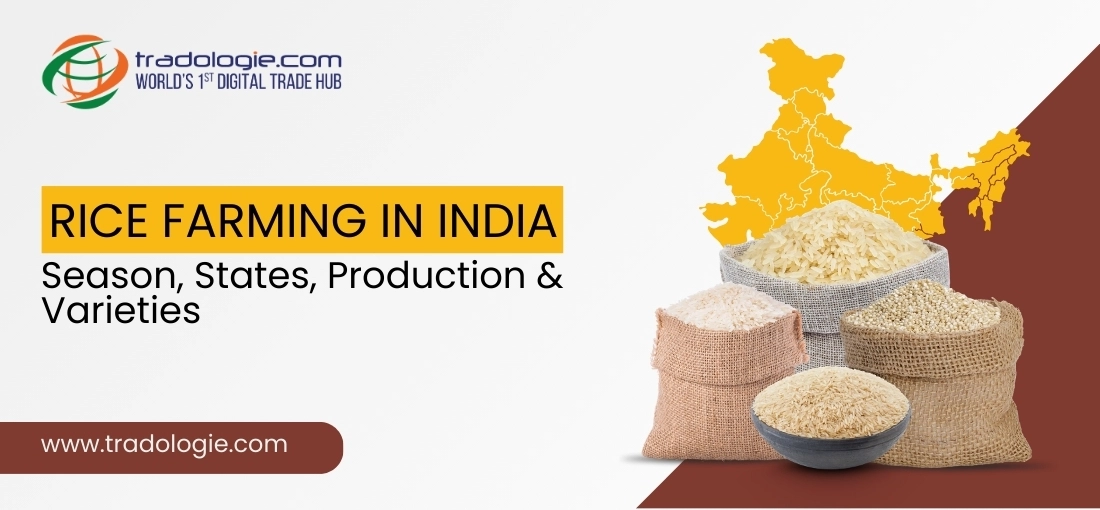
Rice is India's most important food crop. It feeds more than 65% of India's population and is the primary staple across eastern, southern, and northeastern India.
India is currently the world's largest rice exporter, supplying rice to over 140 countries. Understanding how, where, and when rice is grown in India is essential for farmers, students, and businesses involved in food and agricultural trade.

Quick Answer
Rice is primarily a Kharif crop in India, sown in June–July and harvested in September–October. It grows best in hot and humid conditions with abundant water. West Bengal, Uttar Pradesh, Punjab, Andhra Pradesh, and Telangana are the top rice-producing states. India produced approximately 137 million tonnes of rice in 2025-26.
Rice Growing Season in India
Rice requires:
- High temperature — 20°C to 35°C
- Abundant water — 1,200–2,000mm of rainfall or equivalent irrigation
- Humid conditions during growing period
- Dry and sunny weather at harvest time
Rice Crop Calendar
| Stage | Months |
|---|---|
| Nursery Preparation | May – June |
| Transplanting | June – July |
| Vegetative Growth | July – August |
| Flowering | August – September |
| Harvesting | September – October |
In southern states like Tamil Nadu and Andhra Pradesh, a second rice crop (Rabi rice) is grown from November to March using canal and tank irrigation
Top Rice Producing States in India 2025-26
| State | Annual Production | Share of Total |
|---|---|---|
| West Bengal | 15.5 million tonnes | 11.3% |
| Uttar Pradesh | 15.0 million tonnes | 10.9% |
| Punjab | 13.5 million tonnes | 9.8% |
| Odisha | 8.5 million tonnes | 6.2% |
| Andhra Pradesh | 8.0 million tonnes | 5.8% |
| Telangana | 7.5 million tonnes | 5.5% |
| Chhattisgarh | 7.0 million tonnes | 5.1% |
| Bihar | 6.5 million tonnes | 4.7% |
| Tamil Nadu | 6.0 million tonnes | 4.4% |
| Assam | 5.5 million tonnes | 4.0% |
Source: Ministry of Agriculture & Farmers Welfare, 2025-26 Advance Estimates
Popular Rice Varieties Grown in India
India grows hundreds of rice varieties ranging from short-grain aromatic types to long-grain non-basmati varieties.
Basmati Rice Varieties
| Variety | Key Feature | Growing Region |
|---|---|---|
| Pusa Basmati 1121 | Extra long grain, high export demand | Punjab, Haryana, UP |
| Pusa Basmati 1509 | Early maturing, high yield | Punjab, Haryana |
| Traditional Basmati | Premium aroma, thin grain | Dehradun, Tarai region |
| CSR 30 | Salt tolerant basmati | Haryana |
Non-Basmati Rice Varieties
| Variety | Key Feature | Growing Region |
|---|---|---|
| Swarna (MTU 7029) | High yield, widely grown | Eastern India |
| IR 64 | High yield, medium slender | Southern India |
| Sona Masoori | Light, aromatic, popular in South | Andhra Pradesh, Telangana |
| Gobindobhog | Short grain, aromatic | West Bengal |
| PR 126 | Early maturing, saves water | Punjab |
Rice Cultivation Methods in India
1. Transplanted Rice
Most common method in India. Seedlings are first raised in nurseries for 25–30 days then transplanted to the main field. Higher yields but more labour intensive.
2. Direct Seeded Rice (DSR)
Seeds are directly sown in the field without nursery preparation. Saves water and labour. Increasingly popular in Punjab and Haryana due to groundwater concerns.
3. SRI Method (System of Rice Intensification)
Uses younger seedlings, wider spacing, and less water. Can increase yields by 20–30% while reducing water use. Promoted by several state governments.
4. Flood Irrigation
Traditional method where fields are kept flooded throughout the growing period. High water consumption — approximately 3,000–5,000 litres per kg of rice produced.
Rice Production Trend in India (2021–2026)
| Year | Production (Million Tonnes) | Export (Million Tonnes) |
|---|---|---|
| 2021-22 | 129 | 21.2 |
| 2022-23 | 135 | 22.4 |
| 2023-24 | 136 | 16.5 |
| 2024-25 | 136.5 | 18.0 |
| 2025-26 | 137 | 20.0 (est.) |
Note: Export dip in 2023-24 reflects Government of India export restrictions on non-basmati white rice introduced to protect domestic supply.
Source: Ministry of Agriculture, APEDA 2025

India's Role in Global Rice Trade
India is a dominant force in global rice markets:
- World's largest rice exporter — supplies 40% of global rice trade
- Top Export Destinations — Bangladesh, China, Benin, Senegal, Ivory Coast, Nepal, UAE
- Basmati Rice - Premium export to Middle East, Europe, North America
- Non-basmati rice — bulk export to Africa and Asia
The Kharif rice harvest in September–October directly determines how much rice India can export in the following months. For businesses looking to source Indian rice or trade in rice commodities, understanding harvest timing is critical for planning.
Farmers with surplus rice production can sell agricultural commodities online to connect with verified domestic and international buyers. Importers and bulk buyers can buy rice and other agricultural commodities directly from Indian producers at competitive harvest-season prices.
Challenges in Rice Farming in India
1. Water Intensive Crop Rice is one of the most water-intensive crops. Punjab and Haryana face serious groundwater depletion due to rice cultivation. The government promotes Direct Seeded Rice (DSR) and less water-intensive varieties to address this.
2. Climate Vulnerability Erratic monsoon patterns, floods, and droughts directly impact rice yields. Eastern India frequently faces flood damage while rain-deficit years hurt yields in rain-fed areas.
3. Post-Harvest Losses India loses approximately 5–7% of rice production annually due to inadequate storage, poor threshing, and transportation inefficiencies.
4. Export Policy Uncertainty Government export restrictions — as seen in 2023-24 — create uncertainty for rice traders and farmers planning for export markets.
Rice MSP in India 2025-26
| Rice Type | MSP 2025-26 (₹ per quintal) | Change from 2024-25 |
|---|---|---|
| Common Rice | ₹2,369 | +₹117 |
| Grade A Rice | ₹2,407 | +₹117 |
Source: Cabinet Committee on Economic Affairs (CCEA), Government of India
Conclusion
Rice farming is the foundation of India's food security and a critical driver of agricultural export earnings. With production of 137 million tonnes in 2025-26 and a dominant position in global rice trade, India's rice sector continues to grow in both scale and sophistication.
For farmers, choosing the right variety and cultivation method can significantly improve yields and profitability. For traders and businesses, understanding India's rice production calendar — anchored to the Kharif season — is essential for effective market participation.
Data sources: Ministry of Agriculture & Farmers Welfare (2025-26), APEDA Rice Export Data 2025, ICAR Rice Research Institute
Frequently Asked Questions
Is rice a Kharif or Rabi crop?
Rice is primarily a Kharif crop grown during the monsoon season. In some southern states with year-round irrigation, a second rice crop is grown during the Rabi season.
Which state produces the most rice in India?
West Bengal and Uttar Pradesh are India's top two rice-producing states, together contributing over 22% of total national production.
How much water does rice farming need?
Rice requires approximately 1,200–2,000mm of water during its growing season. Traditional flood irrigation uses 3,000–5,000 litres of water per kilogram of rice produced.
Is India the largest rice exporter in the world?
Yes. India is currently the world's largest rice exporter, supplying approximately 40% of global rice trade across both basmati and non-basmati categories.
What is the best rice variety for high yield in India?
Swarna (MTU 7029) and IR 64 are among the highest-yielding non-basmati varieties. For basmati, Pusa Basmati 1121 and 1509 combine high yield with strong export demand.
When is rice harvested in India?
Most Kharif rice is harvested between September and October. In southern states, a second Rabi rice crop is harvested between February and March.