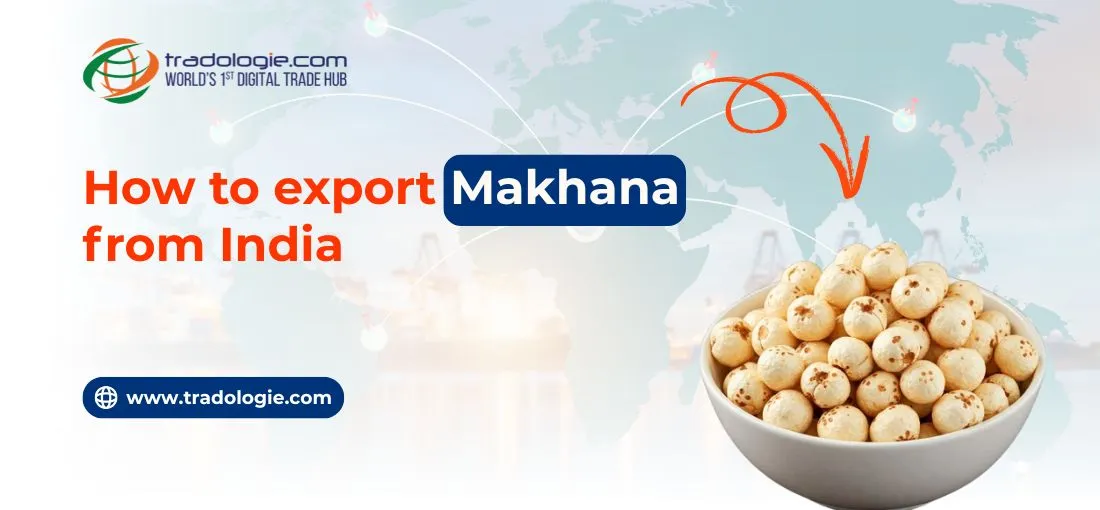
How to Export Makhana from India?
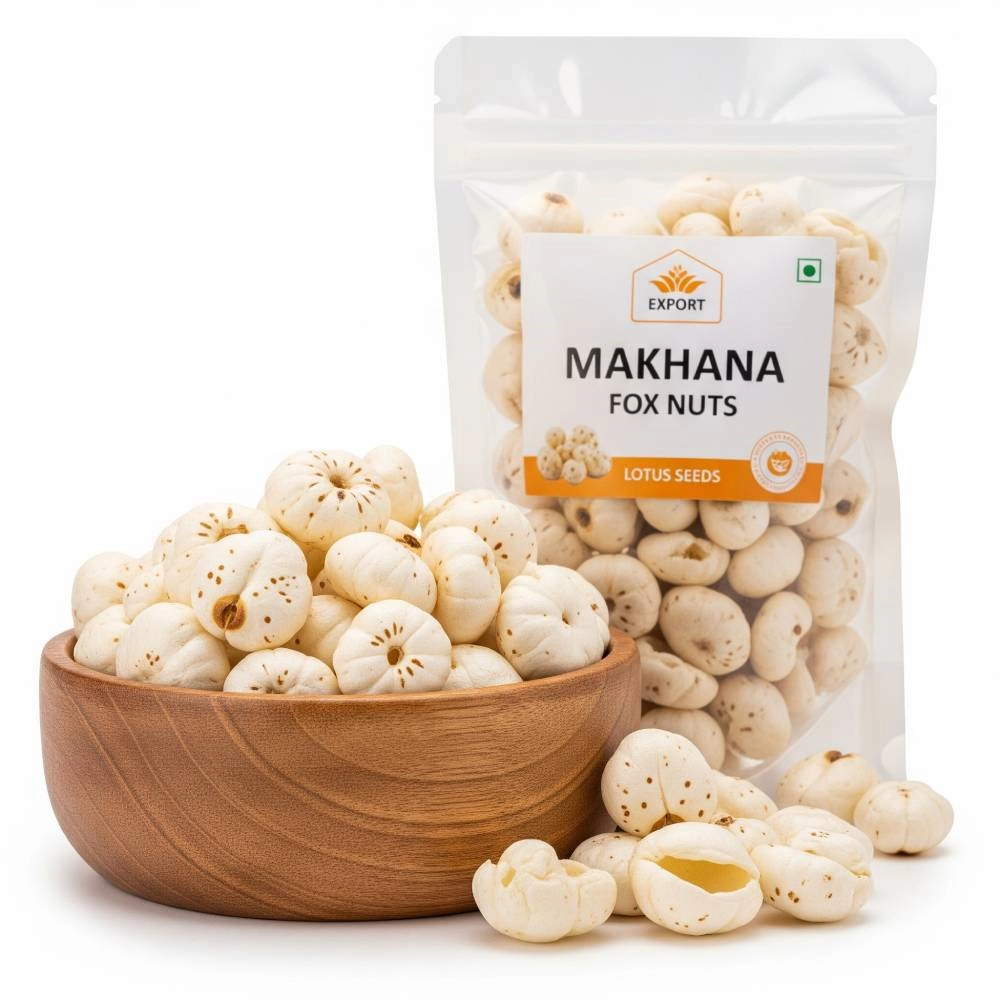
Often referred to as fox nuts or lotus seeds, makhana has emerged as one of India's main exports and nutritional powerhouses. In Asia, makhana is widely grown and frequently used in traditional medicine to treat a range of illnesses. Originally from China and Southeast Asia, the Makhana plant—scientifically known as Euryale Ferox Salisb.—is now exported all over the world.
However, the issue that exporters face is how to export Makhana from India. The entire step-by-step procedure, necessary paperwork, and lucrative prospects for Makhana exports from India in 2026 will all be covered in this blog Makhana from India? In this blog, we will explore the complete step-by-step process, documentation, and profitable opportunities for Makhana export from India in 2026.
Makhana Export Price Per Kg in 2026
One of the most searched questions by new exporters is: what is the actual export price of makhana per kg? Here is the current grade-wise pricing for makhana exports from India in 2026:
| Grade (Suta) | Size | India FOB Price (USD/kg) | India Price (₹/kg) | Best Market |
|---|---|---|---|---|
| 4 Suta | 12–15mm | $8–11/kg | ₹680–920/kg | Middle East, Southeast Asia |
| 5 Suta | 15–18mm | $11–15/kg | ₹920–1,250/kg | UK, Canada, Australia |
| 6 Suta | 18–21mm | $15–20/kg | ₹1,250–1,680/kg | USA, EU, Premium retail |
| 6+ Suta (Jumbo) | 21–24mm | $18–25/kg | ₹1,500–2,100/kg | USA luxury, GCC premium |
| Makhana Flour (20081922) | Powder | $9–13/kg | ₹750–1,100/kg | Food manufacturers globally |
Important price factors to note:
- Prices above are indicative FOB (Free on Board) rates as of early 2026
- Prices fell from a high of $20.3/kg in May 2025 to $15.5/kg by August 2025 due to bumper harvest — they have since stabilized
- Organic certified makhana commands a 20–35% premium over standard grades
- GI-tagged "Mithila Makhana" fetches 10–15% higher prices in the US and EU markets
- Forward contracting for 3–6 months is recommended to protect against price volatility
India Leading the Global Makhana Export Market
The most recent export data indicates:
- With 25,469 shipments in 2024-2025, India has now overtaken Pakistan (95 shipments) and China (261 shipments) to take the top spot as the world's top makhana exporter.
- The improved processing standards in India and the growing global demand for healthful foods are two of the main causes of the rise in makhana exports from that nation.
- In 2024, India's makhana exports increased from 6,700 MT in 2020 to 25,130 MT. This is an increase of nearly four times the amount of makhana that was being exported from India in 2020.
- The increase in makhana export is due to a 39% CAGR. The makhana export from India in 2024-2025 was worth Rs 255 Crore (~$30.5 million), which is an increase of 27% compared to the previous year.
This demonstrates India's unparalleled ability and the demand for its makhana exports around the world unequivocally.
Top Export Categories of Makhana (Fox Nuts) (HS Codes)
India's makhana exports are classified under many HS codes, with the most prominent ones being:
- 19041090 - Prepared foods obtained by swelling cereals or cereal products (used until June 2025)
- 20081921 - Makhana Popped (new HS code effective July 2025)
- 20081922 - Makhana Flour and Powder (new HS code effective July 2025)
- 21069099 - Other food preparations not elsewhere specified
- 08134090 - Other dried fruits
Important Update: APEDA has established new codes under HS for Makhana products as of July 2025. Exporters are advised to use 20081921 for popped makhana and 20081922 for makhana flour going forward in order to facilitate customs clearance. The different ways that makhana is processed and sold to the global market are represented by these codes.
New Makhana HS Code 2026 — What Changed from July 2025?
APEDA introduced two dedicated HS codes for makhana products effective July 2025. This was a major regulatory change and every makhana exporter must now use the correct code to avoid customs delays and clearance issues.
| HS Code | Product | Valid From | Replaces |
|---|---|---|---|
| 20081921 | Makhana Popped (fox nuts, puffed lotus seeds) | July 2025 | 19041090 |
| 20081922 | Makhana Flour and Powder | July 2025 | 21069099 |
| 08134090 | Makhana seeds (raw/dried, unprocessed) | Ongoing | — |
| 21069099 | Flavored/seasoned makhana preparations | Ongoing | — |
Why this change matters for exporters:
Before July 2025, popped makhana was being exported under HS code 19041090 (prepared foods from cereals), which caused recurring disputes at customs in the EU and USA because makhana is not technically a cereal. The new dedicated codes under Chapter 20 (preparations of vegetables, fruit, nuts) eliminate this ambiguity entirely.
Practical checklist for using the new HS codes:
- Use 20081921 on all commercial invoices, packing lists, and shipping bills for popped/roasted makhana
- Use 20081922 for makhana flour, makhana powder, and makhana starch exports
- Ensure your FSSAI license and export declaration reflect the updated code
- Verify the HS code with your customs broker before the first shipment under the new code
- For EU shipments, the new code aligns with Commission Implementing Regulation (EU) 2023/652 which permits only roasted/popped makhana kernels
Why are India's Makhana Exports in High Demand?
India's Makhana exports are on a tear. What was once considered a niche, ceremony-bound, home kitchen ingredient has exploded into a global phenomenon, becoming the nutrient-rich hero it is today, ready to take the world stage by storm.
What sparked this growth?
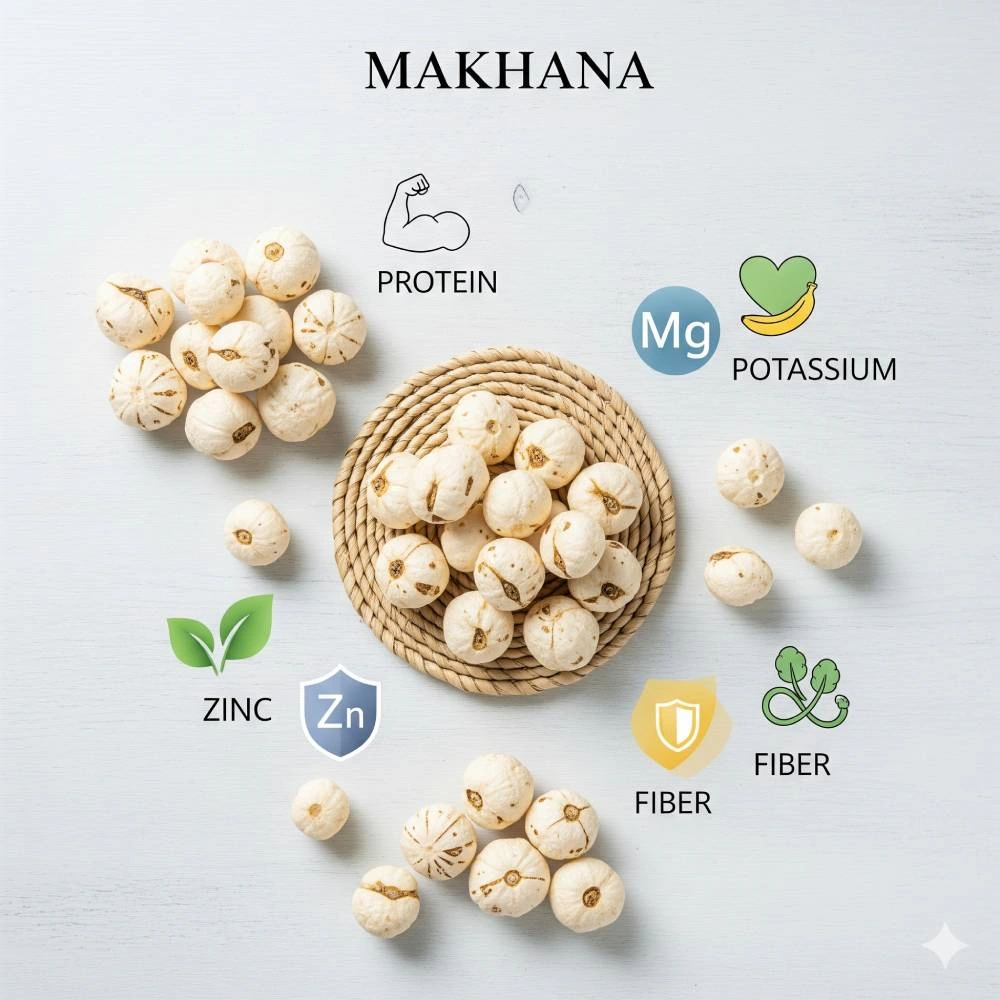
Health trends, and beyond. Makhana is low in calories and gluten and high in iron, magnesium, and antioxidants. Makhana meets all the requirements for the exotic health foods that the Western world is searching for. It is the answer to the growing demand for plant-based, vegetarian protein, providing a healthier alternative to processed snacks.
India is the powerhouse, producing over 120,000 metric tons of Makhana seeds every year, or 60,000 metric tons of popped Makhana. The government is also providing support to this growing industry, including GI tags, APEDA schemes, and the upcoming Makhana Board, to be launched in 2025.
What's next?
A rosy future ahead. With demand coming in strong from the USA, UK, Canada, UAE, Australia, the market is expected to reach ₹11,000-12,000 crores by 2029-2030. The lotus seed story may be over, but it is alive and thriving as a potential opportunity for Indian exporters today.
Production of Makhana in India
Bihar is the undisputed heavyweight of the industry, generating over 80-85% of the world's makhana (Fox Nuts) supply. The sector has seen explosive growth recently. The area under cultivation has grown from roughly 25,000 to nearly 40,000 hectares between 2020 and 2025, a 40-50% increase.
This expansion triggered a massive spike in output. Total seed production nearly tripled during this period, reaching 1.1-1.2 lakh MT. While countries like China, Japan, Korea, Bangladesh, and Russia also harvest makhana in its wild form, India's organized commercial scale remains unmatched.
| State | Area Under Cultivation (Ha) | Production (MT) |
|---|---|---|
| Bihar | 12,000 | 96,000 |
| Jharkhand | 1,000 | 8,000 |
| Uttar Pradesh | 500 | 4,000 |
| Other States | 500 | 4,000 |
| Total | 15,000 | 1,20,000 |

Why Is Makhana Export from India Profitable in 2026?
Due to its increasing demand in the global market, the export of Makhana from India has become a lucrative business for exporters globally.
First, let's analyze the Makhana export data table.
| Makhana Export Metric | Data (2024–25) |
|---|---|
| Total Makhana Shipments | 25,469 |
| Total Export Volume (MT) | 25,130 MT |
| Total Export Value | INR 255 crore (~$30.5 million) |
| Year-on-Year Growth | 27% |
| Number of Makhana Exporters | 1,123+ |
| Number of Makhana Buyers | 2,969 |
Understanding the Makhana Export Data
The market is growing strongly. India's Makhana (Fox Nuts) market has grown 17-18% annually from 2021-22 to 2024-25, and is projected to reach ₹11,000-12,000 crore by 2029-30. The USA alone imports nearly 2,000 MT of makhana every year, accounting for over 17% of India's total exports.
Makhana Export Profit Margin — Is It Actually Profitable in 2026?
| Cost Head | Amount (₹) | Notes |
|---|---|---|
| Raw makhana procurement | ₹7,00,000 | ₹700/kg × 1,000kg farm-gate price |
| Processing & grading | ₹80,000 | Popping, sorting, grading to export grade |
| Packaging (nitrogen-flush vacuum) | ₹40,000 | Export-standard pouches or bulk bags |
| FSSAI testing & quality certificates | ₹15,000 | Mandatory per shipment |
| Freight (sea, FCL to USA) | ₹90,000 | Approx. $1,100 per MT |
| Insurance | ₹12,000 | ~0.5% of cargo value |
| Customs & documentation | ₹18,000 | Shipping bill, phytosanitary, etc. |
| Agent/broker commission | ₹35,000 | If using a freight forwarder |
| Total Cost | ₹9,90,000 | Per MT |
| Export Revenue | ₹15,00,000 | At $18/kg × ₹83 exchange rate |
| Gross Profit | ₹5,10,000 | Per MT |
| Profit Margin | ~34% | Before tax and overhead |
Key factors that improve your margin:
- Sourcing directly from Bihar farmers (cuts ₹100–150/kg vs buying from traders)
- Exporting higher Suta grades (6+ vs 4 Suta) — 40% higher price for ~15% higher procurement cost
- Selling under a private label or branded product — adds ₹200–400/kg margin
- Claiming Duty Drawback and RoDTEP refunds — adds 2–4% back to your margin
- Targeting EU/UK markets where makhana is still relatively novel and commands premium pricing
How to Export Makhana to the USA
The United States is India's single largest makhana export market, importing nearly 2,000 MT annually — over 17% of India's total makhana exports. Here is what you need to know before shipping makhana to the USA:
- Regulatory body: US FDA (Food and Drug Administration) governs food imports
- Prior notice: Submit FDA Prior Notice at least 2–8 hours before shipment arrives at a US port
- Labeling requirements: Nutrition facts panel in FDA format, allergen declaration, country of origin ("Product of India"), net weight in both metric and imperial units
- Pesticide limits: FDA follows US EPA tolerances — ensure your makhana passes pesticide residue testing before export
- Common entry ports: Los Angeles (LA/Long Beach), New York/Newark, Chicago O'Hare
- Import duty: Makhana (HS 20081921) currently attracts 0% MFN duty in the USA — a major advantage over Chinese competitors
Finding US buyers: Platforms like Tradologie.com, Alibaba, and attending Natural Products Expo West (Anaheim) are the most effective channels to connect with US health food importers and distributors.
Global Market for Makhana
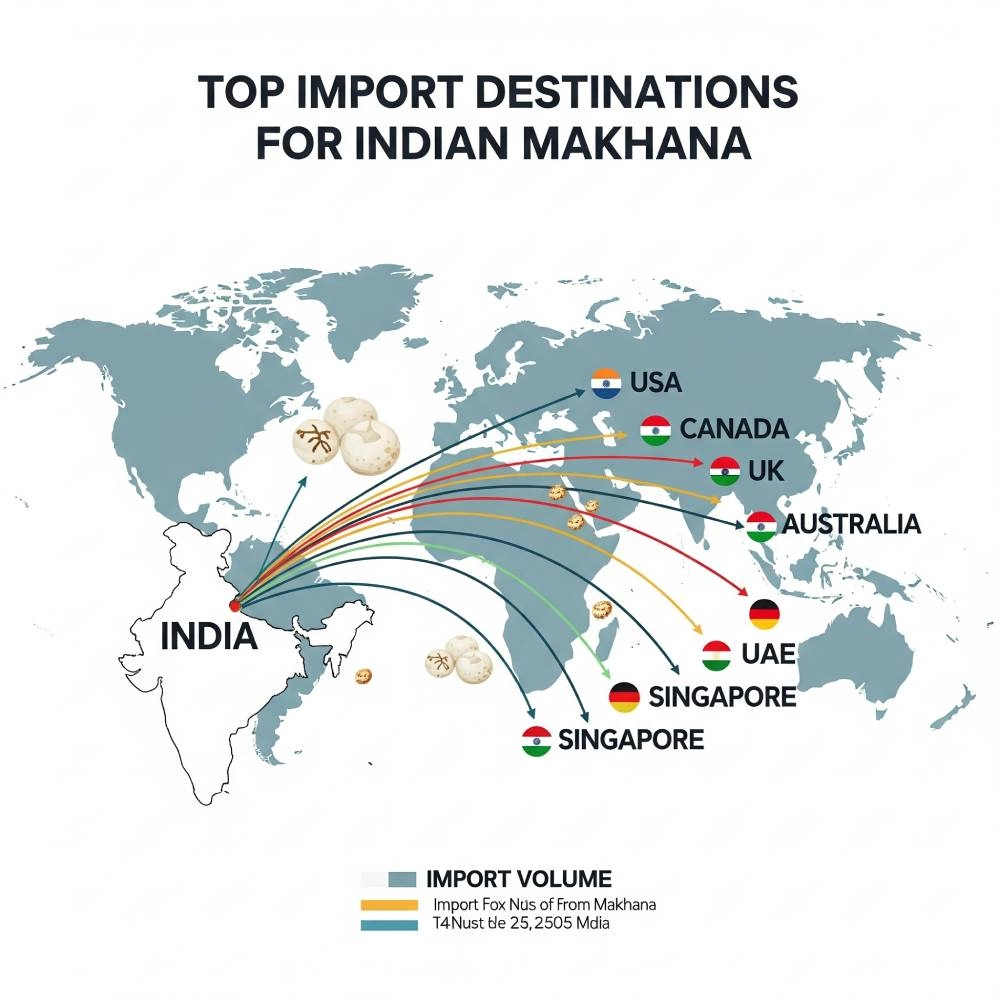
India supplies most of the world's makhana, making it the world's top exporter. The top markets for Indian makhana include the United States, Canada, and Australia, where health-conscious consumers are increasingly incorporating this superfood into their diets.
According to makhana export data, the top three nations involved in makhana exports are:
- India - Leading the market with 25,469 shipments
- China - In second place with 261 shipments
- Pakistan - With 95 shipments
Top 10 Destinations for Export of Makhana From India
The updated list of top nations that import makhana from India are as follows:
- USA
- United Kingdom
- Canada
- Australia
- UAE
- Singapore
- Malaysia
- Germany
- Southeast Asia
- European Union
Makhana is a well-liked, healthy, and adaptable snack from India. Numerous nations have recognised its advantages. One of the main suppliers of makhana to the US is India. As people search for new and healthy snack options, makhana, which has a low calorie content and numerous health benefits, is growing in popularity.
On the other hand, visit tradologie.com to learn more about the international Makhana export business.
In today’s global trade environment, exporters increasingly rely on structured platforms that enable direct interaction with verified buyers across multiple countries. These systems streamline bulk trade by ensuring transparency in pricing, quantity, and payment processes, making it easier for suppliers to scale internationally.
How to Export Makhana to the UAE and Dubai
The UAE is India's fifth-largest makhana export destination and the gateway to the entire GCC market (Saudi Arabia, Kuwait, Qatar, Bahrain, Oman).
- Regulatory body: Dubai Municipality (DM) and Emirates Authority for Standardization (ESMA)
- Halal certification: Strongly recommended — most UAE retail chains require Halal certification on food products
- Shelf life requirement: UAE importers typically require a minimum of 12 months remaining shelf life at the time of import — nitrogen-flush vacuum packaging is essential
- Labeling: Arabic language label must be included alongside English; include manufacturing date, best-before date, and importer details in Arabic
- Port of entry: Jebel Ali Port (Dubai) handles the vast majority of India-UAE food shipments
- Import duty: GCC imposes a 5% customs duty on most food imports
Finding UAE buyers: Gulfood (Dubai, February annually) is the world's largest food trade show and the single best event for meeting verified UAE and GCC makhana importers. Register as an Indian exporter through APEDA to get subsidized participation.
How to Export Makhana to Canada
Canada is India's third-largest makhana export market, driven by a large South Asian diaspora and growing mainstream health food demand.
- Regulatory body: Canadian Food Inspection Agency (CFIA) and Health Canada
- Labeling: Bilingual labeling mandatory (English + French) for all food products sold in Canada
- Nutrition facts: Must follow Canadian NFt (Nutrition Facts table) format — different from US FDA format
- Import permit: No specific import permit required for makhana under HS 20081921, but shipments are subject to CFIA inspection
- Common entry ports: Vancouver (for sea freight from India's west coast ports) and Toronto Pearson (for air freight)
Top 10 Makhana Exporters in India
The list of prominent exporters of makhana in India is given below:
- Cilantro Food Products Private Limited
- Shree Shyam Impex
- Nathubhai Cooverji and Sons
- House of Pura LLP
- Al Shadik Export
- Saksham Food
- Mithila Makhana Udhyog
- Satviki Exports Private Limited
- Dev Exims
- Radhe Radhe Enterprises
Step-by-Step Procedure to Export Makhana From India
Understanding the nuances of the production process is the first step towards adopting a systematic approach for Makhana export from India. Makhana cultivation requires several processes from seed preparation to packing. As an exporter, it becomes your responsibility to ensure that the safety and quality of your goods are at par with global standards.
The following are the basic procedures for exporting makhana from India:
- Step 1: Get your business registered and obtain an IEC (Import Export Code) number from DGFT.
- Step 2: Register with APEDA and obtain your RCMC (Registration-cum-Membership Certificate).
- Step 3: Get GST registration and obtain an FSSAI license for food safety compliance.
- Step 4: Ensure quality certification (FSSAI, HACCP, Organic if applicable).
- Step 5: Find and negotiate with international buyers.
- Step 6: Pack and label as per destination country standards.
- Step 7: Choose the relevant shipment option and book freight.
- Step 8: Clear Customs and submit all required documentation.
Packaging & Labelling Standards for Makhana Export
Foreign nations have extremely high standards for cleanliness and packaging.
Export-quality makhana must be packed in nitrogen-flushed vacuum bags with airtight seals to ensure freshness and an extended shelf life. Each pack must comply with
FSSAI standards and clearly display the following:
- Market Details (Importer name, address)
- Country of Origin (India)
- Batch Number & Production Date
- Expiry Date
- Nutritional Label (per 100g)
- HS Code (20081921 for popped makhana from July 2025)
- Certifications (Organic, GI Tag “Mithila Makhana”, Gluten-Free, HACCP — as required by the destination country)
- Export QR Code for traceability
Grading Note: Makhana is graded using the traditional Suta system. Premium grades (>18mm, 6-7 Suta) command higher export prices, especially in the US and EU markets. Standard export grade (6 Suta, 16-18mm) is the most commonly traded. Always specify the grade clearly on your packing list.
Freight & Shipping Options for Makhana Export
Makhana, being a non-perishable food item, is transported in bulk, and the most suitable mode of transport would be by ship. In case of small quantities, air transport can also be used as an alternative.
- Shipping terms include FOB (Free on Board), CIF (Cost, Insurance, and Freight), and CNF (Cost and Freight). Both the exporter and the buyer must agree on these.
- Documents such as the dock receipt, warehouse receipt, and bill of lading are necessary. For the export process to go smoothly, these must be managed properly.
- Working closely with the export sector, goods forwarders are experts in all aspects of the process, from loading the cargo to transporting it to its destination.
- Makhana is transported via several major ports, including Chennai, Kolkata, Nhava Sheva, Mumbai (JNPT), and others.
- Facilities for small exporters: Daak Ghar Niryat Kendra (DNK), also known as the Post Office Export Centre, is a low-cost choice for small exporters established by the government. With 46 of these offices, Bihar is a great place for new exporters.
Key Documents Required to Export Makhana (Fox Nuts) from India
To successfully export makhana, you will need the following key documents:
- Import Export Code (IEC)
- APEDA RCMC Certificate
- GST Registration Certificate
- FSSAI License
- Commercial Invoice & Packing List
- Bill of Lading / Airway Bill
- Certificate of Origin
- Phytosanitary Certificate (issued by NPPO)
- Inspection / Quality Certificate
- Insurance Certificate
- AD Code Registration

How to Find Buyers for Makhana Export
Finding the right international buyer is one of the most critical steps in the export process. Here are the most effective channels to find makhana buyers worldwide:
- B2B Trade Portals: Register on platforms like Alibaba, IndiaMART, TradeIndia to potential leads and Tradologie.com to connect directly with verified global buyers.
- International Trade Fairs & Expos: Participate in food expos like SIAL, Gulfood, and Anuga to build direct relationships with importers.
- APEDA Buyer-Seller Meets: APEDA regularly organizes buyer-seller meets and virtual trade fairs specifically for Indian agri-food exporters.
- Government Export Portals: Use the India Trade Portal (indiatradportal.in) and DGFT data to identify demand from specific countries.
- Online Retail Platforms: Amazon Global Selling, eBay, and Etsy can work for branded, value-added makhana products targeting retail buyers.
- Export-Import Data Tools: Use platforms like Tradologie, Volza, or SEAIR to identify active buyers, track competitor shipments, and discover new markets.
Government Schemes & Export Support for Makhana
To increase makhana exports, the Indian government has started a number of programmes. Exporters should actively take advantage of these opportunities to lower operating costs. They are also vital tools for gaining market credibility.
- APEDA Support
One important resource is the Agricultural and Processed Food Products Export Development Authority (APEDA). It offers guidance and financial assistance. Additionally, it provides specific training incentives for makhana exporters. You must obtain APEDA registration. It is essential for claiming export benefits. Furthermore, it grants access to buyer networks supported by the government. - GI Tag - Mithila Makhana
In 2022, Mithila Makhana was awarded the Geographical Indication (GI) tag. This status provides legal protection. It also enables premium branding. As a result, it helps build trust among international buyers. GI-tagged makhana often commands higher prices. This is particularly true in the US and EU markets. - Makhana Board (2025)
In the Union Budget 2025, a significant announcement was made. The Government of India will establish a dedicated Makhana Board. This board will be located in Bihar. It has been granted an initial allocation of INR 100 crore. The board’s mandate is to regulate production. It will also promote organized processing. Moreover, it aims to improve quality standards and strengthen India’s global market position. - PMFME Scheme
The PM Formalization of Micro Food Processing Enterprises (PMFME) scheme helps small businesses. It specifically supports makhana processing units. Through this scheme, entrepreneurs can access credit-linked subsidies. Technical training is also provided. - One District One Product (ODOP)
Makhana has been officially recognized as Bihar’s ODOP product. This designation gives the industry an immense boost. It specifically aids in value chain development. It also supports better branding and the expansion of processing infrastructure. - Daak Ghar Niryat Kendra (DNK)
Post Office Export Centers are an excellent resource for small businesses. They provide affordable online documentation. They also assist with customs clearance and general export support. Bihar alone boasts 46 DNK centers. This extensive network makes export accessible. Now, even new and small exporters can reach global markets. - Duty Drawback & RoDTEP
Exporters can claim financial refunds. These refunds cover customs duties and taxes paid on inputs. This is facilitated under the Duty Drawback and RoDTEP schemes. Leveraging these options significantly improves overall export profitability.
Common Challenges in Makhana Export
There is no denying the enormous export potential for Makhana. Exporters must, however, also be completely cognisant of the main obstacles that the industry faces.
- Unorganized Sector
A sizable section of the supply chain is still unofficial. Obstacles arise from this fragmentation. In particular, it makes it challenging to maintain consistency in quality. Additionally, it makes the product's traceability more difficult. - Labour-Intensive Processing
There are still many people who pop and grade makhana using the old-fashioned ways. Most of these procedures are done by hand. As a result, this dependence on human labour restricts the industry's ability to grow. - Lack of Cold Storage & Modern Infrastructure
There is a glaring lack of modern facilities. Inadequate post-harvest infrastructure is common in producing regions. Unfortunately, this flaw could negatively impact the final quality of the makhana. - US Tariff Uncertainty
Concern has been raised by recent geopolitical developments. There is uncertainty as a result of discussions about US tariffs. Diversifying their target markets is therefore highly recommended for exporters. It is advised to expand into Southeast Asia, Australia, South Africa, and the EU. This tactic will lessen reliance on the US market. - Price Volatility
Export prices have witnessed significant fluctuations. For instance, rates fell from USD 20.3/kg in May 2025 to USD 15.5/kg in August 2025. However, prices did eventually recover due to seasonal factors. To manage this risk, forward contracting for 3–6 months is recommended. This should ideally be secured during stable trade windows. - EU Novel Food Regulations
The European Union has strict authorization rules. It currently allows only roasted or popped makhana kernels (Euryale ferox). This is governed under Commission Implementing Regulation (EU) 2023/652. Raw kernels, on the other hand, may require additional authorization. Exporters must ensure their labelling is precise. Proper documentation is also essential for full EU compliance. - Market Awareness
Makhana must be positioned effectively. Building brand awareness for it as a premium superfood is necessary. Achieving this in new markets is not easy. It requires consistent and sustained investment in marketing.
Conclusion
Makhana exporting from India is a very profitable business. The steadily rising demand for this superfood around the world is a major factor in this potential. However, readiness is the key to success. Obtaining the appropriate registrations and quality certifications is essential. Additionally, proper documentation is essential. Additionally, a thorough comprehension of buyer markets is required. Indian exporters can effectively gain a significant portion of the market by becoming proficient in these areas. This international trade is worth $30.5 million at the moment and is still increasing. You might require a list of Indian exporters or the most recent data on makhana exports. Perhaps you require specific export data or the latest HS Code for makhana. For all these requirements, tradologie.com is available to assist. The platform can help you develop a comprehensive makhana export business plan. Additionally, it serves as a bridge to connect you with verified international buyers. Register now at www.tradologie.com.