
Key Highlights
- Dry fruits are no longer a festive or luxury category in many markets. They're moving into everyday consumption, which is why trade is becoming steadier and less seasonal.
- India remains one of the most reliable demand centres. Buyers here rarely stop purchasing; they adjust grades and origins when prices change. That keeps volumes moving.
- Europe brings stability to the business. Much of the demand comes from food processors and private-label brands, so imports continue even when retail sentiment slows.
- The US market is shifting toward quality and traceability. Importers care about certifications, clean sourcing, and long-term supplier credibility, not just the lowest offer.
- China's growth is gradual but deep. As food habits evolve, dry fruits are becoming routine rather than occasional, which creates long-term opportunity.
- Processing and transit hubs like Viet Nam, the Netherlands, and the UAE are gaining importance. They influence trade flows, pricing, and redistribution more than many exporters realise.
- The biggest opportunity in this trade usually comes from consistency. Exporters who build stable corridors and relationships tend to grow quietly but steadily.
Key Dry Fruits Import Markets Every Exporter Should Watch
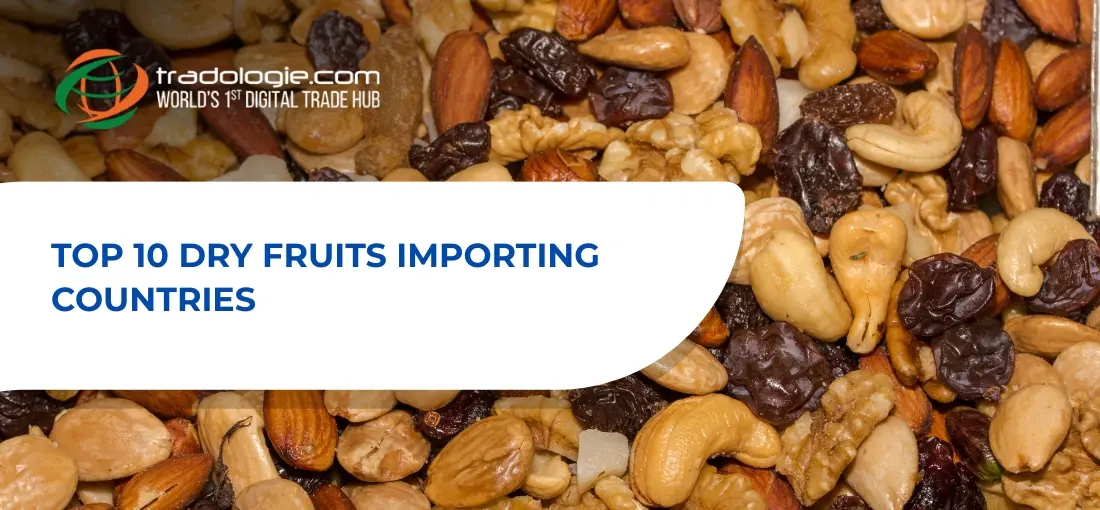
Introduction:
Dried fruits are one of the most premium food commodities in the global markets. They are priced for their premium taste, multifaceted food applications and health benefits. They move through bakery ovens, chocolate lines, snack factories, and dairy formulations. What’s more? The new wave of plant-based innovation is making it all the more special. This fantastic trade segment has stopped being a once-a-year opportunity and has started behaving like a steady commercial lane. Margins are usually kinder, and the demand does not swing wildly the way it does in several other agricultural commodities. It is one of those trades where, once you find your footing, the ground does not shift every season.
This informative piece of blog will give you deep information about the top 10 dry fruits importers globally.
The Quiet Shift: How Routine Consumption Is Redrawing the Trade Map
Consumption, too, is evolving in quiet ways. Rising incomes, growing health awareness, and urban eating habits have created repeat demand rather than occasional buying. Once that shift takes hold, the noise reduces. Shipments move. Volumes build. And the headlines, interestingly, remain absent.
This is why understanding where demand actually sits matters more than chasing price spikes. The biggest opportunity in this business is rarely the most visible one. More often, it is the market that keeps buying even when sentiment weakens.
Here are the countries shaping the dry fruits trade in ways many exporters tend to underestimate.

India (Dates imports: ~526,993 MT)
India continues to be one of the most structurally resilient demand centres in this space. The country absorbs a wide spectrum of products—dates, almonds, pistachios, raisins, and cashews—across price ranges, formats, and consumption patterns.
Dates imports crossing half a million metric tonnes tell their own story. This demand does not rest on a single pillar. It comes from religious consumption, everyday snacking, gifting, processing, and expanding retail chains.
What often stands out is the market’s resilience. When prices move up, dry fruit buyers shift grades or origins rather than stepping away altogether. When supply improves, volumes expand quickly. The flow rarely stops. Exporters who build distribution here tend to see compounding returns over time.
Europe (Dried grape imports: ~50% of global trade)
Europe operates on a different rhythm. Demand here is anchored in industry rather than sentiment. Food processors, cereal manufacturers, and private-label brands drive procurement cycles. Raisins and other dried fruits move into production systems, not seasonal spikes.
This makes Europe a stabilising force. It may not offer dramatic surges, but it provides dependable offtake. In global trade, that kind of predictability often outweighs speed.
United States (Cashew imports: ~177,758 MT)
The United States is one of the most mature markets, while at the same time an evolving market. This is because the consumption is tilting toward premium, clean-label, and plant-based products. Organic, traceable, and protein-rich positioning is no longer a niche. In fact, in many segments, it has become the baseline.
Most dry fruit importers here tend to value supplier credibility and reliability as much as they value the price. Exporters who recognise this move beyond transactional selling. Those who do not often find relationships short-lived.
China (Peanut imports: ~739,526 MT)
China's growth rarely feels dramatic in real time. It is gradual, sometimes uneven, but powerful over the long run. Urbanisation and income growth are quietly reshaping food habits. What used to be occasional is a turning routine.
This is not a fast market. It is a deep one. And depth, as experienced exporters know, eventually creates scale.
Germany (Walnut imports: ~58,773 MT)
Germany's importance lies not only in consumption but in connectivity. It functions as a distribution nerve centre for much of Europe. Large dry fruit buyers work through structured contracts, where consistency often matters more than aggressive pricing.
For exporters, entry here often opens wider regional access.
Netherlands (Peanut imports: ~410,047 MT)
The Netherlands is a reminder that trade is not always about end consumption. Many times, a place which serves as a logistics hub continues to largely influence the price discovery and supply chain. This is quite evident in the case of the Netherlands in which the region imports in bulk, blends at times, and re-distributes across the European markets.Understanding such gateway markets gives exporters both leverage and perspective.
UAE (Date imports: ~232,156 MT)
The UAE plays the role of both buyer and bridge. Its ports connect Africa, the Middle East, and parts of Asia. For Exporters, this reduces the need to build multiple networks from scratch.
A strong foothold in such hubs often unlocks scale across regions.
Türkiye (Walnut imports: ~64,310 MT)
Türkiye operates at multiple levels—consumption, processing, and redistribution. This layered demand makes it dynamic. Short-term volatility exists, but long-term depth remains intact.
Flexible exporters, those willing to adapt to cycles, often perform better here.
Viet Nam (Cashew imports: ~398,129 MT)
Viet Nam’s position as a global processing hub creates steady demand for raw cashew supplies. This demand is industrial in nature, not speculative.
Suppliers aligned with processors rather than traders often benefit from predictable volumes.
United Kingdom (Dried grape imports: ~85,632 MT)
The UK remains a structured, brand-driven market. Retail chains and foodservice continue to ensure regular demand. Growth may not be explosive, but reliability has its own value.
What Exporters Should Watch
If one steps back and looks at the larger pattern, a few themes begin to emerge.
Demand is gradually shifting toward middle-income economies. Processing hubs are gaining influence over global pricing. Transit markets are becoming strategic nodes in supply chains. Industrial consumption is stabilising trade flows.
The exporters who succeed over the long term are rarely those chasing the next spike. More often, they are the ones building stable corridors and investing time in understanding buyer behaviour.
Final Thought
The dry fruits trade rewards discipline more than aggression.
Once consumption becomes embedded in daily food habits, the market stops behaving like a luxury segment and starts behaving like a necessity. And necessities, as history shows, rarely lose relevance overnight.
The real question for exporters is not where demand stands today. It is where habits are quietly forming.




-import-to-india-varieties-price--top-suppliers-(1).webp "The Complete Guide to Importing Dates to India: Taxes, Quality, and Buying in Bulk")