Key Highlights
- Pre shipment inspection helps prevent cargo rejection and trade disputes.
- PSI certificates are often mandatory for customs clearance and L/C transactions.
- Third party inspection agencies verify shipment quality and compliance.
- SGS and Bureau Veritas are globally recognized inspection companies.
- AQL standards determine acceptable defect limits in shipments.
- Packaging, labeling, quantity, and quality are critical inspection checkpoints.
- Agro exports require strict contamination and residue verification.
- Digital trade ecosystems are improving export inspection efficiency.
Introduction:
Getting a foothold in the guava export from India requires far more than just picking up the phone and booking empty reefer space. You are essentially signing up for a high-stakes, temperature-controlled race against the clock.
A massive, global craving for nutrient-dense tropical varieties is completely turning retail supermarket shelves upside down. For generations, people at home looked at amrood as a humble, backyard orchard crop. Today, that exact fruit has broken out to become a high-value global commodity.
But entering this game means learning to strike while the iron is hot.

To reliably export guava in bulk inside European grocery networks or across the major Middle Eastern wholesale distribution hubs, you have to play by a set of unyielding rules. Success doesn't happen by accident; it hinges entirely on your post-harvest handling discipline, your cold-chain tracking, and your direct, face-to-face relationships with verified international procurement heads.
The Financial Reality: Tracking the Global Tonnage
For generations, India’s status as a top-tier fruit grower was an established domestic fact. Transforming that massive decentralized farm yield into an organized international distribution engine, however, represents a newer milestone.
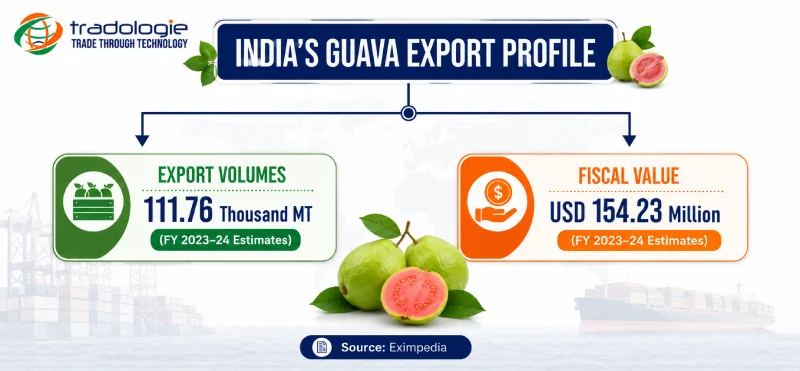
Data from recent trade cycles clarifies the financial scale of this footprint. Official export statistics for FY 2023–24 indicate that Indian traders successfully moved 111.76 thousand metric tonnes of guava across international borders. This high-volume trade lane generated an estimated USD 154.23 million in value. For a commercial enterprise trying to establish a recurring, industrial trade operation, these performance metrics show a highly mature supply base capable of filling substantial, repeating global orders month after month.
Direct Connections: Top Global Guava Buyers in Bulk Containers
Scaling an international distribution desk means bypassing casual brokers and spot traders. If you want to export Guava in bulk and want true long-term growth, then it it requires forming structured ties with corporate fresh-fruit procurement networks capable of absorbing multi-refrigerated container cycles week after week.
The following institutional entities represent the top tier of global produce import and commercial supply chains:
Total Berry / Total Produce (United Kingdom): Premier UK grocery chains rely on this enterprise for highly automated sourcing programs. Operating as a core wing of the expansive Dole plc ecosystem, the company uses buying teams that lean heavily toward long-term contract farming arrangements. This strategy guarantees that container arrivals remain uniform and predictable week after week.
Unifrutti Group (Global / UAE Hub): Immense volumes of tropical commodities move through the established corporate channels of Unifrutti across the GCC. Managing one of the most sophisticated, temperature-controlled supply lines in the Middle East, this group keeps the trade lane completely optimized.
Albert Heijn Sourcing / Bakels Group (Netherlands): Direct procurement for vast supermarket chains across Western Europe is handled entirely by these prominent European buying groups. During this process, their quality teams enforce strict, zero-tolerance caps on any chemical residue anomalies.
Fyffes (United States / Europe): Proprietary ripening hubs and high-spec container fleets across North America are controlled directly by Fyffes. As a historic powerhouse in tropical fruit logistics, this corporation focuses a significant percentage of its inventory strictly on certified organic lines.
LuLu Group International (Middle East Hub): Thousands of tons of fresh amrood are processed and air-freighted every single year through direct consolidation networks run by LuLu’s sourcing hubs across India. This massive supply pipeline directly feeds their extensive hypermarket chains in Dubai, Riyadh, and Muscat.
Fresh Fruit Company (GCC Region): High-end foodservice networks and major urban fruit markets get their supply from this corporate distributor. Specializing strictly in cold-storage logistics and premium wholesale operations across the Gulf, the company keeps the distribution loop moving seamlessly.

Industrial Alternatives: Sourcing Value-Added Guava Products
Focusing your operations exclusively on the fresh-fruit aisle ignores a major profit center. Fresh amrood carries a ticking biological countdown. Its life cycle is measured in days even when tucked inside a modern reefer container. Industrial food processors avoid this shelf-life bottleneck by converting raw fruits into shelf-stable components tailored for global food production lines.
| Value-Added Commodity | Core Technical Specifications | Target Global Market Segment |
|---|---|---|
| Aseptic White/Pink Guava Pulp | Fine-milled, pasteurized fruit paste packed in sterile multi-layer barriers. 24-month ambient storage. | Core ingredient for major juice networks, beverage brands, and dairy manufacturers globally. |
| IQF Guava Dices | Individually Quick Frozen fruit cubes processed at peak ripeness to preserve cellular structure. | Widely utilized by commercial bakeries, frozen dessert brands, and industrial meal kit packagers. |
| Dehydrated Dried Guava Strips | De-seeded, low-moisture dried fruit strips prepared without heavy synthetic preservatives. | High-margin health snacks targeting premium natural food chains across North America and Europe. |
Global beverage brands have driven a massive spike in the demand for aseptic pink guava pulp. Industrial blenders rely on this smooth, intensely aromatic base as a natural thickening agent and vibrant color component for high-end smoothies and tropical blends. Because aseptic steel drums remain perfectly stable at ambient room temperatures for up to two years, you completely eliminate the financial risks of an unexpected cold-chain failure. This makes pulp manufacturing an incredibly reliable hedge for factories positioned near heavy cultivation belts in Uttar Pradesh, Andhra Pradesh, and Maharashtra.
The Operational Playbook: Handling a Perishable Shipment
Moving a 40-foot refrigerated container of fresh produce out of India demands ruthless process discipline. Mistakes on the packing floor turn into heavy insurance claims at the destination dock.
Cultivar Selection and the Ripening Timeline
Different global regions show clear, unmistakable preferences. It is all thanks to their dense white flesh, thick exterior rinds, and natural ability to handle long sea voyages, the Allahabad Safeda and L-49 (Lucknow 49) varieties form the bedrock of bulk ocean shipments. For premium, high-speed air-freight segments, the distinct pink hue of the Taiwan Pink cultivar commands a significant retail premium.
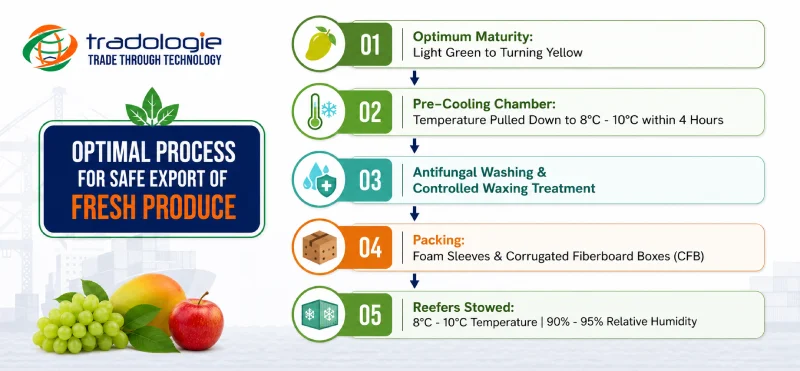
Harvesting crews must clip the fruit at a very precise maturity milestone. The skin needs to show a clear shift from dark, intense green to a paler shade, right before a true yellow hue sets in. Plucking the fruit too early leaves you with a starchy product that never ripens correctly. Delaying the harvest by just 48 hours results in mushy, over-ripe flesh that breaks down inside the container, causing catastrophic cargo leakage before the vessel ever completes its run.
Atmosphere Controls and Cold-Chain Engineering
Guava belongs to the climacteric category. It continues to breathe heavily, produce gasses, and ripen rapidly long after being cut from the tree. Stalling this internal metabolic clock is your only path to profit.
- The Pre-Cooling Phase: Field heat will cook your margins if you don't kill it immediately. Specialized blast-chilling chambers must handle your fruit within four hours of harvest. By acting fast, you drag the internal core temperature down to 8°C to 10°C, slamming the brakes on the decay clock before it even starts ticking.
- Reefer Calibration: Climate controls take over the moment loading is finished. Technicians have to lock your ocean reefer at a steady 8°C to 10°C. But along with the temperature, keeping relative humidity pinned between 90% and 95% is what prevents your fruit from drying out and wrinkling during the voyage.
- Ethylene Suppression: Long-distance transits to places like Rotterdam or London require Controlled Atmosphere (CA) shipping containers. These high-tech units constantly monitor gas levels by actively choking out oxygen while scrubbing away accumulated ethylene gas. Because rapid decay is triggered by ethylene—the fruit's natural ripening hormone—controlling the gas concentration inside the steel box is the only way you secure your destination shelf-life.
Digital Integration: Clearing the Trade Hurdles
Managing traditional, multi-layered agricultural documentation across multiple time zones represents a classic bottleneck for international cash cycles. A single mismatched digit on a phytosanitary document or an error on a bank collection file can stall your cargo at a foreign port. For a highly delicate tropical fruit shipment, even a two-day customs delay under a hot sun can ruin your entire investment.
To wipe out these manual tracking liabilities, modern agricultural trading houses are moving away from traditional, opaque brokerage lines. Smart operators are shifting their workflows onto centralized digital trade networks like Tradologie.com to run their cross-border deals. Using these structured B2B channels brings total clarity to the inspection loop, connects merchant exporters directly with vetted global guava buyers, and standardizes the entire document presentation process. This structural shift ensures your shipping data matches buyer requirements perfectly, accelerating your payment release long before the vessel ever anchors.
Summary Verdict for Agri-Traders
In the unforgiving environment of international fresh produce logistics, an export guava from India desk functions as a high-reward, precision-driven operation. Treating it like a simple bulk commodity play is a shortcut to major losses via port rejections or transit spoilage.
True profitability belongs to those who maintain complete transparency over their supply chain. Every single link matters—from the handling techniques used on the picking floor to the precise climate calibrations locked inside the ocean reefer. By focusing on premium import markets, matching your quality grading to the strict expectations of elite distributors, and utilizing processed aseptic pulp lines to buffer your fresh crop risks, you can turn India’s vast agricultural yields into an exceptionally stable, highly scalable international revenue engine.
Disclaimer
The export data, market insights, logistics practices, and trade recommendations mentioned are for informational purposes only and may vary depending on destination country regulations, seasonal crop conditions, freight rates, and international trade policies. Exporters should verify compliance and market requirements before shipment.