Key Highlights
- India's beef export industry is growing steadily and is expected to cross USD 14.8 billion by 2030.
- Reliability, regulatory compliance, and supply chain consistency are just as important as pricing.
- Large beef exporters dominate the global market due to long-term relationships, higher capacity, and sustained trust.
- Institutional buyers and structured contracts are reshaping the global meat trade.
- Future success will depend on traceability, sustainability, and operational efficiency.
India Beef Export Market Analysis: Key Insights and Leading Beef Suppliers:
Introduction
The beef industry in India does not make headlines very often, but it continues to move in the background with a surprising degree of consistency. In 2023, the industry made a total of nearly USD 12,647.2 million. It is expected to reach around USD 14,887.7 million by 2030, which is a sign of steady but not spectacular growth.
The more fascinating aspect, however, is the pattern of demand. Some cuts of beef, particularly loin, continue to lead the market because of forward planning by consumers in terms of menu, processing, and supply chain. The talk these days is about reliability – whether the exporters can deliver on quality, paperwork, and supply chain even in the lean months.
In this context, a few select exporters are leading the charge for India in the beef export market. These exporters may not always make headlines, but they are quietly shaping the supply chain in the beef market in Asia, the Middle East, and Africa.
Keep reading this informative piece of blog, as it will tell you the top 10 beef exporters in India. So, let us get the ball rolling.
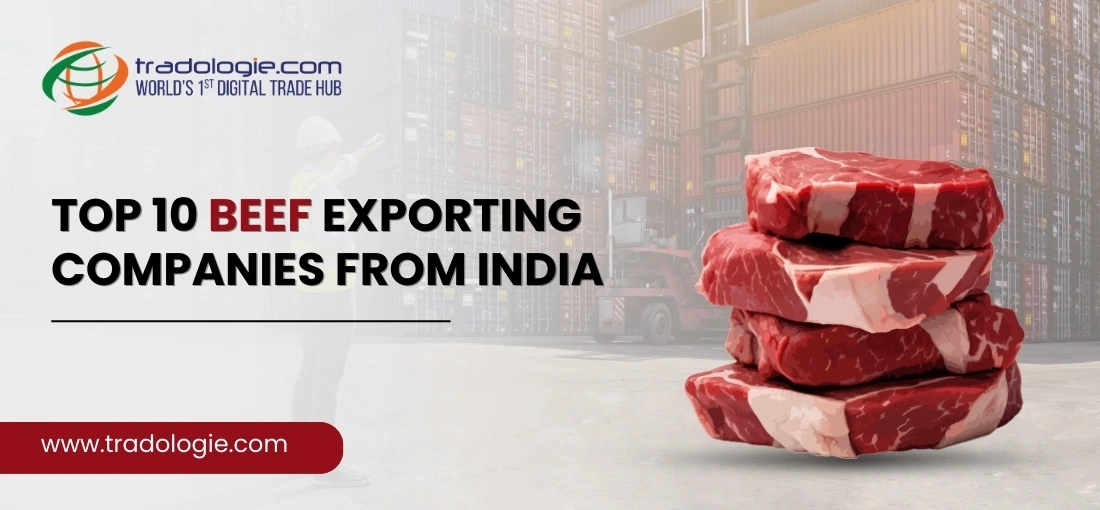
Top 10 Beef Exporting Companies in India
-
Allanasons Pvt. Ltd. – USD 312.6 Million
A dominant name among global buyers, Allanasons has built decades of trust through scale, strong networks, and long-term relationships. Its reputation, reinforced through industry word-of-mouth, makes it a preferred choice for institutional buyers. -
Al-Hamd Food Products Pvt Ltd – USD 61.48 Million
Known for consistency and compliance, Al-Hamd focuses on quality-controlled markets. Buyers value its ability to deliver reliable quality over low pricing, which has supported its steady growth. -
Mirha Exports Pvt Ltd – USD 50.07 Million
Mirha is recognized for flexibility and responsiveness, a key advantage in markets with changing schedules and specifications. Its adaptability has helped it carve out a strong niche. -
MK Overseas Pvt Ltd – USD 46.08 Million
With a long-term strategy centered on strengthening supply chains and processing capacity, MK Overseas emphasizes consistency and reliability—critical factors in commodity exports. -
HMA Agro Industries Pvt Ltd – USD 45.28 Million
A prominent and expanding exporter, HMA Agro has invested heavily in processing infrastructure and market development, positioning itself closer to industry leadership. -
Al-Dua Food Processing Pvt Ltd – USD 23.58 Million
Operating quietly but effectively, Al-Dua focuses on select trade routes rather than broad market coverage, enabling steady and sustainable growth. -
Amroon Foods Pvt Ltd – USD 19.89 Million
Despite operating in highly competitive, low-margin segments, Amroon sustains exports through efficient cost control and procurement management. -
ALM Industries Pvt Ltd – USD 19.63 Million
ALM Industries is valued for strict adherence to specifications. Tight control over grading and processing has helped it retain long-term bulk export contracts. -
Rustom Foods Pvt Ltd – USD 15.59 Million
Rustom Foods operates with strong regional networks and focused geographies, allowing it to build durable buyer relationships and navigate market cycles effectively. -
Al Faheem Meatex Pvt Ltd – USD 13.59 Million
Al Faheem has steadily expanded its export base by emphasizing quality alignment, certification, and regulatory compliance—key advantages as global traceability requirements increase.
What This List Really Tells Us
If you take a pause and reflect for a moment, a few things become apparent.
But scale still counts, and perhaps more than many people are willing to admit. The difference between the leading exporter and the others is not trivial. That margin reflects what has been built over time in terms of relationships, capacity, and trust with buyers. It’s not simple to replicate.
But compliance has also come into the spotlight. Today, buyers want to see process, documentation, and transparency in sourcing. A few years ago, price alone could seal a deal. Today, price is merely the opening salvo.
But markets themselves are undergoing a transformation. Institutional buying is on the rise. Foodservice operators, processors, and distributors are entering into structured contracts, rather than spot market purchases. This makes the business more predictable, but also less tolerant.
And then there is the issue of reliability. In international trade, memory is long. Buyers remember who showed up when the market was short of capacity or when prices were volatile. Those relationships are more likely to last than any fleeting advantage.
The Road Ahead
The future of beef exports from India is likely to be less eventful. It is not that kind of business. Progress in this industry is typically incremental, not dramatic. Yet the demand for beef in various parts of Asia, Africa, and the Middle East is still growing, albeit in a low-key manner. The increased number of cities, foodservice operations, and population growth are doing the hard work in the background.
For the exporters, the challenge is not merely how much they can export, but how easily they can adapt. The rules are constantly changing. Buyers are increasingly asking difficult questions about traceability and sourcing. Sustainability is no longer a secondary topic. It is now on the table.
In truth, success in this industry rarely makes the headlines. It makes the headlines in the form of repeat business, fewer lawsuits, and containers arriving on time. The companies that remain patient and work on systems usually come out on top.