Key Highlights
- Structural shifts toward heart-healthy, high-smoke-point cooking mediums are driving a surge in global demand.
- India holds a massive raw material advantage as the world's second-largest rice producer, keeping crushing units highly competitive.
- Premium western and Asian markets enforce strict regulatory limits on free fatty acids, wax content, and chemical residues.
- Strategic packaging switches—like using heavy food-grade flexitanks instead of small retail tins—radically slash bulk freight costs.
- Cultivating a reputation as a trusted supplier requires transparent, batch-by-batch independent laboratory validation right at the refinery floor.
The international edible oil market hasn't had an easy ride lately. Between severe climate shocks hitting traditional sunflower belts, erratic export taxes, and shifting border policies, procurement desks across the globe have spent the last few years completely re-evaluating where they source their fats. For decades, large food manufacturers and retail brands just stuck to standard choices like canola, palm, or sunflower oil.

But that old playbook is falling apart. Global rice bran oil buyers are dealing with massive price swings and sudden shortages, which is why a product that used to be a secondary local option—rice bran oil—is suddenly taking over premium international supermarket shelves and industrial frying lines. According to tracking data from Grand View Research, the global rice bran oil market size is valued at approximately $5.02 billion in 2024 and is projected to scale up to $6.25 billion by 2030, expanding at a steady compound annual growth rate (CAGR) of 3.7%.
For oil mills and trade houses across India, this global shift isn't just some passing trend. It is a massive commercial opportunity to move away from the low-margin price wars of the domestic market and lock in high-value foreign currency contracts. But surviving this rice bran oil export market takes a lot more than just shouting about low prices. You have to know how to navigate complex physical refining thresholds, manage incredibly tight extraction windows, and clear the intense biosecurity hurdles that international buying desks use to filter out unverified suppliers.
Sourcing Economics: The Lipase Battle on the Ground
India’s real leverage in the Global Rice Bran Oil Market doesn't come from clever marketing—it is rooted in raw agricultural volume. As the world's second-largest producer of paddy rice, our country's milling clusters across states like Punjab, Haryana, Uttar Pradesh, Andhra Pradesh, and West Bengal churn out massive mountains of fresh rice bran every single season. India is the world's leading producer of rice bran oil and accounts for a significant share of global production, supported by its large rice milling industry.
This gives domestic Rice Bran Oil Exporters an absolute head start, but only if they know how to beat a very specific biological countdown:
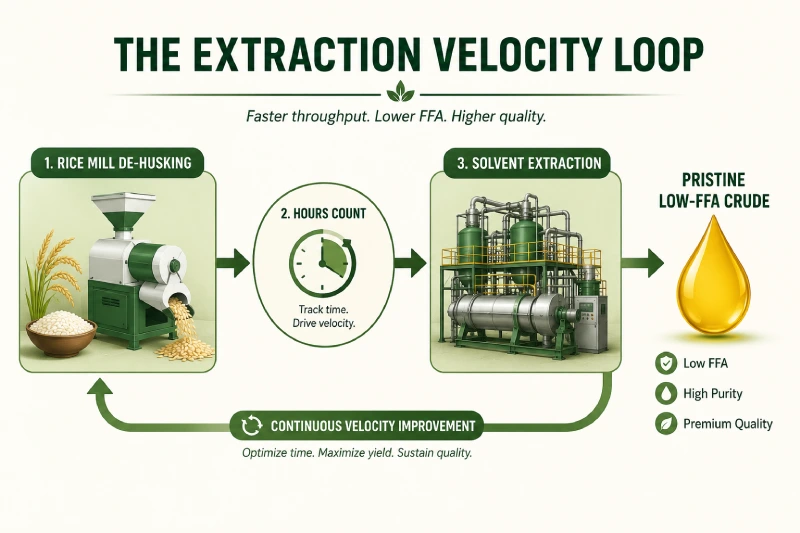
- The 24-Hour Extraction Trap: Rice bran is incredibly unstable. The exact moment the outer bran layer is separated from the grain during standard rice milling, a destructive enzyme called lipase wakes up. It immediately starts eating into the oil content, causing the Free Fatty Acid (FFA) levels to skyrocket within hours. Because our extraction plants are built directly inside or right down the road from massive rice milling hubs, the raw bran can be dumped into the solvent pits almost instantly. This rapid velocity keeps the raw oil clean, stable, and easy to refine.
- The Non-GMO Edge: While major agricultural competitors overseas depend heavily on genetically modified seeds to maximize their yields, India maintains a strict legal ban on commercial GM rice cultivation. This clean genetic footprint is exactly what premium organic buyers in the EU and North America look for, allowing Indian Rice Bran Oil Suppliers to easily clear zero-tolerance thresholds for modified DNA.
Sizing Up the Demand: Where the Volumes Move
International buying orders generally split down two completely different operational tracks. On one side, you have the high-end retail wellness sector chasing the oil for its high concentration of Oryzanol—a powerful natural antioxidant known for cholesterol management. On the other side, massive commercial snack chains are buying up bulk shipments because its high smoke point and oxidative stability make it well suited for repeated high-temperature frying applications. It performs well in commercial frying operations and generally maintains quality longer than many conventional cooking oils.
When you are planning your outbound shipping manifests, your strategy needs to align with these specific regional destination profiles:
- The North American Track (USA & Canada): These rice bran oil imposters are looking for highly stable, physically refined neutral oils for salad dressings and premium plant-based food lines. They demand absolute visual clarity, zero odor, and full laboratory documentation proving the batch is 100% non-GMO.
- The European Union Track: This is an ultra-strict compliance zone focusing heavily on natural cosmetics and organic dietary supplements. European desks run intense checks on chemical solvent residues—demanding near-zero hexane traces—and require absolute transparency regarding the latest pesticide Maximum Residue Limits (MRLs).
- The East Asian Track (Japan, South Korea, Thailand): This is a high-volume B2B play. Snack manufacturers and industrial frying networks buy in massive quantities, focusing their audits primarily on smoke-point longevity, color uniformity, and low peroxide values.
- The Middle East & Gulf Track: A mix of retail-packed branded oils and blending bases for local catering groups. Visual appeal matters immensely here, requiring custom PET bottling profiles or heavy-duty tin containers with clean, English-Arabic stenciled labels.

To see how global macro demand influences your processing options, evaluate the structural shifts highlighted in this segment analysis from Grand View Research and global trade customs data:
Global Market Structural Breakdown (Grand View Research Insights)
| Market Segment Indicator | Dominant Revenue Segment Share | Projected Target Segment Trend | Sourcing Driver & Implications |
|---|---|---|---|
| Product Grade Category | Non-Organic Oils (87.0%) | Organic Premium Oils (Fastest CAGR) | Commercial frying drives baseline volume; retail trends drive chemical purity metrics. |
| Application Channel | Edible Cooking / Food Processing (44.4%) | Nutraceuticals / Personal Care | Bulk volume feeds industrial snack lines; micronutrient retention feeds high-margin extract sales. |
| Regional Distribution | Asia-Pacific Revenue Base (37.8%) | North America Sourcing Channels (Fastest Growth) | High proximity to raw milling hubs; rising western consumer interest in functional cooking fats. |
| Packaging Configuration | Bulk Tankers / Drums (B2B Supply) | Custom Retail Packaging | Large refiners target bulk industrial supply; branded desks look for containerized consumer goods. |
Refinery Gatekeepers: Hard Technical Benchmarks
You cannot build a stable pipeline by treating international quality benchmarks like an afterthought. Global corporate buying desks don't trust promises—they deploy independent surveyors like SGS or Bureau Veritas to drop by your refinery tanks and pull physical samples before your cargo ever gets authorized to move towards the port. Trade shipment data from platforms such as Volza and Eximpedia indicates that exporters maintaining consistent quality standards often build long-term relationships with global rice bran oil buyers.
To protect your capital from devastating port rejections on the other side of the ocean, your mill floor must hit three non-negotiable chemical metrics:
Controlling the Free Fatty Acids (FFA)
For high-grade, refined, bleached, and deodorized (RBD) rice bran oil, rice bran oil importers expect an FFA level sitting comfortably below 0.1%. To hit this without wiping out your profit, your extraction plant has to dump aggressive chemical neutralization methods that ruin the oil's character. Physical refining helps preserve a substantial portion of the oil's naturally occurring oryzanol while reducing free fatty acids.
The Cold Test (Winterization)
Raw rice bran oil is packed with heavy plant waxes and lipids pulled from the outer paddy coat. If your refining setup skips the winterization stage, these waxes will crystallize the moment your shipping containers cross into cooler geographic waters or sit on cold Western grocery shelves. The oil turns into a cloudy, unmarketable sludge. Your production lines must deploy a slow, highly controlled cooling cycle followed by fine pressure filtration. Cold-test requirements vary by buyer and destination market. Premium export contracts often specify extended clarity performance at low temperatures to ensure product stability during transport and storage.
Halting Oxidation (Peroxide Value)
Unsaturated fats make this oil incredibly healthy, but they also make it highly sensitive to air exposure. If your storage tanks let oxygen seep in, the oil will go rancid before it even completes its sea voyage. Keep every single bulk storage tank fully blanketed with nitrogen gas, and enforce an absolute pre-shipment Peroxide Value cap of maximum 1.0 to 2.0 milliequivalents per kilogram.
Logistics: Ditching the Drums for Flexitanks
A classic mistake that completely kills an exporter's margins is defaulting to standard steel drums or small retail bottles for large wholesale orders. Packaging heavy liquids in individual barrels adds massive dead weight to your containers, wastes valuable structural space, and costs a fortune in manual loading labor at the port jetty.
For bulk B2B shipments, the smart play is switching completely to food-grade Flexitanks.
These are heavy, multi-layered bladders that roll out directly inside a standard 20-foot dry container, instantly turning a regular box into a specialized bulk liquid carrier. Using a flexitank lets you pack up to 24,000 liters of refined oil into a single container while completely wiping out the expenses of drumming, palletizing, and forklift handling. It forms a clean, sealed environment that protects your cargo from external air and moisture contamination during the entire ocean transit.
Pre-Shipment Validation Guide
Before your trucks leave the refinery gate and head towards major container terminals like Mundra, Kandla, or Nhava Sheva, make sure your lab teams verify the batch against this baseline operational checklist:
Export-Grade Rice Bran Oil Lab Targets
| Chemical / Physical Parameter | Target Export Limit Baseline | Primary Laboratory Verification | Main Operational Risk if Violated |
|---|---|---|---|
| Free Fatty Acids (FFA) | Max 0.1% | Titration analysis via specialized auto-titrators | Rapid oil breakdown, sour odor developments, and grade cuts. |
| Oryzanol Content | Min 12,000 – 14,000 PPM | UV-Visible Spectrophotometry testing | Loss of premium health status; immediate contract rejection by dietary brands. |
| Moisture & Impurities | Max 0.05% | Karl Fischer coulometric titration check | Accelerated hydrolytic rancidity and rapid microbial spoilage in transit. |
| Cold Test (Winterization) | Performance details vary by buyer contract specification | Physical ice-bath temperature monitoring | Cloudy appearance, oil crystallization, and retail shelf rejections. |
| Peroxide Value (PV) | Max 1.0 – 2.0 meq/kg | Iodometric titration laboratory scanning | Premature rancidity, oxidative flavor taints, and reduced shelf life. |
| Hexane Residue | Levels must comply with the target market destination's regulations | Gas chromatography-headspace analysis | Total biosecurity port ban, customs seizure, or forced destruction. |
The Tactical Verdict
Building a profitable Rice Bran Oil Export from India pipeline isn't about competing on cheap, unrefined volume—it is about execution on the refinery floor. The global shift toward clean-label, functional cooking mediums isn't slowing down, and India's vast natural paddy footprint gives local refiners an unshakeable supply advantage.
By decoupling your trade desk from loose local market habits, running strict physical refining processes, and using independent third-party laboratory data long before your cargo ever gates into a marine terminal, you take all the gambling out of the transaction. You transform your refinery from just another generic mill into a world-class, premium international partner capable of delivering clean, compliant, and deeply profitable edible oil to any port on earth.
Disclaimer
The information provided is for educational and informational purposes only. Export regulations, food safety standards, residue limits, packaging requirements, and import policies vary by country and may change over time. Exporters should verify all technical, commercial, and regulatory requirements with buyers, laboratories, and relevant authorities before exporting rice bran oil.



.webp "Why Castor Oil Export from India Holds Global Importance")
-price-today-mandi-rate-msp--market-trend-(2).webp "Mustard Price Today India: Bulk Mandi Rates and 2026 MSP")