Tradologie
  • Chilli Flakes

Chilli Flakes


Minimum Order Quantity : 5-10 MT

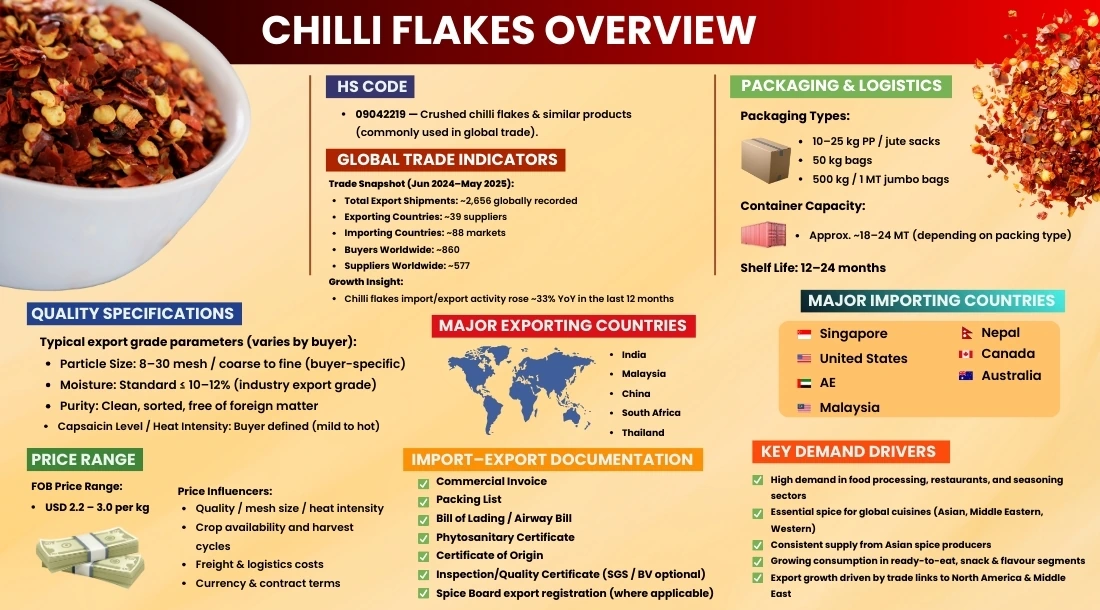
Packaging Types : 10 kg, 25 kg, 50 kg PP or jute bags; bulk / customer-specified packaging

Product Forms : Crushed Chili Flakes, Organic Chili Flakes

Shelf Life : 12-18 months

Moisture Content : Less than or equal to 12% (export standard)

Capsaicin Content : 0.5-2% (depending on variety)

HS Code : 09042210 (Chili flakes)

Origin : India (Andhra Pradesh, Telangana, Madhya Pradesh)

Certifications : ISO, HACCP, FSSAI, APEDA, Organic


Facilitated by Tradologie.com

Offered By : Verified Spice Sellers

veg icon

This is a Vegetarian product.


Chilli Flakes: A Guide to Varieties, Grades, and Global Trade

ABOUT THE PRODUCT

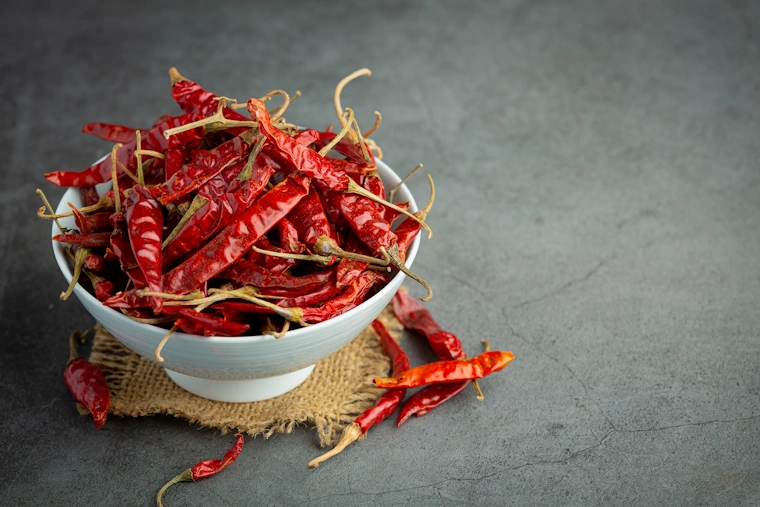
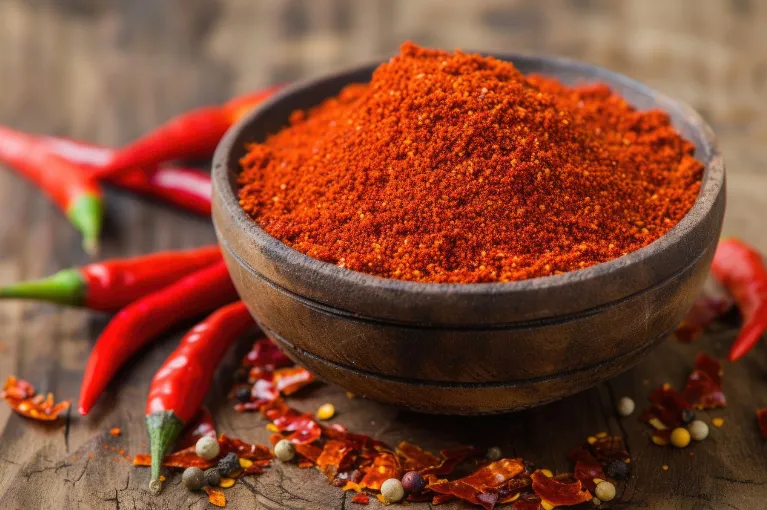
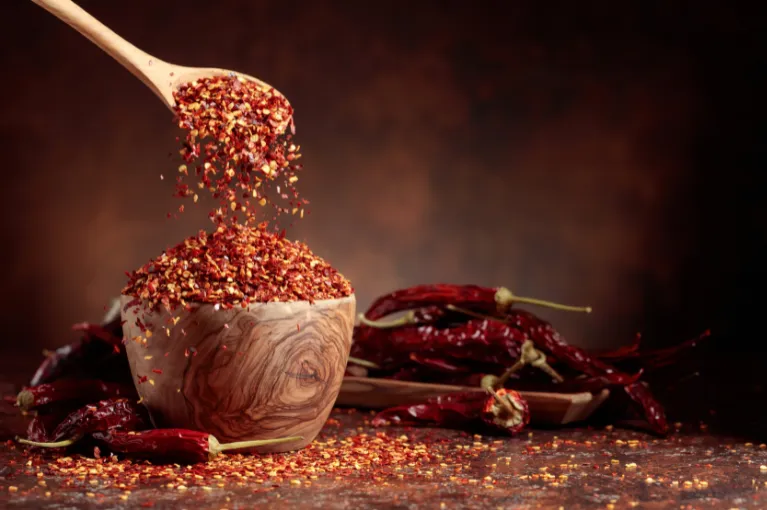
"Chilli Flakes," technically known in the trade as Crushed Red Pepper (CRP), are a coarse spice product obtained by mechanically crushing dried 'Capsicum Fruit Pods' rather than pulverising them into a fine dust. Unlike powder, this commodity retains the structural integrity of the chilli, comprising a visible mix of three components: red skin flakes, yellowish seeds, and a small amount of placental tissue. The commodity is valued by the HORECA and food manufacturing sectors for its textural crunch, visual appeal, and burst of heat. For food manufacturers planning to buy chilli flakes in bulk, understanding these structural nuances is essential for selecting the right processing grade.
 

While commonly recognised as the quintessential "Pizza Topper" in retail, high-grade export Chilli Flakes are engineered for precise "cut sizes" and seed-to-flake ratios. The process involves drying red chillies (often varieties like Guntur Sannam or Teja) and running them through coarse cutters, followed by sieving to remove excessive fine dust.
It functions differently from "Chilli Powder" because of its coarse format.


It can be used as a condiment to provide texture while cooking (in marinades) or to add heat after cooking (as a topping). Because seeds have a high concentration of capsaicinoids and provide an instantaneous, biting heat as opposed to the dispersed heat of powder, their presence is essential.


PRODUCT SPECIFICATIONS


Parameter Standard / Limit
Purity 100% dried crushed fruit of Capsicum annuum
Moisture Content Max 10% - 11%
Total Ash Max 8.0% (dry basis)
Acid Insoluble Ash Max 1.3%
Seed to Flake Ratio Typically 30:70 to 40:60 (Adjustable per buyer)
Dust / Fines Max 3% - 5% (Dedusted grades preferred)
Sudan Dyes (I-IV) ABSENT (Strictly Non-Negotiable for Export)
Aflatoxin (Total) EU: < 10 ppb (µg/kg) | US: < 20 ppb | India: < 30 ppb
Salmonella Absent in 25g
Particle Size (Cut) 3mm - 6mm (Standard Pizza Cut)

Critical Note: "Dust Control" is a major specification for flakes. Premium buyers require "Dedusted" flakes where fine powder is sifted out to ensure the product remains free-flowing and visually distinct.


seller registration


TYPES, GRADES & VARIANTS


In the competitive landscape of the chilli flakes B2B trade, segmentation is strictly driven by the physical 'cut size,' the heat level (SHU), and the visual ratio of seeds to skin.

  • Standard Pizza Cut (Commercial Grade): The global benchmark. A balanced mix of red flakes and creamy seeds (approx. 60% skin / 40% seed). Heat ranges from 30k to 50k SHU. Used universally by QSR chains (Domino's, Pizza Hut) and seasoning blenders.
  • Seedless Flakes (Premium Visual): High-value, purely red flakes with seeds removed. These are preferred for aesthetic applications where red colour is desired without the harsh bite or texture of seeds. Common in gourmet European manufacturing and clear soups.
  • Roasted Chilli Flakes: Before being crushed, the chillies are dry-roasted. This results in a darker, mahogany colour (low ASTA, high flavour) and a smoky, nutty aroma. incredibly well-liked in Mexican blends and Asian cuisine (Thai, Chinese oils).
    • Gourmet / Single Origin: Made from specific high-value cultivars.
      • Kashmiri Flakes: Mild heat, vibrant wrinkled texture, deep red.
      • Guntur Flakes: High heat, bright orange-red, standard industrial choice.
      • Ghost Pepper / Bhut Jolokia Flakes: Extreme heat (>800k SHU) for speciality "challenge" products.


CHILLY FLAKES: APPLICATIONS & END-USE


Food Processing (Industrial)

  • Ready-to-Eat (RTE) & Processed Meats: Flakes are front and centre in marinades and rubs, adding authenticity with their visible presence. In contrast to powders, flakes are evenly distributed in tumbling and won’t form clumps. When consumers notice flakes or seeds visible through the packaging, it’s an indicator of “Homestyle” or “Artisanal” quality, appealing to the consumer’s perception of minimal processing.
  • Pickles, Fermentation & Preserves: Flakes are essential in adding texture to oil-pickled products (consider South Asian pickles) and Kimchi. They absorb the liquid or oil, becoming soft with a pleasant chew that won’t go mushy.

Snacks & Seasonings

  • Extruded Snacks, Chips & Nachos: Flakes signify "rustic" or "gourmet" lines, differentiating them from generic red powders. Applied via oil/slurry for adhesion, the critical particle size prevents falling off or burning. Correctly sized flakes create focused "heat spikes" versus a powder's uniform burn.

Retail & HORECA

  • QSR & Fast Food (Sachet Market): The largest global volume driver (pizza/pasta sachets). The primary technical requirement is Free Flow Capability. Flakes must be dried (below 10% moisture) to prevent clumping for a clean pour. Heat level is standardised (30k-40k SHU) for broad appeal.
  • Artisanal Condiments & Infusions: Flakes form the structural base for high-growth categories like "Chilli Oil" and "Chilli Crisp." They require Thermal Resilience (often roasted varieties) to withstand hot oil infusion (160°C+) without burning, maintaining a "crispy" texture while releasing essential oils and colour into the base.


SUPPLY & DEMAND COUNTRIES


Top Producing Countries & Export Hubs

  • Production Leaders: India dominates the crushed chilli sector, leveraging the massive Guntur crop, which offers the ideal skin thickness for crushing. China is a significant player, particularly for lower-cost, high-seed varieties. Turkey and Syria are famous for the speciality "Aleppo" style flakes, though volumes are lower.
  • Key Export Hubs: The processing zones in Andhra Pradesh (Guntur) and Karnataka (Byadgi) are the global factories. Here, whole chillies are destemmed and crushed. Vietnam has emerged as a re-processing hub, importing Indian chillies to crush and re-export to China and the US.

Top Importing Regions

  • North America: The undisputed king of chilli-flake consumption, driven by a massive pizza culture and Italian-American cuisine. The US imports thousands of containers of "Pizza Cut" flakes annually for institutional use.
  • Europe: Italy, Germany, and the UK are key markets. The European demand is bifurcated: standard flakes for industrial pizza production and high-quality, aflatoxin-free, seedless flakes for retail jars.
  • Southeast Asia: Thailand and Vietnam import flakes for use in local condiments (Nam Prik) and instant noodle seasoning packets, prioritising high heat (Teja variety).


GLOBAL MARKET OVERVIEW


  • Current market value: As of 2024, the global Chilli Flakes market was valued at approximately USD 1.21 billion, a small but premium segment of the Capsicum market (Data Bridge Market Research).
  • Future outlook: The market is expected to grow to around USD 1.86 billion by 2032.
  • Growth rate: The market is expected to grow at a CAGR of 5.5%, which is faster than the overall bulk spice market.
  • Trends: The market is moving from generic heat to textural heat. The market is also moving towards dedusted and stemless varieties, which are in demand by industrial customers who are willing to pay a higher price for bright red flakes that can be used as both a garnish and a spice.


KEY DEMAND DRIVERS


  • The "Visual Texture" Trend (Instagrammability) Modern food culture is visual. Customers associate freshness and quality with readily visible ingredients. A dusting of bright red flakes on Avocado Toast, Pasta, or Pizza provides immediate visual confirmation of "spiciness" and an artisanal flair that a flat red powder cannot offer. This "garnish effect" is driving HORECA buyers to switch from powder to flakes for table condiments.
  • The Chilli Oil Boom The global phenomenon of “Chilli Crisp” condiments (led by brands such as Lao Gan Ma and Momofuku) has driven the industrial demand for specific types of flakes. Companies are seeking flakes with higher seed content for added crunch and specific roasted flavours to replicate the texture in mass-produced sauces.
  • Convenience & Delivery Culture The pandemic-induced delivery culture has ensured a consistent market for single-serve condiments. Western fast food chains expanding into new markets in Asia and Africa are driving the demand for “Pizza Cut” flakes in sachet packaging, with double-digit growth in these markets.


buyer registration


PRODUCTION & SUPPLY DYNAMICS


  • Production Leader: India (Guntur region) leads due to cost-efficiency and variety availability.
  • Processing Note: Unlike powder, flakes require "Destemming" (removing the green stem) before crushing to ensure purity. Mechanical stem-cutting is a critical step in the production line to avoid green specks in the final red product.
  • Risks:
    • Physical Contamination: Since the product isn't ground up, foreign objects like stones and twigs need to be carefully eliminated using magnets and gravity separators.
    • Microbial Load: Although flakes have a greater surface area exposed to air than whole chillies, but less than powder, EU buyers frequently ask for steam sterilisation to ensure that they are free of Salmonella.


EXPORT & IMPORT TREND ANALYSIS


  • Volume Trend: Stable to Rising. The shift towards spicy fast food keeps volumes high. The overall Chili Flakes Export volume is seeing a consistent upward trajectory as Western markets adopt spicier profiles.
  • Value Trend: Moderate increase. "Dedusted" and "Stem-cut" premium grades are commanding higher prices as buyers demand cleaner products.
  • Key Insight: Buyers are increasingly specifying the Seed %. Cheaper grades have more seeds (which are cheaper than skin), while premium grades are skin-heavy.


PRICE & BULK COST INDICATORS


  • Standard Pizza Cut (Medium Heat): Generally ranges from $2,400 to $3,000 per metric ton. This is usually a little lower than high-quality powder due to the lower energy requirements of crushing compared to fine grinding.
  • Premium / Stemless / Dedusted: This variety will cost between $3,200 and $4,500 per MT. The price rises because of yield losses when the product is dedusted and stemmed, and also because of the sterilisation process.
  • Market Volatility: This is directly linked to the price of whole dried chillies. When the price of whole chillies goes through the roof in Guntur, the price of flakes is sure to follow. Therefore, tracking Guntur mandi rates is crucial for buyers calculating the landed import chilli flakes price.


HSN / HS CODE & TAX CLASSIFICATION


  • HS Code (Global): 0904.22 (Fruits of the genus Capsicum Crushed or Ground).
    • Note: It shares the code with powder, so descriptions on invoices must be explicit (e.g., "Crushed Chilli" or "Chilli Flakes").
  • Indian HSN Code:
    • 0904 22 11: Chilli Powder (often used for flakes too if not specified).
    • 0904 22 19: Other (Preferred for Crushed/Flakes to differentiate).


BUYER EXPECTATIONS & TRADE REQUIREMENTS


  • Mesh / Cut Size Consistency: The #1 Requirement. A "Pizza Cut" must not look like powder. Buyers expect a uniform 3-5mm size. Too much dust is a ground for rejection.
  • Flowability: The product must not clump. This is critical for automated packaging machines that fill small sachets. Verified bulk chilli flakes suppliers mitigate this risk by adhering to strict moisture limits and dedusting protocols.
  • Sudan Dye Free: Strict zero-tolerance policy, identical to powder.
  • Microbiological Standards: Salmonella absent. E. coli limits are strictly enforced for RTE (Ready-to-Eat) applications.


Logistics, Packaging & Trade Terms


Packaging Standards

Since flakes are less dense than powder, they require more volume. Bulk packing is typically in 20 kg or 25 kg PP bags or Kraft Paper bags with an inner poly liner to prevent moisture absorption (which kills the crunch). Proper barrier packaging is the standard for Wholesale Chilli Flakes, ensuring the product withstands ocean transit without clumping. For high-end retail, we see PET jars and glass grinders.

Storage & Shelf Life

Flakes hold their flavour longer than powder because less surface area is oxidised. However, they must be kept below 15°C. Heat causes the seeds to turn rancid (oily smell) and the skins to turn brown. Shelf life is typically 18–24 months.

Incoterms & Documentation

FOB and CIF are standard. Documentation is identical to powder: CoA, Phytosanitary Certificate, and Bill of Lading. Some buyers may request a "Sieve Analysis Report" to verify the percentage of fines/dust.


Regulatory Compliance & Certifications


Mandatory & Market Access

Food safety is paramount. Since flakes are often eaten "raw" (sprinkled on cooked food), the microbial counts must be low.

  • Sterilisation: Steam sterilisation (or ETO, where permitted) is highly recommended for exports to the US and EU to eliminate Salmonella.
  • Traceability: Buyers demand to know the origin (Farm to Crusher) to ensure no illegal dyes were used at any stage.


Future Outlook & Opportunities


1. Smoked Flakes & The "Barbecue" Wave There is an aggressive global shift toward "Complex Heat" that goes beyond simple pungency, largely driven by the rising popularity of American BBQ culture and Mexican cuisine. This has created a dedicated market for smoked profiles where flavour depth is as important as heat. The segment is led by Chipotle Flakes, made from fully ripened Red Jalapeños wood-smoked (usually over Pecan or Mesquite) for days to achieve deep, earthy notes with medium heat (15k–25k SHU). For European manufacturing, Smoked Paprika Flakes offer a sweet, zero-heat alternative widely used in sausages and vegan meat alternatives to mimic a "cured" flavour. On the cost-sensitive end, industrial "Infused" Flakes provide a scalable solution, where standard Guntur flakes are treated with "Natural Smoke Condensate" (Liquid Smoke) to replicate the aroma at a fraction of the cost of traditional wood smoking.

2. Fermented Flakes (The "Umami" Factor) Driven by the global obsession with Korean cuisine (K-Food), specifically Kimchi and Gochujang, Western palates are actively seeking the tangy, savoury "Umami" depth that comes from fermentation. The star of this category is the Gochugaru Style flake. These are "semi-dried" or sun-dried, in contrast to regular pizza flakes, to maintain a slightly higher moisture content and a bright, oily sheen. They provide a complex profile that is fruity, slightly sour, and spicy. They are frequently processed from peppers that have undergone a brief fermentation or ageing period. In order to give their "Korean BBQ" sauces and noodle seasonings more texture and legitimacy, Western sauce manufacturers are now actively sourcing these genuine "Gochugaru-style" flakes.

3. Eco-Packaging & Regulatory Shifts (EU Focus) The European Union's "Green Deal" and stringent plastic waste regulations are forcing a rapid departure from traditional, non-recyclable multi-layer laminates (PET/Poly/Foil). In the Bulk Trade, this has spurred a shift towards 20kg Kraft Paper Sacks equipped with high-barrier, bio-degradable inner liners (such as EVOH-free coatings) that protect against moisture while remaining recyclable. The "holy grail" of paper-based high-barrier sachets is being pursued by the retail and sachet industry. Thanks to a microscopic barrier layer that stops chilli oil from oxidising or discolouring the package, these creative packaging options replicate the feel and appearance of paper while enabling brands to use the term "Plastic Free" on their labels without sacrificing shelf life.


TRANSPARENCY & DISCLAIMER


Disclaimer: Market data, price indications, and trade regulations may change because of harvest conditions, geopolitical policies, and currency fluctuations. The technical details are for general guidance only; buyers must verify the details (Cut size, Seed %, Pesticide Limits) with suppliers through a Certificate of Analysis (CoA) before making a purchase. No specific trade result can be guaranteed by Tradologie.

Get in Touch

Frequently Asked Questions

Flakes are coarsely crushed and include visible seeds and skins, offering texture and immediate heat. Powder is finely ground, often seedless or fully pulverised, and used for blending colour and flavour.

Not necessarily, but the perception of heat is different. Flakes contain seeds where capsaicin is concentrated, providing sharp hot spots when bitten, whereas powder provides a uniform, lingering heat.

It is the industry standard specification for flakes, typically 3mm to 6mm in size, with a specific ratio of red flakes to yellow seeds, designed to dispense easily from shakers.

Reputable exporters guarantee Sudan-free products. However, strict testing is required as adulteration can occur in unorganised markets. Always verify the Certificate of Analysis (CoA) before you Buy Chili Flakes to ensure full regulatory compliance.

Roughly 18–24 months if stored in cool, dry conditions. They are more stable than powder but can lose their crunch if exposed to humidity.

Need more help?