Key Highlights
- The industrial uses of black pepper extend beyond food into nutraceuticals, pharmaceuticals, cosmetics, perfumery, animal feed and natural extract manufacturing.
- Different industries procure black pepper as whole peppercorns, ground pepper, essential oil, oleoresin and piperine extracts.
- India was the leading exporter of crushed or ground black pepper in 2024, with exports valued at US$56.66 million.
- Indonesia and Brazil led whole dry black pepper exports in 2024, recording US300.73 million and US 278.29 million, respectively.
- India's black pepper exports, including value-added products, reached approximately US$124.54 million in FY 2024-25.
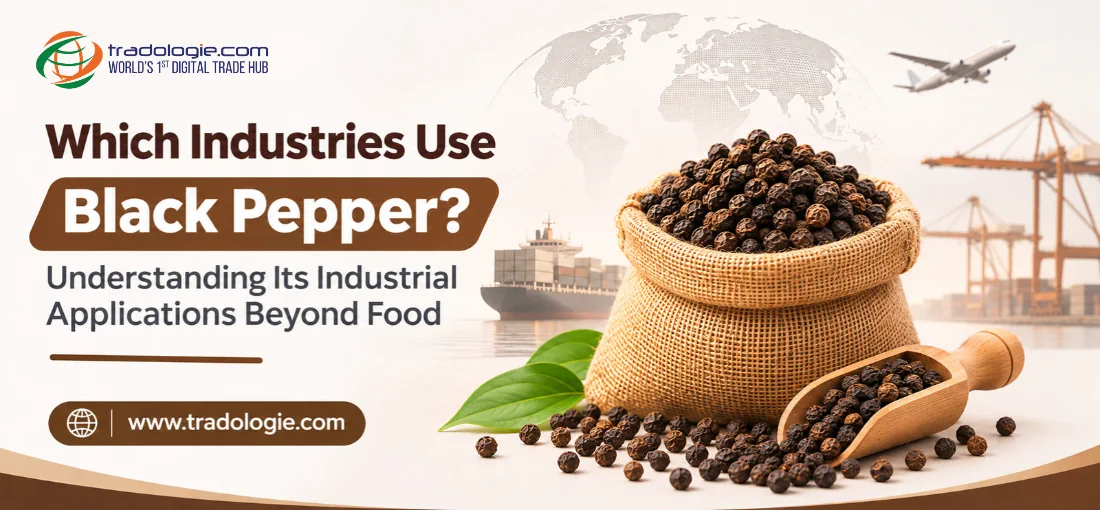
Black pepper is widely recognised as a kitchen spice. But the industrial uses of black pepper value extends beyond seasoning. Industries use different forms of the pepper berry to obtain flavour compounds, aromatic oils and bioactive ingredients. Depending on the application, manufacturers purchase whole peppercorns, ground pepper, essential oil, oleoresin or isolated piperine.
These products serve different industrial purposes. Food manufacturers require consistent flavour and pungency, fragrance companies use aromatic oils, while nutraceutical manufacturers may source standardised piperine extracts. Understanding black pepper uses in different industries therefore requires examining both the raw commodity and its processed derivatives.
Application in Industry
| Product form | Application in industry |
|---|---|
| Whole peppercorns | Food |
| Ground pepper | Seasoning and packaged food |
| Essential oil | Fragrance |
| Oleoresin | Flavouring and select formulations |
| Piperine extract | Nutraceuticals and select formulations |
Depending on the requirements of the manufacturer, its intended application in production, and the product's quality specifications, different forms are often required.

1. Food Industry
When it comes to black pepper uses in different industries , it is extensively used in food manufacturing. Ground pepper and oleoresin facilitate consistent seasoning. Products commonly containing black pepper include instant noodles, soups, savoury snacks, sauces, marinades, processed meats, and ready meals. When procuring black pepper for the food industry, factors considered include pungency, cleanliness, moisture content, microbial load, and batch consistency.
2. Pharmaceutical and Herbal Formulation Industry
Due to its biochemical properties, piperine has been investigated for pharmaceutical applications. In particular, it has been studied for its potential to enhance the bioavailability of certain substances when combined with specific compounds.
As a result, piperine extracts and other pepper derivatives can be found in specialised herbal and formulation products. However, this research does not necessarily establish a proven effect in clinical applications. Manufacturers must consider the purity, concentration, safety and regulatory compliance of ingredients such as piperine extracts.

3. Nutraceutical and Dietary Supplement Industry
Plant-derived compounds are widely incorporated into nutraceuticals and botanical formulations. Black pepper is utilised within this industry due to the piperine content in the product. Certain products contain standardised concentrations of piperine.
Piperine may be combined with other botanical extracts or nutrients to enhance bioavailability. Generally, compared to spice customers, manufacturers in this industry will require precisely defined piperine concentrations, high purity, and specified microbiological quality within the extract.
4. Cosmetic Industry
The essential oil of black pepper is incorporated into select cosmetic formulations. Due to its high concentration of volatile compounds, it can be utilised in fragrance products and specialised topical formulations.
Examples of applications include massage oils, warming balms, spa products, and scented body care. As essential oils can cause irritation, appropriate dilutions, safety assessments and adherence to cosmetic regulations must be considered.
5. Fragrance Industry
The essential oil of black pepper can be utilised to impart warmth and spiciness to fragrance products. It can be blended with citrus, woody and aromatic notes in luxury perfumes, fragrances and select household products.
Buyers consider the olfactory profile, chemical composition, purity and batch consistency. This is a specialised industry, and the sensory attributes of the oil are key considerations when purchasing.
6. Animal Feed Industry
Black pepper oil and oleoresin have been evaluated for use as sensory-enhancing ingredients in animal feed. Their aroma and pungency can enhance the sensory profile of select animal feed formulations.
Assessments have been published by the European Food Safety Authority regarding the use of black pepper oil and oleoresin as animal feed additives. Depending on the product, animal, and regulations of the target market, black pepper products may or may not be authorised for inclusion in animal feed.
7. Natural Extract Production Industry
Black pepper is utilised by manufacturers to produce natural extracts, including essential oils, oleoresins and piperine-rich extracts. These ingredients can subsequently be incorporated into further food products, fragrance products, cosmetic products or specialised formulation products.
Depending on the extraction technique employed, different products can be obtained. Volatile oils in black pepper are generally extracted through distillation. Oleoresin can be extracted from the pepper. When procuring raw black pepper, the concentration of piperine, characteristics of volatile oils, moisture content and extraction suitability may be evaluated.
Global Black Pepper Trade
By analysing global trade data, we can examine how black pepper moves across international markets. Black pepper traded in dried form is classified based on whether it is whole or crushed/ground.
| Code | Description |
|---|---|
| 090411 | Dry black pepper, not crushed or ground |
| 090412 | Dry black pepper, crushed or ground |
Top Exporters of Whole Dry Black Pepper (Code 090411)
According to data provided by the World Bank WITS (based on data from UN Comtrade), in 2024, the leading exporters of whole dry pepper (code 090411) are:
| Country | Value | Weight |
|---|---|---|
| Indonesia | $300.73m | 53,954MT |
| Brazil | $278.29m | 59,663MT |
| Sri Lanka | $166.89m | 25,259MT |
| Germany | $61.70m | 9,783MT |
| India | $55.62m | 8,992MT |
[Note: Data from World Bank WITS (UN Comtrade), 2024]
As a result, Indonesia and Brazil represent significant sources of whole dry black pepper. India is also a notable supplier though less pepper was reported exported than the leading exporting countries.
Top Exporters of Crushed or Ground Black Pepper (Code 090412)
In contrast, for crushed and ground pepper, India is the leading reported exporter in 2024.
| Country/Region | Value | Weight |
|---|---|---|
| India | $56.66m | 10,803MT |
| European Union | $42.50m | 5,872MT |
| Netherlands | $36.93m | 5,428MT |
| Germany | $35.14m | 4,484MT |
| United States | $33.19m | 3,905MT |
[Note: Data from World Bank WITS (UN Comtrade), 2024. European Union is a regional entity].
Approximately $56.66m of crushed or ground black pepper was reported exported from India, compared to only $55.62m of whole dry pepper. This underscores the significance of processed black pepper in international trade, however the figures cannot be directly interpreted as differences in profit margins.
Value Added Black Pepper Exports from India
Black pepper products in India also include processed derivatives. According to an ICAR technical bulletin, approximately ₹548.1 crore worth of ground or crushed black pepper was exported from India in 2024/25. Additionally, black pepper, oleoresin and oil were exported for worth ₹533 crore and ₹64 crore respectively.
Overall, approximately 20,830MT of black pepper was exported from India in 2024/25, worth $124.54 million. This indicates that value-added products constitute a part of India's black pepper exports.
Oleoresin and essential oil are value-added products and must be assessed to ensure they fall under the appropriate customs classification codes. They should not be incorporated into the totals of 090411 or 090412.
Forms of Black Pepper Required by Different Industries
| Industry | Form of black pepper commonly used | Factors considered in buying |
|---|---|---|
| Food | Whole Peppers, Powder, Oleoresin | Flavour, Pungency and Microbial Content |
| Pharmaceutical/Herbal | Piperine Extract, Oleoresin | Purity, Concentration and Safety |
| Nutraceutical | Standardised piperine extracts | Content of active compounds |
| Cosmetic | Essential oil, Select extracts | Scent profile and safety for topical use |
| Perfumery | Essential oil | Scent profile |
| Animal feed | Where permitted, oil/oleoresin | Composition and regulatory compliance |
| Extract manufacture | Whole or cleaned black pepper | Yield and chemical composition |
Moisture content, foreign matter, pesticide residue, contaminants, and batch consistency will also be evaluated. To identify the appropriate black pepper for export, exporters should consider the intended application of the product, and the technical specifications required.
Conclusion
Black pepper has significant commercial relevance across multiple industries. The essential oil, oleoresin and piperine enable its utilisation in food production, fragrance, cosmetic manufacturing, nutraceuticals, specialised pharmaceutical formulations and regulated animal feed products.
Understanding the Industrial uses of black pepper across different industries can help exporters identify new buyers. If the appropriate form, consistently high-quality product, and correct documentation are provided, black pepper presents considerable commercial opportunities.
Disclaimer
The information presented in this article is intended for general informational purposes. Trade values, export quantities, industrial applications and regulatory requirements may change over time. Trade statistics cited relate to calendar year 2024 and FY 2024–25, as specified. The figures for whole and ground black pepper are based on their respective HS classifications, while oleoresin and essential oil are separate value-added products and should not be included in those totals. Pharmaceutical, nutraceutical, cosmetic and animal-feed applications are subject to product-specific safety assessments and regulatory approvals. Buyers and exporters should verify applicable quality standards, ingredient specifications, customs classifications and destination-country regulations before entering into commercial transactions.