Key Highlights
- India exported 52,006 tonnes of coriander during April-January 2025-26.
- Madhya Pradesh, Rajasthan and Gujarat are key production regions.
- Ramganj Mandi and Unjha are important coriander trading centres.
- Buyers check seed size, colour, moisture, cleanliness and volatile oil.
- Major suppliers include Jabs International, Kitchen Xpress and OM Exim.
- Coriander serves spice, food, seasoning, sauce and pickle industries.
- Pesticide and microbiological testing are important for international trade.
- CRES registration is required for Indian spice exporters.
Introduction:
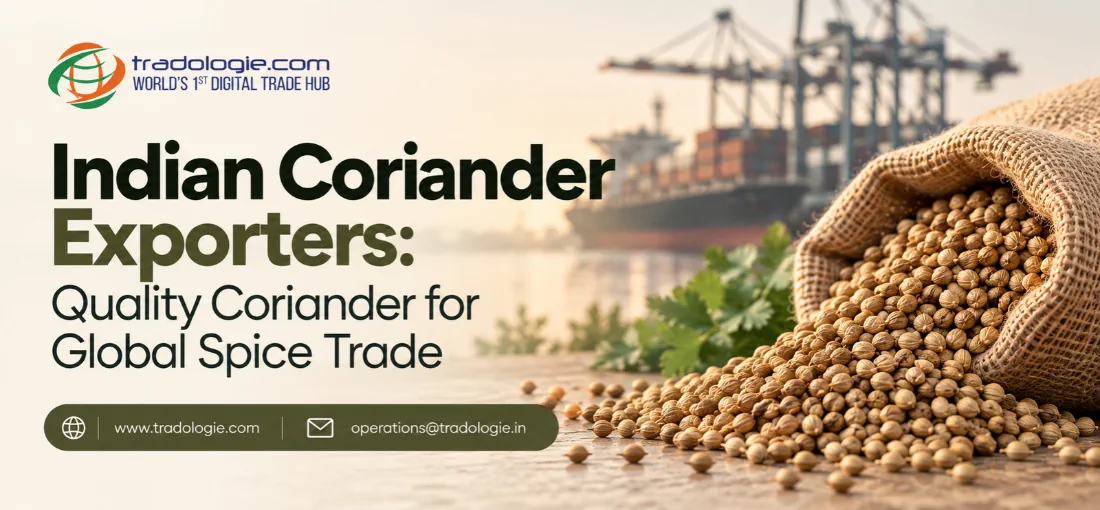
Coriander has always been one of those commodities that do their job quietly. It is present in the spice cupboard, in masala blends, in pickles and sauces, in meat seasonings and in countless food products, but it rarely receives the attention given to chilli, cumin or premium spices. The trade behind it is considerably larger than that modest image suggests. This means opportunities for bulk coriander seeds exporters are far from limited.
India exported 52,006 tonnes of coriander during April-January 2025-26 according to the spices board of India , compared with 49,396 tonnes during the same period a year earlier, an increase of about 5%. Export value also moved higher during the period.
It is not a commodity where the story can be reduced to tonnes alone. Coriander moves through several layers of the food industry, and the requirements change along the way. A trader buying whole seed, a masala manufacturer buying cleaned coriander and a food processor purchasing ground material may all be dealing with the same crop while looking for quite different things.
That is where Indian Coriander Exporters find their space. The seed has to be clean. The colour has to hold. Moisture cannot be allowed to become a storage problem. Volatile oil matters when aroma is important, while pesticide residues and microbiological parameters can determine whether a consignment is accepted in the first place.
For an overseas buyer, therefore, coriander is less of a generic spice than it appears from the outside.

Indian Coriander Seeds Export Is Built Around a Strong Production Base
The coriander crop has a geography of its own.
Walk through the major seed-spice markets of western and central India and coriander quickly becomes part of the landscape. Madhya Pradesh, Rajasthan and Gujarat form the core of the country's commercial production, with their trading centres, mandis, processors and exporters built around the crop over many years.
The latest Spices Board production series puts Madhya Pradesh, Gujarat and Rajasthan among India's principal coriander-producing states, reinforcing the importance of this central and western belt to the country's supply chain.
The geography matters because coriander is not produced evenly across India. The Hadoti region of southeastern Rajasthan and adjoining Madhya Pradesh has long been associated with coriander cultivation, and Ramganj Mandi has grown into one of the important trading centres for the crop.
The result is a supply chain that already knows how to move coriander from farm and mandi to processor and, eventually, to an overseas buyer.
| Major Production Region | Commercial Importance |
|---|---|
| Madhya Pradesh | One of India's largest coriander-producing states |
| Rajasthan | Major seed-spice and trading region |
| Gujarat | Important production and processing base |
| Assam | Smaller but established coriander production |
| West Bengal | Regional production and domestic supply |
Attribution: Spices Board India, state-wise spice production data and publications.
This production concentration gives exporters something valuable: access to a sizeable raw-material pool within an established agricultural and trading network.
Bulk Coriander Seeds Exporter: What International Buyers Actually Check
A Bulk Coriander Seeds Exporter is not really selling a sack of seeds.
At container scale, the buyer is purchasing a specification.
The first discussion may be about price, but it quickly moves towards the quality parameters that determine whether the coriander can actually be used in the buyer's plant.
| Parameter | Why It Matters in Bulk Trade |
|---|---|
| Seed size | Influences processing and appearance |
| Colour | Important for blends and finished spice products |
| Moisture | Affects storage stability |
| Foreign matter | Determines cleaning losses and product quality |
| Damaged / discoloured seeds | Can affect finished-product appearance |
| Volatile oil | Relevant to aroma and flavour |
| Microbiological quality | Important for food-safety compliance |
| Pesticide residues | Critical for many export destinations |
| Packaging | Protects the product during storage and transit |
| Crop / origin | Useful for traceability and procurement planning |
The requirement can change again once the buyer wants processed coriander rather than whole seed. A spice blender may want cleaned and machine-sorted seed. Another buyer may want coriander powder. A food manufacturer may require a specific particle size or sterilisation process.
That is why a good Wholesale Coriander Seeds Supplier usually begins by understanding the application rather than immediately sending a price.
Major Bulk Coriander Seeds Exporters in India
There is no particularly useful public league table for coriander exporters in India. The business is spread across specialist spice houses, agricultural commodity exporters and larger food companies, and shipment activity can change from one season to another.
Still, a number of Indian names appear repeatedly when buyers search the market for coriander seeds and other whole spices.
| Parameter | Why It Matters in Bulk Trade |
|---|---|
| Seed size | Influences processing and appearance |
| Colour | Important for blends and finished spice products |
| Moisture | Affects storage stability |
| Foreign matter | Determines cleaning losses and product quality |
| Damaged / discoloured seeds | Can affect finished-product appearance |
| Volatile oil | Relevant to aroma and flavour |
| Microbiological quality | Important for food-safety compliance |
| Pesticide residues | Critical for many export destinations |
| Packaging | Protects the product during storage and transit |
| Crop / origin | Useful for traceability and procurement planning |
These names are better understood as prominent companies visible in the Indian coriander export market , rather than as a definitive ranking. Public trade information shows several of them repeatedly in coriander-seed export activity, while company-level information also shows established export operations. Jabs International, for example, records repeated industry recognition for coriander-seed exports, including a first-place coriander-seed export award in 2025 and earlier export-performance awards.
Recent shipment data also shows Kitchen Xpress Overseas, Jabs International and OM Exim among the more visible Indian suppliers of coriander seeds. Shipment counts, however, should be treated as an indication of trade activity rather than an official industry ranking.
The broader supplier landscape is much larger than these names. Indian exporters also operate around Gujarat, Rajasthan, Madhya Pradesh and major trading centres such as Unjha and Ramganj Mandi, giving overseas buyers a sizeable sourcing base rather than a handful of dominant suppliers.

Coriander Spice Exporters India Are Serving a Broad Food Industry
Coriander has an advantage that is easy to underestimate: it fits into a lot of food.
The whole seed can go straight into traditional cooking or into a spice blend. Once ground, it becomes part of curry powders, masalas, seasoning mixes, sauces, pickles and processed foods. Further processing can take it into extracts and other specialised applications.
That range gives Coriander Spice Exporters India quite a few different customers to work with.
| Buyer Segment | Typical Requirement |
|---|---|
| Spice importers | Whole seed and powder |
| Masala manufacturers | Cleaned seed and ground coriander |
| Food manufacturers | Ingredient-grade material |
| Seasoning companies | Specific flavour and particle size |
| Meat processors | Spice blends and seasoning ingredients |
| Sauce / pickle manufacturers | Ground or blended coriander |
| Retail brands | Consumer-ready packs or private label |
| Extract manufacturers | Higher-value processed material |
A supplier capable of cleaning, sorting, grinding, sterilising and packing to specification can therefore participate in much more than the raw-seed trade.
And that is where economics starts to become more interesting. The same crop can leave India as an agricultural commodity or as a much more carefully specified food ingredient.
Indian Coriander Exporters Are Operating in a Growing Spice Market
Coriander is not the biggest contributor to India's spice-export earnings. Chilli and cumin are much larger businesses, and spice oils and oleoresins sit in another value bracket altogether.
Yet coriander has been holding its ground.
During 2025-26, India exported 17.34 lakh tonnes of spices and spice products worth US$4.43 billion . Coriander contributed about 2% of total spice export value . The United States, China, UAE, Bangladesh and Saudi Arabia were among the country's major spice destinations.
There is an advantage in that broad network.
A company already importing Indian chilli or cumin does not have to build an entirely new supply relationship to start buying coriander. A large seasoning manufacturer may need several Indian spices at the same time. A distributor serving South Asian food brands may have an even broader requirement.
For an exporter, one good customer can therefore become something larger than a coriander account.
Indian Coriander Seeds Export Has More Than One Market
The international market for Indian spices is already widely spread, and coriander travels through much of the same network.
Spices Board data for 2025-26 shows the United States accounting for 14% of India's spice export earnings, China 12%, the UAE 9%, Bangladesh 8% and Saudi Arabia 5%. European markets, Southeast Asia and other destinations add to that customer base.
Coriander itself fits into several of these markets for different reasons.
In the Middle East, whole seeds can move through traditional spice distribution and food-service channels. In Europe, a seasoning manufacturer may be much more concerned with pesticide residues, microbiological specifications and traceability. Elsewhere, the requirement may simply be dependable bulk seed for further processing.
The crop is the same.
The commercial specification is not.
Wholesale Coriander Seeds Supplier Means Consistency Over Time
One good shipment does not tell an overseas buyer very much.
The second shipment starts to.
If the coriander arriving six months later has noticeably different colour, aroma, moisture or physical cleanliness, the buyer has to adjust its own production process. A spice blender cannot keep changing the character of a finished masala every time a new lot arrives.
For a Wholesale Coriander Seeds Supplier , consistency therefore starts much earlier than the export container. It involves how the seed is procured, how it is cleaned and sorted, how it is stored and how individual batches are tested before dispatch.
Samples are useful for precisely this reason.
The buyer approves one physical benchmark.
The supplier then has to make sure the commercial shipment still looks like that benchmark when it reaches the other side of the world.
Quality and Compliance Are Becoming More Important in Coriander Trade
Spice buyers have become considerably more particular about what sits inside a shipment.
A commercial coriander contract can come with laboratory requirements covering pesticide residues, microbial parameters, heavy metals, moisture and other quality characteristics. The exact list depends on the destination and the intended use of the product.
Spices Board has been working with producers and other stakeholders on quality and safety improvement in Indian spices, including coriander. Its programmes have included work in Madhya Pradesh aimed at improving production practices and meeting international market requirements.
For exporters, that changes the nature of the sales conversation.
The buyer is not merely asking whether the coriander looks clean.
The buyer may want the laboratory report behind it.
India also requires exporters of spices and spice products to hold a Certificate of Registration as Exporter of Spices (CRES) issued by the Spices Board. Certain consignments can also be subject to sampling and testing requirements depending on the destination and applicable regulations.
That is becoming increasingly important as importing countries tighten their food-safety requirements. The Spices Board, for instance, issued a September 2026 advisory concerning Thailand's pesticide-residue standards and another concerning proposed EU limits for mineral-oil aromatic hydrocarbons in spices and spice products.
The export business, in other words, is gradually becoming less about simply finding good coriander and more about being able to demonstrate exactly what has been supplied.
Indian Coriander Exporters Can Move Further Up the Value Chain
There is a natural ceiling to the economics of bulk raw seed.
Processing creates another layer.
Instead of exporting only whole coriander seeds, Indian companies can supply cleaned and machine-sorted seeds, ground coriander, sterilised material, private-label packs and other value-added formats where the buyer's specification allows it.
That does not mean every exporter should immediately move into processing.
It does mean that India's production advantage becomes more interesting when it is combined with processing capability.
The same relationship with a UAE distributor, European spice blender or American food manufacturer can potentially expand from one commodity into a wider portfolio of Indian spices.
The Future of Indian Coriander Seeds Export Is About Reliability
Coriander is unlikely to receive the same headlines as Basmati rice, turmeric or chilli.
It does not need to.
It already has something more useful: a large domestic production base, established trading centres, an international customer network and applications that extend well beyond one cuisine.
For Indian Coriander Exporters , the opportunity is therefore not simply to ship more tonnes.
It is to become more precise about what those tonnes contain.
For the Bulk Coriander Seeds Exporter , that means consistent cleaning, grading and testing. For the Wholesale Coriander Seeds Supplier , it means dependable procurement and repeatable quality. And for Coriander Spice Exporters India , it increasingly means understanding the buyer's end application rather than treating coriander as an interchangeable commodity.
India already has the raw material.
The more interesting part of the trade is what happens after the harvest — when those seeds are cleaned, tested, processed, packed and finally turned into an ingredient that can travel from an Indian mandi to a food factory on the other side of the world.
That is where the real export value of Indian coriander begins.
Disclaimer
This content is for general informational purposes and is based on the trade, supplier and regulatory information provided in the source material. The companies mentioned are prominent names visible in the coriander export market, not a definitive ranking. Shipment activity and buyer requirements can change, so exporters and buyers should independently verify current specifications, certifications, availability and commercial terms.



.webp "Top 10 Health Benefits of Cinnamon ( Daal Chini )")