Key Highlights
- India exported 17.34 lakh tonnes of spices worth ₹39,140.11 crore in FY 2025-26.
- Saudi Arabia accounted for around 5% of India's spice export destinations in FY 2025-26.
- Indian spices exported to Saudi Arabia include chilli, ginger, cardamom, turmeric and curry powders.
- Indian exporters generally need an Importer Exporter Code (IEC) and Certificate of Registration as Exporter of Spices (CRES), subject to applicable requirements.
- Saudi food imports must comply with relevant Saudi Food and Drug Authority (SFDA) regulations, product standards and clearance procedures.
- Exporters should verify Arabic labelling, shelf-life information, food-safety testing and certificate requirements before dispatch.
- Common export documents include the commercial invoice, packing list, shipping bill, transport document and certificate of origin, with additional documents where applicable.
- Tradologie helps Indian spice exporters connect with potential international buyers and explore trade opportunities.
Introduction:
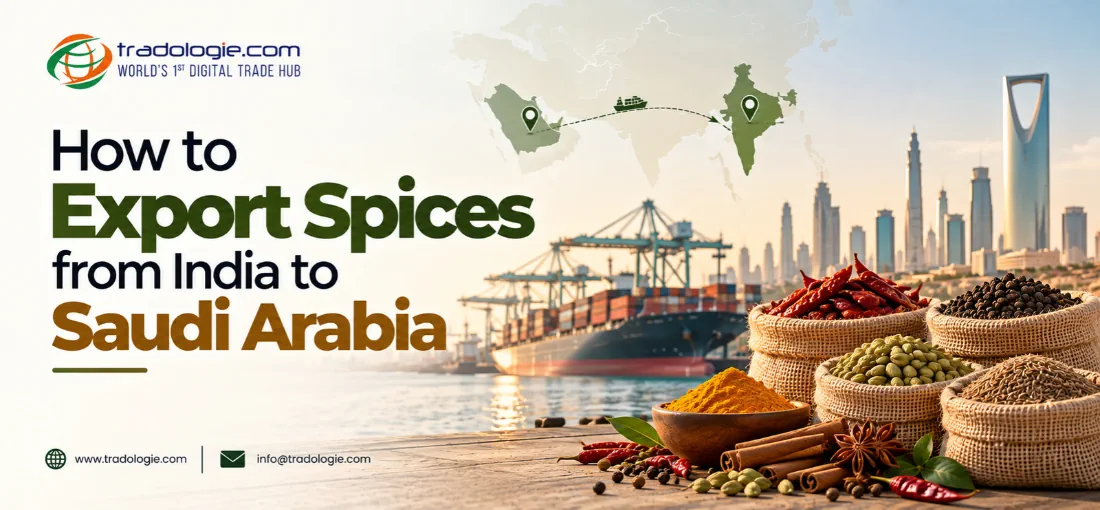
Saudi Arabia is an established market for Indian spices, but getting an order is only one part of the business. Anyone researching how to export spices from India to Saudi Arabia needs to consider what the buyer wants, how the product will be used and what is required for the shipment to clear Saudi food-import checks. Whole chilli, for example, has different handling and quality considerations from curry powder or ground turmeric.
According to the Spices Board of India, India exported 17.34 lakh tonnes of spices and spice products worth ₹39,140.11 crore (approximately US$4.43 billion) in FY 2025-26. Saudi Arabia accounted for around 5% of India's spice export destinations that year. The figures show that the Kingdom is an important market, but they do not mean every spice offers the same opportunity. Chilli, ginger, cardamom and curry powders serve different buyers, and the price, quality and intended use of each product influence whether an order makes commercial sense.
For businesses looking to export spices to Saudi Arabia, the type of operation matters, too. A merchant exporter supplying spices in bulk has different priorities from a manufacturer selling retail-ready packs. One may focus on sourcing, grading and freight costs; the other must also account for processing, packaging, ingredient declarations and shelf-life information.
Getting these details right before accepting an order can save time and money. Once the goods have been packed or dispatched, correcting a documentation or labelling problem becomes considerably more complicated.

Which Indian Spices Have a Market in Saudi Arabia?
Indian exporters supply Saudi Arabia with several spices and spice products, including chilli, ginger, cardamom, curry powders and pastes. For businesses planning to sell spices to Saudi Arabia, the right product to pursue depends on the buyer. A wholesale distributor may purchase whole spices in bulk, while a food manufacturer may need a particular grade or a processed product with consistent specifications.
The Spices Board's product-wise trade figures offer a useful starting point. In FY 2024-25, India exported approximately 7,340 tonnes of chilli to Saudi Arabia, valued at US$15.58 million. Curry powder and paste exports stood at around 6,086 tonnes, worth US$18.88 million. Ginger exports were approximately 1,535 tonnes, valued at US$4.44 million, while large cardamom exports were around 72 tonnes, worth US$1.70 million.
These figures cover specific product categories for that financial year, not the entire spice trade between India and Saudi Arabia. Still, they illustrate why exporters should study individual products instead of treating spices as one uniform market. Anyone researching how to export spices from India to Saudi Arabia should consider these product-level figures alongside current prices, buyer specifications and shipping costs.
| Spice or product | Indian sourcing regions to explore | Details to confirm with Saudi buyers |
|---|---|---|
| Chilli | Andhra Pradesh, Telangana and Karnataka | Colour, pungency, moisture, foreign matter and pesticide residues |
| Ginger | Kerala, Karnataka and other producing regions | Whole or processed form, moisture, cleanliness and specifications |
| Cardamom | Kerala, Karnataka and Tamil Nadu | Size, colour, aroma, moisture and grade |
| Turmeric | Telangana, Maharashtra, Tamil Nadu and Andhra Pradesh | Colour, curcumin content where specified, moisture and contamination |
| Cumin | Gujarat and Rajasthan | Purity, aroma, seed uniformity, moisture and foreign matter |
| Coriander | Rajasthan, Madhya Pradesh and Gujarat | Seed quality, colour, purity and aroma |
| Curry powders and pastes | Processing units across several states | Ingredients, processing standards, packaging and labelling |
These are broad sourcing regions, not exclusive production areas. Spices often pass through wholesale markets and processing centres before reaching an exporter. A business may source from outside the growing region if the supplier can offer the right price, quality and consistency.
It is also worth settling the product format early. Whole spices may require cleaning and grading, while powders and blends bring additional considerations, such as ingredient declarations, contamination controls and batch consistency. Those details should be agreed with the buyer before the exporter commits to the order.
Registration Requirements for Indian Spice Exporters
Before taking an export order, an Indian business needs to complete the registrations applicable to its activities. The main requirements include an Importer Exporter Code, registration with the Spices Board and the relevant tax and food-business formalities. These are important early steps for any business planning to export spices to Saudi Arabia.
Importer Exporter Code (IEC)
The Importer Exporter Code (IEC), issued by the Directorate General of Foreign Trade (DGFT), is generally required for commercial exports from India, subject to applicable exemptions.
The business should check that its legal name, address and registration details are accurate. These particulars appear across export documents, and inconsistencies can lead to avoidable questions during customs clearance or document verification.
Certificate of Registration as Exporter of Spices (CRES)
Spice exporters must obtain the Certificate of Registration as Exporter of Spices (CRES) under the applicable Spices Board framework, in addition to the IEC.
Applications are submitted through the DGFT portal. Supporting documents depend on whether the applicant is a merchant exporter or a manufacturer exporter. The current checklist may include GST documentation, a bank report and FSSAI documentation. Manufacturer exporters may also need MSME details, consent to operate from the relevant pollution-control authority and proof relating to their processing premises.
This distinction matters. A merchant exporter purchasing spices from an established processor does not necessarily have the same operational requirements as a business processing and packing products itself.
Exporters should check the latest Spices Board checklist before applying and keep their registration details up to date. They should also follow the applicable renewal and quarterly export-return requirements. The Board issues notifications on mandatory sampling and testing for specified products and destinations, so it is important to check whether a particular consignment falls within those requirements.
GST and FSSAI requirements
Exporters should have the appropriate GST arrangements in place, including the applicable zero-rated export procedure and the relevant Letter of Undertaking (LUT) or tax-payment route. The documentation depends on the business and the transaction.
FSSAI licensing or registration should be assessed according to the activities undertaken. A business involved in processing, packing, storing or handling food may have different obligations from a merchant exporter whose operations are limited to trading. The relevant licence should cover the actual business activity.
These Indian registrations do not, by themselves, guarantee that a product will be accepted in Saudi Arabia. Businesses learning how to export spices from India to Saudi Arabia must also understand the requirements governing the particular food product and its import into the Kingdom.

Saudi Arabia's Food-Import Rules: What Exporters Need to Know
The Saudi Food and Drug Authority (SFDA) oversees food safety and food-import clearance, while the country's customs authorities handle the relevant customs procedures. The Saudi importer has responsibilities of its own, but the Indian exporter must supply goods and documents that allow the import process to proceed.
SFDA registration and food clearance
Before food is imported, the Saudi importer must meet the applicable establishment and product-registration requirements. The SFDA's published food-clearance conditions include registration of the importing establishment and the food products it intends to import through the relevant systems. Clearance requests are handled through applicable electronic procedures, including the Fasah trade platform.
For the exporter, the practical question is whether the buyer has completed the necessary formalities for the particular product. This should be confirmed before dispatch, not after the shipment is already on its way.
Requirements can vary with the product. Whole spices, ground spices and prepared blends do not necessarily raise the same questions about ingredients, processing or labelling. If a blend contains additional ingredients, the importer should verify that their composition and permitted uses comply with the relevant Saudi or Gulf technical regulations.
Food safety and product standards
Imported food must comply with Saudi Arabia's applicable technical regulations, standards and food-safety requirements. For spice exporters, that means checking the product itself rather than relying on paperwork alone.
Depending on the spice and the relevant standard, checks may cover pesticide residues, contaminants, microbiological parameters, moisture, foreign matter and other product-specific characteristics. A buyer may also ask for laboratory reports or a certificate of analysis before approving a shipment.
There is no single set of tests that guarantees acceptance for every spice. The exporter should establish the applicable limits with the buyer and confirm any mandatory requirements for the product and destination. Where testing is required by the Spices Board or another competent authority, the prescribed procedure must be followed.
Arabic labelling and shelf-life information
Labelling is worth sorting out before ordering printed packaging. Saudi Arabia's rules for prepackaged foods require Arabic information, either on the original label or through an appropriate Arabic translation, in accordance with the applicable technical regulations.
Depending on the product and packaging, the label may need to identify the food, manufacturer or packer, country of origin, ingredients, net quantity and shelf-life information. Additional particulars may apply to the product or its intended use.
A label prepared for the Indian market may not contain everything required in Saudi Arabia. The importer should review the proposed label before it is printed in commercial quantities. Making changes after packing can add costs and delay dispatch.
Bulk shipments intended for further processing may have different practical labelling requirements from finished consumer packs. Exporters should confirm the rules for the actual product and sales format rather than assume one label design will suit every order.
Certificates and customs clearance in Saudi Arabia
The SFDA's published food-clearance requirements include documents such as the certificate of origin, commercial invoice and bill of lading, along with a health certificate or phytosanitary certificate where applicable. Additional certificates or conformity documents may be required depending on the product and the relevant rules.
A phytosanitary certificate should not automatically be assumed necessary for every spice simply because it is a plant product. The exporter and importer need to establish which certificates apply to the product, its processing status and the destination's requirements.
The Saudi importer or its customs broker should coordinate destination-side filing and clearance. The Indian exporter must supply accurate documents and any required certificates in time. Product descriptions, quantities, weights and batch details should match across the invoice, packing list, certificate of origin and transport documents. Unexplained differences can complicate clearance.
Documents Required to Export Spices from India to Saudi Arabia
The final document list depends on the spice, shipping arrangement, buyer's contract and requirements applicable in Saudi Arabia. Anyone researching how to export spices from India to Saudi Arabia should prepare the standard commercial documents first, then confirm any additional requirements for the product and destination.
| Document | Purpose |
|---|---|
| Importer Exporter Code (IEC) | Establishes the exporter's registration for commercial exports, subject to applicable rules. |
| CRES | Spices Board registration required for spice exporters under the applicable framework. |
| GST and business records | Support relevant registration, tax and export documentation. |
| Commercial invoice | Records the buyer, seller, product description, quantity, value and agreed terms. |
| Packing list | Details the package count, packaging type, and net and gross weights. |
| Shipping bill | Indian customs export declaration. |
| Bill of lading or airway bill | Transport document for sea or air freight. |
| Certificate of origin | Establishes the declared origin and is required where applicable. |
| Health certificate | Required where the applicable Saudi food-import conditions call for it. |
| Phytosanitary certificate | Required when applicable plant-health rules require it. |
| Certificate of analysis or laboratory report | Provides results for agreed or mandatory quality and safety parameters. |
| Fumigation or treatment certificate | Required where applicable regulations or the contract specify treatment. |
| Insurance certificate | Relevant where cargo insurance is arranged under the agreed terms. |
| Product label and supporting details | Help demonstrate compliance with applicable Saudi labelling requirements. |
| Other destination-specific documents | May include conformity documents, declarations or additional certificates, depending on the product. |
Not every item is automatically mandatory for every shipment. Exporters should prepare the standard commercial documents and confirm additional requirements with the Spices Board, the relevant Indian authorities and the Saudi importer.
Keep the buyer's purchase order or sales contract with the shipment records. It captures the agreed product, quality parameters, quantity, packaging, delivery terms and payment arrangement. If a dispute arises over quality or shipment conditions, a precise written specification is far more useful than a general description such as “export-grade chilli.”
Choosing an Indian Port for Shipments to Saudi Arabia
The port should be chosen according to where the goods are sourced, the shipping services available and the cost of moving the consignment. Western Indian ports are worth comparing for many shipments to Saudi Arabia, but the nearest port is not always the least expensive option.
An exporter sourcing from Gujarat or Rajasthan might compare Mundra and Deendayal Port (Kandla). A business sourcing from Kerala may look at Kochi, while an exporter in Maharashtra could compare Jawaharlal Nehru Port (JNPA) with other viable routes. The final choice depends on the cargo and the services available when the shipment is booked.
| Port | Region it may serve | Considerations for exporters |
|---|---|---|
| Mundra Port, Gujarat | Gujarat, Rajasthan and connected western and north-western sourcing regions | Compare inland freight, container availability and sailing schedules. |
| Deendayal Port (Kandla), Gujarat | Gujarat, Rajasthan and nearby sourcing areas | Worth evaluating for western-region cargo, subject to available routes. |
| Jawaharlal Nehru Port (JNPA), Maharashtra | Maharashtra and inland locations connected through western freight routes | Compare container-handling options and international shipping connections. |
| Kochi Port, Kerala | Kerala and nearby southern spice-growing regions | May be convenient for pepper, cardamom and other locally sourced spices. |
| New Mangalore Port, Karnataka | Karnataka and neighbouring sourcing centres | Worth checking when the goods originate in Karnataka or nearby areas. |
| Chennai Port, Tamil Nadu | Tamil Nadu and connected southern sourcing centres | A possible option depending on factory location and shipping services. |
| Visakhapatnam Port, Andhra Pradesh | Andhra Pradesh and parts of eastern India | Can be considered for cargo originating in the eastern coastal region. |
| Kolkata-Haldia port system, West Bengal | Eastern and parts of north-eastern India | May suit some eastern sourcing locations, depending on the destination route. |
These are ports to compare, not fixed routes for particular spices. Exporters should obtain current quotations for inland transport, port handling, ocean freight, insurance and destination charges. Transit time and sailing availability also matter, particularly when the buyer has committed to a delivery window.
Sea freight will often be the practical option for larger bulk shipments. Air freight may suit smaller, urgent or higher-value consignments, although its cost can make it unsuitable for many bulk spice orders.
The Export Process: From Buyer Enquiry to Saudi Clearance
The process is easier to manage when the commercial agreement, quality checks and regulatory requirements are addressed in the right order. For businesses learning how to export spices from India to Saudi Arabia, the following sequence helps keep the order on track.
First, confirm the buyer's requirement. Establish the spice variety, grade, quantity, packaging and delivery schedule. Find out whether the buyer wants whole spices, powders, blends or another product form, and put the quality parameters in writing.
Next, verify the requirements and calculate the price. Check India's export policy and the applicable Spices Board procedures. Confirm Saudi food-import requirements with the importer, including registration, labelling, testing and certificates. The quotation should account for procurement, processing, packaging, testing, inland transport, port costs, freight and insurance, as applicable.
Arrange samples and quality approval. If the buyer requests a sample, send one that represents the product you intend to supply. Where laboratory testing is required, agree on the parameters, testing method and responsibility for the cost before proceeding.
Finalise the order and payment terms. Record the specification, quantity, price, delivery terms and payment method in a purchase order or sales contract. For a first transaction, assess the buyer's credentials and payment risk before committing substantial funds to procurement or processing.
Prepare the goods and documentation. Source and process the spices to the agreed specification, complete the required testing and pack the goods appropriately. Prepare the invoice, packing list, shipping bill and transport documents, along with any certificates required for the shipment.
Complete Indian customs formalities and dispatch. Coordinate with the customs broker and freight forwarder, arrange any required inspection or certification, and hand over the goods for transport after the applicable export clearance.
Coordinate Saudi clearance and complete the transaction. Provide the agreed documents to the importer, respond to requests for clarification and follow the payment terms. Retain the invoice, transport records, test reports and relevant correspondence after the shipment is completed.
The exporter's work does not end when the vessel leaves India. The importer still has to complete the relevant procedures in Saudi Arabia, and missing or inconsistent information can delay the release of the goods.
How to Find Buyers for Spices in Saudi Arabia
Finding the right buyer is often where an export business either gains momentum or spends months chasing enquiries that lead nowhere. The aim is not simply to collect a list of Saudi importers. It is to connect with businesses that actually purchase the products being offered, in the required quantities and quality grades.
For businesses looking to sell spices to Saudi Arabia, Tradologie offers one route to connect with potential international buyers and explore trade opportunities. A B2B trade platform can help start relevant commercial discussions without relying entirely on cold outreach. As with any business channel, exporters should verify the buyer, agree on specifications and settle payment terms before confirming an order.
Other methods can complement this approach:
- Trade fairs and food exhibitions: These offer opportunities to meet importers, distributors and food manufacturers in person. They can help build relationships, although participation involves travel, exhibition and follow-up costs.
- Direct outreach to Saudi importers: Exporters can approach spice importers, wholesalers and food processors with product specifications and indicative prices. The challenge is identifying the right contacts and turning an initial approach into a serious buying discussion.
- Trade associations and export-promotion bodies: These can provide market information, industry networks and opportunities to participate in trade events.
- Existing commercial networks: Referrals and repeat customers can generate valuable business, particularly when an exporter has already demonstrated consistent quality and dependable delivery.
Whichever route an exporter chooses, the same commercial checks apply. Confirm the buyer's business credentials, understand its product requirements and calculate the full cost of fulfilling the order. A large enquiry is not necessarily a good opportunity if the buyer's specifications cannot be met or the payment terms expose the exporter to unnecessary risk.
Conclusion
For Indian businesses planning to export spices to Saudi Arabia, success depends on matching the product to genuine buyer demand, meeting Saudi import requirements and calculating the full cost of delivery. Businesses looking to sell spices to Saudi Arabia should start with a product they can supply consistently, confirm the buyer's specifications and get the paperwork right before dispatch.
Tradologie can help exporters explore international buyer connections. From there, consistent quality, clear communication and dependable deliveries are what help turn an initial order into repeat business.