Key Highlights
- India exported 6.04 million kg of fresh garlic in 2024.
- Export value reached around $6.64 million under HS Code 070320.
- Bangladesh and Malaysia are the largest volume markets.
- UAE is a major Middle East market with strict quality requirements.
- IEC and APEDA registration are key steps for garlic exporters.
- Proper curing, grading, testing, and ventilated packaging are critical
Introduction:
What makes Indian garlic hold a high commercial value in the global trade market? It's the strong aroma that makes the food feel rich from the nose, rich flavor that blends well, high and an excellent overall quality. All this makes it a highly profitable bid to export garlic from India.
But let's be real—shipping fresh agricultural produce overseas isn't as simple as packing a few crates and tossing them onto a container ship. You've got strict quarantine checks, timelines that are perishable, and custom requirements which you need to meticulously comply with.
So, how to export garlic in bulk from India ? What is the global demand and what are the documents needed to export garlic from India ? Keep reading this informative piece of blog if you want to get all the vital information on the same.

What Are The Top Importers of Indian Garlic? (The Data)
Before you invest a single rupee, you need to know where the buyers actually are.
Looking at India's export numbers under HS Code 070320 (fresh or chilled garlic), India shipped out roughly 6.04 million kilograms of fresh garlic, bringing in around $6.64 million.
Now, the interesting part isn't just the total number—it's where that garlic actually landed. The market is split between high-volume neighboring markets and smaller, high-value destinations.
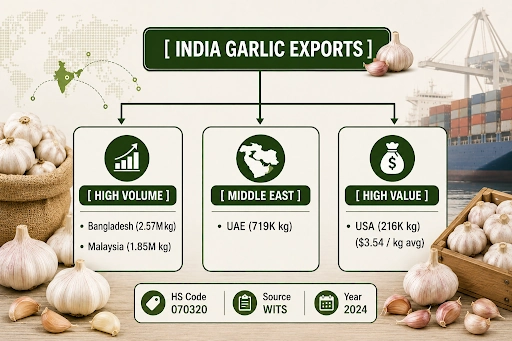
Here is how those numbers break down across the top importers of Indian garlic:
| Destination Market | Export Volume (Kg) | Total Export Value (USD) | What the Market Looks Like |
|---|---|---|---|
| Bangladesh | 2,570,000 kg | $1,950,000 | Massive volume, close border, steady demand |
| Malaysia | 1,850,000 kg | $1,620,000 | High demand for consistent, medium-to-large bulb sizes |
| UAE | 719,245 kg | $847,670 | Regional trading hub, strict quality & packaging rules |
| USA | 216,282 kg | $765,740 | Smaller volume, but much higher price per kilogram |
| Bhutan | 202,868 kg | $481,490 | Reliable neighboring market with simple logistics |
If you look at Bangladesh and Malaysia combined, those two markets alone bought roughly 73% of the total export volume among these top destinations. But look closely at the USA numbers—the volume is way smaller, yet the value per kilogram is drastically higher. That tells you straight away that different markets require totally different strategies.
Step-by-Step Guide On How To Export Garlic From India
Ready to build an export operation? You can't skip corners here. Here is the exact ground-level playbook you need to follow on how to export garlic from India.
Step 1: Set Up Your Legal Business Setup
First things first. You can't trade internationally as an informal setup. You need to get your business paperwork fully sorted with the Indian government.
- PAN Card: Register your business entity (Proprietorship, LLP, or Pvt Ltd) and get a dedicated company PAN.
- Current Bank Account: Open a current account with an authorized dealer (AD) bank that handles foreign exchange.
- Importer Exporter Code (IEC): Issued by the Directorate General of Foreign Trade (DGFT). You literally cannot export a single bulb without an IEC. The process is completely online now and takes just a day or two.
Step 2: Register with APEDA
If we were to say which government organization is at the heart of agriculture exports from India, then it's without any doubt APEDA. In international exports the commodities are exported strictly according to the HS codes and fresh garlic falls under the HS code 070320 Getting your Registration-cum-Membership Certificate (RCMC) from APEDA gives you legal backing to export garlic from India . Plus, it gives you access to government export incentives, tradeshows, and official quality monitoring systems like HortiNet.
Step 3: Know Your Target Market Rules
Don't buy garlic from a farm until you know exactly what your buyer's country demands.
Sending a container to the UAE is totally different from sending one to the US. You need to verify:
- Permitted chemical/pesticide residue limits (MRLs).
- Allowed bulb sizes (e.g., 40mm+, 50mm+ diameter).
- Specific moisture limits (wet garlic rots quickly in transit).
- Mandatory labeling and language requirements for outer cartons.
Step 4: Sourcing from Farmers and Mandis
Garlic quality starts at the farm gate. You can source directly from farmers, local aggregators, or major agricultural mandis in states like Madhya Pradesh (Neemuch and Mandsaur markets are huge for garlic) or Rajasthan.
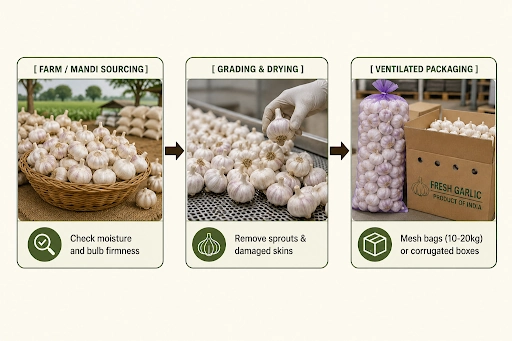
When buying bulk lots, watch out for high moisture levels. If the garlic isn't cured properly, it will sprout or mold inside a humid shipping container.
Step 5: Sorting, Grading, and Packaging
Buyers abroad demand attention to detail and perfection. Here, the mix-and-match mechanism doesn't work. Let us say, for instance, if the buyer has ordered a particular mm length of grains with the particular specifications, it has to be exactly of that specification.
- Sorting: Strip out anything damaged, discolored, sprouted, or soft.
- Grading: Group bulbs by diameter size based on your buyer contract.
- Packaging: Garlic needs air. Period. Most Asian and Middle Eastern buyers prefer mesh bags (10kg, 20kg, or 25kg). High-value markets like the US often prefer corrugated carton boxes with air vents.
Step 6: Lab Testing and Quality Checks
For fresh vegetable exports, buyers—and foreign customs—will often demand a Certificate of Analysis. Through APEDA's system, you may need to register your lot and have an APEDA-accredited lab take samples to test for pesticide residues and heavy metals.
Step 7: Get Your Phytosanitary Certificate (PSC)
This is probably the single most critical piece of paper for fresh garlic. A Phytosanitary Certificate proves that your consignment is clean, pest-free, and meets the plant-health laws of the importing nation.
Officers from the Plant Quarantine department will inspect your consignment before loading. If they find live insects or soil mixed in with the bulbs, your shipment stays on the dock.
Step 8: Customs Clearance & Freight Booking
Work with a reliable Custom House Agent (CHA) and freight forwarder. Your CHA will file the Shipping Bill with Indian Customs.
Depending on the destination, you'll choose between air freight (fast, expensive, used for small high-value loads) or ocean freight (reefer containers set at specific temperatures and humidity levels to prevent spoilage over long voyages).
Step 9: Loading and Final Post-Export Formalities
Once customs clears the cargo and the container is sealed, the shipping line issues your Bill of Lading (or Airway Bill for air shipments).
You then collect all your shipping documents, send copies to your foreign buyer for port clearance on their end, and present the originals to your bank to close out the transaction and claim your e-BRC (Electronic Bank Realisation Certificate).

Quick Checklist: Documents Needed to Export Garlic From India
Keep this checklist handy—missing even one document can cause massive delays at the destination port:
- Commercial Invoice: Detailing quantity, price per kg, inconveniences, and buyer info.
- Packing List: Net weight, gross weight, bag count, and box numbers.
- Bill of Lading (B/L) / Airway Bill: Proof of shipment from the carrier.
- Phytosanitary Certificate (PSC): Issued by Plant Quarantine authorities.
- Certificate of Origin: Proves the garlic was grown in India (issued by Chamber of Commerce or EIA).
- Spices Board of India registration: Main body that manages the export of spices from India.
- APEDA Test Reports: Lab clearance certificates (where required by the importing country).
- Shipping Bill: Generated during customs clearance at the Indian port.
Common Pitfalls First-Time Exporters Make
Moving fresh garlic sounds straightforward, but small mistakes bleed money fast.
The biggest killer? Improper curing . If garlic isn't naturally sun-dried to lock in the outer skin and dry out the neck, humidity inside a closed container will turn the whole shipment into a rotten, moldy mess in less than two weeks.
Second is ignoring size uniformity . Foreign wholesale buyers will dock your payout immediately if a bag promised as "Grade A Big Bulbs" contains mixed sizes.
At the end of the day, garlic export is all about tight quality control at the source and speed in documentation. Get your paperwork clean, partner with reliable suppliers in the mandis, and build transparent relationships with buyers abroad—and you've got a solid, repeatable trade business on your hands.




.webp "Top 10 Health Benefits of Cinnamon ( Daal Chini )")