Key Highlights
- FDA Prior Notice is mandatory for food shipments entering the United States.
- Filing errors can result in costly shipment detentions and delays.
- FDA registration details must remain active and up to date.
- Prior Notice timelines vary by transportation mode.
- Documentation mismatches are a common cause of port holds.
- Proactive compliance helps prevent demurrage and detention costs.
Introduction:
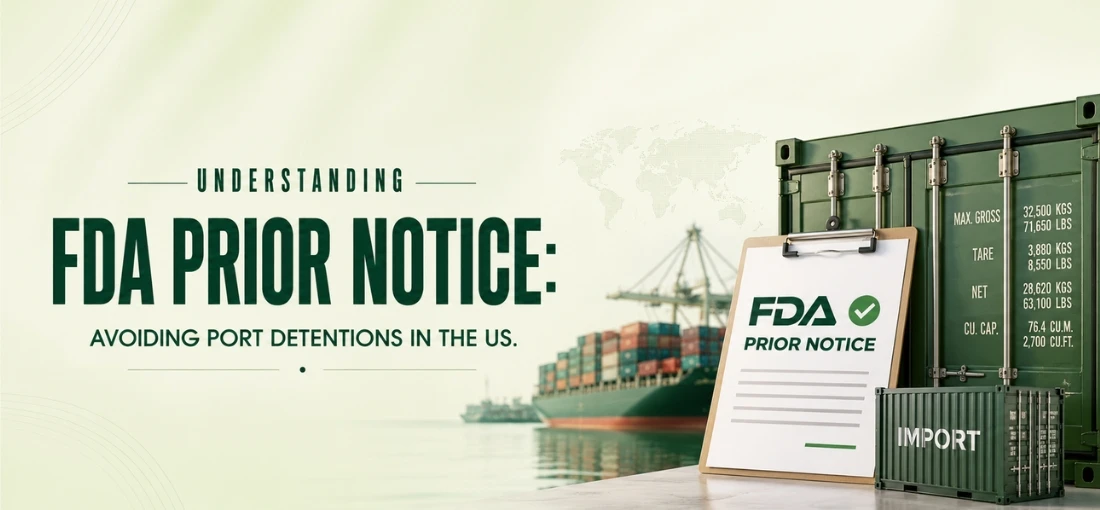
The process of shipping food products into the United States rarely forgives administrative oversight. For supply chain managers, customs brokers, and international suppliers, the arrival of a commercial food container at a US port of entry is the culmination of intense logistical coordination. Yet, many shipments fail to clear the final gate. The bottleneck is rarely a physical issue with the cargo container itself. Instead, it is an electronic document filing failure.
Under current US food import regulations, federal oversight begins long before a vessel hits coastal waters. The primary mechanism used by the US Food and Drug Administration (FDA) to police incoming consumables is the FDA Prior Notice protocol. This mandatory digital submission acts as an automated triage tool. It provides the agency with the operational data required to assess bioterrorism risks, chemical contamination hazards, or basic registration discrepancies before a shipment touches US soil.

Failing to execute this filing correctly creates immediate structural problems. If your data fails to clear automated screening filters, or if the clock runs out before the manifest is filed, the cargo stops moving. Understanding the exact operational mechanics of this requirement is the single most effective strategy for how to avoid FDA shipment detention.
So, if you want to export rice, export sugar, export spices or any other commodity to the USA, then you are bound to comply with the norms of FDA and follow the due process.
The Legal Framework: Why Prior Notice Controls the Gate
The baseline statutory authority for the advance notification program is grounded in the Public Health Security and Bioterrorism Preparedness and Response Act of 2002. This legislation added Section 801(m) to the Federal Food, Drug, and Cosmetic (FD&C) Act, giving the FDA full authority to demand strict advance reporting on all imported food, beverages, and animal feeds.
The operational rules, compiled under 21 CFR Part 1, Subpart I, lay down an absolute "appearance standard". Under this standard, the FDA does not need hard laboratory proof of contamination or misbranding to stop your cargo at the border. The mere appearance of a violation—including an error on a digital filing or an unverified factory code—gives port officials the immediate legal right to halt the shipment.
The system doesn't rely on manual paper checks. When your customs broker submits an entry profile, the details route electronically through the Automated Commercial Environment (ACE) and the International Trade Data System (ITDS). If the screening algorithm flags a missing verification number or an unrenewed manufacturing plant, the entry locks up immediately.
Timing Parameters: The Unforgiving Transits Clocks
A central reason for cargo getting stuck at the port is a simple failure to manage the clock. The FDA does not accept retroactive notifications once a container reaches a dock or crosses a land border. The agency enforces strict, mode-specific minimum advance filing windows. These timelines must be treated as absolute floors, not general operational targets.
Statutory FDA Prior Notice Timelines and Submission Windows
| Mode of Border Transport | Minimum Mandatory Advance Notice Before Arrival | Maximum Allowable System Entry Window (ACE/ITDS) | Maximum Allowable System Entry Window (FDA PNSI Portal) |
|---|---|---|---|
| Land (Road/Truck) | No less than 2 hours before arriving at the port. | Up to 30 calendar days before the anticipated arrival date. | Up to 15 calendar days before the anticipated arrival date. |
| Land (Rail/Train) | No less than 4 hours before arriving at the port. | Up to 30 calendar days before the anticipated arrival date. | Up to 15 calendar days before the anticipated arrival date. |
| Air Freight | No less than 4 hours before arriving at the port. | Up to 30 calendar days before the anticipated arrival date. | Up to 15 calendar days before the anticipated arrival date. |
| Water (Ocean Carrier) | No less than 8 hours before arriving at the port. | Up to 30 calendar days before the anticipated arrival date. | Up to 15 calendar days before the anticipated arrival date. |
| International Mail | Must be cleared before the package is sent (Tracking details required). | Not typically processed via commercial broker lines. | Requires immediate name of mail service and tracking number entry upon generation. |
If an ocean container drops anchor in the Port of Los Angeles, and the digital confirmation code reveals the broker hit "submit" only seven hours prior to arrival, that vessel has violated federal law. The automated system flags it as an invalid submission, leading directly to a port hold.

The Anatomy of an Entry: Crucial Data Points That Cause Detentions
To successfully navigate FDA food import requirements, your compliance team must ensure absolute character-for-character synchronization across every single line item of your manifest data. Minor data-entry shortcuts will compromise the entire filing.
Every valid submission requires clear, unconflicted disclosures across these core informational fields:
- The Food Facility Registration (FFR) Number: Every foreign manufacturing plant, processing floor, packer, or storage facility holding food meant for US consumption must maintain an active registration under 21 CFR Part 1, Subpart H. These registration codes must renew every even-numbered year between October 1 and December 15. If a supplier lets their registration lapse, any advance notification built on that expired number fails automatically.
- The Product FDA Product Code: Generic marketplace names like "dried turmeric powder" or "parboiled non-basmati rice" will not clear customs gates. The system demands a precise, multi-character alphanumeric product code that identifies the industry, the specific product class, the container type, and the process type. Inputting a mismatched code flags the shipment for immediate manual review.
- Complete Sub-Entity Identification: The entry portal requires explicit details for every business involved in the supply chain. This includes the submitter, the transmitter, the ultimate US importer, the foreign manufacturer, the packer, and the final consignee. A minor difference in corporate abbreviations or street addresses between the shipping bill of lading and the FDA portal will freeze the container.
Managing the Real Bottleneck: Refusals vs. Detentions
A common point of confusion for international traders is the difference between an administrative hold and an outright cargo refusal. A port detention is not a permanent denial of entry. It is a temporary hold period where the FDA gives the importer of record an opportunity to demonstrate compliance before final action is taken.
When an entry triggers an electronic risk flag, the local division office issues an official "Notice of Detention and Hearing" to the import broker. This document lists the exact reasons for the hold and specifies a strict deadline—typically 10 to 20 calendar days—to provide counter-evidence or file a formal application for reconditioning.
If the detention stems from an unverified manufacturer registry, providing direct certification files can clear the hold. However, if the issue involves systemic contamination or an active Import Alert, you enter the territory of Detention Without Physical Examination (DWPE).
Under DWPE rules, the burden of proof flips entirely onto the importer. The agency assumes the product is violative based on the manufacturer's past track record. To break this hold, your team must hire a qualified third-party laboratory to pull physical samples from the detained lot and present clean chemical or microbiological test certificates directly to the review branch.
A Defensive Compliance Protocol for 2026 Import Desks
Relying on reactive fixes once a shipment is held at a US port is an expensive approach to supply chain management. Every day a container sits in a storage yard, it accrues compounding demurrage fees that quickly bleed transaction liquidity.
To insulate your trade desk from these preventable operational leaks, your compliance office must implement a proactive, pre-shipment screening loop:
First, audit your suppliers' registration credentials before authorizing cargo handovers. Do not rely on printed letters of guarantee or third-party certificates of compliance. Have your document control desk manually cross-check the foreign facility's FFR number directly against the active FDA Unified Registration and Listing System (FURLS) portal. Ensure their designated US Agent for FDA communication is active and responsive, as any communication breakdowns during a port hold will cause your response window to expire.
Second, align your Foreign Supplier Verification Program (FSVP) with your advance notifications. Under FSVP rules, the US importer is legally accountable for confirming that foreign suppliers utilize equivalent food safety controls. The FDA's screening algorithms frequently cross-verify product-supplier pairings against active FSVP compliance histories. If an importer files a notification for a high-risk commodity without a documented supplier evaluation on file, the entry is immediately flagged for inspection.
Third, synchronize your document trail to clear character-matching filters. Your custom broker's data inputs must match the commercial invoice, phytosanitary certificates, packing lists, and sea bills of lading exactly. Eliminating clerical mismatches allows your shipments to slide through digital screening lanes seamlessly, keeping your logistics moving without manual intervention or expensive delays.
Summary
The era of navigating international agricultural trade via vague handshakes and loose document management has come to a close. As global biosecurity frameworks become more automated, the profitability of an import enterprise depends entirely on absolute compliance discipline. By treating FDA Prior Notice deadlines as strict operational baselines, checking your supplier registries before dispatch, and maintaining a well-synchronized, error-free document trail, you insulate your business from port disruptions and protect your cargo from costly detentions.
Disclaimer
The information provided is for educational and informational purposes only. FDA regulations, Prior Notice requirements, registration obligations, and import compliance procedures may change over time. Importers, exporters, customs brokers, and logistics providers should verify all requirements directly with the FDA and relevant US authorities before shipping food products to the United States.