Key Highlights
- Back-to-back export orders can strain sourcing networks, processing facilities, and logistics operations.
- Successful exporters separate domestic procurement planning from vessel schedules.
- Multi-region sourcing helps reduce dependency on a single mandi or processing cluster.
- Warehouse buffers near ports improve shipment consistency and reduce operational stress.
- Quality checks should be conducted at the mill level rather than at the port.
- Maintaining strong local supplier relationships is critical for long-term export growth.
Introduction:
Securing back-to-back export contracts is the ultimate goal for any trading house, but it is also the exact moment your operational vulnerabilities get laid bare. When international buyers line up deep volume requests one after the other, the pressure doesn't just hit your port logistics—it ripples all the way back to your regional aggregation networks, processing mills, and mandi brokers. If you push the system too hard without structural balancing, your local supply chain will buckle, leading to missed vessel cut-offs, quality drops, and broken relationships with local vendors.

Successful Bulk Order Management isn't about running around putting out fires every time a new letter of credit drops. It comes down to setting up a predictable buffer system, automating your quality gates at the source, and ensuring your domestic sourcing rhythm stays completely insulated from the frantic pace of international shipping deadlines.
The Core Conflict: Sourcing Pace vs Shipping Deadlines
Where do most exporters trip up when trying to handle massive contracts? It almost always comes down to a fundamental clash of speeds. Out on the shipping lanes, global buyers operate on relentless, non-negotiable maritime timelines. They expect thousands of bags sorted, packed, and shoved through the port gates inside tight windows.
But back at the domestic sourcing hubs, things move on a completely different clock. The local mandi runs on its own traditional timeline—tied down by when a crop actually leaves the fields, day-to-day labor availability, and seasonal arrivals.
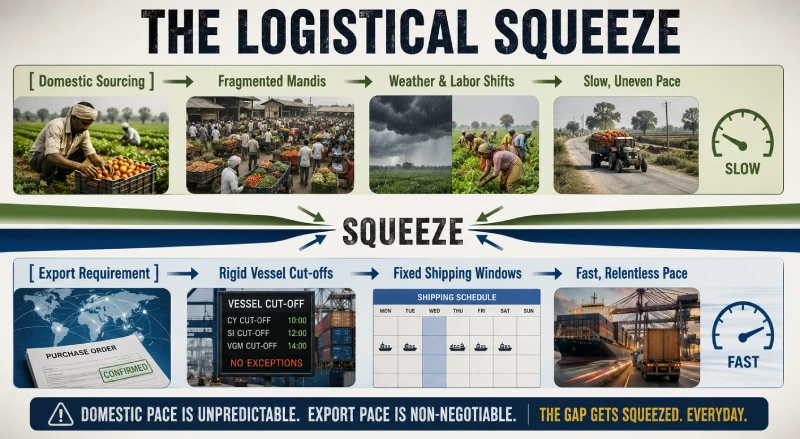
If you attempt to bridge this gap by aggressively buying up everything in sight the moment an order arrives, you will artificially spike the local spot price against yourself. Worse, you risk blending sub-par harvests just to fill the trucks, which guarantees rejections down the line at the port quarantine gates. Stabilizing this requires integrated Supply Chain Management for Exporters, where your procurement infrastructure operates independently of individual vessel deadlines.
Strategic Buffer Mapping and Multi-Tier Aggregation
To survive back-to-back demands without choking your local networks, you have to move away from just-in-time purchasing. Successful trading houses split their sourcing into distinct, multi-layered geographic zones to avoid over-exhausting a single market yard.
When your desk needs to export rice in bulk, for example, relying entirely on one primary mill cluster in Haryana or Punjab leaves you highly vulnerable to local transportation strikes or localized power deficits. Smart operators map out secondary and tertiary procurement points across completely different states—like targeting clusters in Uttar Pradesh or Madhya Pradesh—to run parallel supply lines.
This same multi-tier structure protects your liquidity and logistics when handling highly volatile commodities. If you scale up to export sugar in bulk, your processing timelines are tightly bound to seasonal cane crushing windows. By spreading your refinery contracts across both the northern tropical belts and southern milling zones, you can stagger your intake blocks, preventing your transport trucks from getting stuck in massive, non-moving queues outside a single over-burdened processing facility.

Operationalizing Your Bulk Procurement Planning
Managing continuous orders demands a structured, week-by-week blueprint that maps your warehouse capacities directly against your shipping manifests. The table below outlines how an integrated tracking system balances incoming field cargo against outbound port freight.
Continuous Sourcing and Warehouse Buffer Framework
| Sourcing Operation Phase | Core Logistics Focus | Risk Mitigation Action | Primary Supply Chain Target |
|---|---|---|---|
| Mandi Accumulation | Tracking daily inflows across multiple regional market yards. | Utilizing local commission agents to lock down spot prices before export announcements go public. | Stabilizing the baseline purchase price to protect trade margins. |
| Mill Processing & Sortex | Enforcing strict grading, de-stoning, and size separation. | Restricting intake lots to dedicated automated lines to eliminate variety mixing. | Guaranteeing absolute batch uniformity across consecutive shipments. |
| Warehouse Staging | Maintaining a continuous, pre-cleared product buffer near the port. | Running real-time digital moisture tests on every incoming truck lot before unloading. | Preventing internal heating, sweating, and premature mold growth. |
| Port Gate-In & Loading | Coordinating customs documentation, fumigation, and container stuffing. | Securing pre-shipment laboratory clearances well ahead of vessel arrival. | Eliminating demurrage penalties and avoiding missed vessel connections. |
Insulating Quality Gates During High-Velocity Sourcing
When you are scrambling to hit consecutive container cut-offs, quality control is usually the first thing that gets sloppy. Look at what happens when teams try to export dried fruits in bulk during a heavy demand spike; workers feel the pressure, skip basic grading steps, and rush the sorting lines.
But high-value cargo like raisins or walnuts is incredibly sensitive to transit conditions. Let just one damp, unverified batch slip past your dock team, and that trapped moisture will turn your closed container into an oven. By the time the ship crosses the tropics, mold will bloom across the entire lot, destroying your margins.
You run into the exact same quality trap when you export spices in bulk. Foreign buyers scan these high-ticket shipments with ultra-sensitive lab tools, hunting down even trace anomalies in volatile oil strength or chemical residues. If you treat these critical compliance checks as just another annoying, bureaucratic hurdle to solve at the port gates, you are playing Russian roulette with your capital.
True Agro Commodity Supply Chain safety requires placing your quality filters right at the processing floor. Run your gas chromatography tests and moisture probes before the cargo is bagged and loaded onto inland trucks. Finding an issue with aflatoxins or high moisture while the grain is still at the regional mill costs pennies to fix via re-drying or batch sorting; discovering that same failure while your cargo is sitting inside a sealed box at a port terminal can completely break your business.
Balanced Capacity Allocation: Protecting Vendor Relations
A frequently overlooked risk of handling massive export booms is alienating your core local suppliers. If you drop your regular local millers or squeeze your transport networks on payment terms just to chase a short-term international price spike, you will find yourself completely stranded when the global market cools down.
To make your Bulk Procurement Planning actually sustainable, you have to balance your allocation. Keep a steady, predictable slice of your processing volume reserved for your domestic buyers, even when global prices look tempting. By keeping your local mills happy year-round, you ensure they prioritize your trucks, give you their cleanest labor, and stand by you when peak-season transport or container shortages make operations difficult for everyone else.
The Tactical Verdict
At the end of the day, keeping up with back-to-back export deals without breaking your business isn't about working longer hours. It comes down to decoupling your local purchasing from the chaotic schedules of the shipping lines.
The trading houses that consistently grow their volumes are the ones that systematically build deep warehouse buffers near the ports and set up rigid, automated quality gates right on the mill floor. This takes the frantic guesswork out of the entire logistics chain. It turns your operation away from a high-stress scramble and converts it into a quiet, predictable, and highly profitable pipeline built to service any destination on the globe.
Disclaimer
The information provided is for educational and informational purposes only. Procurement strategies, warehouse planning, logistics costs, supplier availability, commodity quality requirements, and export timelines may vary depending on crop cycles, market conditions, infrastructure, and destination requirements. Exporters should evaluate their operational capabilities and supply chain risks before implementing procurement and sourcing strategies.





-export-from-india-complete-b2b-guide--primary-kw--psyllium-husk-export-india.webp "Psyllium Husk (Isabgol) Export from India: Complete B2B Guide")