Key Highlights
- India's spice exports touched nearly ₹40,000 crore in FY 2024-25.
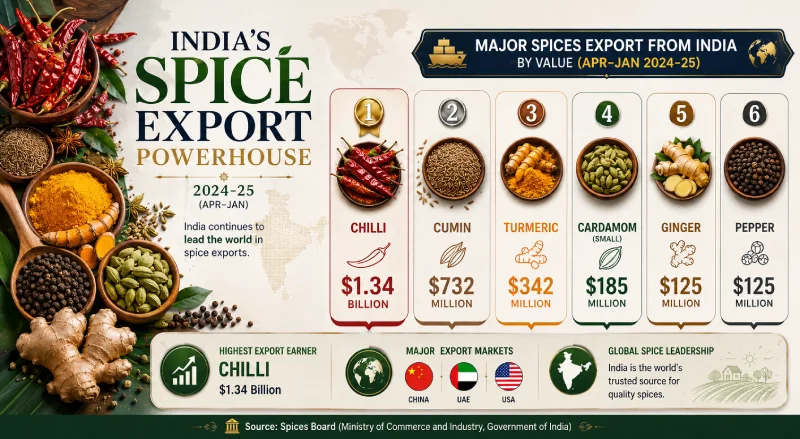
- Red chilli remains India's largest spice export by volume and value.
- Cumin continues to command strong export realizations in global markets.
- Turmeric demand is being supported by the wellness and nutraceutical sectors.
- Spice oils and oleoresins generate some of the highest export values per ton.
- China, the UAE, Bangladesh, and the US remain key destinations for Indian spices.
Introduction:
Walk through the open, chaotic auction yards of Unjha or spend a morning tracking spot prices in the narrow lanes of Khari Baoli, and the reality of the global flavor supply chain hits you instantly. India doesn't just participate in this trade; it anchors it. Today's shipping game has turned intensely technical. Shifting container volumes, volatile crop yields, and the hyper-strict pesticide caps enforced at international borders mean that spice exports from India are no longer about basic exports. It is about quality and consistency.
Look at the mainstream business press, and the coverage almost always stays stuck on generalities. The real operational intelligence, though, hides inside the multi-year closing data sets published by the Spices Board of India. By analyzing how these trade curves bend over consecutive fiscal cycles, an export house can accurately separate short-term market noise from genuine, long-term demand pull.
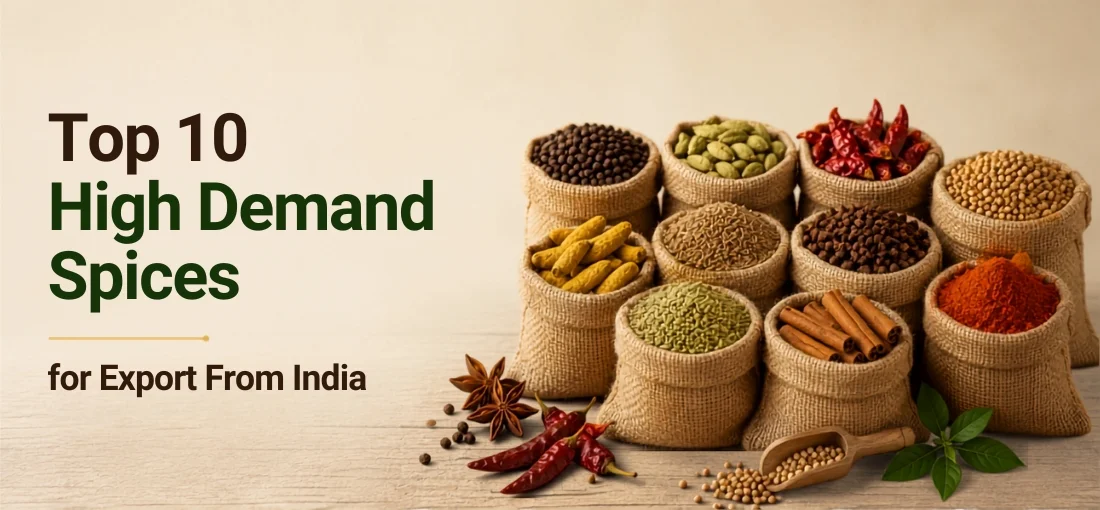
Keep reading this informative piece of blog. It will tell you everything you need to know about top 10 high demand Indian spices.
The Macro Trends Driving Subcontinental Trade
To understand the scale of spices export from India, you have to look at the massive surge in financial valuations over recent fiscal cycles. According to the Spices Board of India’s consolidated trade ledgers, the grand total value of outbound spice shipments scaled from an already massive 30,973 crores back in the 2020-21 cycle to a historic, towering peak of nearly 40,000 crores by the close of the 2024-25 financial year.

This steady upswing shows that global consumption isn't just a passing trend. International buyers are consistently paying higher values for clean, standardized Indian lots. For active Indian spices exporters, this broad valuation lift proves an important operational point: spending capital on multi-stage mechanical cleaning, precise color sorting, and advanced sterilization loops is no longer an optional business expense. It has become a mandatory investment if you want to protect your margins at destination ports.
Deep-Dive Profiles: High-Demand Spice Corridors
Treating every spice line identically is a massive trap for a procurement team. Each crop answers to its own distinct localized variables—weather patterns in the growing belts, shifting destination port rules, and unexpected volume surges. Here is how the high-demand export lanes actually stack up.
1. The Red Chilli Corridor (The Volume Engine)
For sheer tonnage, nothing touches red chillies. This single commodity acts as the heavy engine for subcontinental trade, pushing out an enormous 7,15,506 tons during the 2024-25 cycle alone. Financial returns for this lane reached a massive 11,404 crores.
Feeding its massive industrial extraction and food processing sectors, China remains the dominant buyer here, taking in 2,36,831 tons. Bangladesh follows as a heavy volume partner at 1,16,711 tons, while the United States maintains a premium presence, buying 39,466 tons. When handling chilli lots, your processing floor must be completely disciplined regarding aflatoxin control and moisture stabilization. If you let your moisture levels creep past the standard 11% threshold during the damp monsoon transit legs, you are risking an immediate port rejection at destination custom gates.
2. Cumin (The High-Value Frontier)
If chilli represents bulk weight, cumin represents raw value volatility. The numbers here show an incredible consolidation of value density over recent financial years. Back in the 2020-21 cycle, India shipped out 2,98,422 tons of cumin, which brought home 4,251 crores. Flash forward to the 2024-25 closing registers, and even though physical volumes contracted down to 2,29,881 tons, the total financial value exploded to 6,178 crores.
Wholesale buyers across major regional transit hubs like the UAE (30,693 tons) and Bangladesh (30,515 tons) are explicitly signaling that they will pay a premium for high-essential-oil, super-cleaned seed lots. For a trade desk, this means tracking pesticide residues down to parts per billion is absolutely critical. A single lot flagged for chemical traces at a European or North American port can easily erase months of trading profits.
3. Turmeric (The Wellness Asset)
Supported by the global expansion of functional foods and wellness extractions, turmeric has evolved into a highly secure, long-term export asset. Total outbound shipments climbed to 1,76,325 tons in the 2024-25 cycle, drawing a major financial valuation of 2,885 crores.
The buyer profile for turmeric is highly diversified, spreading the risk for export desks. While Bangladesh leads volume consumption at 34,073 tons, premium pharmaceutical and supplement processors in the United States (8,536 tons) and Germany (4,232 tons) actively source high-curcumin varieties. When exporting to these high-end western processing hubs, standard visual inspections are no longer enough; your lot files must present clean laboratory verification certificates confirming the exact curcumin percentages and the absolute absence of heavy metal adulteration.
4. Ginger (The Industrial Comeback)
The ginger trade has seen a massive structural recovery, showcasing how rapidly international buying patterns can realign. In the 2022-23 cycle, Indian ginger exports dropped to a minor 50,884 tons. However, by the close of 2024-25, volumes roared back to a powerful 1,31,359 tons, pulling in a value of 1,062 crores. Bangladesh heavily anchors this corridor by taking 1,03,986 tons, while the UAE takes 7,533 tons. Because ginger is highly prone to internal mold development during long maritime transits, your shipping desks must use specialized ventilation container settings and continuous strings of high-absorption desiccants to avoid container sweat issues.
5. Coriander (The Regional Wholesale Staple)
Coriander functions as a highly reliable, consistent volume stabilizer for regional trading houses. Total export volumes reached 60,323 tons in 2024-25, generating a stable valuation of 633 crores. Malaysia remains the traditional cornerstone for this commodity, consuming 13,620 tons, while the UAE has steadily scaled its purchasing to 10,117 tons. For coriander processors, the primary operational challenge is preserving the structural integrity of the delicate split seeds and avoiding volatile oil loss during the industrial mechanical de-stemming and grading sequences.

Shifting Focus: The Premium Value-Added Segments
To insulate your trading desk from the sharp price swings of raw agricultural commodities, you need to transition your product mix toward value-added processing segments. This is exactly where the smart money is moving in modern subcontinental trade.
6. Spice Oils and Oleoresins (The Advanced Extraction Market)
The shift toward liquid spice extractions represents the absolute highest-margin sector in modern trade. According to the Spices Board data, while the total volume for spice oils and oleoresins hovered at a modest 20,940 tons in 2024-25, the total financial value reached a massive 4,533 crores.
The United States completely dominates this specialized market, consuming 5,634 tons of extractions valued at 1,565 crores. South Korea also shows strong demand, taking 1,218 tons. Because these extractions are used directly by global flavor houses and perfume manufacturers, your processing floor must operate under strict international hygiene rules like BRCGS or FSSC 22000, backed by complete lot-traceability data from the farm gate to the extraction tank.
7. Curry Powder and Spice Pastes (The Retail-Ready Avenue)
Driven by the global expansion of convenient, ethnic cooking styles, retail-ready curry powders and spice blends are seeing highly reliable, steady growth. Total shipments climbed to 77,151 tons in 2024-25, yielding a value of 2,094 crores. The United States leads this retail-ready segment at 10,679 tons, followed closely by traditional consumer networks in the UAE (8,472 tons) and the UK (7,889 tons). Success in this segment requires complete command over complex destination packaging regulations, multi-lingual labeling rules, and exact allergen disclosures.
The Fine-Grain Seed Spice and Botanical Lanes
To round out a diversified export portfolio, active desks should leverage the steady, smaller-tonnage seed spice corridors that supply international bakery, meat processing, and traditional medicine sectors.
8. Black Pepper (The Rebounding Benchmark)
Historically known as "black gold," pepper continues to hold a critical spot on international manifests. Total export volumes moved up to 20,830 tons in 2024-25, pulling in a value of 1,055 crores. The United States remains the primary target for premium black pepper, taking 8,049 tons, while the UAE takes 966 tons. Pepper lots require intensive mechanical cleaning to eliminate light berries and pinheads, ensuring the final container matches the strict bulk density requirements specified in your proforma invoices.
9. Fennel Seed (The High-Velocity Surge)
Fennel seed has experienced one of the most explosive volume expansions in recent spice history. Total outbound shipments surged to a massive 76,586 tons in 2024-25, generating a value of 765 crores. This represents a giant leap from the 21,200 tons recorded just two seasons prior. China has driven this massive demand spike by consuming 45,075 tons, while Bangladesh takes 6,864 tons. Processing desks must focus on maintaining the natural green color of the seeds during the post-harvest drying phase to command top-tier market prices.
10. Fenugreek (The Consistent Crop)
Completing the top ten list is fenugreek, which continues to provide a highly predictable, consistent volume base for seed spice exporters. Total shipments reached 44,515 tons in 2024-25, valued at 365 crores. The UAE anchors the purchasing line by taking 4,330 tons, while Yemen consumes 3,881 tons. Fenugreek’s hard seed structure makes it highly resilient during long ocean transit, making it an excellent baseline commodity for balancing container logistics budgets.
Spices Board of India Reference Table: 2024-25 Closing Export Metrics
To keep your trade projections accurate, your risk-management desk can map the final Top 10 Indian Spices to Export From India or optimize plans to export spices from India using the Spices Board of India's closing dataset:
| Spice Commodity Classification | Closing Export Volume (Metric Tons) | Total Export Valuation (INR Crores) | Primary Global Destination Port | Core Quality Operational Parameter |
|---|---|---|---|---|
| 1. Red Chillies | 7,15,506 | 11,404.90 | China (2,36,831 MT) | Strict moisture caps (<11%) and rigorous aflatoxin screening. |
| 2. Cumin Seeds | 2,29,881 | 6,178.86 | UAE (30,693 MT) | Parts-per-billion pesticide residue monitoring and oil density checks. |
| 3. Spice Oils & Oleoresins | 20,940 | 4,533.24 | U.S.A (5,634 MT) | ISO 17025 clean-room extractions and advanced heavy metal profiling. |
| 4. Turmeric | 1,76,325 | 2,885.39 | Bangladesh (34,073 MT) | Verified curcumin percentage assays and zero lead-chromate tolerance. |
| 5. Curry Powder & Pastes | 77,151 | 2,094.99 | U.S.A (10,679 MT) | Retail packaging labeling compliance and exact allergen disclosures. |
| 6. Fennel Seeds | 76,586 | 765.44 | China (45,075 MT) | Post-harvest green color retention and strict dust elimination. |
| 7. Ginger | 1,31,359 | 1,062.40 | Bangladesh (1,03,986 MT) | Active ventilation container routing to prevent internal transit mold. |
| 8. Black Pepper | 20,830 | 1,055.00 | U.S.A (8,049 MT) | Mechanical sorting for uniform berry size and high bulk density levels. |
| 9. Fenugreek | 44,515 | 365.89 | UAE (4,330 MT) | Clean mechanical sorting to eliminate small farm-gate stones and debris. |
| 10. Coriander Seeds | 60,323 | 633.20 | Malaysia (13,620 MT) | Splitting ratio control and preservation of delicate volatile essential oils. |
Tactical Blueprint for Active Trading Desks
If you want to move past simple spot brokerage and build a resilient, modern spice export enterprise, you need to run a tight, technically disciplined ship long before your containers ever arrive at the port gate. To execute this correctly and understand the true potential of Top 10 high demand Indian Spices, you must align your warehouse lines directly with evolving global mandates.
First, professionalize your industrial clean-down sequences. When you are looking to expand toward premium western markets, relying on basic manual sorting on tarpaulin sheets is an absolute dead end. Your processing facilities should adopt automated gravity separators, high-definition de-stoners, and multi-channel color sorters to eliminate field-level contaminants completely. Upgrade your management layers to GFSI-recognized quality systems like BRCGS. When major global food brands or international distribution houses look for new Indian spices exporters, they prioritize facilities that can instantly share a digitized, clear lot-traceability record from the regional farm hub to the final shipping pallet.
Second, protect your capital from sudden freight shocks and terminal holdups. Spice lines are highly sensitive agricultural lots; a sudden random customs delay for a microbiological screening or a document review can easily destroy your margins if you are running on a tight timeline. Never ship a container under standard three-day port gate allotments. Always instruct your freight forwarders to lock in a minimum 14-day factory-to-dock free-time clause directly into your ocean bills of lading. This gives your destination customs agents a comfortable cushion, ensuring that a routine botanical hold won't trigger immediate, budget-busting container detention fees.
Finally, eliminate documentation errors entirely. Ensure your documentation desk cross-checks every commercial invoice, packing list, and weight certificate against your phytosanitary certificates before the vessel departs. Automated customs computers flag typographical errors and minor weight variations instantly. Avoiding these simple clerical mismatches prevents your container from being diverted to a physical staging yard for a manual inspection, protecting your delivery timelines and safeguarding your operational capital from unnecessary port storage costs. Wrap your pallets thoroughly in heavy-duty shrink wrap and deploy uniform lines of clay desiccants to keep your cargo dry and secure throughout the long ocean transit.
Summary
The era of the old-school commodity broker who moves raw, uncleaned spice lots is drawing to a close. The future of the global seasoning trade belongs to technically literate trade desks that treat compliance, precise processing standards, and strict contamination controls as core competitive advantages. By professionalizing your processing loops, securing your logistics chains against environmental threats, and maintaining an error-free paper trail, you can successfully shield your business from market volatility and transform the growing international demand for subcontinental flavors into a highly predictable, sustainable international business asset.