Key Highlights
- India exported $1.5 billion worth of red chilli in FY24 , dominating global spice trade.
- Red chilli falls under HS Code 0904 in international trade classification.
- The USA market shows 24% volume and 42% value growth in imports.
- Export prices range $2,200-$5,500 per MT depending on quality and processing.
- Profit margins typically range 8-18% bulk and up to 25% for processed chilli.
- Success depends on quality compliance, certifications, and long-term buyer relationships.
Introduction
There are some commodities in global trade that quietly move in the background.
And then there are a few that carry serious weight and hotness in tasts.
Red chilli is one of them. Not just because of volume. Not just because of price.
But because it plays a direct role in the global food supply chain as a strong spice.
From spice blending companies and packaged food brands to large-scale food processors, red chilli is not just an ingredient — it's a B2B necessity.
Bulk quantities move across countries every day.
Containers are shipped not for retail… but for processing, blending, and redistribution.
The thing is, in the trade market, red chilli is less about consumption and more about continuous supply and industrial demand.
And that's exactly why it has become one of the most serious segments in the global spice business.
From household kitchens to large food processing units, chilli is not optional. It's essential.
And when you start looking at numbers, the scale becomes very clear.
Keep reading this informative piece of blog if you want to export red chilli from India. It will provide you vital information on the same.
India's Position in the Global Red Chilli Market
India is not just another exporter here.
It's one of the key players in the global spice trade.
In FY24 alone, Indian red chilli exports reached around $1.5 billion, touching approximately ₹12,492 crore.
That's not a small number.
Exports grew by about 15% in volume and 18% in value compared to the previous year.
To put things into perspective:
- Export volume reached 6.01 lakh tonnes
- Red chilli alone contributed about 34% of India's total spice exports
You'll notice something here.
This is not a niche market anymore. This is a serious, large-scale trade segment.
Demand for Indian Red Chilli: Not Just One Market
Now when people talk about chilli exports, they often assume it's limited to a few countries.
But that's not the case.
China
Still one of the biggest buyers.
In FY24, China imported over 1.79 lakh tonnes , with demand driven by both culinary use and oleoresin extraction.
Thailand
Demand is rising steadily.
Imports crossed ₹1,400 crore , with consistent growth in both volume and value.
Bangladesh
This one stood out.
Exports jumped by 67% in volume , which tells you how quickly demand can shift in nearby markets.
United States
Now this is where things get interesting.
Exports to the USA grew by:
- 24% in volume
- 42% in value
That kind of jump doesn't happen randomly.
It usually signals growing long-term demand.
Why the USA Market Matters So Much
If you're planning to export red chilli from India to the USA , you need to understand one thing.
The US market is not just large — it's structured.
Demand comes from:
- food processing companies
- spice blending businesses
- restaurant supply chains
- retail packaged spice brands
You'll notice the difference here.
This is not just raw consumption.
It's industrial and commercial demand , which means:
- higher consistency requirements
- stricter quality standards
- repeat bulk orders
That's why many exporters consider the USA one of the most important markets in the red chilli export business India.
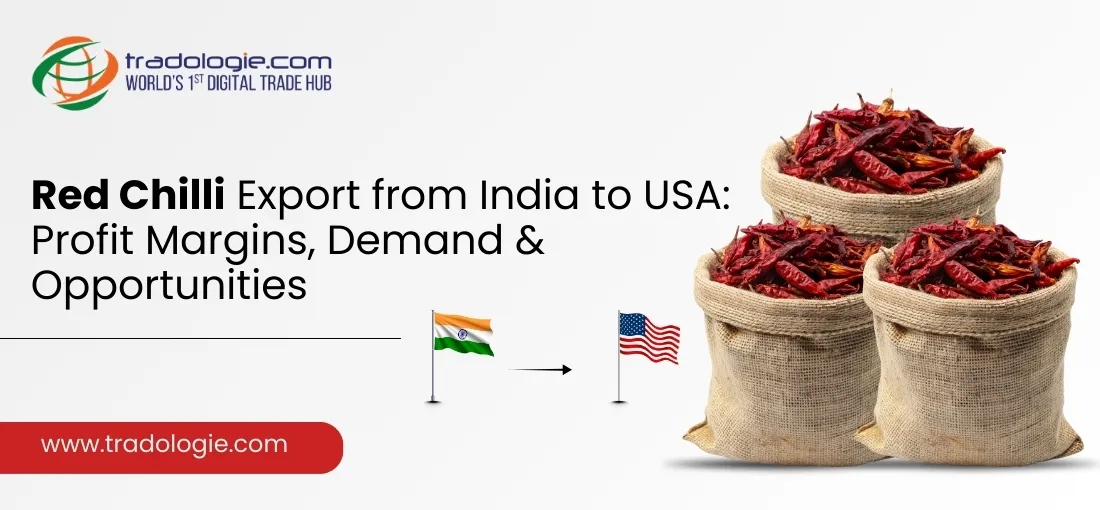
Profit Margins in Red Chilli Export (India to USA)
Now let's come to the question everyone is thinking about.
What about red chilli export profit India to USA?
Well, there's no single fixed number.
But here's how it generally works.
Margins depend on:
- variety (Guntur, Byadgi, etc.)
- quality and color value
- processing level (whole, powder, crushed)
- packaging
- buyer type (wholesaler vs processor)
In most cases, exporters work with moderate margins per shipment , but the real earnings come from:
- volume
- repeat orders
- long-term contracts
- In the current export market, Indian red chilli prices typically range between: $2,200 to $3,800 per metric ton (MT) for whole dried chillies
- $3,000 to $5,500 per MT for processed forms like powder (depending on quality & specs)
(Prices vary based on ASTA color value, moisture content, and global demand cycles.)
Average Profit Margins
In most cases, exporters operate within:
- 8% to 18% profit margins on bulk shipments
- 15% to 25% margins for value-added or processed chilli products
The thing is, a single shipment might not look very exciting in terms of margin.
But when shipments become regular — say monthly or even more frequent — that's where the business starts to scale.
You'll also notice that exporters who deal in processed or value-added chilli products (like powder or customized blends) often manage slightly better margins compared to raw whole chilli exports.
So in a way, the profit is not just in the product — it's in how you position it in the market.
Key Requirements to Export Red Chilli from India to the USA
Now let's talk about the practical side.
Because the US market is strict.
And that's where many exporters either succeed… or struggle.
Documentation
You'll need the usual export documents:
- IEC (Import Export Code)
- Commercial Invoice
- Packing List
- Bill of Lading
- Certificate of Origin
Pretty much the standard routine.
Well… you prepare the documents, submit them, and then it moves through the usual process like most export shipments.
Nothing unusual there.
Certifications (Important for USA)
Now this part matters.
For exporting to the USA, buyers usually expect:
- US FDA Registration
- FSSAI License (India)
- Spices Board Registration
- Phytosanitary Certificate
- Quality testing reports (pesticide residue, aflatoxin levels)
You'll notice something here.
In the US market, compliance is not optional.
Even a small issue in quality reports or residue levels can lead to shipment delays or rejection.
That's why many exporters spend extra effort on:
- lab testing
- proper documentation
- consistent quality checks
It may feel like extra work in the beginning.
But in the long run, it actually helps in building trust with buyers , which is what leads to repeat business.
How to Find Buyers in the USA
Now comes the real challenge.
Finding buyers.
Because demand exists. But access is the real game.
Middlemen & Agents
Still used, but margins get shared.
The thing is, many exporters initially depend on agents because they already have buyer connections.
You don't have to search much. The agent brings the deal.
But over time, a few things become noticeable.
- you don't always know the end buyer
- pricing discussions are controlled by the agent
- commissions reduce your overall margin
And in some cases, the relationship stays with the middleman, not with you.
So yes, it works — especially in the beginning.
But for long-term growth, many exporters eventually try to move towards direct buyer relationships.
Trade Shows
Trade shows are one of those things every exporter considers at some point.
On paper, it sounds simple.
You participate in an international food or spice exhibition, set up your stall, display your products, and meet buyers from different countries — including the USA.
And yes, that does happen.
You get conversations.
You exchange visiting cards.
Sometimes even discuss pricing on the spot.
But the thing is, it doesn't always translate into business immediately.
A lot of those conversations stay at the “we'll get back to you” stage.
And then there's the cost side.
- stall booking
- product samples
- travel and accommodation
- logistics
By the time everything adds up, it becomes a fairly expensive exercise.
Now, that doesn't mean trade shows don't work.
They do — especially if you're:
- building your brand
- entering a new market
- or trying to understand buyer expectations
But if you're expecting instant buyers or quick deals , that's where expectations need to be realistic.
In most cases, trade shows work better as a relationship-building channel , not a direct transaction channel.
Listing Platforms
You get inquiries… but not always serious ones.
Many exporters list their products on B2B platforms expecting consistent leads.
And yes, inquiries do come in.
But after a while, a pattern becomes clear.
- some buyers are just comparing prices
- some inquiries are incomplete
- follow-ups don't always convert into orders
You may spend time sharing quotations, specifications, and samples… and then the conversation just stops.
That's why listing platforms are useful for visibility , but not always reliable for closing deals.
They work best when combined with other, more direct channels.
Transaction-Oriented Platforms
Now this is where things shift.
These platforms focus on actual buying requirements , not just listings.
You'll notice:
- buyers come with clear quantities
- requirements are defined
- negotiations are direct
Instead of chasing leads, you're responding to real buying demand.
Which makes them one of the most effective ways to scale in the red chilli export business India.
Direct Importer Connections
Building relationships directly with US importers works well — but takes time.
You might reach out through email, LinkedIn, or industry contacts.
Sometimes you get a response. Sometimes you don't.
And even when conversations begin, it usually takes multiple follow-ups before anything moves forward.
But here's the thing.
Once a direct connection turns into a buyer, it tends to be more stable.
- better communication
- clearer pricing discussions
- long-term potential
The only challenge is the time and effort it takes to get there.
So while this method is effective, it usually works best for exporters who are willing to stay consistent and patient with outreach.
Opportunities in the Red Chilli Export Business
If you step back and look at the bigger picture, a few things become clear.
- Demand is growing globally
- The USA market is expanding steadily
- India already has a strong supply base
Which means the opportunity is not about entering a new market.
It's about positioning yourself correctly within an existing large market.
Now here's where it gets interesting.
A lot of exporters focus only on selling raw chilli.
But the market is slowly shifting towards:
- processed chilli products
- customized grinding and packaging
- private label supply
- consistent quality sourcing
You'll notice that buyers in the US often prefer suppliers who can offer standardization and reliability , not just low pricing.
That opens up opportunities for exporters who are willing to:
invest in processing
maintain quality consistency
build long-term buyer relationships
So in a way, the opportunity is not just in exporting more.
It's in exporting better and more consistently.
Final Thoughts
The thing about red chilli exports is this.
It's not a casual business.
It's a serious trade segment with:
- large volumes
- strict quality requirements
- and strong international demand
For exporters looking to export red chilli from India to the USA , the opportunity is very real.
But it works best for those who focus on:
- consistency
- compliance
- and building long-term buyer relationships
Because in this business, one good buyer is often worth more than ten random inquiries.
See complete HSN Code List or HSN Code Finder Tool
See Complete IEC code list
Disclaimer : The information provided in this article is for general informational purposes only . Export prices, profit margins, demand trends, and regulatory requirements may vary based on market conditions, quality specifications, and time. Readers are advised to verify all trade, pricing, and compliance details with official authorities and industry experts before making any export decisions.
Frequently Asked Questions (FAQs)
What is the HS code for red chilli export?
Red chilli is classified under HS Code 0904 for global trade and customs clearance.
What is the profit margin for exporting red chilli to the USA?
Profit margins typically range from 8% to 18% for bulk whole chillies, and up to 15% to 25% for processed products like chilli powder.
What is the current export price for Indian red chilli?
Prices generally range from $2,200 to $3,800 per MT for whole dried chillies and $3,000 to $5,500 per MT for processed forms.
What certifications are required for the USA market?
Key mandatory documents include US FDA Registration, an FSSAI License, Spices Board Registration, a Phytosanitary Certificate, and strict lab reports clearing pesticide and aflatoxin levels.
Why is the USA a top market for Indian red chilli?
The US is a highly structured market driven by massive commercial demand from food processors and spice blenders, recently showing a 42% growth in import value.
How can I find genuine red chilli buyers in the USA?
Exporters typically find buyers through agents, international trade shows, B2B listing platforms, transaction-oriented portals, and direct outreach to US importers.