
Key Highlights
- India exports more than 9,500 tamarind shipments annually.
- Over 1,000 Indian exporters participate in global tamarind trade.
- More than 2,400 international buyers source tamarind from India.
- USA, UAE, and Australia are among the leading import destinations.
- The global tamarind extract market is projected to reach USD 1.99 billion by 2034.
- Tamarind paste and spray-dried powder generate higher export value than raw blocks.
- Food processing, sauces, beverages, nutraceuticals, and industrial applications drive demand.
- Tartaric acid content, moisture levels, and purity standards are key buyer requirements.
Introduction:
Industrial buyers don't look at tamarind as just an ingredient for ethnic grocery shelves; they treat it as a high-acid, natural binding agent that holds its own in massive food manufacturing runs. When a b2b procurement food desk pulls a sample lot of Tamarindus indica—or raw Imli, depending on which regional mandi you are booking from—they are calculating the exact tartaric acid yield and pectin strength needed to stabilize bulk sauce formulations or industrial textile sizing arrays. The actual velocity of this trade lane is hitting a highly practical stride, with steady container runs leaving Indian hubs like Visakhapatnam and Chennai to feed international processing plants that require consistent, heat-stable gelling traits. For an enterprise anchoring its margins in the tamarind export from India pipeline, success relies on moving past basic crop trading to position the commodity as a highly predictable, standardized industrial asset.

The commodity has transitioned far beyond standard ethnocentric grocery shipping. Today, it operates as a predictable, year-round industrial input, anchoring automated production runs for international condiment facilities, ready-to-eat meal manufacturers, health-supplement plants, and industrial textile sizing networks across multiple continents. For an active trade desk, navigating this corridor successfully means moving past simple, unrefined commodity shipping to treat the tamarind export from India sector as a highly technical, value-added ingredient pipeline.
Global Sourcing Metrics and Trade Velocity
Outbound container tracking reveals an immense, highly active supply infrastructure, with international buying networks relying systematically on Indian refiners to keep their production pipelines moving. The sheer scale of this trade corridor becomes obvious when analyzing bilateral shipping frequencies.
Recent customs logs outline the structural footprint of the outbound trade flow:
Indian Tamarind Export Performance Metrics
| Performance Dimension | Absolute Volume Tracker | Strategic Supply Chain Implication |
|---|---|---|
| Annual Export Shipments | More than 9,500 cargoes | Establishes massive, continuous container flow through deep-water hubs. |
| Active Supply Network | Over 1,000 certified exporters | Provides international buyers with a highly competitive, diversified procurement floor. |
| Global Purchasing Base | Serving more than 2,400 buyers | Confirms widespread institutional integration across multi-country retail chains. |
| Primary Customs Gateways | HS Code 08109020 & HS Code 0810 | The specific legal classifications required to clear global botanical entry ports. |
What these figures suggest to an active agribusiness desk is a mature, thoroughly tested supply ecosystem. Managing over 9,500 shipments annually demonstrates that India's processing clusters—predominantly situated across the farm belts of Chhattisgarh, Karnataka, Telangana, and Andhra Pradesh—maintain the automated handling and pneumatic cleaning arrays necessary to fulfill high-volume international contracts. For foreign procurement managers, this concentration makes the imli export India network the only global source capable of guaranteeing uninterrupted inventory continuity.
Major International Gateways and Regional Demand Drivers
Distribution desks must analyze regional market variations before planning their shipping allocations. Botanical import priorities differ significantly depending on whether the destination country uses the fruit for consumer retail packaging or advanced industrial processing.
Outbound tracking metrics point toward three core destination hubs dominating the trade lane:
Top Global Import Markets for Indian Tamarind
| Target Market | Primary Regulatory & Trade Driver | Dominant Product Format Required |
|---|---|---|
| United States | High-volume industrial food processing and clean-label snack manufacturing. | Concentrated pastes, micro-powders, and fiber-free extracts. |
| UAE | Functions as a critical multi-directional distribution hub for Middle Eastern retail networks. | Compressed blocks, seedless whole fruit, and cooking pastes. |
| Australia | Rapid retail expansion focused entirely on organic wellness products and culinary inputs. | De-seeded food-grade blocks and premium organic powders. |
The North American market is one of the primary markets where high-value shipments of Tamarind are exported bulk. It's one of those markets where R&D teams of food processing companies actively use tamarind concentrates in mainstream BBQ sauces, a wide variety of functional beverages, and clean-label fruit leathers. On the other hand, the focus shifts more towards logistical agility when it comes to the UAE market. Importers at Jebel Ali utilise Indian cargo to service secondary markets that are landlocked across West Asia and North Africa. They rely on the fruit's natural shelf stability to navigate extended overland transport loops.

Processing Depth: Divergent Export Product Forms
Trade desks categorize outbound botanical freight strictly by processing depth, fiber purity, and moisture retention parameters rather than basic weight metrics. The global commodity mix divides into distinct processing categories to meet specific industrial requirements:

1. Compressed Fruit Blocks (Seedless & Seed-In)
The foundational tier of the market involves whole tamarind pods that have been stripped of their outer shells, cleaned of heavy fiber strings, and mechanically compressed into uniform 500-gram or 1-kilogram blocks. Sourcing desks route these blocks primarily into traditional food markets or bulk extraction mills where visual appearance matters less than raw tartaric acid content.
2. High-Density Pastes and Concentrates
For commercial kitchen integrations and industrial sauce compounding, the tamarind paste export sector is rapidly expanding. Factories process the fruit pulp through series of automated steam cookers and multi-stage fine sieves which completely remove any trace seed fragments or coarse skin. The resulting paste is vacuum-concentrated to specific Brix levels that typically range between 65° and 70° Brix and ensures the liquid resists microbial spoilage during long maritime journeys without requiring artificial preservatives as such.
3. Spray-Dried Botanical Powders
Serving the high-end nutraceutical and convenience food sectors is the tamarind powder export pipeline. Refiners convert the liquid extract into a free-flowing, completely soluble micro-powder through advanced spray-drying arrays. This format is highly sought after by international seasoning blenders and instant-soup manufacturers who require immediate dispersion traits and absolute flavor uniformity across mass-production baking runs.
The Tamarind Extract Market: A Billion-Dollar Industrial Frontier
Value-added extract alternatives are steadily capturing market share from unrefined agricultural inputs. International food tech labs and pharmaceutical firms actively prefer standardized botanical ingredients because raw crops naturally feature variable chemical profiles depending on the season. An extract ensures completely uniform bioactive delivery per dosage unit.
The global trajectory of this value-added segment displays a highly steady upward climb:
Global Tamarind Extract Market Projections
| Financial Metric Horizon | Absolute Market Valuation | Target Sector Dynamic |
|---|---|---|
| Current Market Size (2024) | USD 1,145 Million | Establishes a heavy consumption floor for entry brands. |
| Long-Term Forecast (2034) | USD 1,987 Million | Projected procurement volume required by international brands. |
| Expected Sector CAGR | 5.7% | Sustained pace of demand expansion over the decade. |
What these figures suggest to an active exporter is a clear path toward high-margin processing. A market size which is projected to break past USD 1.9 billion confirms that international wellness brands are actively prioritising concentrated raw materials over bulk agricultural hauling. What’s more? Switching production capacity to handle advanced evaporation and vacuum-drying workflows allows Indian firms to secure premium pricing contracts with global nutraceutical conglomerates because extracts command significantly higher prices per container load than raw fruit.
How Tamarind Is Exported from India: The Operational Flow
Exporters typically establish the regulatory and quality foundation required for international trade long before any physical agricultural material moves toward a port terminal. For a professional trade desk, the export process doesn't follow a simple government checklist. It functions as a carefully synchronized quality loop that balances farm-level cultivation with international custom clearance protocols.
Transitioning cargo cleanly from local fields to an overseas destination port requires the process to move through several operational stages:
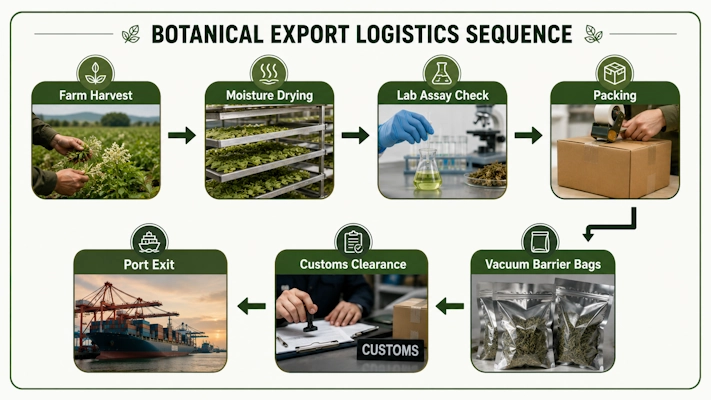
- Harvesting: Pulling pods from the trees at exact chemical maturity, usually when the outer shell turns brittle and dry.
- Cleaning: Cracking the outer hulls and removing the seed matrix and heavy structural fibers.
- Drying: Capping residual moisture via sun-drying or controlled dehydration tunnels to drop levels below a strict 15% threshold.
- Processing: Converting the fruit pulp into dense pastes via industrial boilers or grinding into multi-mesh powders.
- Testing: Verifying total absence of pesticide residues, mold spores, and heavy metal concentrations.
- Packaging: Deploying heavy-duty, food-grade corrugated boxes with inner polymer linings or vacuum-sealed drums for liquids.
- Documentation: Compiling phytosanitary records, origin certs, and shipping invoices for custom inspection.
- Shipment: Sealing clean, moisture-controlled sea containers for international delivery.
Technical Quality Parameters and Regulatory Compliance
Foreign food brands and industrial buying houses run comprehensive risk-assessment loops before onboarding an international supplier, focusing entirely on a few key biochemical parameters to ensure raw materials will pass regulatory audits in their home markets.
The technical benchmarks that dictate batch acceptance can be categorized into four core quality fields:
Buyer Quality Parameters
| Quality Parameter | Import Acceptance Relevance | Standard Market Target Threshold |
|---|---|---|
| Purity Profile | Measures the presence of accidental seed fragments or shell specs. | Capped strictly below 1% to 1.5% for seedless grades. |
| Moisture Content | Directly impacts shelf stability and mold prevention during long sea transit. | Capped below 15% for blocks; under 5% for spray-dried powders. |
| Tartaric Acid Yield | Determines the natural sourness and industrial functional value of the batch. | Minimum range of 8% to 12% total acidity. |
| Contaminants Assay | Non-negotiable safety compliance monitored at destination entry ports. | Absolute zero tolerance for Salmonella and unapproved pesticides. |
The processing temperature and microbial count represent major hurdles during laboratory checks at entry ports. If a batch shows even minor trace counts of heavy metals like lead or arsenic, or carries residues of unpermitted pesticide components from old farming practices, it faces immediate border rejection. This eventually forces expensive return shipping or sometimes even destruction at the exporter's expense.
Export Documentation
Customs agents at major international ports evaluate incoming botanical cargo based on documentation precision, matching chemical test readouts with physical packing manifests. Gaps in these files can lead to immediate terminal detention and expensive demurrage fees.
To ensure trouble-free border clearance, the trade desk must assemble a complete compliance folder:
- Import Export Code (IEC): The legal baseline for corporate export authorization, issued directly by the DGFT in India.
- Commercial Shipping Invoice: Declares the absolute transaction value, weight parameters, and custom item codes for duty check metrics.
- Packing List Details: Itemizes exact cargo information, including net container weights and packaging dimensions.
- Certificate of Origin: Crucial customs documentation confirming the geographic zone of production.
- Phytosanitary Certificate: Mandatory declaration issued by plant protection authorities verifying that the crop lot is completely free of stored-product pests or organic contaminants.
- Bill of Lading: Official contract of carriage detailing shipping lines, port points, and title transition data.
- Independent Laboratory Analysis: Government-signed confirmation verifying that the batch cleared all heavy metal and pesticide safety checks.
Tamarind Price Per Kg Export: Pricing Variables
Wholesale trading values in this sector do not follow a flat, predictable trajectory. The tamarind price per kg export structure is highly sensitive to processing depth, organic certification layers, and seasonal crop volumes coming out of major regional mandates.
The market pricing levels split significantly based on the final format of the commodity:
Indicative Export Price Ranges (2026 Estimates)
| Product Format | Indicative Export Price Range (2026 Estimates) |
|---|---|
| Standard Raw Blocks (Seed-In) | USD 1.10 - USD 1.40 per kg |
| Premium Seedless Blocks | USD 1.80 - USD 2.30 per kg |
| Industrial Concentrate / Paste | USD 2.80 - USD 3.90 per kg |
| Standardized Spray-Dried Powder | USD 5.50 - USD 7.50 per kg |
Mandatory Pricing Disclaimer: Export prices are indicative only and may vary based on product grade, organic certification, destination market, order volume, packaging requirements, quality specifications, and prevailing market conditions.
Market Outlook and Strategic Sourcing Recommendations
The long-term consumption trends point to clear, sustainable market expansion. Analyzing the broad revenue projection—where the exact market alone scales up from a USD 1.14 billion baseline to an estimated USD 1.98 billion by 2034—proves that global purchasing power is transforming structurally.
For a forward-looking enterprise, this behavioral shift means that long-term commercial security belongs entirely to refiners who invest in certified laboratory assays and state-of-the-art steam-sterilization infrastructure, matching the strict transparency needs of the global preventive healthcare market.
Succeeding in the modern tamarind exporters India corridor requires balancing commercial flexibility with complete regulatory discipline. The expanding global food processing ecosystem offers exceptional long-term volume loops, but it remains accessible only to suppliers who prioritize consistent batch packaging and absolute supply continuity.
As formal retail formats continue to scale up across major gateway hubs, the commercial value of unverified, loose spot brokering will continue to decline. True corporate longevity belongs to asset-backed manufacturing firms that align their workflows with the exact technical standards of foreign food and drug agencies. By optimizing logistics loops, locking down clear private label channels, and structuring pricing metrics around urban household budgets, Indian agricultural enterprises can secure a premium, dominant foothold across the international trade landscape.




.webp "How Dry Fruit Buyers Check Quality Before Bulk Purchase")