Key Highlights
- Australia imported 235.62 thousand MT of agricultural products from India in FY 2024–25.
- India's agricultural exports to Australia were valued at USD 504.01 million.
- Miscellaneous food preparations are India's largest agricultural export to Australia.
- Basmati rice, spices, marine products, and other agricultural commodities are among the top export categories.
- Australia's multicultural population and growing demand for specialty foods create strong opportunities for Indian exporters.
- Strict biosecurity and food safety compliance are essential for successful exports.
Introduction:
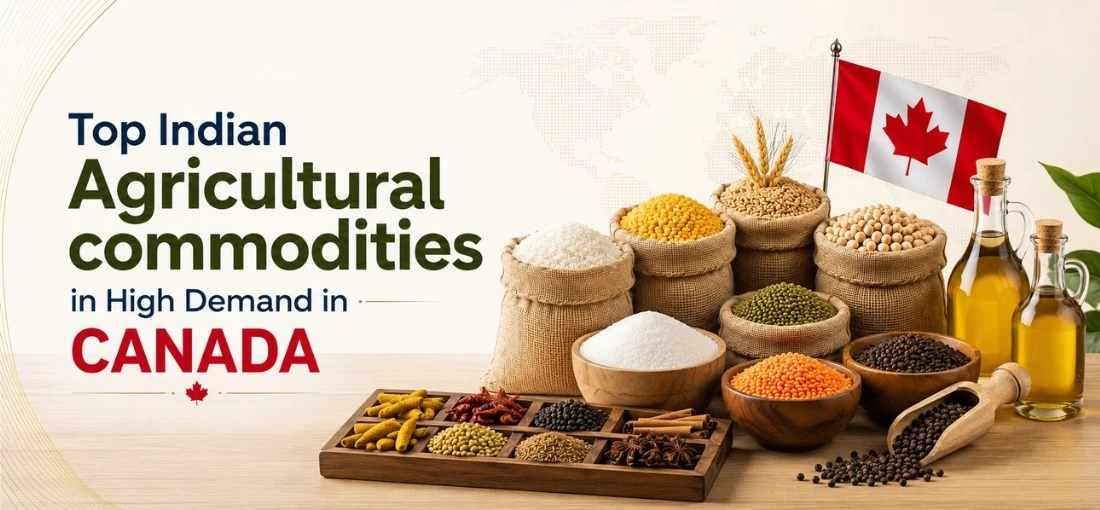
Ever look at the shipping logs for a massive farming country like Canada and wonder why on earth they're importing hundreds of millions of dollars in food from India? It seems totally counterintuitive at first glance. This is because Canada is a big player in global agriculture and literally encompasses vast fields of wheat, canola, and pulses year-round. But guess what? If you walk into a Loblaws, a local ethnic grocery in Surrey, or a massive food distribution hub in Mississauga, you'll see entire aisles packed with Indian Agro Exports to Canada.
So, what's really driving this steady trade pipeline? The Canadian food import market is one such market, like others, that doesn't rely on a single food import. In India-Canada agri trade, exporters ship a healthy mix of goods that keeps trade steady throughout different seasons. And that is pretty much evident from the fact that between financial years 2024 and 2025, Indian agricultural exports to Canada included everything from frozen seafood all the way to premium long-grain rice varieties and, yes, whole spices and packaged ready-to-eat food.

Looking at the latest APEDA export statistics, Canada stands as India's 20th largest market for agricultural goods, pulling in USD 772.48 million (about ₹6,532.81 crore) and taking a 1.45% share of India's overall agricultural exports. Let's break down how these commodities actually stack up.
This informative piece of blog will tell you the top agricultural commodities exported from India to Canada.
India-Canada Agricultural Trade Overview
When you look closely at India Canada agri trade, you quickly realize the whole relationship isn't tied to a single crop that could crash next season. Instead, it's a remarkably balanced export basket that holds steady year after year. In FY 2024-25, Indian Agro Exports to Canada covered everything from marine products to staple grains and shelf-stable packaged foods.
Here is how those core metrics line up according to official APEDA trade figures:
| Export Indicator | Value |
|---|---|
| Canada's Global Rank | 20th |
| Export Value (USD) | USD 772.48 Million |
| Export Value (INR) | ₹6,532.81 Crore |
| Quantity Exported | 342.16 Thousand MT |
| Share in India's Total Agri Exports (%) | 1.45% |
Moving over 342 thousand metric tonnes of cargo across long ocean routes takes serious coordination between Indian exporters and Canadian importers. And because the trade value is spread over several distinct commodity streams rather than one single crop, suppliers face far less risk if one market sector happens to slow down.
Top Agricultural Commodities Exported from India to Canada
Before diving into each category, here is a quick snapshot of how the top five export brackets compare in dollar value and market share:
| Commodity | Export Value (USD Million) | Share of Total Agri-Exports (%) |
|---|---|---|
| Marine Products | 211.91 | 27.43% |
| Basmati Rice | 94.92 | 12.29% |
| Spices | 78.45 | 10.16% |
| Miscellaneous Preparations | 78.27 | 10.13% |
| Cereal Preparations | 51.12 | 6.62% |
These five sectors make up the main core of Indian Agro Exports to Canada, keeping reliable supply lines open for Indian food exporters.

Marine Products - India's Largest Agricultural Export to Canada
Want to guess what actually takes the top spot in India's agricultural exports to Canada? It isn't a field crop or a grain at all—it's marine products. Pulling in a massive USD 211.91 million, seafood accounts for a whole 27.43% of all Indian Agro Exports to Canada.
Now, why are Canadian food managers importing so much seafood from India of all places? That’s because Canada's local fisheries specialise heavily in catches like wild salmon, lobster, and snow crab. But these are mainly cold-water catches. That’s the reason Canadian supermarket chains, restaurant distributors, and hospitality buyers need a reliable supply of warm-water frozen seafood that is year-round. This mostly includes Vannamei shrimp and prawns. Indian aquaculture plants have built up world-class cold chain networks to meet strict Western entry standards. This makes them a natural primary vendor for companies looking to export food products to Canada.
Export Basmati Rice in Bulk to Canada
Then you have Basmati rice, of course, the king of aroma, that sits in second place in agriculture exports to Canada. It pulls an export number of USD 94.92 million, which makes it have a decent 12.29% share in the overall export pie. But what makes the Canadian market such a reliable destination for a Basmati rice exporter India?
A lot of it comes down to simple daily habits and changing demographics. Millions of South Asian, Middle Eastern, and Asian families living in major hubs like Toronto, Vancouver, and Calgary consider long-grain aromatic rice an absolute non-negotiable part of their kitchen staples. On top of that, everyday Canadian shoppers are actively switching to aged Basmati for its distinct fragrance and fluffy, non-sticky texture.
For large-scale importers and regional distributors, the main focus is all about scale—they need to export Basmati Rice in bulk to Canada. Shipping in full container loads lets Canadian distributors repackage under their own private store labels or supply commercial kitchens efficiently. If you are an active Basmati rice exporter from India, securing contracts that multi shipment to export Basmati Rice in bulk to Canada opens up steady, long-term business, especially as demand for genuine Indian Agro Exports to Canada keeps growing year after year. Setting up tight logistics to export Basmati Rice in bulk to Canada gives suppliers a permanent foothold in North America's fastest-growing ethnic food markets.
Export Spices in Bulk to Canada
Right after rice, you've got Indian spices holding down a massive chunk of trade with Canada, bringing in USD 78.45 million and locking in a 10.16% slice of the total export basket. From whole red chilies and turmeric to cumin, seed spices, and mixed masalas, Indian spice shipments move consistently through Canadian ports every single month.
Where are all these spices actually going once they land? That comes down to two primary buying channels:
- Retail & Specialty Grocery Stores: Pre-packaged jars and pouches sold across major Canadian supermarket chains and local ethnic markets.
- Industrial Food Processing Plants: Canadian commercial food factories, soup manufacturers, and meat processors buying bulk shipments for their own product blends.
And because these industrial buyers need massive volumes, Canadian food plants frequently line up agreements with an Indian spices exporter who can export spices in bulk to Canada. Ordering whole or ground spices in bulk keeps raw material costs down while making sure factory batches taste identical every time. For any serious Indian spices exporter, having the lab testing capacity to export spices in bulk to Canada—while meeting strict Canadian Food Inspection Agency (CFIA) limits on pesticide residues—is the key to securing long-term supply contracts and expanding Indian Agro Exports to Canada. Importers who regularly export Spices in bulk to Canada always prioritize vendors who provide complete lot traceability and clean lab reports upfront.
Growing Demand for Value-Added Food Products
Beyond raw commodities and frozen seafood, processed, ready-to-use foods represent one of the fastest-growing niches for Indian food exporters. Two key categories highlight this momentum:
- Miscellaneous Preparations: USD 78.27 Million (10.13% share)
- Cereal Preparations: USD 51.12 Million (6.62% share)
Together, these two categories generate nearly USD 130 million, which shows that Canadian consumers are buying way more than just raw cooking ingredients. What's actually inside these shipping containers? That includes ready-to-eat meal trays, instant snack mixes, packaged flatbreads, regional sweets, and pre-cooked grain products.
With busy urban working professionals in Canada looking for quick, hassle-free meal options, companies that can export food products to Canada in consumer-ready packaging are winning big market share. Moving beyond bulk food exports to Canada into these value-added processed items gives manufacturers far better profit margins than traditional raw commodity trading.
Why Canada Continues to Import Agricultural Products from India
Why does Canada keep relying on India for its food pipeline month after month? When you analyze the overall Canada food import market, a few plain facts explain why this trade axis isn't going anywhere:
- Severe Winter Climates: Canada's short growing season makes local commercial farming of tropical goods—like spices, mangoes, and Basmati rice—completely impossible.
- Demographic Tailwinds: A massive, continuously growing South Asian population creates a permanent, non-negotiable baseline demand for traditional foods.
- Mainstream Palate Expansion: Indian cooking has officially crossed over into mainstream Canadian homes and restaurant menus nationwide.
- Reliable Year-Round Production: Indian processors have the raw farming volume, processing scale, and export infrastructure to fulfill large multi-year Canadian contracts without running dry.
These drivers prove that Indian Agro Exports to Canada are backed by deep structural demand rather than short-term market trends.
Conclusion
At the end of the day, trade between India and Canada is anchored by a healthy, well-rounded mix of agricultural products. Hitting USD 772.48 million in FY 2024-25, top categories like marine products, Basmati rice, spices, packaged preparations, and cereal foods continue to drive the numbers. The latest APEDA statistics show a mature, highly resilient trade channel that offers predictable returns for serious exporters.
If you have your quality control and supply chain tight, Canada is an incredible market to scale in. Whether your goal is to export Basmati Rice in bulk to Canada, establish your brand as a preferred Indian spices exporter to export Spices in bulk to Canada, or ship packaged food lines, keeping your quality spotless and meeting Canadian import rules is your fast track to long-term success with Indian Agro Exports to Canada.
If you want to export agro commodities to Canada in bulk, register as a seller today through Tradologie’s seller registration page.
Disclaimer
The information provided in this article is for educational and informational purposes only. Export statistics, customs procedures, biosecurity regulations, and Australia's import policies may change over time. Exporters should verify the latest DGCIS data, Department of Agriculture, Fisheries and Forestry (DAFF) requirements, and destination-country compliance requirements before exporting agricultural products.




.jpg "Top 5 Indian Agro Products Exported to Saudi Arabia")