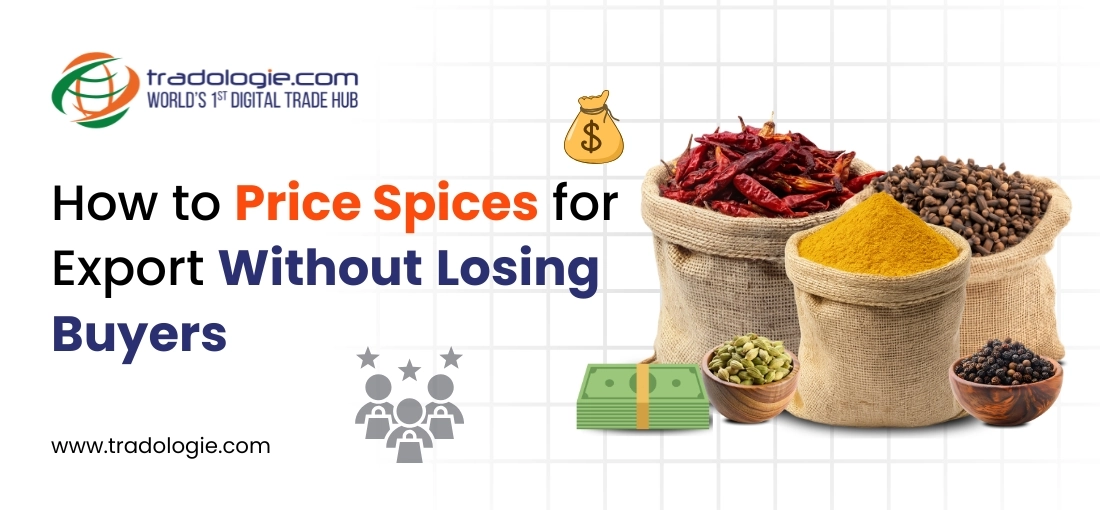
How to Price Spices for Export Without Losing Buyers
Because in spice trade, the right price isn't the highest — it's the one that keeps the order repeating
Key Highlights
- Pricing in spice exports isn't about squeezing the highest number out of a buyer. Most deals quietly settle at a level where both sides can breathe — importer gets workable margins, exporter sleeps at night. That balance is what keeps orders repeating.
- A lot of newcomers copy “market rates,” but experienced traders start with their own math first. Once you know your real cost — cleaning, freight, shrinkage, finance — the rest of the negotiation feels less stressful.
- Quality ends up deciding price more often than people admit. Cleaner, uniform lots simply face fewer arguments at destination, and fewer arguments usually mean fewer discounts.
- Buyers rarely look at FOB the way exporters do. They're thinking about the full landed number — freight, duties, delays. Sometimes logistics quietly matters more than shaving a few dollars off the product itself.
- The smartest exporters don't chase every low quote in the market. They focus on steady customers, steady volumes, and contracts that feel predictable. Stability tends to pay better over time than one flashy deal.
- After a few seasons, you realize pricing isn't a trick or a formula. It's mostly discipline — know your cost, stay consistent, don't overpromise. The buyers who like that rhythm usually stick around.
Introduction:
In spice exports, pricing rarely starts with ambition. It starts with caution. Every bulk spice exporter learns this sooner or later. Quote too high and the buyer disappears. Quote too low and you win the order but lose your margin. Somewhere between those two lies the number that keeps business moving — not once, but again and again.
That number is never random. It's built piece by piece.
Spices aren't impulse purchases for importers. They're ingredients that run factories — grinders, blenders, seasoning lines, food processors. When a buyer looks at your price, they aren't comparing it with last week's offer. They're calculating their landed cost, processing yield, and retail margins.
So bulk spice pricing isn't about what you want to earn. It's about what the buyer can comfortably absorb.
- Buyers calculate backward from finished product margins
- Even small price gaps change sourcing decisions
- Repeat business usually matters more than one high-margin deal
- Stability often beats “lowest”
Start with Your Real Cost, Not the Market Rumor
Many new bulk spice suppliers make the same mistake. They ask around for “today's market rate” and copy it. But that number rarely reflects their own structure. Freight differs. Cleaning losses differ. Packaging differs. Without knowing your true cost, you’re negotiating blind.
Experienced spices traders build from the inside out.
They calculate raw procurement, cleaning and sorting losses, grading, packaging, inland freight, port charges, finance costs, and a realistic buffer for rejection or claims. Only after that do they even look at the market.
- Raw material + processing losses
- Packaging and fumigation
- Inland logistics and port handling
- Finance, insurance, inspection
- Margin buffer for risk
Quality Specs Quietly Shape the Price
In spices, not all tonnes are equal. A lot with lower moisture, tighter mesh size, and clean microbiological results commands easier acceptance. A dusty or uneven lot might need discounts just to clear.
Buyers price quality into their math, even if they don't say it directly.
Better specs reduce their downstream cleaning and rejection costs. That saving shows up in negotiations. Which is why two bulk spice exporters selling “the same spice” often quote very different numbers.
- Moisture and volatile oil content
- Mesh size or grind uniformity
- Colour value and cleanliness
- Residue and microbial limits
- Lab-tested Certificate of Analysis
Think in Landed Cost, Not Just FOB
FOB pricing is comfortable for bulk spice suppliers. But buyers rarely think in FOB. They think they landed — product + freight + insurance + clearance. If your FOB looks cheap but freight is expensive from your port, you’re still uncompetitive.
Serious exporters constantly track freight spreads and container rates.
Sometimes shaving two dollars off freight wins more orders than shaving five dollars off product price.
- Compare CIF/landed cost with competitors
- Monitor ocean freight trends
- Consider alternate ports or consolidation
- Quote realistically, not cosmetically
Leave Room to Negotiate
A perfectly tight price may look efficient, but it often kills conversation. In B2B bulk spice trade, buyers expect some space to talk. A small cushion helps close deals without hurting margins.
Think of it as flexibility, not padding.
If you quote your absolute bottom on day one, every counter-offer becomes uncomfortable. But a sensible buffer lets both sides feel they've “won” something. That psychology matters more than spreadsheets sometimes.
Reward repeat orders, not one-offs
- Build 2-3% negotiation space
- Avoid quoting bare minimum first
- Use volume-based discounts
Watch Competitors — But Don't Chase Them Blindly
Markets for turmeric, cumin, chilli, or pepper move with crop sizes, weather, and origin supply. Someone will always undercut. Matching every low quote becomes a race to the bottom.
Smart exporters don't chase every deal. They focus on bulk spice buyers who value consistency and timely shipment.
There's a difference between competitive and desperate. Buyers notice that difference quickly.
- Track origin-wise pricing trends
- Understand seasonal crop cycles
- Walk away from loss-making orders
- Prioritize long-term relationships
Use Contracts to Stabilize Pricing
Spot deals feel exciting, but they're unstable. Regular exporters prefer quarterly or seasonal contracts. These smooth out price swings and give both sides predictability.
For b2b bulk spice importers , that means supply security. For sellers, it means stable cash flow.
In volatile spice markets, stability is often worth more than squeezing the last dollar.
- Forward contracts for key buyers
- Pre-agreed tolerance ranges
- Volume commitments
- Less exposure to daily swings
Don't Forget the “Soft” Factors Spice Buyers Value
Pricing isn't only numbers. It's also trust. An exporter who loads clean containers, ships on time, and responds quickly often gets accepted even at slightly higher prices.
Because delays cost bulk spice importers more than small price differences.
Reliability quietly becomes part of your price justification.
- On-time shipments
- Consistent documentation
- Clean inspection records
- Faster claim resolution
- Professional communication
Where Most Good Exporters Finally Land
After a few seasons, most bulk spice traders settle into a simple mindset. Price fairly. Protect margin. Leave room to talk. Deliver consistently.
Nothing dramatic. No clever tricks.
Just steady arithmetic and a bit of common sense.
Because in the bulk spice trade, buyers rarely remember the cheapest supplier. They remember the one whose cargo behaved exactly as promised. And that, more than anything, is what keeps the next purchase order coming.
Pricing, in the end, isn't about squeezing the deal.
It's about keeping the door open.