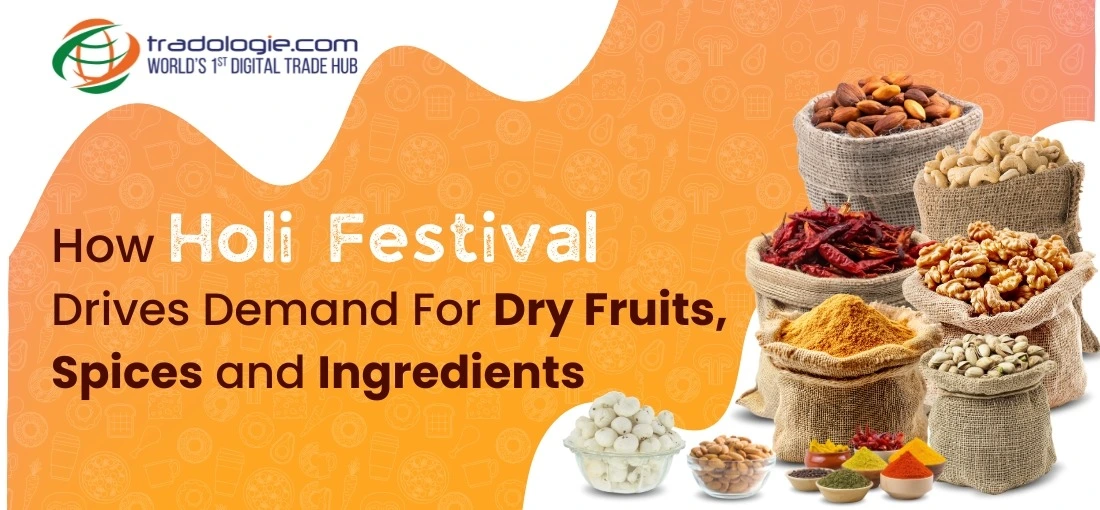
Holi is a widely celebrated festival of colors all over the world. But this cultural phenomenon is much more than just a celebration. Behind the spectacle of gulal, it actively operates as a massive economic engine. This reality is particularly true for the bulk Dry Fruits trade and spice sectors. Spices importers, Spices Exporters, and wholesale distributors all experience massive operational shifts during this period. In fact, it consistently emerges as one of the most lucrative financial quarters of the entire year.
The financial scale of this festival is staggering. Insightful forecasts for 2026 have been released by the Confederation of All India Traders (CAIT). According to their data, India's total Holi trade is expected to reach an incredible ₹80,000 crore. When compared to the prior year, this number shows a strong increase of almost 25%. Apparel and festive colors certainly claim a highly visible share of this market. However, they are not the sole drivers of this economic surge. The true heavyweights commanding this season's bulk trade are actually dry fruits, premium spices, and base culinary ingredients.
The supply chain for food commodities is severely disrupted by this holiday demand. This surge has complicated, fast-moving, and very profitable mechanics. A detailed explanation of how the Holi festival propels this enormous bulk market can be found below.
THE "THANDAI" EFFECT: SURGING DEMAND FOR PREMIUM DRY FRUITS
Consider the traditional beverage Thandai. Pair it with the quintessential sweet known as Gujiya. In any Holi celebration, both are unavoidable components. Making these holiday mainstays in large quantities is no easy task. It demands enormous quantities of high-value agricultural commodities. As a direct consequence, procurement patterns shift dramatically. Both the Dry Fruits import volumes and domestic sourcing must adapt. Throughout the first quarter of the year, they are on an unquestionably steep upward trajectory.
- Almonds and Pistachios: These nuts serve a crucial dual purpose. They serve as crucial components for internal fillings and garnishes. Domestic production simply cannot keep pace with this sudden spike. Therefore, India's reliance on imported almonds remains incredibly robust. Relying on international Dry Fruits sellers and nations focused on dry fruits export is the only viable way to meet such localized peak demand. Historical data provides vital context here. USDA reports regularly track India's annual imports of in-shell almonds. These imports consistently hover at nearly $937 million. A highly significant portion of that total volume is explicitly allocated to fuel Q1 festive manufacturing.
- Cashews and Raisins: The demand profile for these commodities is equally intense. Traditional sweet manufacturers represent a major bloc of Dry Fruits Buyers. The broader FMCG sector also aggressively enters the fray. Together, they look to Buy Bulk Dry Fruits in massive quantities. This aggressive, simultaneous buying strategy rapidly tightens the available market supply. The ripple effect across the trade network is highly predictable. As a result, the industry frequently witnesses a sharp price surge. Wholesale spot prices routinely get driven up just weeks before the festival actually begins.
SPICE MARKET DYNAMICS: CARDAMOM, SAFFRON, AND BEYOND
Spices function as the aromatic backbone of countless Holi delicacies. They provide the essential flavor profiles expected during the festivities. However, this festival serves a much larger economic purpose. It acts as a major market catalyst. It drives both robust domestic consumption and high-volume international export of Indian spices. The Holi season specifically triggers massive bulk procurement, where spices buyers aggressively target cooling and sweet-enhancing spice varieties. Buyers aggressively target cooling and sweet-enhancing spice varieties.
- Saffron (Kesar) & Cardamom: These specific commodities are highly prized across the market. They are fundamentally essential for flavoring Thandai and premium Mithai (sweets). Because of this non-negotiable demand, they consistently command premium pricing throughout the quarter.
- Black Pepper & Fennel: The demand curve for these items also sharpens. They are absolutely crucial for traditional beverage formulations. They successfully provide the distinct, slightly spicy kick expected by consumers.
The overall scale of this market remains vast. Data from the trade platform Tradologie clearly illustrates this massive footprint. In FY24, India successfully exported about 1.4 million metric tons of spices. The impressive $4.46 billion was the value of this volume. The industry's long-term projections are likewise very positive. Market analysts predict a $10 billion total valuation by 2030.
FMCG AND CORE INGREDIENTS: THE BACKBONE OF FESTIVE PRODUCTION
Behind the scenes of every local sweet shop and large-scale packaged food manufacturer is a colossal supply chain of core ingredients. To guarantee that shelves are stocked, the Fast-Moving Consumer Goods (FMCG) industry must scale its production months in advance.
According to industry estimates, the annual trade in sweets and namkeen (snacks) in India is expected to reach an all-time high of ₹1.25 lakh crore, with huge tailwinds during festivals. — Indian Retailer
To meet this demand, bulk commodity trading intensifies across several key staples:
|
Commodity |
Primary Festive Application |
Trade Dynamics & Focus |
|
Sugar / Jaggery |
Syrups, Gujiya, Beverages |
Massive domestic procurement; heavily influenced by futures trading. |
|
Edible Oils / Ghee |
Deep-frying snacks and sweets |
High import volumes (Palm, Sunflower oil) are scaling up pre-festival. |
|
Refined Flour (Maida) |
Outer casing for sweets/snacks |
High reliance on steady, localized domestic supply chains. |
|
Milk Powder / Khoya |
Base for traditional sweets |
High-volume dairy procurement requires strict cold-chain logistics. |
INTERNATIONAL MARKETS: NRI COMMUNITIES DRIVING EXPORT SPIKES
Spices function as the aromatic backbone of countless Holi delicacies. They provide the essential flavor profiles expected during the festivities. However, this festival serves a much larger economic purpose. It acts as a major market catalyst. It drives both robust domestic consumption and high-volume international export of Indian spices. The Holi season specifically triggers massive bulk procurement. Buyers aggressively target cooling and sweet-enhancing spice varieties.
- Saffron (Kesar) & Cardamom: These specific commodities are highly prized across the market. They are fundamentally essential for flavoring Thandai and premium Mithai (sweets). Because of this non-negotiable demand, they consistently command premium pricing throughout the quarter.
- Black Pepper & Fennel: The demand curve for these items also sharpens. They are absolutely crucial for traditional beverage formulations. They successfully provide the distinct, slightly spicy kick expected by consumers.
The overall scale of this market remains vast. Data from the trade platform Tradologie clearly illustrates this massive footprint. In FY24, India successfully exported about 1.4 million metric tons of spices. The impressive $4.46 billion was the value of this volume. Long-term industry forecasts are also very optimistic.
QUALITY, SAFETY, AND ADULTERATION: CHALLENGES IN BULK TRADING
Consumer demand frequently outstrips available supply during this intense festive period. Consequently, supply chain vulnerabilities escalate rapidly. The specific risk of product adulteration rises exponentially across the market. Import-export businesses face immense operational pressure. Bulk procurers are equally vulnerable to these fraudulent practices. Maintaining stringent quality control is absolutely mandatory. It is far more than a simple regulatory requirement. It represents a critical, non-negotiable brand-survival imperative.
- Saffron Substitution: This premium spice is highly susceptible to market fraud. Artificial dyes are frequently introduced into the supply chain by dishonest vendors. These substances are illegally used to fool consumers by imitating the vivid color of real saffron.
- Dairy Contamination: Market demand for milk and khoya peaks dramatically right before the festival. This massive surge creates lucrative opportunities for bad actors. Starch or cheap synthetic substitutes frequently infiltrate these localized, high-volume supply chains.
- Spice Adulteration: Bulk buyers must remain constantly vigilant against hidden physical fillers. Black pepper serves as a prime example of this specific operational risk. In order to artificially inflate weight, suppliers frequently covertly incorporate dried papaya seeds into the finished bulk product.
Proactively reducing these supply chain risks is a fundamental obligation for bulk buyers. Giving ISO-certified spices suppliers priority is an essential first line of defense. However, certification alone is often insufficient during peak rush periods. Procurers must also consistently mandate rigorous, independent lab testing. This critical verification step must occur absolutely before finalizing any major freight shipments.
NAVIGATING PRICE VOLATILITY IN PEAK SEASONS
The food commodity market faces several severe challenges during the Holi festival. Chief among these operational hurdles is extreme price volatility. Raw material costs fluctuate unpredictably during this intense period. Weather uncertainties also introduce significant supply chain risks. Furthermore, actual crop yields frequently prove inconsistent. Together, these compounding variables can completely wreak havoc on established profit margins.
Consider the specific market behavior of cumin and turmeric. Both of these essential spices remain highly dependent on fragile seasonal factors. Unseasonal rainfall poses a severe, immediate threat to these delicate crops. Such unpredictable weather events can drop overall production yields significantly. Consequently, wholesale prices get driven up rapidly across the entire market. This sudden price spike inevitably occurs exactly as FMCG demand peaks for the upcoming festival.
Traders simply cannot afford to be reactive in this volatile environment. They must proactively and closely monitor all relevant agricultural forecasts. Furthermore, they are required to strategically hedge their financial bets. Securing forward contracts is a vital, non-negotiable strategy. It remains the most effective way to protect their tight operational margins against unpredictable market swings.
Strategic Procurement: Preparing for the Festive Rush
Traders must aim to capitalize on the massive Holi demand effectively. However, they simply cannot rely on reactive buying habits. The market requires a much more proactive operational approach. Buyers must consistently execute flawlessly timed procurement strategies. Many businesses make the critical error of waiting until February to actively secure their inventory. This operational delay is highly penalizing. It almost always results in severely squeezed profit margins. Furthermore, it frequently leads to compromised overall product quality.
Advance Stockpiling: The bulk market dictates a strict timeline for certain stable commodities. Buyers must proactively secure contracts for all long-shelf-life goods. Dry fruits and whole spices fall squarely into this critical category. These specific procurement deals cannot wait for the new year. They must be completely finalized by Q4 of the preceding year.
Supplier Diversification: Supply chains remain inherently fragile during peak festive seasons. As a result, purchasers must never depend on a single place of origin. This rule is particularly applicable to high-value, highly volatile commodities like saffron or cardamom. Procurement teams must instead proactively create a network of suppliers that are completely redundant.
Logistics Optimization: Moving bulk commodities requires meticulous operational planning. Traders must guarantee completely robust cold-chain logistics. This specialized infrastructure is absolutely non-negotiable for highly perishable, dairy-based ingredients. They must also require safe, completely moisture-free transportation conditions. These climate-controlled conditions are absolutely necessary for hygroscopic staples like refined flour and bulk sugar to avoid clumping and spoiling.