Key Highlights
- Nescafe distributorship India offers entry into a high-demand, repeat-consumption FMCG category.
- Investment required ranges between ₹40 lakh to ₹89 lakh+, depending on territory and scale.
- Distributor margins typically range between 3%–8%, with additional incentives improving returns.
- The business works on high-volume, fast stock rotation rather than high per-unit margins.
- Nescafe holds ~45% share in India’s instant coffee market, ensuring strong demand.
- Distribution covers retail, HoReCa, modern trade, and institutional supply channels.
- Basic requirements include GST, FSSAI license, warehouse (1,500–2,500 sq. ft.), and logistics setup.
- Profitability depends on network strength, inventory turnover, and supply efficiency.
- Strong brand recall reduces selling effort and ensures faster retailer acceptance.
- HS Code for coffee trade: 0901
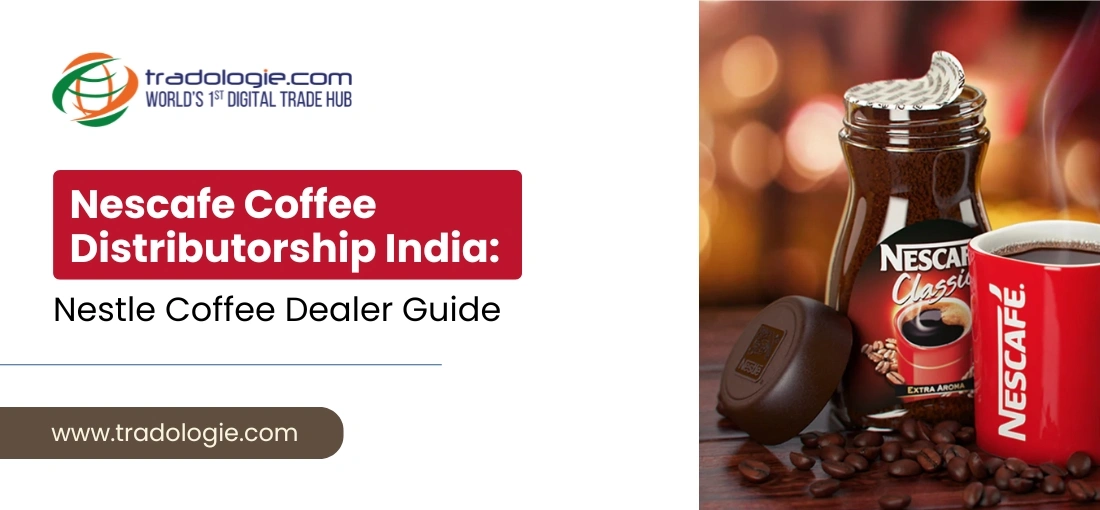
Every cup of coffee tells a story, but for a business owner? It’s a story of high-velocity turnover. In India, coffee has moved past being just a beverage—it’s a premium experience now, and Nescafe is the undisputed protagonist of that shift. When an Indian consumer thinks of coffee, they think of the red mug. From a commercial standpoint, this isn't just a "good" brand to stock. It’s a door-opener for any retail or grocery network.
Securing a Nescafe distributorship India means you aren't just shifting "instant coffee." You’re managing a high-demand asset that clears shelves faster than almost any other ambient product in the aisle. If you’re ready to stop chasing "trends" and start looking at actual, real-world ROI, this guide is your blueprint.
According to Grand View Research, the Indian coffee market generated a revenue of USD 1,957.3 million in 2025 and is currently barreling toward USD 3,542.0 million by 2033. But forget the global numbers for a second. Here’s the real kicker for the Indian market: Nescafe doesn't just lead; it dominates with a 45.2% share of the instant coffee segment. We’re talking about a brand that dragged 3.7 million new households into the category last year alone. That's not just growth—that's a takeover.
Keep reading this informative piece of blog, as it will cover all the important aspects pertaining to getting instant coffee distributorship of Nescafe.

Overview of Nescafe Distributorship in India
What is a Nescafe distributorship, really? It isn't just a contract to move boxes. It’s a license to operate as the local face of one of the world’s most precise supply chains. As a distributor, your role is to act as the primary "break-bulk" point. Nestlé sends you the massive pallets; you break them down and ensure that every Kirana store, supermarket, and high-end cafe in your territory never runs dry.
But it’s more than just retail. A Nestle beverage dealership India puts you in the driver’s seat for the HoReCa (Hotels, Restaurants, and Catering) segment. Think about every vending machine in a corporate office or the "É by NESCAFÉ" machines in premium lounges. That’s your territory. You’re managing high-frequency replenishment for products that people literally cannot start their day without.
The Scale of the Network
Nestlé India doesn't play small. They operate one of the largest and most sophisticated FMCG distribution networks in the country. We’re talking about a system that reaches over 5.1 million retail outlets directly and indirectly.
The structure is built on three main pillars:
- General Trade: Supplying the massive web of local mom-and-pop stores.
- Modern Trade: Managing the high-volume requirements of supermarket chains.
- Nestlé Professional: Handling the out-of-home (OOH) consumption, from office vending to hospital canteens.
In short, becoming a distributor means joining a "winning portfolio" that just hit its highest-ever quarterly turnover of INR 5,643.5 crore in early 2026. Nestlé is currently aggressive on rural expansion and quick-commerce integration, meaning they aren't just looking for "stockists"—they’re looking for tech-ready partners who can keep up with a market that's moving faster than ever.
Why Choose Nescafe Distributorship in India?
Let’s be honest: in the FMCG world, you want products that move without you having to "sell" them. That’s the core appeal of a coffee brand distributorship India anchored by Nestlé. You aren't educating the market on what coffee is; you’re simply fulfilling an existing, massive demand. It’s one of the few businesses where the "product education" cost is effectively zero. Everyone knows the red mug.
The "Habit" Factor
Coffee isn't a luxury purchase; it’s a repeat-consumption habit. Once a consumer settles on a Nescafe blend, they buy it every 15 to 30 days. For a distributor, this creates a predictable, "sticky" cash flow that most other retail categories lack.
According to IMARC Group, the India coffee market was valued at USD 9.53 Billion in 2025 and is projected to skyrocket to USD 17.31 Billion by 2034. That’s a compound annual growth rate (CAGR) of 6.86%. When you align with a brand that owns nearly half that market, you aren't just riding the wave—you are the wave.
Diversified Demand Streams
A Nestle coffee dealer India doesn't just rely on the local grocery store. Your revenue is hedged across multiple sectors:
- The Retail Engine: High-volume sales through Kirana stores and supermarkets.
- The HoReCa Boom: Supplying hotels, restaurants, and cafes where Nescafe is the institutional standard.
- Quick Commerce: Capitalizing on the "10-minute delivery" trend where coffee is a top-performing SKU on platforms like Blinkit and Zepto.
Zero-Friction Sales
Nestlé spends hundreds of crores on marketing every year so you don't have to. When you walk into a retail outlet as an authorized distributor, the trust is already in the room. You’re offering a brand that just reported an 18.3% YoY domestic growth in early 2026. In a volatile market, that kind of stability is rare. You get a portfolio that clears shelves, high-frequency replenishment, and the backing of a global giant that's currently aggressive on expanding its Indian footprint.
Types of Nestle Coffee Distribution Opportunities
Nestle doesn't just put every product across the shelves and hope for the best. The Nestle beverage dealership India is dynamic. Depending on your infrastructure and where you want to play, you’ll fit into one of these four specific channels.
1. Retail Distribution
This is the bread and butter of the FMCG world. You’re supplying the "General Trade"—the local kirana stores and neighborhood shops that drive that massive 45.2% market share. A coffee brand distributorship India at this level is high-volume and high-frequency. You need a solid local fleet—think Tata Aces or Mahindra Boleros constantly on the move. If you want a business that never sleeps, this is the one.
2. HoReCa Supply (Hotel, Restaurant, Cafe)
Under the Nestle beverage dealership India banner, the focus shifts to out-of-home consumption. You aren't selling jars here; you’re selling solutions. This involves bulk coffee, vending machines, and high-end blends like Nescafe Milano. It’s a relationship-heavy game with higher margins, but it requires "hand-holding" and technical support. You're a partner, not just a supplier.
3. Institutional Buyers
We’re talking about the big fish—corporate offices, hospitals, and airlines. It’s consistent, predictable, and bulk-heavy. These buyers aren't looking for a "deal" every week; they’re looking for a reliable partner who can manage supply without a single day of downtime. Scale is the primary requirement. If you can't handle a massive order on short notice, don't enter this tier.
4. Modern Trade
This is the "Organized Retail" segment—think Reliance Retail, DMart, or Star Bazaar. It’s a different beast entirely. Margins might feel tighter because of the sheer scale, but the volume is massive. You’re dealing with sophisticated inventory systems and strict delivery windows. It’s perfect for distributors who have their logistics and tech stack (like SAP/DMS) perfectly optimized.
Investment Structure for a Nescafe Distributorship
Securing a Nescafe distributorship India is a capital-intensive commitment that requires a robust financial foundation. You aren't simply purchasing inventory; you are investing in a high-velocity supply chain. Nestlé maintains rigorous standards for its partners, expecting a level of financial health that can support rapid market expansion and consistent stock rotation.
To operate an instant coffee distributorship effectively, your capital must be strategically allocated across infrastructure, inventory, and liquid working capital.
Capital Requirements: The Strategic Breakdown
While the total investment varies depending on your assigned territory—Tier-1 metros naturally command higher operational costs than rural hubs—the core financial pillars remain consistent.
| Investment Component | Estimated Cost (INR) | Strategic Purpose |
|---|---|---|
| Initial Stock Purchase | ₹15 Lakh – ₹35 Lakh | Necessary for immediate market penetration and seeding. |
| Security Deposit (Refundable) | ₹2 Lakh – ₹7 Lakh | Standard interest-free deposit held by Nestlé India. |
| Warehouse & Infrastructure | ₹5 Lakh – ₹15 Lakh | For a 1,500 - 2,500 sq. ft. facility meeting FSSAI norms. |
| Logistics & Fleet | ₹8 Lakh – ₹12 Lakh | Procurement of dedicated delivery vehicles (e.g., Tata Ace). |
| Working Capital | ₹10 Lakh – ₹20 Lakh | Essential for managing the credit cycle and daily overheads. |
| Total Estimated Investment | ₹40 Lakh – ₹89 Lakh+ | The total capital outlay for a sustainable operation. |

Operational Financials: What You Need to Know
The strength of the instant coffee distributorship model lies in its Inventory Turnover Ratio. Unlike slower-moving FMCG goods, Nescafe products have a high secondary sales velocity. This means your capital isn't locked in a warehouse for long; it’s constantly moving.
- Infrastructure Standards: Your warehouse isn't just a storage space. It must be a perfect climate-controlled and pest-free environment that perfectly aligns with Nestlé’s global quality protocols. Hygiene is a non-negotiable metric at any cost.
- Logistics Efficiency: In the distribution game, reliability is your currency. Maintaining a dedicated fleet ensures you hit your delivery windows, which is critical for maintaining shelf dominance in high-traffic retail outlets.
Disclaimer: The figures mentioned above are estimated based on standard FMCG distribution benchmarks in India and available industry data. Actual costs may vary significantly based on the specific territory, updated corporate policies from Nestlé India, and local real estate conditions.
Eligibility Criteria to Become Nescafe Coffee Dealer
Becoming a Nestle coffee dealer India is a credentialed move. Nescafe doesn’t just look for investors; they look for partners who understand the mechanics of the Indian supply chain. You are the face of a global giant in your local market. This means the "entry bar" is set high. Brand integrity isn't something they compromise on.
The eligibility isn't just a checklist—it's about operational muscle. If you can’t tick these boxes, the conversation usually stops before the application is even reviewed.
1. Legal & Statutory Compliance
You need a registered business entity. Whether it’s a sole proprietorship or a private limited company, it must be legally sound. A valid GST registration is mandatory. And since you’re moving food, an FSSAI license is a non-negotiable hard stop. You’ll also need your state-specific Trade Licenses. No shortcuts here.
2. Prior Business Experience
Nestlé rarely bets on rookies. They prefer a track record in FMCG distribution. If you already manage a network for other brands, it proves you understand the "retailer credit loop" and the high-velocity rotation of stock. They want someone who knows how to handle the pressure of daily primary and secondary sales targets.
3. Storage & Infrastructure
Your warehouse is the first thing they’ll audit. You need a dedicated, dry, and hygiene-compliant godown. We are talking about a space that can pass a rigorous safety and pest-control audit on day one. Typically, a Nestle coffee dealer India needs 1,500 to 2,000 sq. ft. of clear space just to manage the peak inventory loads.
4. Distribution Network
You need "legs" on the ground. This means a dedicated fleet of delivery vehicles and a sales team that actually knows the local geography. Nestlé looks for dealers who can ensure the product is on the shelf, not gathering dust in the back of your warehouse.
Documentation Checklist
| Requirement | Specification | Importance |
|---|---|---|
| GST Certificate | Active registration with clear filing history | High (Legal Mandatory) |
| FSSAI License | State/Central license for food storage | High (Legal Mandatory) |
| Premises Proof | Ownership documents or a long-term lease | Moderate (Operational) |
| Financial History | Audited balance sheets (Last 3 years) | High (Financial Health) |
| ID & Address Proof | PAN, Aadhaar, and Partner Voter IDs | Moderate (Identity) |
How to Apply for Nescafe Distributorship in India
Applying for a Nescafe distributorship India is a process of systematic elimination. Nestlé is protective of its supply chain integrity, so your first interaction—the data you provide—has to be structurally sound.
The Application Pipeline
- Official Portal Access: Initiate the process via the Nestlé India official website under the "Partner with Us" or "Contact Us" section. This is the only legitimate digital entry point.
- Strategic Inquiry Submission: Complete the distributor inquiry form with precision. You aren't just giving a name; you’re detailing your intended territory and current business scale.
- RSM/ASM Review: Your profile lands with the Regional or Area Sales Manager. They aren't looking for enthusiasm; they’re looking for financial depth and a history in FMCG rotation.
- Field Inspection: A company representative will conduct a site visit to inspect your godown. They’re checking for roughly 1,500 – 3,000 sq. ft. of space, FIFO-compliant palleting, and strict hygiene standards.
- Documentation Audit: You’ll be required to submit GST registration, FSSAI licenses, and a local trade license. Any discrepancy here is an immediate "No."
- Security & Onboarding: Once the security deposit is cleared, you receive your distributor code and access to the Distributor Management System (DMS) for your first stock order.
Using B2B Trade Platforms
If you find the direct corporate route opaque, many serious entrepreneurs leverage online B2B trade platforms like Tradologie.com. These platforms streamline the process by acting as a digital bridge, allowing you to showcase your verified business profile directly to brand-authorized channels. It effectively cuts through the noise of a crowded applicant pool by providing a pre-vetted credential to the right decision-makers.
Profit Margin in Nescafe Distribution Business
In the world of FMCG, you aren’t chasing unicorn-style margins. You’re chasing the "velocity of money." A Nescafe distributorship India operates on the classic high-volume, low-margin model. If you’re looking for 30% margins, you’re in the wrong business. But if you want a product that clears the shelf before the invoice is even due, this is it.
In an instant coffee distributorship, your profitability isn't tied to a single big sale. It’s tied to the fact that millions of Indians wake up and reach for that red mug every single day. That repeat purchase advantage is your actual safety net.
The Margin Reality
Typical FMCG margins for a distributor hover in the 3% to 8% range, sometimes touching 10% if you’re hitting aggressive performance incentives or handling high-margin premium SKUs like Nescafe Gold.
| Factor | Typical Range | Impact on Bottom Line |
|---|---|---|
| Standard Margin | 3% – 6% | The base "keep-the-lights-on" profit per unit. |
| Cash Discounts (CD) | 1% – 2% | Earned by making prompt payments. |
| Performance Schemes | 1% – 3% | Variable; tied to hitting monthly/quarterly targets. |
| Institutional Margins | 5% – 10% | Higher for HoReCa or specialized vending solutions. |
Disclaimer: The figures provided are estimates derived from publicly available information and industry benchmarks. For precise and verified data, please consult the official team at Nestlé.
In the world of FMCG, you aren’t chasing unicorn-style margins. You’re chasing the "velocity of money." A Nescafe distributorship India operates on the classic high-volume, low-margin model. If you’re looking for 30% margins, you’re in the wrong business. But if you want a product that clears the shelf before the invoice is even due, this is it.
In an instant coffee distributorship, your profitability isn't tied to a single big sale. It’s tied to the fact that millions of Indians wake up and reach for that red mug every single day. That repeat purchase advantage is your actual safety net.
The Margin Reality
Typical FMCG margins for a distributor hover in the 3% to 8% range, sometimes touching 10% if you’re hitting aggressive performance incentives or handling high-margin premium SKUs like Nescafe Gold.
| Factor | Typical Range | Impact on Bottom Line |
|---|---|---|
| Standard Margin | 3% – 6% | The base "keep-the-lights-on" profit per unit. |
| Cash Discounts (CD) | 1% – 2% | Earned by making prompt payments to Nestlé. |
| Performance Schemes | 1% – 3% | Variable; tied to hitting monthly/quarterly targets. |
| Institutional Margins | 5% – 10% | Higher for HoReCa or specialized vending solutions. |
Where the Real Money is Made
Profitability in this game depends on scale, logistics efficiency, and the depth of your retailer network. It’s a game of three levers:
- The Rotation Play: Since Nescafe is an "A-Class" item (high demand), your stock turns over 3-4 times a month. Even a 5% margin becomes incredibly lucrative when you've rotated that same capital 36 times in a year.
- Logistical Tightness: If your trucks are running half-empty or your fuel costs are spiraling, that 5% margin evaporates. The most profitable distributors are the ones who have optimized their route planning to the minute.
- The "Premium" Mix: Smart distributors don't just push the ₹10 sachets. They balance their portfolio with high-value jars and premium blends where the absolute rupee-margin per unit is significantly higher.
Challenges in the Coffee Distribution Business
You aren't just competing with other coffee brands; you’re competing with every other product in the store for the retailer’s attention and capital. Here is the "grit" behind the operation.
1. The Multi-Front Competition
The market is saturated. On one side, you have the global legacy players like Nestlé and HUL (Bru). On the other, a surge of D2C specialty brands and regional roasters are eating into the "premium" niche. As a distributor, you’re constantly defending your territory. If you aren't active on the ground, a local player with a "fresher" narrative or a deeper discount will displace your stock in a week.
2. The Retailer Credit Loop
This is the silent killer of FMCG businesses. In India, most General Trade (GT) retailers expect a credit window—usually 7 to 21 days. However, Nestlé expects you to pay upfront or within a very tight window. This creates a "capital gap." If your collection team isn't aggressive, your liquid cash gets trapped on retail shelves while your warehouse sits empty because you can't fund the next primary order.
3. The War for Shelf Space
Visibility is everything. In a typical 200 sq. ft. kirana store, the "Eye-Level" zone is the most expensive real estate in India. Getting your red jars or sachets into that prime spot requires more than just a brand name; it requires constant relationship management (and often, trade incentives). If you aren't auditing your outlets weekly, your product will get pushed to the bottom shelf where it goes to die.
4. Fragmented Logistics & Cold Chain
While instant coffee is shelf-stable, the move toward "Ready-to-Drink" (RTD) and premium beans adds a layer of complexity. India's temperature-controlled logistics are still maturing. In 2026, the challenge isn't just moving boxes—it's orchestrating multi-temperature distribution without your fuel costs evaporating your 5% margin. One late delivery in a Tier-2 city can sour a relationship with a key Modern Trade partner for months.
This is the final "go or no-go" moment. For any entrepreneur looking at a Nescafe distributorship India, the question of profitability isn’t about the margin on a single jar—it’s about the massive, compounding power of the Nestlé ecosystem.
The short answer? Yes, it is incredibly profitable, but only if you have the operational stomach for high-volume logistics. This isn't a passive investment where you "set it and forget it." It’s a game of pennies played at a scale of millions.
The Profitability Verdict: Why It Works
Profitability in this sector is driven by three "moats" that few other brands can offer:
- Unmatched Brand Pull: You don't have to "sell" Nescafe to a retailer. They already have customers walking in and asking for it by name. This reduces your marketing spend to almost zero. You aren't a salesman; you’re a fulfiller of inevitable demand.
- The Velocity Advantage: Because the stock rotates 3–4 times a month, your actual Return on Investment (ROI) is much higher than the base margin suggests. You are essentially sweating your capital much harder than you would with a slower-moving premium brand.
- Cross-Category Leverage: Being a Nestlé distributor often opens doors to their wider portfolio—Sunrise, Maggi, KitKat, and Milkmaid. Once you have the infrastructure for coffee, adding these high-demand categories significantly dilutes your fixed costs (warehouse rent, staff, fuel).
Who Should Apply?
- The Scale Players: If you already own a warehouse or have a fleet of 3+ delivery vehicles, this is your perfect next move. You have the infrastructure to handle the volume.
- The Networkers: If you have existing relationships with 1,000+ local retail outlets, you can plug Nescafe into your system and see immediate cash flow.
- The Long-Termers: This is for those looking for a generational business. Nestlé partnerships often last decades.
Who Should Avoid?
- The Margin Chasers: If you’re looking for a 20% net profit margin to justify your time, skip this. FMCG is a 3–6% game. If that bores you, the "hustle" won't be worth it.
- The Low-Capital Entrants: If your budget is tight and you can’t afford to have ₹20 Lakh locked in a credit cycle with retailers, the "capital gap" will break your business in six months.
- The "Hands-Off" Investors: This business requires daily auditing of stock, collection of payments, and managing "Primary" (Company to you) vs. "Secondary" (You to retailer) sales. It’s a 24/7 grind.
The Bottom Line: A Nescafe distributorship India is arguably the safest "blue-chip" bet in the Indian FMCG landscape. It won't get you insane profits overnight, but it provides a level of recession-proof stability that very few businesses can match. If you have the capital and the grit for logistics, it's a "yes."

.webp "Coffee Export from India: Arabica, Robusta & Top Global Markets")