Key Highlights
- India's mustard oil exports reached USD 25.26 million in FY 2024-25.
- Demand is growing beyond ethnic markets into premium food and industrial applications.
- Erucic acid compliance remains a critical requirement for Western markets.
- Kachi Ghani mustard oil commands premium pricing in international markets.
- Bulk pricing depends on seed costs, processing expenses, and freight rates.
- Mundra, Dadri ICD, and JNPT are major export gateways for mustard oil shipments.
Introduction:
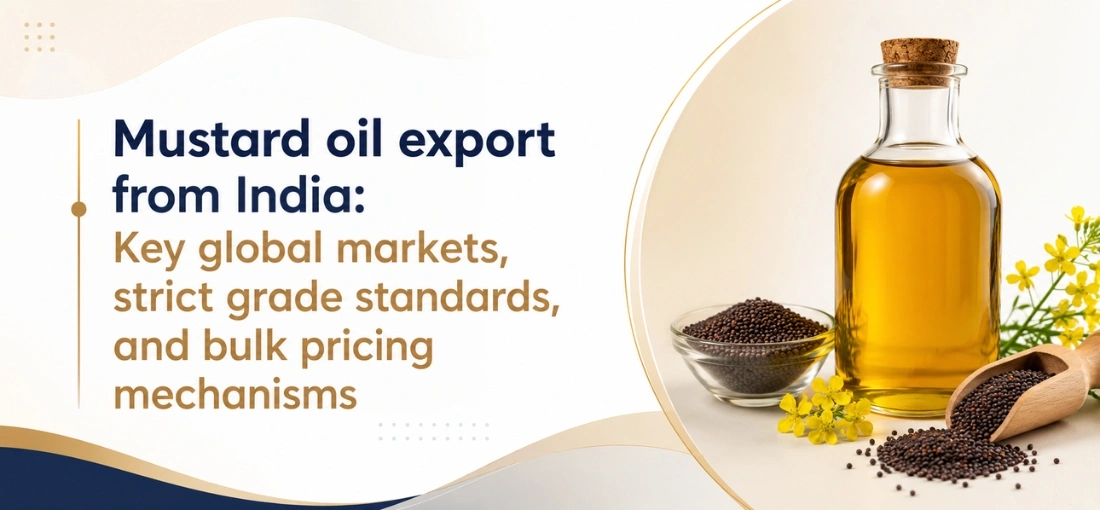
Whenever agribusiness executives start talking about global vegetable oils, they instantly look at massive palm oil tankers from Indonesia or corporate soybean processing plants across America. Hardly anyone stops to think about the smaller, specialized spice oil routes. But if you keep an eye on them, you can spot a fascinating trend. Because food lovers worldwide are suddenly obsessed with authentic flavors and cold-pressed options, mustard oil export from India has grown out of its old ethnic shell. It has quietly become a highly organized, premium product line in the mustard oil international market.

According to the hard data from the Directorate General of Commercial Intelligence and Statistics (DGCI&S), India's shipments of rape, colza, and mustard oil (tracked under code HS 1514) hit 25.26 Million USD over the 2024-25 financial year. That counts as a solid 8.26% year-on-year growth.
Still, if you talk to experienced Indian mustard oil exporters, they will tell you that making the leap from small domestic retail shops to large international containers isn't a piece of cake. You have to learn the tricky parts of regional global buyers, get a firm grip on local crop sourcing, and keep things aligned with strict mustard oil export standards.
Understanding the Global Demand Flow
This trade doesn't follow the same massive, chaotic paths as standard sunflower or palm oil. It is specific, targeted, and highly regional.
For decades, Indian mustard oil suppliers relied almost entirely on South Asian communities living abroad. Big grocery networks in the UAE, Saudi Arabia, the UK, Canada, and the USA constantly buy up small consumer bottles to satisfy traditional cooking needs. In these neighborhoods, customers stick fiercely to brands they know, allowing manufacturers to keep their retail margins steady.
But look at the other side of the coin. A larger bulk market is opening up. Specialty food brands across Europe and North America are beginning to purchase bulk volumes. They value it for its natural preservative properties, use it as a foundational base for industrial dressing recipes, or blend it into gourmet condiments.
Handling this requires two completely different supply setups. Retail shipments mean packing 20-foot shipping containers with neatly branded bottles. On the flip side, industrial sales mean configuring industrial flexitanks or heavy-duty ISO containers to move thousands of liters safely without leaking or catching a hint of oxidation.
The Reality of Purity Regulations
Any veteran customs broker will tell you that high tariffs aren't what keep cargo stuck at a port. It's the paperwork and quality checks. Since this oil has a distinct biochemical profile, overseas inspectors put every batch under a microscope.
If you want your shipments to pass without getting flagged, you need complete control over your crushing equipment and filtration lines. Two specific rules can make or break your business:
- The Erucic Acid Ceiling: This is a major hurdle if you plan to ship to Western countries. The US FDA and Europe's EFSA mandate that any imported oil meant for home cooking must contain under 2% erucic acid by weight. Since regular Indian seeds naturally produce much higher levels, you have to adjust. Exporters either have to source low-erucic varieties (like Canola-equivalent strains) or target non-food buyers who use the oil for industrial lubricants or chemical processing.
- Protecting Cold-Pressed Shipments: Premium stores pay top dollar for a true Kachi Ghani mustard oil export. Authentic Kachi Ghani means using old-school wooden or heavy mechanical presses without turning up the heat or using chemical shortcuts. That's how you save the intense aroma, golden look, and natural antioxidants. To pass foreign laboratory audits, these lots must be entirely free of solvent residues like hexane. If an overseas lab runs a test and finds even a tiny hint of chemicals or cheap blending substitutes like rice bran oil, customs will impound the container and flag your trading credentials on the spot.

Sourcing Seeds and Figuring out the Price
Quoting a price to an overseas buyer involves a lot more than checking the daily domestic wholesale index and adding a standard freight fee. In this industry, bulk mustard oil export pricing is a fluid calculation tied closely to farming regulations, crushing costs, and processing power.
Your base numbers come straight from the busy seed mandis across Rajasthan, Madhya Pradesh, and Haryana. Since the government changes the Minimum Support Price (MSP) for oilseeds to keep farming incomes stable, the ground price for raw inputs stays fairly insulated from sudden downward trends in global markets. Export companies have to figure out their margins against these local market realities while navigating unpredictable container shipping freight rates.
Most large supply deals use one of two regular contracts:
| Contract Choice | How it Works | The Practical Benefit |
|---|---|---|
| Fixed FOB / CIF Forward Quotes | You lock in a set rate for short-term retail shipments over a 30 to 60-day window. | Lets you buy up seed inventory from local mandis right away at a known price. |
| Formula-Based Rolling Adjustments | Used for institutional supply deals running 6 to 12 months, where prices adjust periodically. | Connect your final invoice directly to official solvent extractors' indices to shield everyone from wild market swings. |
Where the Cargo Actually Moves: Indian Port Infrastructure
Liquid cargo is heavy, meaning your supply chain depends on ports with the right pumping and storage setups. Looking at data from the DGCI&S, the bulk of this business travels through a few well-equipped gateways:
- Mundra Port (Gujarat): Handled 5.32 Million USD in shipments during the 2024-25 run. It leads the pack because of its sprawling liquid tank farms, fast customs processing, and close rail connections to northwestern farming belts.
- CGM Dadri ICD: Processed 4.88 Million USD in trade value. It serves as a vital inland container yard where northern crushing mills can consolidate their shipments onto rail lines.
- Nhava Sheva (JNPT): Handled 4.82 Million USD. This port remains the favorite for packing containerized consumer boxes heading toward Western shipping lanes.
Final Thoughts
The global market for specialized vegetable oils is growing. For trading desks willing to put in the work, this sector offers an excellent way to escape the brutal, low-margin price wars of the basic commodity oil markets.
But building a long-term business takes more than just playing the middleman. The firms that make it work are the ones building direct ties with seed farmers, keeping clear traceability records from the field to the dock, and tuning their extraction machinery to hit international biological standards. When you view strict quality compliance as a competitive advantage instead of a stack of annoying paperwork, you can establish a dependable, repeatable business across premium global food and industrial markets.
Disclaimer
The export statistics, market insights, pricing mechanisms, compliance requirements, and trade opportunities discussed are for informational purposes only. Import regulations, food safety standards, erucic acid limits, freight costs, and international trade policies may change over time. Exporters should independently verify regulatory and commercial requirements before entering export agreements.





-export-from-india-types-price--global-markets.webp "Jaggery (Gur) Export from India: Types, Price & Global Markets")