
Key Highlights:
- Traditional directories and trade shows are no longer enough for global food trade that demands speed, trust, and real-time decision-making.
- AI is reshaping how traders export food products by filtering serious buyers and sellers before conversations even begin.
- Tradologie replaced lead chasing with verified, intent-driven trade since 2016—long before AI became a buzzword.
- Real-time, AI-powered negotiations allow buyers to compare offers instantly and sellers to compete on actual trade terms.
- Global agriculture traders now win not by having more contacts, but by executing faster, cleaner, and smarter trades.
For decades, global food and agriculture trade ran on the same tired mechanics. Directories filled with outdated contacts. Excel sheets passed around teams. Trade fairs that promised “networking” but delivered a stack of business cards and months of unanswered follow-ups.
For traders trying to export food products or export agriculture commodities at scale, the problem was never demand. The problem was access, timing, and trust.
That old system is now showing its age.
Why Traditional Trade Discovery No Longer Works
Most agri-traders know this reality well. A directory listing tells you who exists, not who is active. Trade shows give you visibility for a few days, but not continuity. Cold emails and calls take time, and even then, you don’t know whether the counterparty is serious, solvent, or even operational.
Worse, lead-based information systems create friction at every step:
- Leads are static, but markets are dynamic
- Contact details go stale faster than contracts are signed
- Negotiations happen off-platform, scattered across emails and calls
- There’s no real-time view of pricing, availability, or seriousness
In global food trade, where prices move weekly and market requirements change overnight, this lag is expensive.
The result? Missed opportunities, slow deal cycles, and an uncomfortable amount of speculation—especially for traders dealing in bulk food and agricultural commodities.
AI Is No Longer “Coming” to Trade. It’s Already Here
Artificial Intelligence isn’t replacing traders. It’s replacing inefficiency.
In global agri-trade, AI’s real value isn’t automation for the sake of it. It’s decision compression—cutting down the time between intent and execution.
This is where platforms built for trade, not just for listings, begin to matter.
Tradologie saw this shift early.
Tradologie: Built for Trade, Not for Listings
Since 2016, Tradologie has approached global agri-trade from a different angle. Instead of building another directory or lead marketplace, it built a transaction-oriented trade ecosystem.
The starting point is simple but powerful: verification before interaction.
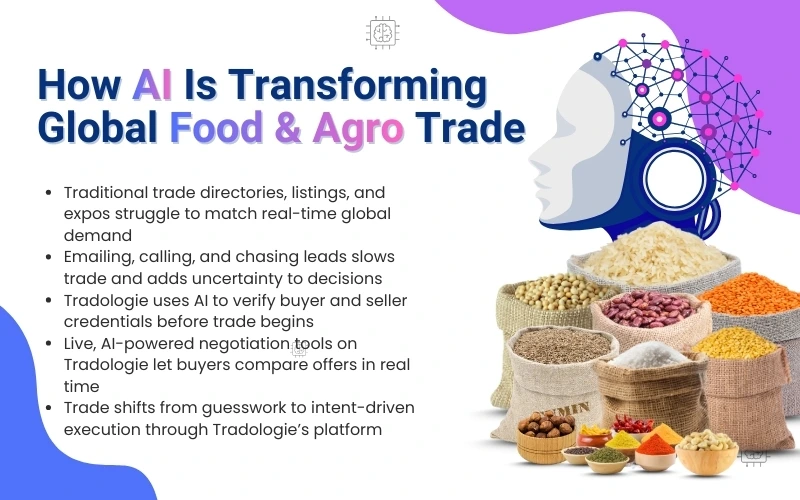
Every buyer and seller on Tradologie goes through a structured, AI-assisted verification process. Credentials, documents, trade intent, and operational capacity are checked before access is granted. This changes the quality of conversations immediately.
You’re no longer negotiating with anonymous leads. You’re engaging with verified global agriculture traders who are actually in the market.
AI-Verified Inquiries Change the Game
In traditional systems, inquiries are just expressions of interest. Many never convert because they were never serious to begin with.
On Tradologie, inquiries are AI-verified. That means intent, completeness, and trade readiness are assessed before an inquiry enters the system. This filters noise at the source.
For traders looking to export food products or trade food products globally, this matters more than marketing reach. It means time is spent negotiating, not qualifying.

Negotiation Moves From Email to Intelligence
One of the most underestimated frictions in agri-trade is negotiation itself.
Emails go back and forth. Quotes arrive late. Comparisons happen manually. By the time decisions are made, prices may already have shifted.
Tradologie replaces this chaos with an AI-powered negotiation portal.
Buyers can see multiple offers side by side in real time. Sellers know exactly what they’re competing against. Negotiations become transparent, structured, and faster.
This isn’t about driving prices down artificially. It’s about market clarity—something agri-trade has lacked for years.
Real-Time Comparison Beats Static Quotation
In bulk trade, the ability to compare offers in real time changes behavior.
Buyers no longer rely on “best guesses.”. Sellers compete on actual terms—price, specs, delivery, compliance—not on who replied first.
This dynamic is especially powerful when exporting agriculture commodities, where margins are thin and consistency matters more than branding.
From Lead Chasing to Trade Execution
The biggest shift AI brings to global food trade is psychological.
Traders move away from chasing leads and toward executing deals. Less time is spent sourcing contacts. More time is spent closing aligned transactions.
Trade becomes:
- Intent-driven instead of exposure-driven
- Negotiation-focused instead of contact-focused
- Data-supported instead of assumption-based
This is why directories and trade fairs feel outdated today. They were built for visibility, not velocity.

Why This Matters Now More Than Ever
Global food systems are under pressure. Climate variability, policy shifts, logistics volatility, and price sensitivity are all intensifying.
In this environment, traders don’t need more information. They need better filtering, faster negotiation, and higher trust.
AI enables that—but only when it’s embedded into the trade workflow itself, not layered on top as a tool.
The Future of Global Agro Trade Is Already Operational
AI in agri-trade isn’t about replacing the actual traders. It’s strengthening them by removing friction.
Platforms like Tradologie don’t eliminate human negotiation—they sharpen it. They don’t automate trust—they enforce it.
For global agriculture traders, the shift is clear. Trade is moving away from static listings and event-based networking, and toward always-on, AI-assisted execution environments.
And in a market where timing is everything, that difference isn’t incremental.