Key Highlights
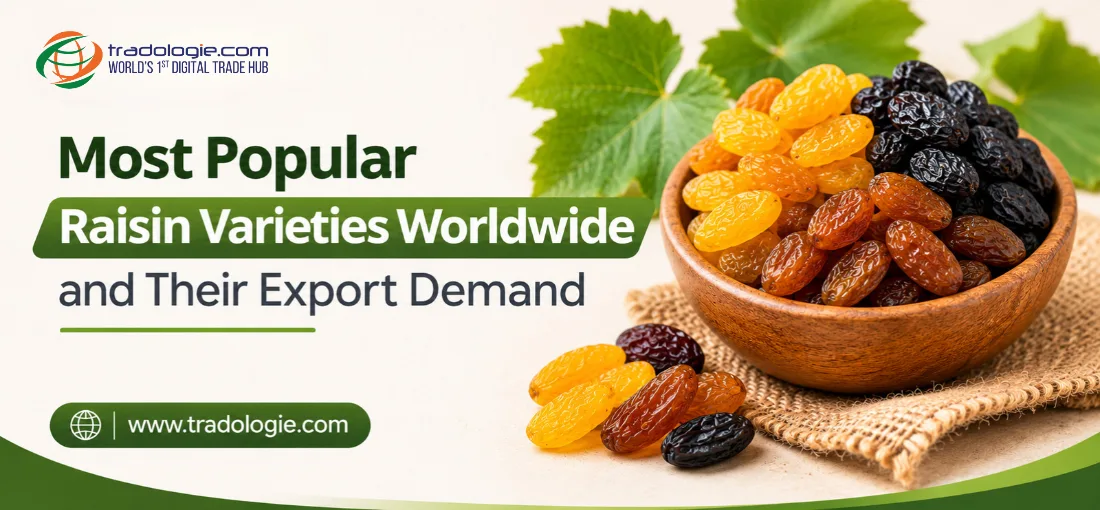
- The most popular raisin varieties include Thompson Seedless, Sultana, Golden Raisins, Flame Raisins, Black Raisins, Monukka, Muscat, Malaga and Corinthian Currants.
- Türkiye was the world's largest dried-grape producer in 2024, with approximately 315,000 MT, followed by the United States and China.
- Türkiye led global raisin exports in 2024, recording US$599.33 million in export value, followed by the United States and South Africa.
- The European Union was the largest dried-grape importing market in 2024, with imports worth approximately US$605.18 million.
- India exported US$79.93 million worth of raisins in 2024, with Morocco, Saudi Arabia and Romania among its leading destinations.
Introduction
Raisins (or known as Kishmish in India) are some of the most popular dried fruits. They can be found in many food products including baking, confectionery, breakfast cereals, snack mixes and traditional foods. They are purchased by food manufacturers, wholesalers, retailers and ingredient processors worldwide. There are many types of raisins available including Thompson Seedless, Sultana, Golden Raisins, Flame Raisins and Black Raisins. Knowing which are the most popular varieties of raisins and which types of kishmish are available can help businesses understand what options they have when sourcing.
Below are some of the popular raisin varieties globally.
Thompson Seedless Raisins – A Popular Variety
Thompson Seedless is one of the most popular raisin varieties. This raisin was originally created in the United States from a grape indigenous to the Middle East and is now grown in many countries including India, Türkiye, United States, Australia and South Africa.
The grapes are seedless and will create a light green, golden or brown raisin depending on how they are dried. They are very sweet and small seeds free making them suitable for eating, baking, confectionery and food manufacturing.
In India Thompson Seedless and its clones are the main raisin variety used for commercial raisin production. This raisin is popular amongst exporters as it can be used in many styles.

Sultana Raisins – Popular Variety
Sultana raisins are one of the most popular commercial varieties. They are popular in countries such as Türkiye and Australia. They are usually made from seedless white grapes. They are often linked to Thompson Seedless.
Sultanas are small to medium sized, soft and sweet. The light golden-brown colour makes them suitable for using in cakes, biscuits, breakfast cereals, fruit mixes and snack foods.
Sultana raisins are a major supplier globally. The Aegean region of Türkiye is heavily involved in the production with Manisa and Izmir being a key region. They are a popular choice in European food manufacturing and wholesale.
Golden Raisins – Premium Variety
Golden raisins are identifiable by their bright golden-yellow colour and soft texture. They are usually made from seedless grapes.
Many golden raisins are treated with sulphur dioxide to help preserve the golden colour. However, this will depend on the manufacturer and food regulations. These raisins are popular for using in premium retail, baking, confectionery, breakfast cereals and specialty foods due to their attractive appearance. When importing golden raisins it is important to check how much sulphur dioxide has been used and what the labelling requirements are in the destination market.
Flame Raisins – Red Variety
Flame Seedless is a red grape variety that is popular for eating. However, it can also be used for dried grapes. When made into raisins they will be a darker red/brown colour.
They are very sweet and have a nice firm berry and attractive colour. They can be used in snack mixes, baking and specialty dried fruits.
They are not as well established as Thompson Seedless/Sultana raisins but can offer a unique product.
Black Raisins – Dark Variety
Black raisins are made from dark skinned grapes. They are popular commercially for their dark purple, brown or almost black colour. They can vary in taste from moderately sweet to rich.
In India Sharad Seedless and its clones are some of the grape varieties used for darker raisins. They are commonly sold in retail grocery. They can also be used in confectionery, baking and traditional foods.
When purchasing raisins it is important to know what colour you want, how much stem has been removed, the size of the berries and the moisture content. Black raisins can vary in grape variety and process so it is important to know what variety your supplier is using.
Manukka/Monukka Raisins – Large Variety
Monukka is a seedless or sometimes seeded dark grape variety. They are known for having large berries and a distinct flavour.
In India Manukka is used for some larger dark dried grapes. However, not all raisins labelled as manukka will be the same botanically or commercially. It is important to know what variety, seeded or not and where they are from.
These raisins are generally sold in specialty retail and dried fruit markets.
Muscat Raisins – Traditional Variety
Muscat raisins are made from Muscat grape varieties. They can vary from golden, amber to dark brown dependant on the variety and drying process.
They tend to have a more intense flavour than usual seedless raisins. They can be used in premium baking, desserts, confectionery and specialty dried fruits.
Muscat raisins are produced in many Mediterranean and grape growing regions. They are different to regular Sultana raisins so it is important to know what variety you are getting.
Malaga Raisins – Traditional Variety
Malaga raisins are traditionally produced in the Málaga region of Spain. They are usually made from Muscat of Alexandria grapes. They are larger than many small seedless raisins and can be seeded.
They are known for having a rich flavour and larger berries. They are a specialty product in the dried fruit market. They can be used in premium retail, desserts and traditional foods.
They may differ from regular seedless raisins.

Corinthian Currants – Small Dark Dried Grapes
Zante currants are commonly known as Corinthian currants. They are made from small dark grape varieties such as Black Corinth. They are not the same as regular raisins.
They are small, dark and have a concentrated flavour. They are popular in baking, fruit cakes, puddings and confectionery. They are well known for being produced in Greece.
It is important to note that currants differ from regular raisins. They will have different physical characteristics and commercial requirements.
Important Raisin Varieties and Grape Varieties in India
India has a strong raisin processing industry. Many varieties are produced in Maharashtra and some in Karnataka. Thompson Seedless and its clones are identified as important varieties by the ICAR-National Research Centre for Grapes.
Some important grape varieties in India include:
- Thompson Seedless – A key raisin variety in India. They are seedless and suitable for drying.
- Sonaka – A Thompson Seedless clone with long berries and thin skin. They can be used for raisins; however, there is a risk of berries splitting and rotting due to rain close to harvest.
- Tas-A-Ganesh – Another Thompson Seedless clone. They are known for having larger berries and clusters. They are an important variety in Maharashtra grape-growing regions.
- Manik Chaman – A Thompson Seedless clone with long berries. They are grown in Maharashtra and surrounding grape-growing regions and can be used for raisins.
- Sharad Seedless – A dark seedless grape. They are used for black raisins.
Other promising varieties identified by the ICAR-NRC for Grapes include A 17-3, E 12/3, Mint Seedless, Superior Seedless and KR White. However, these may not always be available commercially so it is important to check what variety your supplier is offering.
Key Raisin Producing Countries
Raisins are produced in countries with suitable grape growing climates. In 2024 there was approximately 1.287 million metric tonnes of dried grapes produced globally (OIV).
The top producers were:
| Country | 2024 Production (Approx.) |
|---|---|
| Türkiye | 315,000 MT |
| United States | 228,000 MT |
| China | 170,000 MT |
| Iran | 164,000 MT |
| South Africa | 94,000 MT |
| Uzbekistan | 63,000 MT |
| Chile | 47,000 MT |
| Argentina | 40,000 MT |
| Afghanistan | 38,000 MT |
| India | 33,000 MT |
Türkiye, United States, China, Iran and South Africa account for around 3/4 of the global production.
It is worth noting that there are varying estimates for dried grape production in different industry sources. The above figures have been taken from the OIV 2024 data to ensure they are comparable globally.
Global Raisin Export Market
Raisins are classed as dried grapes (HS Code 080620). This means they can come in many varieties and styles so it is not possible to accurately split the value between Thompson Seedless, Sultana, Golden Raisins etc.
According to World Bank WITS data (UN Comtrade) the top raisin exporters in 2024 were:
| Country | Value (US$ Million) | Quantity (MT) |
|---|---|---|
| Türkiye | 599.33 | 205,939 |
| United States | 197.40 | 53,711 |
| South Africa | 178.78 | 81,720 |
| Chile | 149.08 | 59,069 |
| China | 144.50 | 76,378 |
| India | 79.93 | 55,618 |
| Uzbekistan | 78.31 | 52,963 |
| Argentina | 71.85 | 38,521 |
Türkiye were the largest exporter of raisins. They are well known for supplying Sultana raisins globally. The United States, South Africa and Chile also have large export industries.
The OIV estimated there was approximately 933,000 tonnes of dried grapes exported globally. This would be worth around €1.8 billion. This is for dried grapes overall and not for any specific raisin variety.
Key Markets
According to WITS data, the largest importer of dried grapes was the European Union. This was worth approximately US$605.18 million and 227,016 MT.
Other key importers were:
| Country | Value (US$ Million) | Quantity (MT) |
|---|---|---|
| United Kingdom | 232.72 | 84,923 |
| Germany | 181.81 | 67,267 |
| Netherlands | 145.49 | 56,732 |
| Japan | 92.28 | 27,471 |
| India | 89.22 | 30,344 |
| France | 77.33 | 26,044 |
| Canada | 69.32 | 22,152 |
There is a high demand for dried grapes from many sectors including retail grocery, baking, confectionery, breakfast cereals and snack foods. European markets are particularly important for suppliers offering quality, traceability and food safety.
India's Raisin Export Market
India is a key raisin producer and exporter. Most raisins are produced commercially in Maharashtra with some in Karnataka.
According to WITS/UN Comtrade India exported dried grapes worth approximately US$79.93 million in 2024. This was 55,617.70 MT.
Some of the top destinations for raisin exports in 2024 were:
Destination Value (US$ Million) Quantity (MT)
| Country | Value (US$ Million) | Quantity (MT) |
|---|---|---|
| Morocco | 15.41 | 9,811 |
| Saudi Arabia | 7.63 | 5,259 |
| Romania | 5.65 | 4,491 |
| Russia | 4.63 | 3,394 |
| Vietnam | 4.26 | 2,661 |
| Sri Lanka | 3.55 | 2,713 |
This shows India has access to many markets including North Africa, Middle East, Eastern Europe and Southeast Asia. Morocco was the largest destination in terms of value.
India also have many options for exporting raisins. There are many different grades, darker varieties, berry sizes and styles available. However, to be competitive they must offer quality, pricing, food safety and the correct specifications.
HS Codes
It is important to know what product you are importing/exporting.
Globally raisins are classed under:
HS 080620 – Dried grapes.
In India they are classed under:
| ITC-HS Code | Product |
|---|---|
| 08062010 | Raisins |
| 08062090 | Other dried grapes |
This is important to know when exporting. Globally raisins fall under HS 080620. In India there are further classifications. Exporters and importers should check what variety they are exporting and what the current customs tariff is.
What to Check When Importing Raisins
The value of raisins will depend on what variety you are importing. It is important to have a written specification for the product.
Key points to consider:
- Variety – What grape variety, country of origin and seeded/seedless?
- Colour – What colour do you want? Green, golden, amber, brown or black? What colour variation is acceptable?
- Size – What size berries do you want? What size range?
- Moisture Content – High moisture can cause deterioration, mould and fermentation. What level of moisture is acceptable?
- Stem – Are there any stalks?
- Foreign Matter – Are there any leaves, dust, stones, etc.?
- Sulphur Dioxide – Are they treated? What level of SO₂ have they declared? What levels are acceptable in the destination market?
- Pesticides & Microbiology – Ask for suitable lab reports.
- Packaging – Are they packaged in food-grade packaging? What is the net weight? What conditions will they be stored in? What is the shelf life?
The Codex Standard for Raisins and General Standard for Dried Fruits will give you an idea of what quality and product you should be getting. Importers should also check what food regulations apply in their destination market.
Conclusion
The dried grape industry can vary greatly globally. There are many different varieties available from regular seedless raisins to premium golden, dark and specialty raisins. It is important to choose a supplier who can offer the correct product, process, quality and application.
Exporters should be able to offer consistent quality, what is needed in the destination market and consistent quantities.
Disclaimer
The information presented in this article is intended for general informational purposes. Production estimates, export values, import demand and international trade conditions may change over time. Trade statistics cited in this article relate to 2024 and cover dried grapes collectively rather than individual raisin varieties. HS classifications and national tariff codes should be verified against the latest applicable customs tariff. Importers and exporters should also confirm product specifications, food-safety standards, documentation and destination-country regulations with the relevant authorities before entering into commercial transactions.