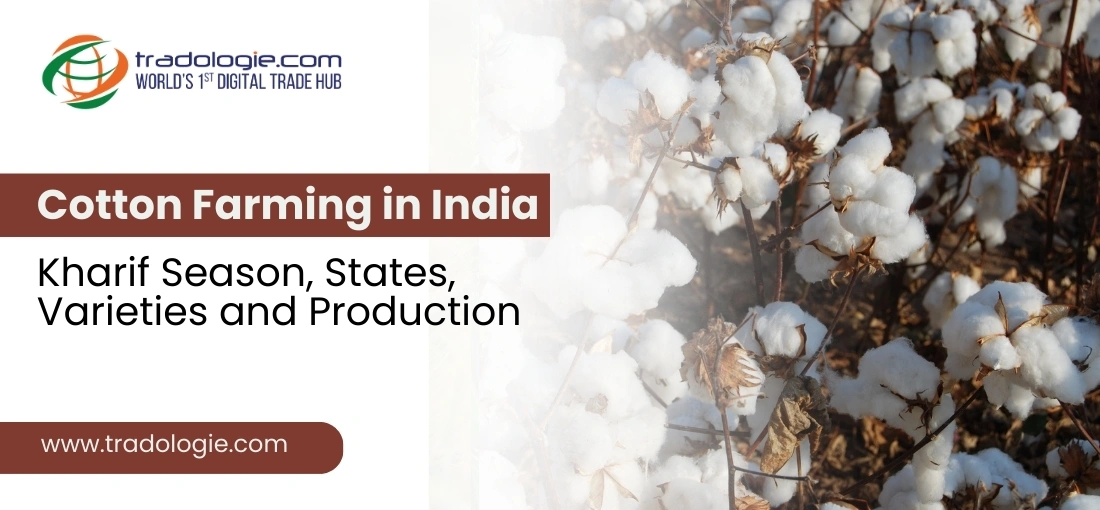
Cotton is India's most important commercial crop and the backbone of the country's textile industry. Known as "White Gold", cotton supports the livelihoods of over 6 million farmers and employs approximately 40 million people across the textile and ginning industries.
India is the world's largest cotton producer, growing approximately 32 million bales annually. Understanding cotton farming — when it is grown, where it thrives, and how it reaches global markets — is essential for farmers, students, and businesses involved in textile and agricultural commodity trade.

Quick Answer
Cotton is a Kharif crop in India, sown in April–June and harvested between October and December. It grows best in black cotton soil with warm temperatures and moderate rainfall. Gujarat, Maharashtra, and Telangana are India's top cotton-producing states. India produced approximately 32 million bales of cotton in 2025-26.
Cotton Growing Season in India
Cotton is a Kharif season cropwith a longer growing cycle than most other Kharif crops. While most Kharif crops are harvested in September–October, cotton harvesting extends through November–December due to its longer maturation period.
Cotton requires:
- Warm temperature — 21°C to 35°C throughout growing period
- Moderate rainfall — 500–1,000mm well distributed
- Deep, well-drained black soil — also called Regur or black cotton soil
- Long frost-free growing season — minimum 180 days
- Dry conditions at boll opening — excess moisture causes boll rot
Cotton Crop Calendar
| Stage | Months |
|---|---|
| Field Preparation | March – April |
| Sowing | April – June |
| Vegetative Growth | June – August |
| Flowering and Boll Formation | August – September |
| Boll Opening | October – November |
| Harvesting | October – December |
| Picking Completion | December – January |
Cotton has one of the longest crop cycles among Kharif crops — approximately 180–210 days from sowing to final picking. This is why cotton harvesting continues well after other Kharif crops have been harvested.
Top Cotton Producing States in India 2025-26
| State | Production (Million Bales) | Share of Total | Soil Type |
|---|---|---|---|
| Gujarat | 9.5 | 29.7% | Black and alluvial soil |
| Maharashtra | 7.8 | 24.4% | Deep black cotton soil |
| Telangana | 5.2 | 16.3% | Black and red soil |
| Andhra Pradesh | 3.0 | 9.4% | Black and red soil |
| Rajasthan | 2.2 | 6.9% | Alluvial and sandy soil |
| Haryana | 1.5 | 4.7% | Alluvial soil |
| Punjab | 1.2 | 3.8% | Alluvial soil |
| Madhya Pradesh | 0.8 | 2.5% | Black soil |
| Karnataka | 0.6 | 1.9% | Red and black soil |
| Other States | 0.2 | 0.6% | Various |
Source: Cotton Corporation of India, 2025-26 Estimates
Gujarat is India's largest cotton-producing state, contributing nearly 30% of national output. Maharashtra grows cotton predominantly in the Vidarbha region, where cotton farming is deeply embedded in the agricultural economy.
Popular Cotton Varieties Grown in India
India grows both Bt cotton (genetically modified for pest resistance) and traditional non-Bt varieties across different regions.
Bt Cotton Hybrid Varieties
| Variety | Key Feature | Growing Region |
|---|---|---|
| Bollgard II (BG II) | Double gene pest resistance | All cotton zones |
| RCH 2 BG II | High yield, widely grown | Central and South India |
| MRC 7351 BG II | Long staple, high quality | Maharashtra, Telangana |
| Ankur 651 BG II | Drought tolerant | Rainfed areas |
| Nuziveedu varieties | High yield, multiple options | Andhra Pradesh, Telangana |

Traditional and Non-Bt Varieties
| Variety | Key Feature | Growing Region |
|---|---|---|
| Suvin | Extra long staple, premium quality | Tamil Nadu |
| DCH 32 | Long staple hybrid | Karnataka |
| Jayadhar | Medium staple, drought tolerant | Karnataka |
| LD 694 | Short staple, rainfed | Punjab, Haryana |
Cotton Fibre Classification by Staple Length
| Category | Staple Length | Use |
|---|---|---|
| Short Staple | Below 20mm | Coarse textiles |
| Medium Staple | 20–24mm | General textiles |
| Long Staple | 24–28mm | Fine textiles |
| Extra Long Staple | Above 28mm | Premium export textiles |
Cotton Cultivation Methods in India
1. Rainfed Cotton
Grown entirely on monsoon rainfall without supplemental irrigation. Approximately 65% of India's cotton area is rainfed. Common in Maharashtra's Vidarbha region and parts of Telangana. Yields are lower but input costs are significantly reduced.
2. Irrigated Cotton
Grown with assured irrigation — either canal, drip, or groundwater. Higher yields and more consistent quality. Common in Gujarat, Punjab, Haryana, and parts of Andhra Pradesh.
3. Drip Irrigation Cotton
Drip irrigation combined with fertigation (fertilizer through drip lines) is increasingly adopted in Gujarat and Maharashtra. Saves 40–50% water compared to flood irrigation and improves yields by 20–30%
4. High Density Planting System (HDPS)
More plants per hectare with reduced spacing. Can increase yields significantly. Under large-scale trials by ICAR across major cotton-growing states.
Cotton Production Trend in India (2021–2026)
| Year | Production (Million Bales) | Area (Million Hectares) | Yield (Kg/Hectare) |
|---|---|---|---|
| 2021-22 | 31.2 | 12.6 | 446 |
| 2022-23 | 33.7 | 13.3 | 457 |
| 2023-24 | 32.5 | 12.9 | 452 |
| 2024-25 | 31.8 | 12.5 | 458 |
| 2025-26 | 32.0 | 12.4 | 463 |
Note: One bale = 170 kg of lint cotton Source: Cotton Corporation of India, Ministry of Textiles 2025-26
India's cotton yield per hectare remains significantly below the global average of approximately 800 kg per hectare. The United States and Australia achieve yields above 1,000 kg per hectare. Improving India's cotton yield is a major priority for agricultural research institutions.
Cotton MSP in India 2025-26
The Government of India announces cotton MSP before each Kharif sowing season.
| Cotton Type | MSP 2025-26 (₹ per quintal) | Increase from 2024-25 |
|---|---|---|
| Medium Staple Cotton | ₹7,121 | +₹501 |
| Long Staple Cotton | ₹7,521 | +₹501 |
Source: Cabinet Committee on Economic Affairs (CCEA), Government of India
Cotton MSP has increased significantly in recent years reflecting rising input costs and government support for cotton farmers.
India's Role in Global Cotton Trade
India occupies a dominant position in global cotton markets as both a major producer and significant exporter.
India Cotton Trade Facts 2025-26
| Indicator | Value |
|---|---|
| Total Production | 32 million bales |
| Domestic Consumption | 26 million bales |
| Export Volume | 4.5–5 million bales |
| Import Volume | 1.5–2 million bales |
| Major Export Destinations | Bangladesh, China, Vietnam, Indonesia, Pakistan |
| Major Import Origin | USA, Australia, Brazil |
India exports raw cotton primarily to Bangladesh — the world's largest garment exporter — as well as to Vietnam, China, and Indonesia where textile manufacturing is concentrated.
India also imports extra long staple cotton from the USA and Australia for premium textile manufacturing that requires fibre quality beyond what domestic varieties offer.
For cotton farmers and traders looking to connect with textile mills and exporters, selling agricultural commodities online provides direct access to verified buyers across domestic and international markets. Textile businesses and cotton importers can buy cotton and agricultural commodities online directly from Indian producers at competitive prices during the harvest season.
Challenges in Cotton Farming in India
1. Pink Bollworm Resistance Pink bollworm — a key cotton pest — has developed resistance to Bt cotton in several states, particularly Gujarat and Maharashtra. This has increased pesticide costs and reduced the yield advantage of Bt varieties. New resistance management strategies and next-generation Bt traits are being developed.
2. Low Yield Per Hectare India's cotton yield of approximately 463 kg per hectare is among the lowest of major cotton-producing countries. Poor soil health, rainfed cultivation, and suboptimal agronomic practices are key reasons.
3. Price Volatility Cotton prices are determined by global supply-demand dynamics and are highly volatile. Farmers in rainfed areas are particularly vulnerable to price crashes after good monsoon years when production surges.
4. Input Cost Escalation Rising costs of Bt hybrid seeds, pesticides, and fertilizers have significantly increased cotton cultivation costs over the past decade, squeezing farmer margins especially in low-yield rainfed areas.
5. Climate Change Impact Erratic rainfall, extended dry spells during boll formation, and unseasonal rains during harvest reduce cotton yields and quality. Vidarbha region in Maharashtra is particularly vulnerable to climate variability.
Cotton vs Other Kharif Crops — Key Differences
| Feature | Cotton | Rice | Maize |
|---|---|---|---|
| Season | Kharif | Kharif | Kharif |
| Sowing Time | April–June | June–July | June–July |
| Harvest Time | October–December | September–October | September–October |
| Crop Duration | 180–210 days | 110–150 days | 90–110 days |
| Water Requirement | Moderate | Very High | Moderate |
| Primary Use | Fiber and oil | Food | Food and feed |
| Best Soil | Black cotton soil | Clay and loam | Sandy loam |
For a complete overview of all Kharif crops and their comparison, read our Kharif crops complete list with states.
Conclusion
Cotton farming is the economic lifeline of millions of Indian farmers and the foundation of India's massive textile industry. As a Kharif crop grown across 12–13 million hectares annually, cotton's performance each monsoon season has far-reaching implications for farmers, textile manufacturers, and global commodity markets.
Improving cotton yields, managing pest resistance, and expanding drip irrigation adoption are the most critical priorities for India's cotton sector in the coming years. For farmers, traders, and businesses across the cotton value chain, understanding India's cotton production calendar and market dynamics is essential for informed decision-making.
Data sources: Cotton Corporation of India (2025-26), Ministry of Textiles, ICAR-Central Institute for Cotton Research, APEDA Cotton Export Data 2025
Frequently Asked Questions
Is cotton a Kharif crop?
Yes. Cotton is a Kharif crop sown during the monsoon season between April and June and harvested between October and December. It is one of India's most important Kharif cash crops.
Which state produces the most cotton in India?
Gujarat is India's largest cotton-producing state, contributing approximately 30% of national production. Maharashtra is the second largest producer.
Why is cotton called White Gold?
Cotton is called White Gold because of its high economic value, white fluffy appearance of cotton bolls, and its critical importance to India's textile industry and farmer livelihoods.
What is Bt cotton?
Bt cotton is a genetically modified cotton variety that produces a protein toxic to bollworm pests, reducing the need for pesticide applications. Bt cotton covers over 90% of India's cotton cultivation area.
When is cotton harvested in India?
Cotton harvesting in India begins in October and continues through December. Unlike most Kharif crops harvested in September–October, cotton has a longer growing cycle of 180–210 days.
What is the MSP of cotton in 2025-26?
The MSP for medium staple cotton is ₹7,121 per quintal and for long staple cotton is ₹7,521 per quintal for the 2025-26 season.
How much cotton does India export?
India exports approximately 4.5 to 5 million bales of cotton annually. Bangladesh, China, and Vietnam are the largest buyers of Indian cotton.
What soil is best for cotton farming?
Deep black cotton soil — also called Regur soil — is the best soil for cotton farming. It has excellent water retention capacity and is rich in calcium, magnesium, and iron.