Key Highlights
- If you want to export wheat from India to Dubai, first check the current Indian export policy and confirm the applicable HS code.
- Identify buyers whose requirements match your wheat quality, quantity, protein content and intended use.
- Complete the applicable Indian export registrations and verify UAE import, food-safety and phytosanitary requirements.
- Prepare the required export documents, including the commercial invoice, shipping bill and applicable certificates.
- Calculate procurement, testing, transportation, freight and destination-related costs before quoting your buyer.
- Connect with potential UAE importers, flour mills and grain traders through trade networks and B2B platforms such as Tradologie.
Introduction:
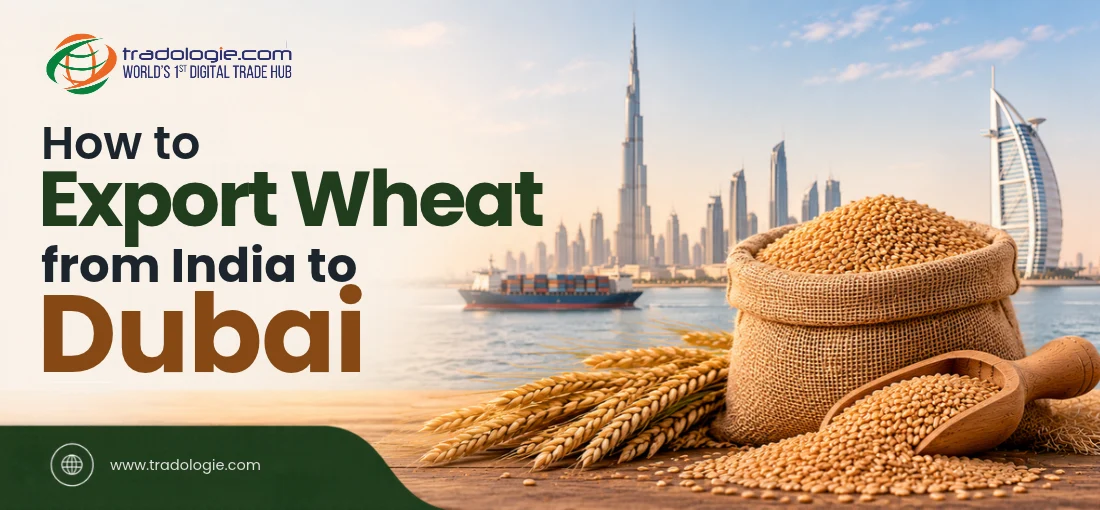
For Indian wheat exporters, profitability depends on more than the price agreed upon with a buyer in Dubai. Quality specifications, transportation costs to the port, freight rates and delivery terms all influence the final cost of a shipment. A clear understanding of the wheat export process from India to Dubai helps exporters calculate these expenses in advance and determine whether the agreed price leaves enough room for a reasonable profit.
The buyer's requirements deserve equal attention. A flour mill purchasing wheat for production has different priorities from a grain trader buying bulk cargo for resale. One may be particular about protein content and milling performance; another may focus more on price, availability and consistency across shipments. An exporter needs to establish these expectations before confirming a purchase or making a firm offer.
For businesses learning how to export wheat from India to Dubai, the first step is not finding the cheapest wheat available. It is understanding what can be supplied reliably, which buyers need that quality and whether the numbers make commercial sense.
This informative blog piece tells you the wheat export process from India to Dubai in detail.

Understanding the Wheat Market in Dubai
Dubai is an important trading and distribution centre for food commodities. According to World Integrated Trade Solution (WITS) data, the UAE imported approximately 1.55 million tonnes of wheat and meslin in 2023, valued at around US$547 million. Wheat entering the UAE may supply local flour mills and food manufacturers or enter trading networks that serve other markets.
Indian exporters can pursue these opportunities, but they are competing with established international suppliers.
Russia, Canada, Australia and European suppliers have a presence in the UAE wheat market. An Indian exporter therefore needs to approach buyers with a clear understanding of what they want to purchase. A suitable wheat specification, dependable supply, competitive pricing or the ability to fulfil an agreed quantity within a particular delivery window may help make an offer more attractive.
Market demand alone does not guarantee a sale. An importer may already have contracts with established suppliers, and a new offer will need to make sense against the buyer's existing procurement arrangements. Before approaching potential customers, exporters should understand the type of wheat they need, the quantity they purchase and the terms under which they normally import it.
Check India's Wheat Export Policy First
Export policy should be checked before making commitments to an overseas buyer. India's wheat export rules have changed over time, so exporters should not rely on an old news report, a previous shipment or advice received several months earlier.
DGFT Notification No. 35/2026-27, dated 24 August 2026, changed the export policy for specified wheat categories under ITC (HS) codes 10011900 and 10019910 from Prohibited to Free, with immediate effect. Exporters should verify the latest DGFT notifications and the precise classification applicable to their product before proceeding.
Wheat grain and wheat flour also fall under different HS codes. The export policy for wheat flour should therefore be checked separately rather than assumed to be identical to the policy for whole wheat.
Once the Indian export position is clear, the next task is to confirm that the proposed shipment meets the UAE's import conditions. Permission to export a commodity from India does not, by itself, mean that the consignment will automatically be cleared for entry into Dubai.
Decide Which Wheat You Can Supply
Not every buyer in Dubai will accept the same wheat. The required specification depends on its intended use, the buyer's production process and the terms of the purchase contract.
A flour mill may ask for particular protein levels, moisture limits, test weight and milling characteristics. A bulk grain trader may be more concerned with the overall grade, price, shipment size and resale requirements. These details should be agreed in writing instead of being left to assumptions.
Before finalising the purchase, confirm the following:
- Moisture content: Excess moisture can affect storage and increase the risk of deterioration during transit.
- Protein content: Important for buyers who need wheat with specific baking or milling characteristics.
- Foreign matter and impurities: The consignment should remain within the buyer's agreed limits.
- Damaged and broken grains: The acceptable percentage should be clearly stated in the contract.
- Test weight and grain condition: These help establish whether the wheat meets the buyer's quality expectations.
- Sampling and inspection: Both parties should know how samples will be collected, tested and approved.
A sample is useful, but it does not remove the need for quality control across the actual consignment. If the sample meets the specification while the bulk shipment does not, the exporter may face a claim, a price adjustment or a dispute over acceptance.
The agreed specification should also be checked against applicable UAE requirements. A buyer's preferred grade and a country's legal food-safety requirements are not the same thing. The contract needs to address the commercial specification, while the importer must ensure that the product is eligible for entry and sale in the UAE.
Find Buyers Before Committing to Stock
Exporters can approach flour mills, food manufacturers, commodity traders and importers that handle wheat or other grains in the UAE. Trade exhibitions, industry contacts, referrals and B2B trade platforms can help identify potential buyers.
Tradologie is one option for businesses looking to connect with buyers and sellers in bulk commodity trade. Whatever channel is used, the exporter should assess the buyer's requirements and commercial credibility before committing to a transaction.
An introductory message should do more than announce that wheat is available. It should state the wheat type, origin, available quantity, quality parameters, packing or bulk-loading arrangement and proposed delivery terms. If the buyer has a specific specification, ask for it before quoting.
The quantity matters as well. A buyer seeking a regular supply programme may evaluate the offer differently from one purchasing a single shipment. Exporters should be clear about the volume they can deliver now and the quantities they can support in later orders.
When planning to export wheat to Dubai, avoid purchasing a large quantity solely because a prospective buyer has expressed interest. An inquiry is not a confirmed order. Written agreement on the product specification, quantity, price, delivery schedule and payment terms provides a much firmer basis for procurement.

Complete the Required Indian Export Registrations
Before shipping wheat commercially, make sure the business has the registrations and documentation applicable to its activity. Requirements can vary with the product, transaction and current regulations, so the checklist should be confirmed with the relevant authorities and a customs professional.
Importer-Exporter Code (IEC): An Import export code IEC issued by the Directorate General of Foreign Trade is generally required for commercial exports from India.
GST registration and tax documentation: Confirm the applicable GST treatment and export documentation with a qualified tax professional.
APEDA requirements: Check whether APEDA registration or other commodity-specific formalities apply to the proposed wheat export.
FSSAI requirements: Confirm the food-business licensing and compliance requirements applicable to the exporter and its activity. Do not assume that every export transaction has identical licensing requirements.
Product classification: Establish the correct ITC (HS) code for Indian export documentation and confirm the corresponding UAE import classification with the buyer or customs representative.
The exporter should also check whether additional approvals, declarations or inspection requirements apply to the specific consignment. Completing this work early is preferable to discovering a missing requirement after the cargo has reached the port.
Dubai and UAE Import Requirements for Wheat
Indian export clearance is only one side of the transaction. The wheat must also satisfy the applicable UAE import requirements before it can be released at the destination.
The importer in Dubai normally plays a central role in arranging local registrations, submitting the import application and coordinating customs and food-control procedures. The Indian exporter should work with that importer before dispatch, rather than treating destination clearance as something that can be handled after the vessel arrives.
1. Dubai Municipality Food Registration and Import Clearance
Where wheat is being imported for the Dubai local market, the importer should confirm the applicable Dubai Municipality requirements, including food-establishment registration, food-item registration and assessment, and import-consignment release procedures.
Key requirements and procedures:
- Food-establishment registration: The importer should confirm the applicable registration requirements for the business.
- Food-item registration: The wheat product may need to be registered and assessed through the relevant municipal system.
- Import application: The importer should submit the required request and supporting shipment documents.
- Inspection and release: The consignment may undergo document checks, inspection or sampling before release.
Dubai Municipality provides services for food-item registration and assessment, as well as the release of imported food consignments for sale in the local market. The applicable process and documents should be confirmed for the product and intended use.
Important distinction: A wheat shipment intended for re-export may follow a different procedure from one being released for sale within Dubai. The importer should make this distinction clear when arranging the transaction.
2. Phytosanitary Certificate and Plant-Health Conditions
Wheat is a plant product, so plant-health requirements deserve particular attention. Under the UAE's federal agricultural-quarantine legislation, regulated agricultural consignments are subject to applicable phytosanitary requirements and inspection. A phytosanitary certificate issued by the competent authority in the exporting country is a key requirement for covered consignments.
What Indian exporters should check:
Phytosanitary certificate: Coordinate with the appropriate plant-quarantine authority in India to establish the certification procedure for the shipment.
Additional declarations: Confirm whether any specific declarations apply to wheat originating in India.
Treatment and inspection: Verify whether the destination's plant-health conditions require particular treatment or inspection.
Pest and contamination control: Ensure the grain complies with applicable restrictions on prohibited pests and other contaminants. Soil, weed seeds and extraneous material can also create problems under phytosanitary controls.
The certificate must correspond to the actual consignment. Do not wait until loading to arrange it. If the required inspection or treatment has not been completed, the shipment may face delays or other difficulties at the destination.
3. Food Safety and Quality Compliance
The UAE's food-control requirements concern whether imported food meets the applicable safety, quality and technical standards. Wheat should therefore be checked for the characteristics relevant to its intended use and the requirements applicable to the consignment.
Quality parameters to review:
- Moisture content: Check the grain's moisture level against the buyer's specifications and applicable requirements.
- Impurities: Assess foreign matter and other impurities in the grain.
- Grain condition: Verify that the wheat meets the agreed quality specifications.
- Contamination: Check for relevant contaminants and arrange testing where required.
Depending on the product, risk assessment and applicable requirements, the shipment may be selected for inspection or laboratory testing.
Quality documents and certifications
- Certificate of analysis (COA): Helps document test results when required by the buyer, contract or relevant regulations. It is not a universal substitute for official inspection or automatically mandatory for every shipment.
- HACCP and ISO 22000: Buyers may request evidence of food-safety management, and particular business activities may be subject to specific requirements.
Exporters should verify the actual conditions applying to their transaction rather than assuming that every certification is compulsory for all wheat consignments entering Dubai.
4. Fumigation and Treatment Requirements
Fumigation may be required where the applicable phytosanitary conditions, import instructions or contractual terms call for it. The treatment must be suitable for the commodity and carried out in accordance with the relevant requirements.
Before dispatch, confirm:
- Treatment requirements: Whether fumigation or another treatment is required for the specific consignment.
- Approved procedure: Whether the treatment must follow particular destination requirements.
- Supporting documents: Whether the importer or destination authorities require treatment records or a fumigation certificate.
A fumigation certificate should not be treated as automatically interchangeable with a phytosanitary certificate. They serve different purposes: one records treatment, while the other certifies plant-health compliance under the applicable requirements.
5. Labelling and Packaging
Bulk wheat and bagged wheat involve different handling and packaging arrangements. Before production or loading, confirm what the buyer and destination authorities require for the chosen shipment format.
For bagged wheat:
- Check the applicable labelling rules.
- Ensure that product information is consistent with the accompanying documents.
- Confirm whether any specific declarations or language requirements apply.
- Verify supporting documentation for claims such as organic or GMO-free, where applicable.
Special claims should not be printed or made casually. The exporter should be able to substantiate them in accordance with the applicable rules.
For bulk wheat:
- Check the condition of the cargo and cleanliness of the loading arrangements.
- Protect the grain against moisture and contamination.
- Ensure that the declared quantity and product details are consistent with the shipment documents.
Final check: Before dispatch, the Indian exporter and Dubai importer should jointly verify the applicable registration, phytosanitary, food-safety, treatment, labelling and customs-clearance requirements for the specific shipment. Requirements can differ depending on the product, intended use and whether the wheat is entering the UAE local market or moving through Dubai for re-export.
Documents Required to Export Wheat From India to Dubai
The final document set depends on the product, shipment arrangement, contract and applicable Indian and UAE requirements. The following table separates commonly used export documents from documents that need to be confirmed for the specific consignment.
| Document | Why it matters |
|---|---|
| Commercial invoice | Records the goods, quantity, price and agreed commercial terms. |
| Packing list or cargo details | Describes the shipment and its packaging, where applicable. |
| Shipping bill | Used for Indian export customs clearance. |
| Bill of lading | Serves as the principal transport document for sea freight. |
| Certificate of origin | Establishes the declared origin when required by the buyer or importing authorities. |
| Phytosanitary certificate | Certifies plant-health compliance for covered agricultural consignments. |
| Fumigation or treatment certificate | Provides evidence of treatment when required by the applicable conditions or contract. |
| Certificate of analysis or quality certificate | Records tested wheat characteristics when required or requested. |
| Insurance certificate | Provides evidence of cargo insurance when insurance is arranged under the contract. |
| Import application and supporting documents | Submitted by the UAE importer through the relevant destination procedures. |
The UAE importer should confirm the documents required for food registration, the import application and release of the shipment. Depending on the case, this may involve product-registration details, the relevant certificates from the country of origin, cargo information and supporting records for inspection.
A health certificate should not automatically be assumed to apply to every wheat shipment in the same way. The applicable food-control and phytosanitary requirements should be checked with the competent authorities for the product and consignment.
Keep the information consistent across all documents. Differences in product description, quantity, origin, HS classification or consignee details can delay customs clearance and create avoidable correspondence between the exporter, importer and freight forwarder.
Calculate the Export Price Carefully
A wheat export quotation should reflect the full cost of fulfilling the order, not just the price paid to the supplier.
Start with the cost of wheat procurement. Add cleaning, grading, testing, handling, packaging if applicable, inland transport, port charges, customs-related expenses, documentation, freight and insurance where relevant. Include financing costs and a reasonable allowance for unexpected expenses.
Destination-side charges also need attention. The importer and exporter should establish who will bear the applicable destination handling, customs clearance, inspection, storage and other charges under their agreed terms. These costs should not be left vague when the buyer compares offers from different suppliers.
The quotation must also reflect the delivery term agreed with the buyer.
- FOB (Free on Board): The seller generally arranges delivery and export clearance up to loading on board the vessel at the named port. The buyer normally arranges the main sea freight and insurance, although the precise allocation of responsibilities should be checked against the agreed Incoterms.
- CFR (Cost and Freight): The seller arranges and pays for sea freight to the named destination port. Insurance is not generally the seller's obligation under CFR.
- CIF (Cost, Insurance and Freight): The seller arranges and pays for sea freight and the required minimum insurance cover to the named destination port. The parties should check the precise obligations under the agreed Incoterms.
These terms are not interchangeable. A buyer comparing a CFR offer with an FOB offer is not necessarily comparing the same set of costs.
Before quoting, calculate the minimum price at which the order remains viable. Freight rates, currency movements, port expenses and the purchase price of wheat can change the final margin. A quotation that leaves no room for these movements can turn a completed shipment into an unprofitable one.
Choose the Shipping and Packaging Arrangement
The shipment method depends on the order size, buyer requirements, available logistics and the condition in which the wheat will be transported.
Large consignments may move as bulk cargo, while other orders may use containerised transport. Bagged shipments require suitable packaging and protection against moisture and contamination. Bulk cargo also needs appropriate handling, clean loading arrangements and checks to ensure the grain remains in acceptable condition.
The exporter should discuss loading, cargo inspection, sealing where applicable, transit time and delivery arrangements with the freight forwarder before confirming the shipment schedule. The buyer should know the expected dispatch and arrival dates, along with the process for handling delays or quality discrepancies.
The lowest freight quote is not always the best option. Reliability, handling practices, insurance arrangements and the likelihood of meeting the delivery window should also influence the decision.
Agree on Payment Terms Before Dispatch
Payment terms should be settled before the exporter commits funds to procurement and shipment. Both parties need to understand when payment becomes due, which documents trigger payment and what happens if the shipment is delayed or the documents contain discrepancies.
Depending on the relationship and the transaction, payment may be arranged through an advance payment, a letter of credit or another mutually agreed banking arrangement. The appropriate option depends on the buyer's creditworthiness, the exporter's risk tolerance and the cost of financing the order.
For a new buyer, checking business credentials and banking arrangements is particularly important. An attractive price is of little value if payment is uncertain after the goods have been dispatched.
The contract should clearly record the product specification, quantity, tolerance for weight differences where applicable, inspection procedure, delivery term, payment schedule and process for resolving disputes. Both sides should understand these conditions before signing.
The Steps to Export Wheat From India to Dubai:
The practical sequence to how to export wheat from India to Dubai is straightforward, provided each stage is completed before the next commitment is made.
- Check the current Indian wheat export policy and confirm the applicable HS classification.
- Identify the buyer's intended use, required grade, quantity and quality parameters.
- Source wheat that meets the agreed specification and arrange testing.
- Calculate the full export cost and submit a quotation under clearly stated delivery terms.
- Agree on the contract, inspection procedure, delivery schedule and payment conditions.
- Confirm the Indian export registrations and the UAE import requirements applicable to the shipment.
- Have the UAE importer confirm the relevant food-item registration and import-clearance process before dispatch.
- Arrange the phytosanitary certificate and any additional inspection, treatment or supporting documents required for the consignment.
- Prepare the invoice, shipping bill, transport documents and other applicable paperwork.
- Arrange transport, complete export customs formalities and dispatch the shipment.
- Coordinate with the importer on arrival procedures, inspection and release of the consignment.
- Submit the agreed shipping documents to the buyer or bank and follow the payment terms.
The precise sequence may vary with the shipment and the destination procedure. The important point is to settle the import requirements before dispatch, not after the cargo has reached Dubai.
Export Wheat to Dubai With a Clear Plan
Exporting wheat is not simply a matter of buying grain in India and finding a customer in Dubai. The exporter must bring together the right product, a workable price, reliable logistics, accurate documentation and payment terms that protect the transaction.
Businesses looking to export wheat to Dubai from India should begin by confirming the current export policy and identifying buyers whose requirements match the wheat they can supply. At the same time, the UAE importer should establish the applicable food-registration, phytosanitary, inspection and customs-clearance requirements for the intended shipment.
These checks are easier to manage before a contract is finalised. They also help both parties understand which documents are legally required, which depend on the shipment and which are simply part of the buyer's own quality standards.
A well-prepared offer gives the buyer fewer reasons to hesitate. It also gives the exporter a better chance of completing the order without avoidable delays, unexpected expenses or disputes over quality.
Disclaimer
Export policies, customs classifications, registration procedures and UAE import requirements may change. Requirements can vary depending on the wheat category, intended use and whether the consignment is intended for the local UAE market or re-export. Exporters should verify current DGFT notifications and confirm shipment-specific requirements with the relevant Indian authorities, UAE authorities and the importer before dispatch.