Key Highlights
- If you want to know how to export tur dal from India , start by obtaining an Importer Exporter Code (IEC) and checking the applicable APEDA, FSSAI, GST and other business requirements.
- Decide whether you will export whole dried pigeon peas or split and dehusked tur dal, as the product form affects processing, quality specifications and customs classification.
- Verify the current DGFT export policy and the correct ITC-HS code before accepting an order.
- Check the destination country's import requirements, including applicable food safety standards, pesticide residue limits, plant-health conditions, permits and labelling rules.
- Calculate the complete export cost, including sourcing, processing yield, grading, packaging, testing, freight, insurance and banking charges.
- Finalise the buyer's specifications, payment terms, required documents and shipping arrangements before dispatch to reduce the risk of delays, disputes and financial losses.
Introduction:
For an Indian pulse exporter, the opportunity in Tur Dal lies in finding buyers who need a dependable supply at a price that works for both sides. But the export business is not simply about sourcing Dal cheaply and shipping them overseas. Importers may have precise requirements for grain size, moisture, processing quality, packaging and cooking performance, while destination countries can impose their own food-safety and plant-health conditions. Anyone researching how to export tur dal from India needs to understand these commercial and regulatory requirements before accepting an order.
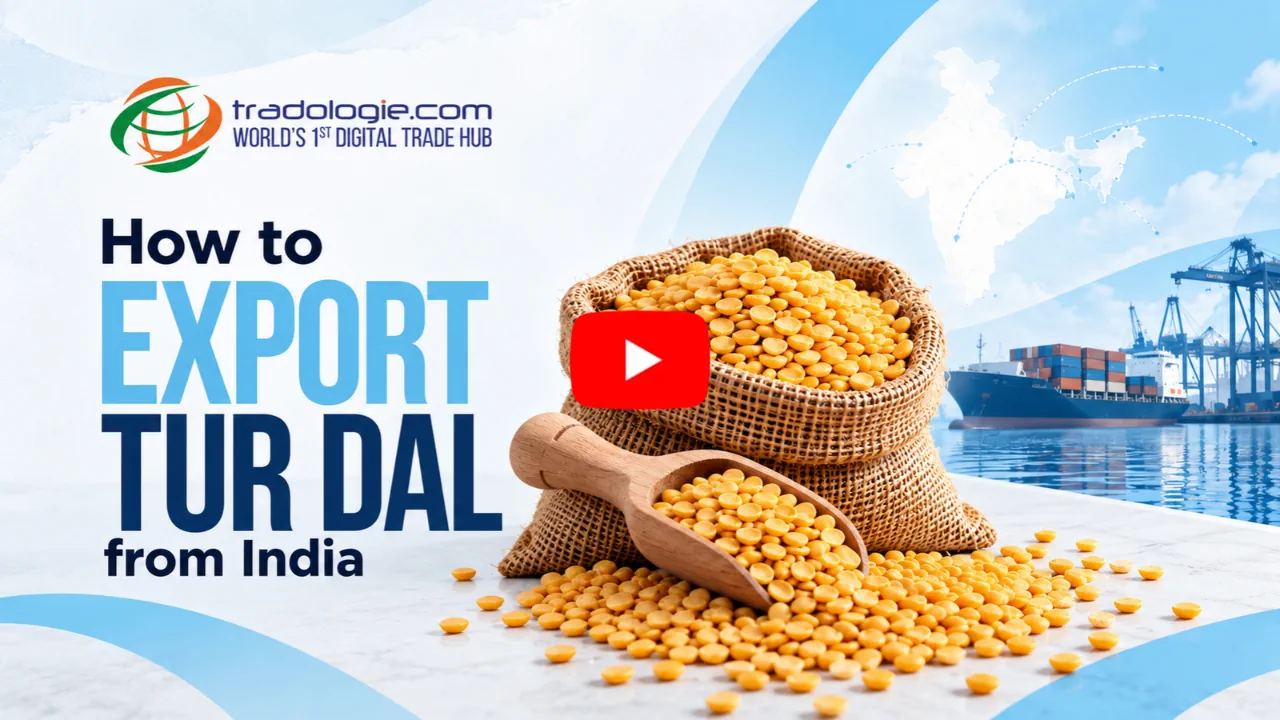
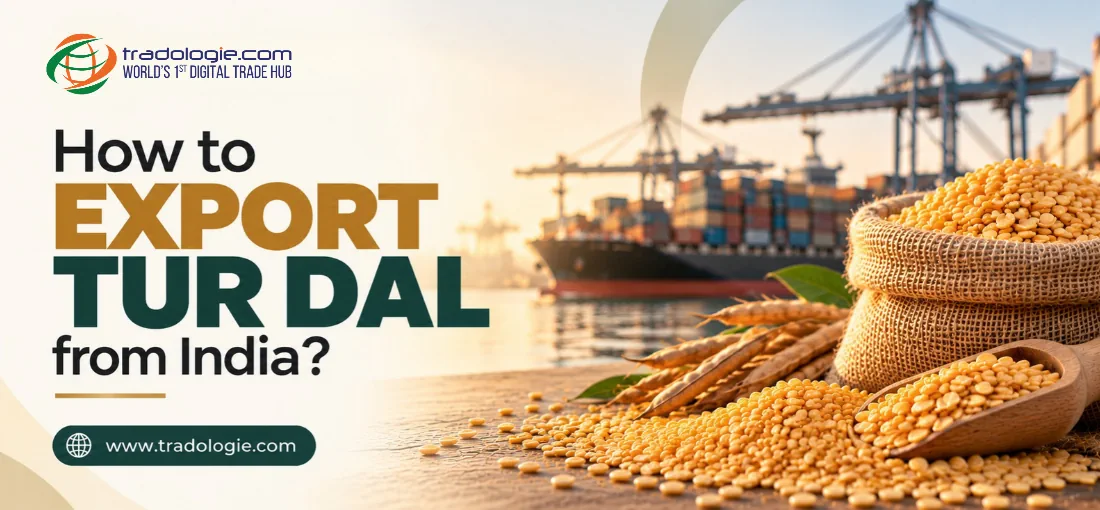
Tur dal, also known as arhar dal or pigeon pea, is traded in different forms. Some buyers import whole dried pigeon peas and process them locally, while others want ready-to-cook split and dehusked dal. That distinction affects the processing required, product specifications, packaging and potentially the customs classification. Exporters should settle these details before calculating their costs or making a commercial offer.
Reading this informative piece of a blog as it will tell you in detail the process of exporting tur dal from India.

India's Tur Dal Export Market: Understanding the Opportunity
India has a large pulse-processing industry, supported by production in states such as Maharashtra, Madhya Pradesh, Karnataka, Gujarat and Uttar Pradesh. The country also has established trade links with overseas buyers who source pulses for retail distribution, wholesale markets and food processing.
APEDA reported that India exported approximately 1 million tonnes of pulses, worth about US$969.53 million, during FY 2025-26. China, the United Arab Emirates, Bangladesh, the United States and Sri Lanka were among the leading destinations for Indian pulses overall. These figures cover multiple pulse varieties, not tur dal alone, but they indicate the wider export network available to Indian suppliers.
For tur dal exporters, the opportunity depends on the destination and the product being offered. Buyers in markets with established South Asian grocery networks may look for split, dehusked arhar dal in consumer-ready packs. Importers serving wholesale or food-processing businesses may prefer larger bags or whole pigeon peas for local processing.
There is no single export market that suits every supplier. Before approaching buyers, consider whether your business can supply the required quantity consistently, whether your processing setup meets the buyer's quality standards and whether the destination's import rules allow the product in the form you intend to ship.
A useful starting point is to study demand for the specific product rather than relying on broad claims about the global pulses market. Trade data, importer enquiries and the tariff classification for your product can help identify destinations worth investigating.
1. Complete the Registrations Required for Exporting Tur Dal
Before shipping tur dal overseas, an Indian business needs to establish its export credentials and check the requirements that apply to its products. Understanding the procedure for tur dal export from India at this stage helps exporters avoid documentation gaps and delays later.
Obtain an Importer Exporter Code (IEC)
The Importer Exporter Code (IEC), issued by the Directorate General of Foreign Trade (DGFT), is generally required to undertake commercial exports from India.
The application is made through the DGFT portal. Ensure that the business details, PAN and bank information are accurate, and keep the IEC details updated as required.
Check APEDA Registration Requirements
Pulses fall within APEDA's scheduled agricultural product portfolio. Exporters should check the applicable requirement for an APEDA Registration-cum-Membership Certificate (RCMC) and apply through the DGFT system where required.
APEDA registration can also be useful when researching export markets and understanding the support and information available to agricultural exporters.
Check FSSAI and Other Business Requirements
Businesses involved in food processing, packing, storage or export should check the applicable Food Safety and Standards Authority of India (FSSAI) licensing requirements for their activities. The appropriate licence depends on the nature and scale of the food business.
GST registration and export-related tax documentation may also be relevant to the business. Exporters should confirm their tax treatment and the documentation needed for their chosen export arrangement with a qualified tax professional or customs broker.
Verify the Current Export Policy and HS Code
Pulses have specific tariff classifications, and the correct code depends on the product. The international HS subheading 0713.60 covers dried shelled pigeon peas, whether or not skinned or split. The full Indian ITC-HS code and its applicable policy conditions should be confirmed for the exact product being exported.
Do not automatically use the same classification for every product sold as tur dal. Whole dried pigeon peas and a processed product may require a closer classification check depending on the processing and applicable tariff rules.
DGFT's export policy should be checked before accepting an order. Trade policies and conditions can change, and an exporter should not rely on an old shipment's documentation as proof that the same conditions still apply.

2. Decide Whether You Will Export Whole Pigeon Peas or Split Tur Dal
This decision affects almost every part of the export transaction, from sourcing and processing to the buyer's expectations.
Whole Pigeon Peas
Some importers prefer whole dried pigeon peas because they have their own processing facilities. They may dehusk, split, grade and pack the product after it reaches the destination market.
For these buyers, the condition of the raw pulses is important. They may assess seed size, uniformity, moisture, foreign matter, infestation and the suitability of the product for milling.
Split and Dehusked Tur Dal
Other buyers want ready-to-cook tur dal that can be sold directly to wholesalers, retailers or food-service businesses. This product requires appropriate processing, including splitting and dehusking, followed by grading and packing.
The buyer may specify the desired colour, size, percentage of broken pieces, cleanliness and cooking characteristics. A shipment that does not match these expectations can lead to a price dispute or rejection.
Agree on the Specification Before Production
Do not rely on a product name alone. A purchase order should describe the product and its quality parameters in enough detail that both parties know what is being supplied.
Confirm:
- Whether the product is whole, split or dehusked.
- Variety or type, where relevant.
- Grain size and uniformity.
- Moisture limits.
- Maximum broken percentage.
- Foreign matter and damaged-grain limits.
- Insect infestation requirements.
- Colour and cooking characteristics.
- Packaging, net weight and labelling.
- Sampling, inspection and rejection procedures.
Where possible, send a representative sample and obtain written approval before processing a large order. This is particularly useful when working with a new importer.
3. Source Tur Dal and Maintain Consistent Quality
Exporters can source tur dal from farmers, agricultural markets, traders, processors or dal mills. The right arrangement depends on whether the business is exporting raw pigeon peas or processed dal.
Sourcing from a reliable mill can help exporters maintain uniformity across orders. If buying from multiple suppliers, establish a grading and inspection process so that the final shipment does not contain inconsistent batches.
Storage deserves particular attention. Tur dal and other pulses can lose quality when exposed to excess moisture, pests or unsuitable storage conditions. A product may pass an initial visual check but develop problems during a long storage period or sea journey.
Before accepting stock, inspect the product for:
- Excess moisture or signs of dampness.
- Live insects or evidence of infestation.
- Stones, dust and other foreign matter.
- Discolouration and damaged grains.
- Unusual odour or visible mould.
- Inconsistent grain size or processing quality.
Use suitable food-grade packaging and keep the product in a clean, dry storage area. Maintain batch records showing the supplier, date of receipt, processing details and quality checks. These records can help trace a problem if the importer raises a complaint later.
4. Understand the Destination Country's Import Requirements
There is no universal import procedure for tur dal. The requirements depend on the destination country, the product's condition, its intended use and the regulations in force when the shipment arrives.
Before confirming a sale, ask the buyer or its customs broker to verify the following.
Plant Health and Phytosanitary Rules
Some destinations impose plant-health conditions on imported pulses. Depending on the country and product, the shipment may require a phytosanitary certificate, an import permit, treatment or other documentation.
The exporter should check the requirements with the relevant plant quarantine authority and the importing country's competent authority. Do not assume a phytosanitary certificate is required for every shipment, or that it is unnecessary simply because the product is dried.
Food Safety and Contaminants
The importing country may have requirements covering pesticide residues, contaminants, microbiological hazards, foreign matter and pest infestation. Buyers may also have their own supplier approval and laboratory-testing requirements.
Check the relevant standards for the destination market and arrange testing where necessary. A test report should relate to the product and batch being shipped and should be issued by a laboratory acceptable to the buyer or regulator where required.
Import Permits, Customs and Clearance
The buyer should confirm whether an import permit, prior declaration, inspection, product registration or other clearance step is needed before the cargo arrives.
Customs classification is particularly important because the duty and regulatory treatment can differ according to the exact product. Confirm the applicable tariff code and import charges with the buyer's customs broker rather than using a generic estimate.
Labelling and Packaging
Bulk shipments and consumer-ready packs may face different requirements. Retail packs may need specific product descriptions, net quantity, origin information, importer details, lot identification and language declarations.
Have the buyer approve the label and packaging details before printing large quantities. This can prevent avoidable relabelling costs and delays at the destination.
5. Find Buyers for Tur Dal in Overseas Markets
Finding a buyer involves more than sending a price list to every importer you can find. The best prospects are businesses whose purchasing requirements match your product, processing capability and shipment volume.
Potential buyers include:
- Pulses and dry-food importers.
- Wholesale food distributors.
- South Asian grocery distributors and retailers.
- Food-service suppliers.
- Pulse processors and dal mills.
- Private-label food brands.
- Traders supplying regional wholesale markets.
Begin by identifying destinations where the product is imported and where your business can meet the applicable quality and regulatory requirements. Trade statistics can help narrow the search, but they should be used carefully: figures for all pulses do not establish demand for tur dal specifically.
When approaching a prospective buyer, share a clear product profile. Include whether you supply whole pigeon peas or split tur dal, the available grades, packing options, minimum order quantity, expected supply capacity and any relevant quality documentation.
B2B trade platforms such as Tradologie can also help exporters connect with potential buyers, share product specifications and discuss commercial requirements. Whatever channel you use, verify the buyer's business details and import capability before committing stock or extending credit.
For a first transaction, clarify who will act as the importer of record, who will arrange clearance and who will bear the destination charges. These details should be settled before the price is finalised.
6. Calculate the Export Price Properly
Tur dal prices can move with domestic arrivals, crop conditions, stock availability, demand and processing costs. A quotation made today may not remain workable if the exporter has to procure stock later at a higher price.
The cost calculation should cover the full transaction, including:
- Purchase of raw pigeon peas or processed tur dal.
- Cleaning, grading, splitting and dehusking, where applicable.
- Sorting losses and processing yield.
- Packaging and labelling.
- Quality testing and inspection.
- Inland transport to the port.
- Export customs clearance and documentation.
- Port handling and loading.
- Ocean freight and insurance, where applicable.
- Banking and financing costs.
- The exporter's margin.
Processing yield matters when exporting split and dehusked dal. The quantity of finished product obtained from raw pulses can vary, so the purchase cost should not be calculated as though every kilogram of raw material becomes a kilogram of saleable dal.
The quotation should specify the product, quality parameters, packing, quantity, price, currency, shipment period, payment terms and quotation validity. It should also identify the agreed Incoterm and named place or port.
For example, an FOB quotation and a CIF quotation do not cover the same costs or responsibilities. Make sure the buyer understands what is included and what will be charged separately.
Ask the buyer or its customs broker to confirm destination duties, taxes and clearance charges. These should not be guessed or treated as identical across countries.
7. Prepare the Export Documents
The exact documents depend on the destination, product classification, transport arrangement and applicable regulations. A typical export file may include the following:
| Document | Purpose |
|---|---|
| Commercial invoice | Records the product, quantity, value, buyer and seller. |
| Packing list | Describes the packages, weights and packing details. |
| Shipping bill | Export customs declaration filed through the applicable Indian customs process. |
| Bill of lading | Records the sea-carriage arrangement and receipt of cargo by the carrier. |
| Certificate of origin | Establishes origin where required by the buyer or destination rules. |
| Phytosanitary certificate | Required when the applicable plant-health rules call for it. |
| Certificate of analysis or laboratory report | Supports agreed quality and safety specifications where required. |
| Fumigation or treatment certificate | Needed where the importing rules or buyer require the treatment and its evidence. |
| Insurance certificate | Relevant where insurance is arranged under the agreed delivery terms. |
| Purchase order or sales contract | Records the commercial agreement and product specifications. |
Other documents may be necessary for a particular market or shipment. Confirm the list with the customs broker, freight forwarder, buyer and relevant authorities before dispatch.
Check that the product description, weights, package count, consignee details and shipment marks are consistent across the documents. If a certificate or declaration is required, arrange it before the shipment reaches the stage where a delay would be costly.
8. Arrange Shipping and Protect the Cargo
For commercial volumes of tur dal, sea freight is often worth considering because it can be more economical than air freight. The choice depends on the order size, destination, delivery deadline and buyer's requirements.
Before booking the shipment, confirm:
- The port of loading and destination port.
- Whether the shipment will move as a full container load (FCL) or another suitable cargo arrangement.
- The packaging and loading method.
- The cargo-ready date and estimated transit time.
- Freight, handling and destination charges.
- Cargo insurance responsibilities.
- Who will arrange import clearance and inland delivery.
Pulses must be protected from moisture and contamination during loading, transit and storage. Check that the container is clean, dry and suitable for food cargo. Poor container conditions or wet packaging can damage the product and create disputes over responsibility.
Transit time should be treated as an estimate, not a guarantee. Port congestion, transshipment, customs inspection and other operational issues can affect delivery. Keep the buyer informed of the shipment status and share the documents within the agreed timeline.
9. Agree on Payment Terms Before Dispatch
A good export price does not guarantee a profitable transaction if payment is delayed or disputed. Before accepting an order, check the buyer's credentials and agree on when payment will be made.
Common payment arrangements include:
- Advance payment: The buyer pays all or part of the amount before shipment.
- Letter of credit (LC): A bank undertakes to pay against documents that comply with the credit terms.
- Documentary collection: Banks handle the documents and collection process, but do not provide the same payment undertaking as an LC.
- Open account: The buyer pays after receiving the goods, leaving the exporter exposed to credit risk.
A new buyer may ask for favourable credit terms, but the exporter should weigh the risk against the expected margin and working capital available. Do not accept a payment arrangement that could leave the business unable to fund its next order.
For an LC transaction, review the conditions carefully before shipping. A mismatch between the credit terms and the shipping documents can delay payment even when the goods have been dispatched correctly.
The sales contract should also explain the agreed quality inspection process, claims deadline and procedure for resolving disputes.
10. Steps to Export Tur Dal From India
The process of exporting tur dal from India becomes easier to manage when the commercial and compliance checks are completed in the right order. The procedure for tur dal export from India will depend on the product form, the destination market and the requirements confirmed by the buyer.
- Complete the necessary registrations. Obtain an IEC and check the applicable APEDA, FSSAI, GST and other business requirements.
- Choose the product. Decide whether you will export whole dried pigeon peas or split and dehusked tur dal.
- Confirm the export classification. Check the correct ITC-HS code and current export policy for the exact product.
- Research the destination market. Identify buyers and verify the country's plant-health, food-safety, packaging and import-clearance rules.
- Agree on the specifications. Confirm quality, moisture, broken percentage, packaging, quantity and inspection requirements.
- Calculate the complete cost. Include processing yield, packaging, testing, logistics, financing and the required margin.
- Approve the sample and order terms. Obtain written agreement on product quality, price, Incoterm, payment and shipment schedule.
- Prepare the product and documents. Complete processing, testing, packing and the required export documentation.
- Book transport and complete customs formalities. Coordinate with the freight forwarder and buyer to avoid gaps in the shipment plan.
- Track delivery and close the transaction. Retain records, follow up on payment and document any quality feedback for future orders.
These are the main steps to export tur dal from India , but the sequence may need to change for a particular market or shipment. If you are comparing the procedure for tur dal export from India across multiple destinations, check each country's rules separately instead of assuming that one set of documents will work everywhere.
How to Start a Tur Dal Export Business in India
Anyone researching how to start a tur dal export business in India should begin with a practical question: will the business trade in whole pigeon peas, or will it supply processed and packed dal?
The first option may require strong sourcing and quality-control arrangements. The second can involve additional processing, grading, packaging and yield calculations. Both models require reliable suppliers, clear product specifications and a realistic view of the working capital needed to complete an export order.
A new exporter does not need to start with multiple products and destinations at once. It can be more manageable to focus on one product specification, understand the requirements of one target market and build a dependable supplier and buyer relationship.
Before investing in stock, estimate how much money will be tied up in procurement, processing, packaging, testing, freight and the time between dispatch and payment. A large order may look attractive on paper but can put pressure on cash flow if the buyer pays late or unexpected charges arise.
Keep documentation for each batch and shipment, including supplier details, quality checks, processing records, laboratory reports and buyer approvals. Consistency is valuable in pulse exports because importers often need the same quality for repeat orders and retail distribution.
If you are planning how to start a tur dal export business in India , do not treat a buyer's initial enquiry as a confirmed sale. Verify the business, agree on the specification and payment terms, and check the destination's import rules before committing to production or shipment. A carefully managed first order can help you understand the market without taking on unnecessary financial risk.
Conclusion
Tur dal exports depend on a combination of reliable sourcing, consistent processing, correct documentation and a clear understanding of the destination market. The requirements for whole dried pigeon peas may differ from those for split and dehusked dal, so exporters should settle the product details before quoting a price.
For businesses learning how to export tur dal from India, the sensible starting point is to choose a specific product, verify the current export policy, identify buyers whose requirements match the available supply and confirm the import rules before dispatch. Understanding the process of exporting tur dal from India also means accounting for processing yield, shipping costs, payment risks and the quality standards expected by the buyer.
With strong quality control, accurate documentation and clear commercial terms, Indian exporters can build a more reliable route into overseas pulse markets.
Disclaimer
Export policies, registration requirements, customs classifications and destination-country regulations may change. Requirements can also differ according to whether the shipment contains whole dried pigeon peas or split and dehusked tur dal. Exporters should verify the latest requirements with DGFT, APEDA, the relevant Indian authorities, the importer and the destination country's competent authorities before confirming an order or dispatching goods.