

Key Highlights:
- India’s Global Dominance: India leads in chickpea exports, supplying steady volumes to key markets, making it the first choice for Chickpea Buyers worldwide.
- Top Export Destinations: UAE, Bangladesh, Sri Lanka, and North Africa remain high-demand regions, each with unique expectations for quality, timing, and pricing for Chickpea Importers.
- Mandatory Documentation: IEC, FSSAI, and APEDA registrations are essential, while lab testing and third-party inspections build trust. HS Code 071320 applies to dried, shelled chickpeas.
- Understanding Buyers: Chickpea Importers prioritize reliability, consistent quality, certifications, and dependable supply over flashy promises.
- Logistics & Storage: Proper handling, dry storage, and efficient port operations (Kandla, Mundra, Nhava Sheva) are crucial to maintain quality and profitability.
- Market Opportunities: Rising global demand, plant-based diets, and emerging markets in Africa and Southeast Asia create long-term growth potential for Chickpea Buyers and exporters alike.
What Makes India a Reliable Origin for Bulk Chickpea Imports
India didn’t capture the global chickpea market randomly. It earned that spot the hard way—steady supply, dependable quality, and years of showing up when it mattered. Today, for bulk chickpea buyers across the Middle East, South Asia, and North Africa, India is often the first port of call when serious volumes are on the table.
That said, exporting chickpeas at scale isn’t just about moving containers from point A to point B. The real work happens behind the curtain—airtight documentation, a sharp read on chickpea buyer preferences, and compliance that leaves no loose ends. Get all the pieces moving in sync, and repeat orders tend to fall into place. Drop the ball, though, and delays or penalties can quickly throw a spanner in an otherwise promising deal.
India’s Chickpeas Export Footprint
When you look at the numbers, India’s presence in the global chickpea export is anything but modest. As per the latest WITS data for 2024, exports of dried, shelled chickpeas clocked in at a solid $283.2 million, with shipments touching 247,296 tonnes. These figures aren’t just statistics—they reflect relationships that have been nurtured over time and markets that continue to pull their weight.
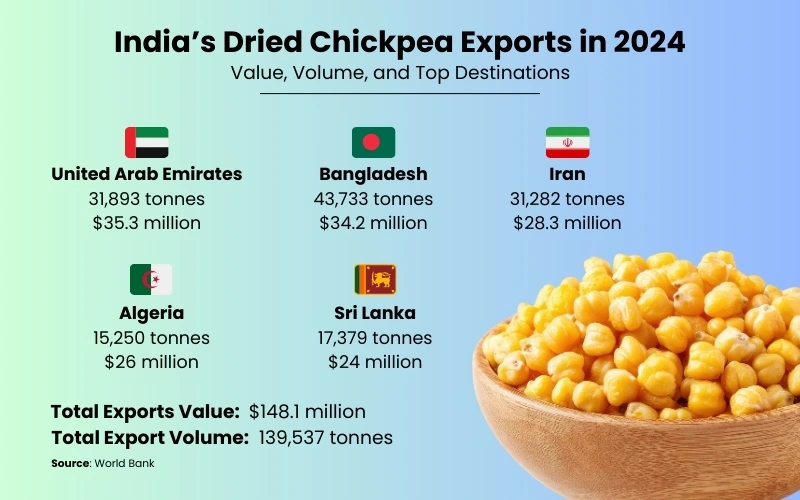
- UAE: The Middle East Launchpad – Think of it as the gateway market. Nail your presence here, and you’re opening doors to wider distribution across the region.
- Bangladesh & Sri Lanka: Speed and Consistency Rule – These markets aren’t forgiving of delays. Timely delivery and unwavering quality are the name of the game.
- North Africa (Algeria, etc.): Price Meets Loyalty – Buyers here watch costs closely, but once trust is earned, they stick around. Know the payment norms and paperwork inside out to keep repeat orders flowing.
Operational Excellence + Market Savvy = Competitive Edge – Exporters who marry smooth operations with sharp market intelligence, and tick all the certification, lab test, and inspection boxes, are the ones who come out on top.
What’s more? The chickpea importers like Turkey, China, and Saudi Arabia also quietly, yet consistently, strengthen India’s formidable footprint on the global chickpea map beyond usual heavyweights. They add real depth and penetration to the trade that India needs and keep the wheels turning steadily.
Understanding the Buyer Mindset
Chickpea importers usually play the long game. They’re not just picking up a commodity off the rack; they’re putting their weight behind a supplier who won’t vanish when it counts. In their book, steady quality and certifications, a dependable supply line, and overall reliability carry far more value than big talk or glossy promises.
- IEC — no code, no export. That’s the first gate, and there’s no way around it.
- FSSAI license — applicable for all, but especially for edible pulses, buyers want comfort that food safety isn’t being treated casually.
- APEDA registration — not something bulk chickpea buyers always ask about it, but it is something mandatory when exporting chickpeas and other agro commodities from India.
- Lab testing reports — moisture levels, pesticide residue, basic quality checks. These questions come sooner or later, usually sooner.
- Third-party inspection — bulk chickpea importers won’t even consider a shipment without it. It is a mandatory and legal requirement.
- Additional certifications — certifications like ISO 22000, HACCP, organic, Fair Trade are also some miscellaneous certifications to name a few. It depends on the buyer and the market. When they ask, they usually mean business.
Exporting Chickpeas in Bulk: Key Considerations
Anyone who’s been in bulk exports long enough knows one thing for sure, which is that quality alone doesn’t carry the deals home. Logistics and storage are just as much part of the bargain, whether we like it or not; it is the truth. Chickpeas, for all their resilience, still need to be handled with care. Dry conditions, proper ventilation, no shortcuts. The moment you ignore that, and spoilage can creep in before you even see it coming.
On the port side, names like Kandla, Mundra, and Nhava Sheva keep popping up and are mostly preferred by the traders and for good reason. Solid infrastructure that can handle large shipments, reliable connectivity, and shipping routes that are well-trodden to the Middle East, Africa, and Asia make them natural choices for chickpea exports.
If you get your shipment schedules right and keep freight costs in check, and you’re playing with healthy margins. The moment you miss the timing or misjudge the costs, and suddenly a good deal starts looking a lot thinner.
Global Chickpeas Market: Opportunities and Trends
The global chickpea market is quietly picking up steam, and it’s not just a flash in the pan. Plant-based diets are gaining serious traction, pulses are being hailed as the new protein powerhouse, and flavors from South Asia and the Middle East are making their way to plates worldwide. With India sitting on a surplus and a well-oiled supply chain, it’s in the perfect spot to ride this wave.
Emerging markets in Africa and Southeast Asia are snapping up Indian chickpeas more consistently, creating a chance for multi-country deals rather than one-off shipments. Savvy B2B players know it’s not just about chasing a quick sale—they’re playing the long game, nurturing relationships that pay off in repeat orders and steady, predictable revenue
Trade Insights for B2B Exporters
- UAE: The Middle East Launchpad – Think of it as the gateway market. Nail your presence here, and you’re opening doors to wider distribution across the region.
- Bangladesh & Sri Lanka: Speed and Consistency Rule – These markets aren’t forgiving of delays. Timely delivery and unwavering quality are the name of the game.
- North Africa (Algeria, etc.): Price Meets Loyalty – Chickpea importers here watch costs closely, but once trust is earned, they stick around. Know the payment norms and paperwork inside out to keep repeat orders flowing.
- Operational Excellence + Market Savvy = Competitive Edge – Exporters who marry smooth operations with sharp market intelligence, and tick all the certification, lab test, and inspection boxes, are the ones who come out on top.
Conclusion:
Exporting chickpeas from India isn’t just about loading containers—it’s a bit of a balancing act. Regulations, certifications, logistics, and buyer expectations all have to line up. The ones who make it? They’ve got IEC, FSSAI, APEDA, lab reports, and third-party inspections down pat, and they’re always thinking one step ahead on buyer-specific requirements.
The global chickpea market is wide open, but here’s the truth: only exporters who mix solid compliance, top-notch quality, smooth logistics, and a sharp read on buyers keep landing profitable deals.


.webp "India Pulses Sourcing Guide 2026 — Buyers, Prices & Export Steps")