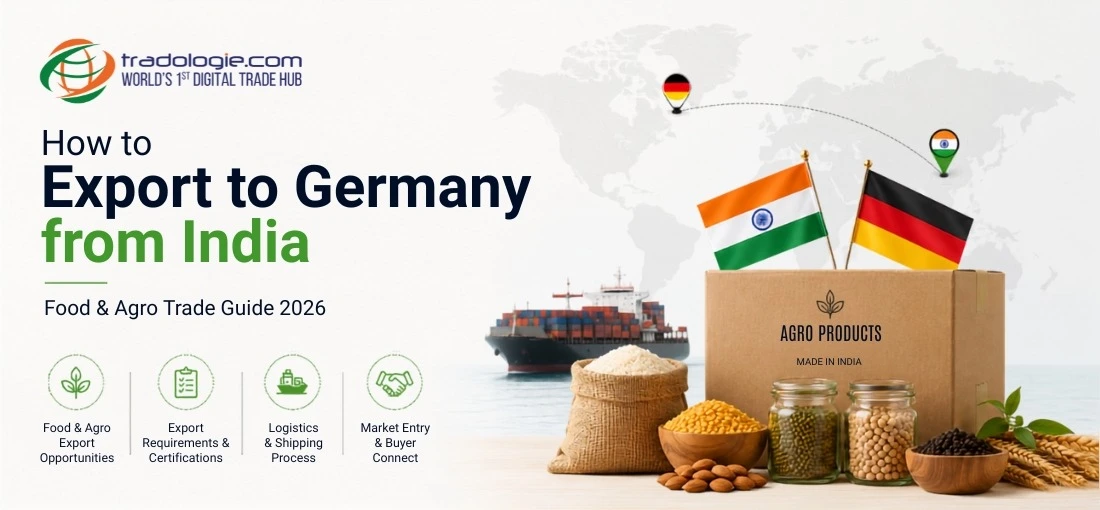
Key Highlights
- Germany is one of Europe’s largest food importing economies.
- Indian exports to Germany include spices, processed foods, oils, tea, and seafood.
- Germany is Europe’s largest organic food retail market
- EU MRL compliance is critical for Indian food exporters.
- Hamburg and Frankfurt are major food import gateways in Germany.
- HACCP, BRC, and FSSC 22000 certifications improve buyer trust.
- Sustainable packaging and traceability are mandatory for retail acceptance.
- Clean label and value added food products are driving demand growth.
Intro:
Exporting food products to Germany involves much more than competitive pricing. Compliance consistency, traceability, documentation accuracy, and packaging standards often become equally important in long-term buyer relationships. For commercial enterprises aiming to clear cargo through Hamburg or Frankfurt, entry into the German market requires a profound shift in operational habits.
Germany stands as one of Europe's major food-importing economies. The retail system here is tightly structured, highly consolidated, and relentlessly defensive regarding consumer safety. For Indian agribusinesses, this demanding trade arena offers a lucrative premium positioning opportunity. However, this opportunity is open only to those who move past bulk raw commodity mindset variations and commit to zero-defect technical execution. Knowing how to export to Germany from India means understanding that a shipment's validity is decided at the laboratory gate long before the vessel docks.
Germany continues maintaining a strong position within Europe's food import ecosystem. And despite the regulatory intensity of the EU market, Indian suppliers remain commercially active across spices, processed foods, seafood products, oils, tea, and industrial agro ingredients. What matters more is how an exporter aligns their facility with these highly specialized, non-negotiable expectations to transform a trial container into a stable, multi-year supply channel.

India Germany Food Trade: Understanding the Import Landscape
The distribution of Germany's agro imports from India reveals a highly diversified procurement model. According to Trading Economics data based on United Nations COMTRADE statistics, the bilateral India Germany food trade spans a broad spectrum of value-added, processed, and raw agricultural components.
What becomes noticeable in Germany's imports from India is the spread across multiple value-added categories. Spices, processed vegetable products, industrial oils, seafood preparations, medicinal agro ingredients, and beverage-linked products all continue maintaining measurable trade relevance. That trade structure reflects Germany's preference for traceable, compliance-driven sourcing relationships—especially in processed and retail-ready food categories. It highlights that the market is moving decisively away from erratic raw shipments and steering toward trace-verified, identity-preserved lines under the broader framework of the EU food import India pipeline.
Germany imports from India across raw agro products, industrial ingredients, processed foods, retail-ready packaged foods, beverage-linked products, seafood preparations, spices and seasonings. That diversification itself is commercially important. It shows that the German ecosystem relies on India not just as a primary field producer, but as an advanced technical processing partner capable of delivering specialized food components that feed European manufacturing lines directly.
Understanding Germany's Food Import Preferences and Consumer Trends
Germany's food-import preferences are shaped not only by regulations, but also by evolving consumer behavior. Clean-label products, ingredient transparency, sustainability, and consistency increasingly influence how retailers and importers evaluate international suppliers. To systematically build long-term relationships, traders must realize that German consumers maintain a highly structured, risk-averse food purchase culture.
| German Consumer Preference | Related Indian Export Opportunity |
|---|---|
| Clean-label ingredients | Spices & herbal ingredients with zero chemical add-ons |
| Organic food demand | Organic tea, heritage rices, and certified agro products |
| Convenience food consumption | Processed food exports, aseptic pulps, and dehydrated packs |
| Sustainable sourcing | Traceable agro supply chains backed by digital field logs |
| Global cuisine interest | Indian spice blends, high-end curry pastes, and ready foods |
What becomes noticeable here is the deep institutional backing for organic categories. Germany operates as Europe's largest organic food retail market, meaning that standard commercial lots often face a rigid price ceiling. If an exporter can back their crop with verified organic paperwork, the margin potential expands dramatically. Furthermore, a massive processed-food ecosystem across Germany drives a continuous demand for convenience foods and shelf-stable products. This preference links up perfectly with Indian manufacturing lines exporting vegetable preparations, processed sauces, and preserved components designed to trim manual kitchen labor in Western food service networks.
Which Indian Food Products Have Demand in Germany?
The German retail and industrial food sectors follow distinct, data-backed sourcing patterns. According to Trading Economics data based on United Nations COMTRADE statistics, the purchasing values reflect specialized procurement routes rather than generic commodity buying:

A. Coffee, Tea, Mate & Spices
- Tea: USD 9.95 Million — High premium placements for single-origin orthodox leaves, organic Darjeeling, and flavor-grade Assam blocks.
- Ginger/Turmeric/Thyme etc.: USD 3.14 Million — High demand driven by the wellness sector and industrial extraction labs chasing clean curcumin levels.
- Seeds/Cumin/Coriander/Fennel: USD 1.47 Million — Bakery and savory snack blending lines prioritize these varieties for spice mixes.
- Pepper: USD 1.17 Million — Whole, steam-sterilized black and white pepper lots with verified volatile oil content.
B. Vegetable Preparations & Processed Foods
- Other Vegetables (Prepared/Preserved): USD 59.29 Million — This volume-heavy line dominates trade, reflecting Germany’s massive institutional consumption of gherkins, preserved pickling vegetables, and ambient food service bases.
- Fruit Juices: USD 8.50 Million — Concentrates and aseptic purees used as primary bases by continental beverage blenders.
- Jams/Jellies/Marmalades: USD 1.78 Million — Value-added fruit spreads tailored for European retail breakfast brands.
C. Animal & Vegetable Fats / Oils
- Industrial Fatty Acids: USD 39.39 Million — Highly specialized agricultural derivatives feeding European bio-chemical and technical processing networks.
- Fixed Vegetable Fats & Oils: USD 25.22 Million — Bulk oils optimized for industrial food production, cosmetic manufacturing, and food service bases.
- Hydrogenated Oils/Fats: USD 8.90 Million — High-stability structured lipids processed for specific confectionery and baking tolerances.
D. Seafood Preparations
- Crustaceans: USD 6.08 Million — Frozen aquaculture lines, particularly block-frozen and IQF peeled prawns clearing strict veterinary gates.
- Prepared Fish Products: USD 3.45 Million — Value-added seafood preserves targeted at commercial catering and cold salad processing lines.
E. Medicinal Plants & Agro Materials
- Plants for Pharmacy/Perfume/Insecticides: USD 7.74 Million — Botanical extractions, herbal inputs, and raw plant materials driven directly by Europe’s expanding natural supplement and clean-cosmetic labs.
- Seeds/Spores for Sowing: USD 3.65 Million — Identity-preserved seedstocks clearing strict European agricultural purity metrics.
Not just processed foods either. The balance across industrial fatty acids and medicinal plant lines proves that German buying behavior is deeply rooted in manufacturing integration. Exporters must look past basic wholesale trading models and adapt their processing to deliver highly uniform technical specifications.
German Food Import Standards Indian Exporters Must Understand
Germany's food import framework is built around predictability and traceability. Exporters capable of maintaining documentation discipline and laboratory-backed compliance generally face fewer disruptions during import clearance and buyer audits. Operating inside this market requires an uncompromising understanding of German food import standards.
1. EU Food Safety Framework & Traceability
Germany follows the foundational European Union food safety framework with absolute administrative rigidity. Under these laws, accountability is absolute. Batch traceability requires that an importer can trace a product's movement backward through one single step of the supply chain—all the way to the precise agricultural cluster of origin. Source tracking and raw-material documentation must be complete, verified, and instantly accessible.
2. Maximum Residue Limits (MRLs) & Chemical Scrutiny
And this is where exporters face stricter scrutiny. Germany enforces an ultra-sensitive stance on pesticide residue compliance. Sourcing lines for spices and tea are subjected to intensive multi-residue testing screens. If a single random custom analysis reveals chemical trace marks exceeding the strict parts-per-million limits of the European Union, the entire ocean container is permanently seized, quarantined, and destroyed.
3. Contaminant, Heavy Metal & Microbiological Testing
Aflatoxin testing forms the primary border defense for incoming Indian oilseeds, nuts, and spice shipments. Processing mills must implement rigorous microbiological controls to ensure absolute absence of Salmonella and E. coli strains. Furthermore, heavy metal monitoring sets strict legal thresholds for lead, cadmium, and arsenic levels in food-contact materials and raw products.
4. HACCP and Institutional Quality Certifications
German buyers almost universally avoid uncertified suppliers. To pass initial vendor screenings, processing facilities must back their operations with internationally accredited safety certifications, such as HACCP, ISO 22000, BRC, or FSSC 22000.
5. Organic Compliance and Food-Contact Packaging Rules
If your trade desk targets the highly lucrative German organic market, standard domestic papers will not work. Shipments must achieve complete alignment with EU organic compliance parameters, verified through accredited certifying bodies. Then comes the logistics side. Packaging must utilize strict food-grade materials that prove zero chemical migration under intense food-contact material regulations. Furthermore, Germany's Packaging Act (VerpackG) mandates that exporters register their packaging materials and pay into a dual recycling system, reflecting a strong national preference for recyclable options.
6. Strict Labeling Standards & Retail Audits
Every single retail pack or bulk shipping container must carry a flawless technical print. This print must explicitly state ingredient declarations, high-contrast allergen labeling, accurate nutritional info, and clear shelf-life declarations. Unless otherwise agreed in the commercial contract, all consumer-facing text must be presented in the German language to clear retail acceptance lines. Furthermore, premium buyers often mandate on-site retail audit expectations to ensure the facility meets absolute environmental, social, and governance (ESG) baselines.
| Compliance Area | Why It Matters |
|---|---|
| MRL Compliance | Baseline requirement for customs clearance |
| HACCP/FSSC | Essential for German buyer approval and onboarding |
| Traceability | Mandatory under core EU food laws |
| Aflatoxin Testing | Critical food safety clearance for nuts, seeds, and spices |
| Labeling Accuracy | Passing retail acceptance and customs inspection |
| Packaging Standards | Distribution approval and VerpackG recycling compliance |
How to Export to Germany from India: Step-by-Step Process
Exporting to Japan usually became smoother when compliance preparation started well before shipment scheduling, and Germany follows an identical, rigorous administrative path. Documentation gaps that may seem minor in other markets can create devastating bottlenecks in the European customs clearance system. Operational success depends entirely on executing a practical, sequential pipeline.
Step 1: Legal Export Onboarding
The trade desk must first secure a valid Import Export Code (IEC) from the Directorate General of Foreign Trade (DGFT) in India. This functions as the non-negotiable regulatory baseline for any commercial cargo leaving an Indian maritime port.
Step 2: Verification of EU Product Eligibility
Exporters must cross-reference their exact product formulation against Germany food regulations India checklists. Certain food colors, preservatives, or processing aids permitted in domestic Indian markets are explicitly banned inside the EU.
Step 3: Processing Plant Certification
The processing installation must hold valid FSSAI licenses and operate under standardized food safety systems. Upgrading facilities to hit BRC or FSSC 22000 benchmarks is a prerequisite for generating commercial traction with European purchasers.
Step 4: Advanced Pre-Shipment Laboratory Assays
Before sealing container doors, representative cargo samples must be checked at accredited facilities. Purity reports must confirm compliance with all EU heavy metal, microbiological, and pesticide residue limits.
Step 5: Packaging and Technical Labeling Assembly
Exporters must source compliant, recyclable packaging materials. Technical labels must accurately list all ingredients, clear nutritional profiles, metric weights, and mandatory language elements requested by the German importer.
Step 6: Securing Phytosanitary and Health Certificates
Plant-based items must be backed by a valid phytosanitary certificate to confirm advanced pest control and proper fumigation runs. Marine, dairy, or honey derivatives demand equivalent government-sanctioned health certificates.
Step 7: Commercial Documentation Consolidation
The shipping desk must assemble an ironclad customs folder. This bundle must include the commercial invoice, exact packing list, certificate of origin, bill of lading, transit insurance certificates, and all independent laboratory analysis metrics.
Step 8: Buyer Integration & EU Customs Clearing
The Indian exporter must maintain absolute coordination with the German importer. The buyer handles the pre-arrival notifications and manages the final EU customs filing well before the cargo container arrives at the European port of entry.
| Export Requirement | Purpose |
|---|---|
| IEC Code | Legal export authorization |
| HACCP/BRC | Food safety and processing facility compliance |
| Residue Testing | Verifying alignment with EU MRL and contamination rules |
| Phytosanitary Certificate | Official plant health approval for entry |
| Certificate of Origin | Crucial customs & trade tariff documentation |
EU Food Import Germany: Certifications and Compliance Expectations
The legal architecture governing the EU food import India corridor places an immense burden of responsibility directly onto the shoulders of the European importer. Under the European Union's General Food Law, if a product triggers a health alert on store shelves, the importing entity faces immediate legal prosecution, heavy financial fines, and total brand damage.
Because the importer absorbs 100% of this counterparty risk, German buyers are exceptionally cautious. They demand comprehensive certification systems and independent third-party verification before signing off on any purchasing run. Many major German retail chains and manufacturing groups require regular, hands-on supplier audits of Indian processing floors. A trade desk cannot expect to secure sustainable business simply by emailing a generic quote; you must prove that your processing lines can consistently maintain zero-variance safety outputs.
Packaging and Traceability Expectations in Germany's Food Market
The European consumer market handles packaging with a level of environmental seriousness that directly impacts import clearance. For agribusinesses looking to sustain long-term positioning, navigating Germany food regulations India guidelines requires an absolute focus on green design.
Then comes the compliance side. Retailers maintain a severe aversion to multi-layered, non-recyclable plastics, leaning heavily toward barcode systems and clean tracking formats. Sustainable, automated packaging lines that print detailed allergen disclosures and real-time shelf-life dates are baseline criteria to pass entry audits.
| Requirement | Importance |
|---|---|
| Batch Traceability | Essential for import compliance and swift recall handling |
| Sustainable Packaging | Overwhelming retail preference and legal packaging compliance |
| Allergen Labeling | Critical driver for consumer safety and customs clearance |
| Shelf-Life Accuracy | Mandatory for continuous retail acceptance and inventory rotation |
Opportunities for Indian Agro Exporters in Germany
Germany is a demanding, compliance-driven market, but it remains highly attractive for exporters capable of maintaining consistency, documentation discipline, and long-term supply reliability. The real margin expansion is achieved by walking away from low-value, bulk commodity price wars. True, sustainable profit sits inside specialized niches and high-tier value-added processing formats.
The rapid expansion of the German clean-label sector has generated massive commercial demand for organic products, single-source spices, and certified plant-based ingredients. Indian milling and processing syndicates can exploit this drift by supplying high-purity dehydrated vegetables, premium cold-pressed oilseed selections, and custom spice extracts to the ethnic food retail and industrial agro ingredients networks. Long-term supply reliability carries significantly more weight than offering aggressive price reductions in the German trade ecosystem. Once an Indian operator demonstrates that it can reliably clear EU food safety gates without a single hitch, German buying desks will lock in multi-year, premium-rate purchase contracts that insulate the supplier from global market volatility.
Conclusion
Exporting food products to Germany requires balancing commercial competitiveness with regulatory discipline. Exporters capable of maintaining compliance consistency, traceability systems, and documentation precision are generally better positioned for sustainable market access across Germany and the wider European Union.
The market is unyielding on quality, yet highly rewarding for firms that invest in structural food safety systems. As the European retail network continues shifting toward clean labels, complete trace-verification, and eco-friendly presentation formats, value-added agro-processing will continue outperforming simple commodity trade. The margins are open and highly liquid, but they belong exclusively to trading desks that execute their international logistics with absolute technical and legal precision.


-price-today-mandi-rate-msp--market-trend-(2).webp "Mustard Price Today India: Bulk Mandi Rates and 2026 MSP")
.webp "Guar Gum Export from India: Industrial Uses, Grades & Trade Guide")