Key Highlights
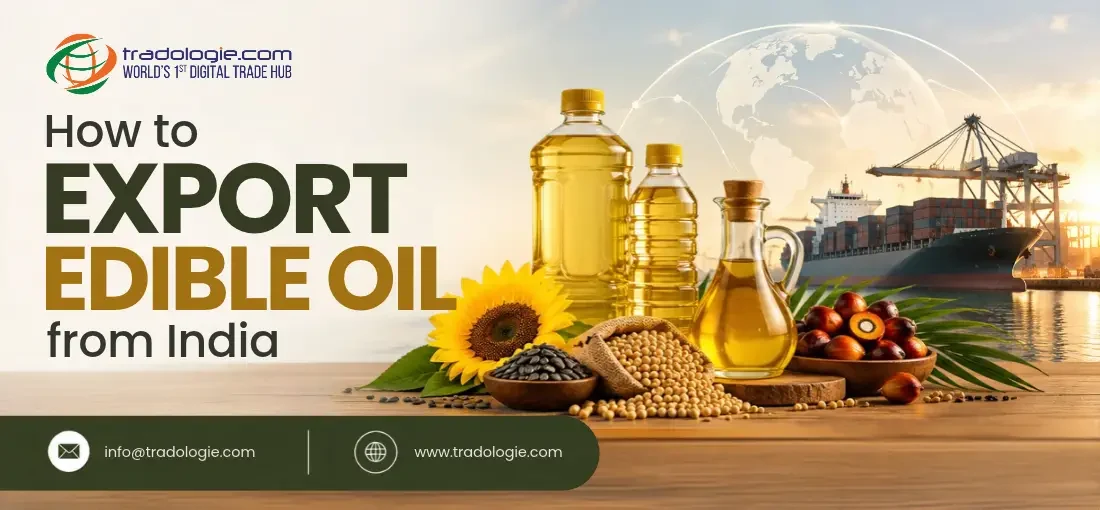
- If you want to export edible oil from India to the USA, start by choosing the oil and identifying potential American buyers.
- Source quality-tested sesame oil, groundnut oil or other edible oils that meet buyer specifications.
- Check India's export policy, IEC requirements and applicable registrations before shipping.
- Meet relevant US FDA requirements, including facility registration and Prior Notice where applicable.
- Prepare compliant product labels, food-safety records and export documents.
- Calculate procurement, packaging, testing, freight, duties and other costs before quoting your price.
- Connect with potential American buyers through Tradologie and explore B2B trade opportunities.
Introduction:
Sesame oil and groundnut oil have established buyers in the American market, but getting an export order is only one part of the business. If you're looking into how to export edible oil from India to the USA , you'll need to sort out three things early: which oil you can supply, what the American buyer expects and whether the shipment meets US import rules.
The work involved depends on the product. A food manufacturer buying sesame oil in bulk may ask for a laboratory report and a consistent specification. A supermarket distributor importing bottled oil will also want compliant labels, suitable packaging and a product that can compete on shelf price.
Keep reading this informative piece of blog. It will tell you how to export edible oil to America in detail.

India's Edible Oil Exports to the United States
Trade figures can help narrow down which products are worth researching. World Bank WITS data, based on UN Comtrade statistics, recorded the following Indian exports to the US in 2024.
| Product | Export Value | Export Quantity |
|---|---|---|
| Groundnut oil, excluding crude, and fractions | US$3.16 million | 964 tonnes |
| Sesame oil and fractions | US$10.11 million | 2,289 tonnes |
Source: World Bank WITS, based on UN Comtrade data. These figures cover the specified product categories, not every edible oil.
Sesame oil recorded higher exports than groundnut oil across these two categories. That gives exporters a starting point for market research, though it doesn't guarantee that a new supplier will find buyers at a profitable price.
Steps to Export Edible Oil to USA: Complete Process
Below are the steps to export edible oil to the USA in detail. Right from deciding which oil to export to the USA to understanding the certifications and requirements, each step plays a vital role in exporting edible oil to the USA. The steps also explain how to find reliable buyers.
Step 1: Decide Which Oil to Export
When looking at how to export edible oil from India to the USA , you need to start with a product you can source reliably. Each oil has its own buyers, specifications and price considerations.
| Oil Type | Potential Buyers | Points to Consider |
|---|---|---|
| Sesame oil | Food manufacturers, specialty food stores and distributors | Flavour, colour, extraction method |
| Groundnut oil | Food manufacturers and specialty food businesses | Refining, flavour, allergen controls |
| Rice bran oil | Food processors and distributors | Composition, refining and stability |
| Soybean oil | Food processors and industrial buyers | Crude or refined grade, competition |
| Sunflower oil | Food manufacturers, distributors and retailers | Fatty-acid profile, packaging and price |
| Mustard oil | Specialty food businesses and selected buyers | Product classification and US admissibility |
The intended use matters. A buyer purchasing bulk oil for food production may accept industrial packaging, while a retailer needs finished bottles with labels that meet US requirements.
Decide whether you will supply crude, refined, cold-pressed or another grade before requesting quotations. These products are not interchangeable, and their processing costs can differ considerably.
Step 2: Find a Supplier and Agree on Quality
If you don't operate an oil-processing facility, you can source from an established Indian manufacturer. Before paying for stock, check that the supplier can meet the buyer's specification throughout the order.
The main quality parameters may include:
| Parameter | What It Tells You |
|---|---|
| Free fatty acids (FFA) or acid value | Indicates aspects of oil quality and condition |
| Peroxide value | Helps assess primary oxidation |
| Moisture and volatile matter | Relevant to stability and storage |
| Insoluble impurities | Indicates cleanliness |
| Fatty-acid profile | Helps verify the oil's composition |
| Colour, odour and flavour | Important for oils sold directly for food use |
| Processing method | Confirms whether the oil is refined, cold-pressed or another grade |
| Contaminants and residues | May require testing under the product specification or applicable rules |
Not every oil requires the same tests or limits. The buyer's specification and relevant US requirements determine what needs to be checked.
Before dispatch, agree on the sampling method, laboratory, acceptable limits and inspection arrangements. A certificate of analysis should relate to the actual batch being shipped rather than a previous consignment.
Step 3: Check India's Export Rules and Registrations
Don't assume that every edible oil follows the same export policy. India's rules have changed over time, and mustard oil has had specific conditions that differ from those applying to many other edible oils.
Check the current policy against the product's HS code before accepting an order. For commercial exports, an Importer-Exporter Code (IEC) from the Directorate General of Foreign Trade (DGFT) is generally required.
Other registrations depend on the business and transaction.
| Requirement | What to Check |
|---|---|
| IEC | Generally required for commercial exports |
| GST | Applicable registration and tax obligations |
| APEDA registration or RCMC | Whether it applies to your product or the export benefit being claimed |
| Export permission | Whether the particular oil is subject to restrictions or special conditions |
| Product-specific approvals | Any additional authorisation applicable to the shipment |
An IEC alone does not override an export restriction. Confirm that the shipment is permitted before buying stock or promising a delivery date.
Step 4: Meet US FDA Requirements
The US Food and Drug Administration (FDA) regulates imported edible oils intended for human consumption. Three requirements deserve particular attention.
Food facility registration
A foreign facility that manufactures, processes, packs or holds food for consumption in the US may need to register with the FDA. Where required, the facility must designate a US agent.
If another company processes or packs your oil, confirm the registration position of the actual facility. FDA facility registration is not the same as product approval. The FDA does not pre-approve every edible oil product or individual shipment before it enters the US.
Prior Notice
The FDA generally requires advance notification of imported food shipments. This is commonly arranged by the US importer, broker or another responsible party using the shipment details supplied by the exporter.
The notification must be submitted within the applicable timeframe before the food arrives. Confirm that the Prior Notice requirement has been met before dispatch and retain the relevant confirmation.
Foreign Supplier Verification Program (FSVP)
The responsible US importer generally has to verify that food from its foreign supplier meets applicable US food-safety requirements, unless an exemption or modified requirement applies.
The buyer may ask you for:
- Manufacturing and processing details.
- Food-safety controls and hazard information.
- Product specifications and laboratory reports.
- Supplier and batch traceability records.
- Information on storage and handling.
- Details of relevant testing and corrective actions, where applicable.
For edible oil, the information required can depend on the oil type, processing method, intended use and potential food-safety hazards. There is no single universal laboratory checklist that applies to every edible oil.
Discuss these requirements before production. The importer will need accurate information to fulfil its obligations, and missing records can delay a shipment.
Step 5: Check US Duties and Import Rules
The correct US tariff classification depends on the oil's type, composition and whether it is crude or refined. Edible oils generally fall under Chapter 15 of the US Harmonized Tariff Schedule, but the exact code must be confirmed for the product.
Before finalising the price, establish:
- The applicable US HTS code and import duty.
- Whether additional duties or trade measures apply.
- The origin and customs-value declarations required.
- Whether any product-specific import authorisation is needed.
- Who will act as importer of record and handle US customs clearance.
The American buyer or its customs broker should confirm the current tariff treatment. An incorrect classification can affect duties and create customs delays.
Step 6: Prepare the Labels and Food Safety Records
Bulk oil and retail-packed oil have different requirements. A manufacturer purchasing oil for further processing may focus on technical documentation, while a retailer needs packaging and labelling that meet US rules.
For retail edible oil, the label should be checked for the following requirements, as applicable:
- Correct product identity: Clearly identify the oil, such as sesame oil, groundnut oil or soybean oil. The product name must accurately describe what is inside the bottle.
- Net quantity: State the quantity in the format required for the US market.
- Nutrition Facts: Provide the required nutrition information unless a valid exemption applies. Serving size and nutrient declarations must follow the applicable rules.
- Ingredients: Declare ingredients where required, particularly for blended oils or products containing other ingredients.
- Manufacturer, packer or distributor details: Include the required name and place-of-business information.
- Allergen declaration: Sesame and peanuts are major food allergens under US law. Check the actual ingredients and processing conditions to determine the applicable declaration. Highly refined oils may be treated differently from less-refined oils, so do not assume that every oil receives the same treatment.
- Country-of-origin marking: Confirm the applicable US Customs and Border Protection requirements for the product and packaging.
- Product claims: Claims such as “organic,” “cold-pressed,” “pure” or other quality and health-related statements must be accurate and properly supported.
Edible-oil-specific packaging and labelling checks
Edible oil needs particular attention because its quality can deteriorate through oxidation and unsuitable storage conditions. Heat, light and exposure to oxygen can affect flavour, odour and shelf life. The risk varies by oil type, processing method and packaging.
Before approving the retail pack, check:
- Bottle material: The bottle must be suitable for food contact and compatible with the specific oil.
- Cap, seal and liner: These should prevent leakage and help limit unwanted exposure to air.
- Light protection: Select packaging that provides suitable protection for the oil's stability and intended shelf life.
- Storage and shelf life: The declared shelf life should be supported by appropriate product and stability information.
- Food-contact compliance: Bottles, caps, liners, seals and other packaging components must be suitable for their intended food-contact conditions.
- Bulk packaging: Drums, intermediate bulk containers and flexitanks must be suitable for edible oil. Check cleanliness, previous cargo, compatibility and sealing before loading.
Don't print a large quantity of labels before the US importer has checked them against the applicable requirements. Organic products need particular attention to the relevant certification and import conditions.

Step 7: Prepare the Export Documents
There is no single certificate that clears every edible oil shipment into the US. The required documents depend on the product, buyer, facility and shipping arrangement.
| Document or Requirement | Purpose |
|---|---|
| IEC | Exporter identification |
| Commercial invoice | Records product, quantity, value and sale terms |
| Packing list | Shows packages and weights, where applicable |
| Shipping bill | Indian export customs declaration |
| Bill of lading | Sea-freight transport document |
| Certificate of origin | Required where applicable |
| Certificate of analysis | Records agreed quality parameters |
| FDA facility registration | Required for facilities covered by the registration rules |
| Prior Notice confirmation | Evidence of the required shipment notification |
| FSVP supplier information | Supports the US importer's verification process |
| Organic certificate | Relevant for certified organic products |
| Inspection certificate | Required where stipulated |
| Insurance certificate | Required where applicable under the contract |
A phytosanitary certificate should not automatically be assumed mandatory for processed edible oil. Check the specific product and applicable requirements.
Keep the product description, batch details, quantity and origin consistent across the invoice, packing list, quality report and shipping documents.
Step 8: Find Buyers in America
Potential buyers include food manufacturers, specialty food brands, importers, wholesale distributors and food-service suppliers.
You can approach them through trade exhibitions, industry associations, importer directories, direct outreach and B2B trade platforms. Tradologie is also an option for connecting with international buyers, receiving procurement inquiries and negotiating offers.
When contacting a buyer, include the information they need to assess your offer:
- Oil type and processing method.
- Available quantity and supply capacity.
- Quality specification and laboratory reports.
- Packaging options and minimum order quantity.
- Indicative price and quotation basis.
- Expected shipment schedule and loading port.
A buyer looking for bulk sesame oil may have little interest in retail-packed groundnut oil. Target your offer accordingly.
Before accepting an order, verify the buyer's business credentials and agree on payment terms. Also confirm who will handle US customs clearance and the relevant FDA procedures.
Step 9: Calculate the Export Price
The supplier's quotation is only one part of the final cost. Packaging, testing, transport and shipping can change the economics of the order.
| Cost Component | What to Include |
|---|---|
| Oil procurement | Purchase price from the manufacturer |
| Processing and refining | Costs not already included |
| Packaging | Bottles, drums, flexitanks, cartons and labels |
| Testing | Laboratory analysis and inspection |
| Inland transport | Movement to the Indian port |
| Export handling | Customs broker, port and documentation charges |
| Ocean freight | Shipping to the US destination |
| Insurance | Cargo cover where applicable |
| US-side costs | Duties, customs broker and destination handling as agreed |
| Finance | Interest, banking fees and foreign-exchange costs |
State whether your quotation is FOB, CFR or CIF and identify the relevant port. These terms allocate costs differently, so compare quotations on the same basis.
Edible oil prices can change with oilseed prices, refining costs, freight and exchange rates. Calculate the cost per litre or metric tonne consistently, and leave enough margin for reasonable changes in cost.
Step 10: Choose Packaging and Shipping
The packaging depends on the buyer's needs and shipment volume.
| Packaging | Typical Use |
|---|---|
| Food-grade drums | Smaller commercial quantities |
| Intermediate bulk containers | Suitable bulk liquid shipments |
| Flexitanks | Larger shipments, subject to product and carrier suitability |
| Retail bottles | Supermarkets and specialty retailers |
| Cartons containing bottles | Protection during handling and transport |
Before loading, check that the container or tank is clean, dry, suitable for food contact and compatible with the oil. Confirm that seals, closures and liners are intact.
For retail bottles, consider leakage protection, storage conditions and light exposure, which can affect some oils. The packaging specification should be agreed before production.
For bulk shipments, confirm the previous cargo and cleaning records where relevant. Containers previously used for unsuitable chemical or non-food cargo should not be used for edible oil.
The shipping plan should account for transit time, port handling and destination storage. A lower freight rate is not necessarily the best option if the packaging is unsuitable or the carrier cannot accept the proposed arrangement.
Step 11: Complete Customs Clearance and Ship
Once the product is ready and the required permissions and documents are in place, the exporter or customs broker prepares the shipping bill and supporting paperwork.
The cargo moves to the port and is inspected where required. The US importer or its broker handles the US entry process, including customs declarations and applicable FDA procedures.
After loading:
- Obtain the bill of lading.
- Prepare the documents required by the buyer or bank.
- Submit the documents within the agreed timeline.
- Track the shipment and keep the buyer informed.
- Retain records of testing, customs clearance, shipment and payment.
If payment is through a letter of credit, check the documents against its terms before submission. Errors in dates, quantities or wording can delay payment.
Step 12: Agree on Payment Terms and Manage Risk
The first shipment to a new US buyer can involve substantial upfront costs. You may need to pay the processor, buy packaging, arrange tests and cover transport before receiving payment.
Common payment arrangements include:
- Advance payment: Reduces the seller's exposure, although buyers may not agree to pay the full amount upfront.
- Letter of credit (LC): Provides a bank-administered payment mechanism, subject to its terms and compliant documents.
- Documentary collection: Banks handle documents against payment or acceptance, but this does not provide the same payment guarantee as a confirmed LC.
For a first transaction, verify the buyer's credentials and agree on a payment schedule that suits the shipment's cash-flow requirements. If the buyer asks for credit, assess the exposure before accepting the order.
The contract should also explain how quality claims, shortages, transit damage, delays and regulatory problems will be handled.
Conclusion
To export edible oil to the USA , an Indian business needs a suitable product, a reliable supplier, a genuine buyer and a clear understanding of US import requirements.
The work involves more than securing an order. You need to confirm India's export rules, establish which FDA requirements apply, provide the information needed by the US importer, prepare accurate documents and calculate the full delivery cost.
For businesses planning to export edible oil to America , start with a specific product and a clearly defined buyer. Once the grade, compliance requirements and shipment economics are clear, you can negotiate a realistic price and work towards repeat orders.
Disclaimer
Export policies, US import duties, FDA requirements, labelling standards and documentation requirements may change. Exporters should verify the latest applicable regulations with DGFT, the US FDA, US Customs and Border Protection, and other relevant authorities. Requirements depend on the oil type, processing method, packaging, business activities and shipment details. Confirm the final compliance checklist with the US importer and customs broker before dispatch.