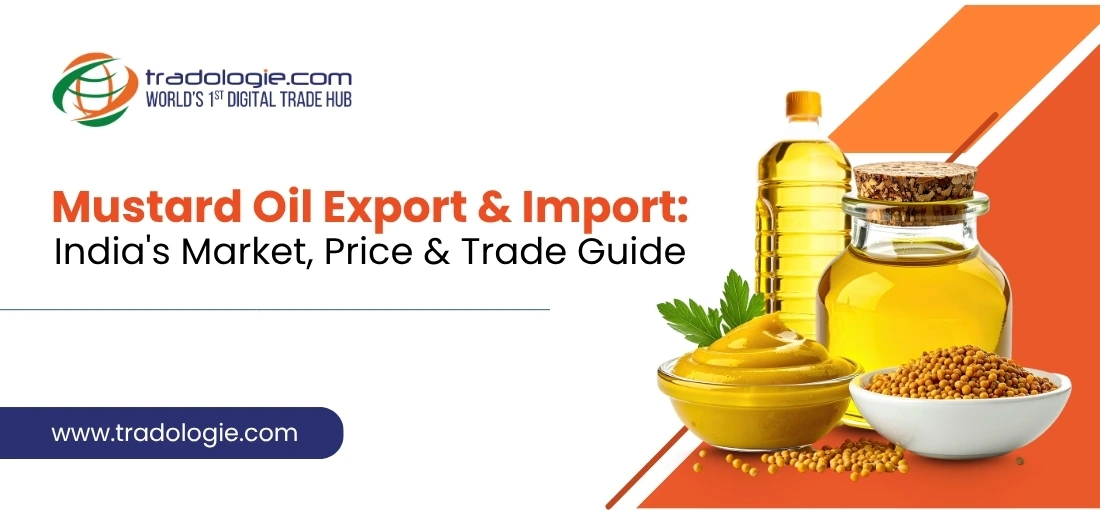
India is the world's second-largest producer of mustard and rapeseed. Yet most global buyers still do not know how to source mustard oil from India legally, at the right price, and without shipment rejections. India stands out as an agricultural powerhouse in this shifting landscape.
The country shows a unique contrast in its trade habits. On one hand, India imports huge amounts of bulk edible oils. These include palm and soybean oil. On the other hand, it rules a highly specialized, premium niche. This niche focuses on exporting traditional, cold-pressed oils.
The global mustard oil market was valued at $8.9 billion USD in 2023 and is projected to grow at 4.2% CAGR through 2030, according to industry estimates — and India sits at the center of this growth. A massive South Asian diaspora drives this demand. Global buyers are also learning about its health benefits. Plus, India's strong domestic farming output keeps the supply steady.
Farming Roots: India's Mustard Production
India's mustard export strength starts at the farm level. Rapeseed mustard is produced in large quantities in India. This crop is primarily grown by farmers during the Rabi season in the winter. It is vital to the farming economy in the western and northern states.
We can look at the 2024-25 production reports from Igrain. The USDA also supports these numbers. India’s mustard production should reach an impressive 11.5 million metric tons (115.16 lakh tonnes). The total planted area has also grown. It now covers about 92.15 lakh hectares.
- Rajasthan: This state is the clear leader. It has 34.74 lakh hectares of planted land. About 52.03 lakh tonnes are produced there.
- Madhya Pradesh and Uttar Pradesh: These states come next. They produce about 15.60 lakh tonnes and 14.66 lakh tonnes, respectively.
- Haryana & Gujarat: These states plant less mustard. However, they have very high yields. Haryana produces over 1,723 kg per hectare.
The Rabi harvest typically concludes between February and April. This means peak crushing and export availability falls between May and August each year. Buyers placing bulk orders outside this window often pay a 6–12% price premium due to tighter supply. Smart importers lock in contracts before March. This strong farming base ensures a steady supply. Local crushers and bulk exporters rely on this. It protects the industry from sudden supply drops.
By the Numbers: India's Mustard Oil Exports
Local buyers consume about 30% of India's edible oil. The export industry has nevertheless expanded steadily and slowly.
The Directorate General of Commercial Intelligence and Statistics (DGCIS) shared recent data. For the 2024–25 financial year, mustard oil exports reached $25.26 million USD. (This falls under HS Code 1514). This is an 8.26% growth from the year before. In 2023–24, exports were at $23.33 million USD.
This growth is very impressive. Global inflation has been high. Shipping has faced many delays. Yet, the export value keeps rising. This shows that buyers will pay extra for Indian mustard oil. They do not view it as a cheap bulk good. Instead, they see it as a high-value, special product.
Global Demand and Top Buyers
As the mustard oil global market expands, demand has spread far beyond just South Asian expats. The oil has a high smoking point. It offers a unique, spicy taste. It is also rich in omega-3 fatty acids.
As a result, it is making its way into commercial kitchens overseas. It is also used to treat medical conditions. In natural food markets, it is becoming more and more well-liked.
Based on current shipping data, here are the top mustard oil importers sourcing directly from India:
| Market | Annual Import Est. | Primary Buyer Type | Key Entry Point |
|---|---|---|---|
| United States | 4,000 - 6,000 MT | South Asian grocery chains, Amazon retail | New York, New Jersey, California ports |
| Australia | 1,200-1,800 MT | Indian/Bangladeshi diaspora, health food stores | Sydney, Melbourne |
| United Arab Emirates | 2,000-3,000 MT | Expat workers, food factories, re-export to East Africa | Jebel Ali Free Zone |
| Nepal & Bhutan | 3,500-5,000 MT | Local cooking use, cross-border wholesale | Land border trade |
| European Union | 800-1,200 MT | Organic food retailers, Ayurvedic importers | Netherlands, Germany |
| Canada | 600-900 MT | South Asian grocery retail | Toronto, Vancouver |
In terms of unit price, the US market continues to be the most valuable. However, because of FDA erucic acid regulations (described in Section 4), it is also the most complicated legally. The fastest-growing market for premium cold-pressed Kachchi Ghani oil is Australia, where Indian exporters can command a price premium of 30–40% over refined varieties. Because Dubai reexports a large amount of Indian mustard oil to East Africa and Southeast Asia, the UAE's Jebel Ali Free Zone is crucial.
Trade Barriers: The Erucic Acid Problem
Global demand is strong. But exporting to the West is tricky. The rules are complex and strict. The biggest hurdle is erucic acid.
This is an omega-9 fatty acid. It naturally occurs in traditional Indian mustard oil. The levels are very high. They often sit between 20% and 40%. The US FDA and the European Food Safety Authority (EFSA) have strict rules about this. They point to older animal studies linking high erucic acid to heart fat. Because of this, the FDA and EFSA set a strict limit. Edible oils can only have up to 2% erucic acid.
Traditional Indian Kachchi Ghani oil fails this test. It has way more than 2%. So, it is illegal to sell it as food in the United States. Exporters use a legal trick to clear customs. They label the oil "For External Use Only" or call it massage oil. This lets them meet the huge demand from the diaspora.
Traders must be very careful with this. A shipment can be ruined by a single error. The FDA will issue an Import Alert if the label states that the oil is intended for cooking. They will stop the cargo and destroy it.
A slightly different rule applies to exporters who target the EU. In 2022, the European Food Safety Authority (EFSA) updated its erucic acid limits. Now, oils intended for direct food consumption must have less than 2% erucic acid. EFSA does, however, also keep an eye on erucic acid in final food items. This means that every shipment from Indian exporters to European food manufacturers, not just retail buyers, must include full lab certification.
Indian scientists have found a fix. They created new mustard seeds with low erucic acid. You can legally export this oil as food. However, it lacks the strong, spicy taste that buyers want. Traders must choose carefully between real flavor and easy legal entry.
Mustard Oil Price India: 2025 Wholesale and Export Rates
Pricing depends heavily on oil type, order volume, and destination. Below are current benchmark rates as of Q1 2025.
| Oil Type | Domestic Wholesale (per kg) | Export FOB Price (per MT) |
|---|---|---|
| Kachchi Ghani Raw | ₹130-₹160 | $1,100-$1,350 |
| Refined Mustard Oil | ₹105-₹125 | $950-$1,150 |
| Cold-Pressed Organic | ₹220-₹280 | $1,800-$2,400 |
| Double Filtered | ₹115-₹135 | $1,020-$1,200 |
Government MEP floor: $900/MT. No exporter can legally sell below this price regardless of private negotiation.
Four factors that move mustard oil prices:
1. Rabi crop output — Rajasthan accounts for over 45% of national production. A drought or excess rain in Rajasthan directly pushes export prices up or down within 4-6 weeks.
2. Palm oil import price — When global crude palm oil gets cheaper, Indian buyers switch to palm. Mustard oil demand softens and prices dip. When palm oil gets expensive, mustard demand rises and prices climb.
3. Rupee-Dollar rate — A weaker rupee makes Indian mustard oil cheaper for foreign buyers. Export volumes typically rise 8-12% when the rupee depreciates significantly.
4. MEP revisions — The DFPD can raise or lower the Minimum Export Price. Any revision changes the competitive position of Indian mustard oil against Pakistani and Nepali suppliers overnight.
Last Updated: Q1 2025. Traders should verify current rates directly with IOPEPC or registered exporters before placing orders.
Bulk Trade Rules and Pricing
Market demand does not control everything. In bulk farm trade, the government steps in. India limits edible oil exports. They do this to prevent local shortages. It also keeps domestic food prices low.
Many competitors forget about export price limits. The Department of Food and Public Distribution (DFPD) allows mustard oil exports. However, they set a strict Minimum Export Price (MEP). This price floor is $900 per Metric Ton (MT) .
Customers frequently inquire as to why Indian mustard oil is more expensive than Canadian canola oil. Erucic acid content and flavor profile are the main distinctions. Canola is specifically bred to have less than 2% erucic acid, which makes it flavor-neutral but food-legal everywhere. Traditional Indian mustard oil contains 20–40% erucic acid, which gives it the sharp, strong flavor that buyers from the diaspora especially seek. These two distinct products cater to two distinct customer segments. They don't directly compete on price.
Early 2025 records reveal a diverse range. Prices per kilogram varied from $1.37 to $3.51. The type of oil determines this cost. Prices for refined oil and raw Kachchi Ghani are different. The final cost is also altered by the destination nation.
Shipping and Packaging Rules
Domestic food policies change how we ship goods. Mustard oil is a daily need in India. Because of this, the government bans bulk shipping. You cannot use large flexitanks or chemical ships to export it.
The government wants to keep raw materials in the country. They enforce two main rules. First, the oil must meet the $900 MT MEP. Second, you can only export it in consumer packs up to 5 kilograms.
This changes the game for B2B exporters. They are no longer just moving bulk liquids. They are now shipping retail goods. Traders must plan for the following:
- Packing Containers: You cannot pump oil into a giant tank. You must put it in small bottles or tins. You stack these on pallets. In a shipping container, this takes up more room. The freight cost per kilogram increases as a result.
- Shelf-Life on Ships: Small bottles face more temperature changes. Ocean trips can take 40 to 60 days. Exporters must buy good seals and UV-safe plastic. This keeps the oil fresh and spicy.
- Building a Brand: The 5kg limit seems annoying at first. But it actually helps Indian sellers. They ship ready-to-sell retail packs. This means they are not just selling a nameless liquid. They are putting their own brands on global supermarket shelves.
Required Export Documents
Exporting food oils from India requires strict paperwork. A single missing paper can freeze your shipment. Traders must get the following items to export legally:
- Import Export Code (IEC): This is a basic 10-digit number. You need it for any global trade leaving India.
- FSSAI License: This comes from India's food safety board. It proves your oil is safe and clean.
- IOPEPC RCMC: This is a membership certificate. It comes from the oilseeds export council. You must have this to clear customs. It also helps you get government export perks.
- Plant Health Certificates: Many countries ask for this. It proves your product has no pests or bugs.
- Certificate of Origin (COO): The majority of importing nations demand proof that the oil was produced in India. issued by regional chambers of commerce or the FIEO.
- Lab Test Report: An independent analysis verifying the percentage of erucic acid, moisture content, and absence of adulterants. This is strongly advised for all destinations and required for shipments headed to the United States. Obtain this from SGS/Bureau Veritas or labs accredited by the FSSAI.
Imports vs. Exports: The Big Picture
To understand the market, we must look at imports too. India imports more vegetable oil than any other nation.
In 2024-25, India spent $17.59 billion USD on edible oils. Most of this was crude palm oil from Indonesia and Malaysia. Soybean oil came from Argentina. Sunflower oil arrived from Ukraine and Russia.
This creates an interesting split. To feed its 1.4 billion people, India purchases enormous quantities of inexpensive oil. It also sells pricey local oils overseas. This split offers a great chance for traders. Importing bulk palm oil has low profit margins. But exporting branded, high-quality mustard oil brings in much higher profits.
The Future: Growth Chances for Traders
The future looks bright for mustard oil exports. Still, domestic rules and weather changes will pose challenges. A strong supply chain is a must.
Smart exporters can find open spaces in the market. Here are a few ways to grow:
- Add Value: Move away from basic refined oil. Sell organic, non-GMO, cold-pressed versions. Buyers in the US and Europe will pay more for these.
- Find New Buyers: Look beyond the South Asian diaspora. Target health-focused shoppers worldwide. Highlight the oil's good fats.
- Use Farm Tech: Use blockchain to track the oil from farm to bottle. Western retail chains love this feature. It proves the product is pure.
Entering the international mustard oil trade is tough because the rules are strict. But the rewards are huge for those who learn the ropes. Traders must understand farming trends. They must follow government pricing rules. They must also meet global trade laws. By doing this, they can build a lasting and highly profitable export business.



.webp "Sunflower Oil Price in 2026: Global Trend, Import Cost & B2B Buying Insights")