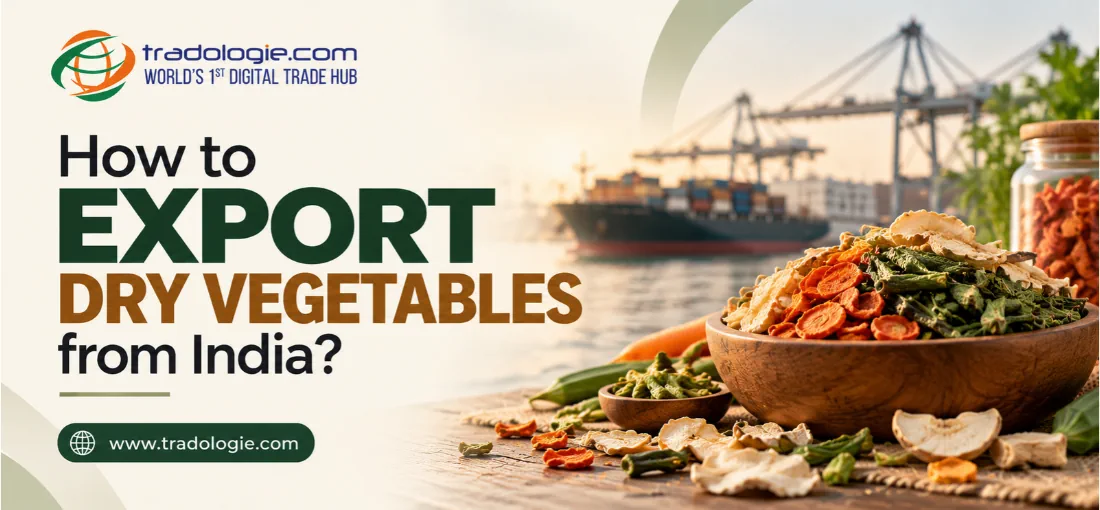
Key Highlights
- If you want to know how to export dry vegetables from India , start by obtaining an Importer Exporter Code (IEC) and checking the applicable APEDA, FSSAI, GST and other business requirements.
- Choose the right product, such as dried onion flakes, dehydrated garlic, dried potatoes or dehydrated peas, and confirm the buyer's requirements for moisture, colour, flavour, particle size and shelf life.
- Verify the correct ITC-HS code and India's current export policy for the specific vegetable and processing method.
- Check the destination country's food safety, pesticide residue, plant-health, import permit and labelling requirements before accepting an order.
- Calculate the complete export cost, including raw material, drying, processing yield, packaging, testing, transport, freight and insurance.
- Finalise product specifications, payment terms, export documents and shipping arrangements before dispatch to minimise the risk of delays, quality disputes and unexpected expenses.
Introduction:
Drying vegetables is a practical way to extend their shelf life, reduce transportation weight and supply food manufacturers throughout the year. But for an exporter, removing moisture is only part of the job. The product must retain the colour, flavour and rehydration quality expected by the buyer, while meeting the food-safety standards of the destination market. Businesses researching how to export dry vegetables from India need to consider these product requirements alongside sourcing, processing costs and international trade regulations.
India exports a range of processed vegetables, including dried garlic, garlic flakes, dehydrated asparagus, dried potatoes, dehydrated peas and other vegetable products. These products serve different markets, from food-processing companies and seasoning manufacturers to wholesalers and retail brands. The right export strategy depends on the vegetable being supplied, how it is processed and the buyer's intended use.
Keep reading this informative piece of blog, as it will tell you steps to export dry vegetables from India in detail.

India's Dried Vegetable Export Market: Where Are the Opportunities?
India's processed vegetable industry supplies both finished food products and ingredients used by other manufacturers. Dried vegetables are particularly useful to businesses that need ingredients with a longer shelf life, predictable availability and lower storage or transportation requirements than fresh produce.
Trade data provides a useful indication of the market. According to World Bank WITS data based on UN Comtrade, India exported approximately US$79.8 million worth of dried vegetables under HS code 071290 in 2025, with reported quantities of about 63,458 tonnes. Indonesia, the United States, Germany, Nepal and Malaysia were among the leading destinations for this product category.
These figures relate to the specified dried-vegetable classification, not every type of dehydrated or processed vegetable. Products such as dried onions, mushrooms and other vegetables may fall under different tariff lines, so exporters should examine the relevant code before drawing conclusions about demand.
The commercial opportunity also depends on the form in which the vegetable is sold. A food manufacturer buying dehydrated onion flakes may have very different requirements from a seasoning company purchasing garlic powder or a distributor sourcing dried vegetable mixes. Particle size, moisture, colour, microbial limits and packaging can all influence the buyer's decision.
For exporters, the sensible starting point is to select a product that can be supplied consistently and then identify buyers who already use that ingredient. This is generally more useful than trying to sell every type of dried vegetable to every possible market.
1. Complete the Registrations Required for Exporting Dry Vegetables
Before accepting an overseas order, an Indian exporter should establish the necessary business registrations and check the requirements applicable to the product.
Obtain an Importer Exporter Code (IEC)
The Import Export Code (IEC), issued by the Directorate General of Foreign Trade (DGFT), is generally required for commercial exports from India.
Applications are made through the DGFT portal. The business should ensure that its PAN, banking details and other registration information are accurate and that its IEC details remain updated as required.
Check APEDA Registration Requirements
APEDA covers a range of agricultural and processed food products, including processed vegetables. Exporters should check whether their specific product and business activity require an APEDA Registration-cum-Membership Certificate (RCMC).
The registration route and applicable conditions should be confirmed through APEDA and the relevant DGFT process. Do not assume that every vegetable product has identical requirements simply because it falls within the broader processed-food sector.
Check FSSAI and Other Business Requirements
Businesses involved in food manufacturing, processing, packing, storage or other regulated food activities should check the applicable Food Safety and Standards Authority of India (FSSAI) registration or licensing requirements.
The appropriate requirement depends on the activities carried out by the business. Exporters should also review GST and other tax-related obligations with a qualified professional, particularly when structuring their first export transaction.
Confirm the Product's HS Code and Export Policy
The customs classification depends on the vegetable and the extent of processing. HS heading 0712 generally covers dried vegetables, whole, cut, sliced, broken or in powder form, but not further prepared. Different products may fall under more specific subheadings, while seasoned, mixed or otherwise further-prepared products may need a different classification.
The full Indian ITC-HS code should be confirmed before the quotation and shipping documents are prepared. Check the current DGFT export policy for that code as well. Export conditions can change, and the policy for one vegetable should not automatically be applied to another.

2. Decide Which Dried Vegetable You Will Export
The product decision affects sourcing, processing equipment, quality control, packaging and the type of buyer you should approach.
Dried Onion
Dried onion may be supplied as flakes, chopped pieces, granules or powder. It is used in seasoning blends, instant foods, sauces, snacks and other processed products.
Buyers may specify colour, aroma, particle size, moisture content and microbiological limits. Onion powder, for example, may require a different texture and particle-size distribution from flakes intended for further processing.
Dehydrated Garlic
Garlic is traded in several forms, including flakes, granules, minced pieces and powder. The required form depends on the buyer's manufacturing process.
Colour, flavour strength, moisture, foreign matter and particle size can all affect acceptance. Exporters should also confirm whether the buyer requires a particular processing method or quality certification.
Dried Potatoes and Other Vegetables
Dried potatoes, peas, carrots, beans, mushrooms and other vegetables can serve food manufacturers, ingredient distributors and retail markets. However, not all dried vegetables have the same processing requirements or storage characteristics.
Before investing in equipment or stock, establish which product has a realistic market, what quality standards buyers expect and whether the business can supply it at a competitive cost.
Confirm Specifications Before Production
A product name alone is not enough to define an export order. The buyer and exporter should agree on a written specification covering:
- Vegetable type and product form.
- Moisture content and water activity, where specified.
- Colour, flavour and aroma.
- Particle size and uniformity.
- Foreign matter and physical impurities.
- Microbiological requirements.
- Pesticide residues and other applicable contaminants.
- Packaging material and pack size.
- Shelf life and storage conditions.
- Sampling, inspection and rejection procedures.
Where possible, send a representative sample and obtain written approval before processing a commercial quantity. This helps avoid disputes over quality after the shipment arrives.
3. Source Raw Vegetables and Maintain Processing Quality
The quality of a dried vegetable product begins with the raw material. Damaged, contaminated or poorly handled vegetables can affect the finished product even when the drying process is properly managed.
Exporters can source vegetables from farmers, agricultural markets, aggregators or established processors. The choice depends on whether the business will operate its own processing facility or purchase finished dried vegetables from a supplier.
If sourcing from multiple suppliers, establish clear acceptance criteria. Raw materials should be checked for visible damage, contamination, maturity and suitability for the intended processing method.
The drying process also needs to be controlled carefully. Different vegetables respond differently to washing, cutting, blanching and drying. Excessive heat can affect colour and flavour, while insufficient drying or poor storage can create food-safety and shelf-life problems.
For a commercial export operation, quality checks should cover:
- Raw-material inspection and supplier records.
- Washing, sorting and preparation practices.
- Drying conditions and moisture control.
- Prevention of contamination during processing.
- Metal detection or other foreign-body controls where appropriate.
- Finished-product testing and batch identification.
- Packaging integrity and storage conditions.
A reliable supplier should be able to explain how the product is processed, how batches are identified and what quality checks are performed. Depending on the buyer's requirements, exporters may also need to provide laboratory reports, a product specification sheet or evidence of a food-safety management system.
4. Understand the Destination Country's Import Requirements
The process of exporting dry vegetables from India does not end when the product meets Indian quality standards. The importer must also comply with the regulations of the destination country.
Requirements vary according to the vegetable, product form, intended use and destination. Before confirming an order, ask the buyer or its customs broker to verify the relevant conditions.
Plant Health and Phytosanitary Requirements
Some dried vegetable products may be subject to plant-health conditions, import permits, inspections or phytosanitary documentation. The exact requirements depend on the product and importing country.
Do not assume that drying automatically removes all plant-health requirements. Confirm whether the specific product needs a phytosanitary certificate, treatment or other declaration before shipment.
Food Safety and Contaminant Limits
The destination market may impose requirements for pesticide residues, microbiological hazards, contaminants and foreign matter. Products intended for further manufacturing may also be subject to buyer-specific specifications.
The exporter should identify the applicable standards and arrange suitable testing where required. A laboratory report can help demonstrate compliance, but it does not replace the obligation to meet the importing country's legal requirements.
Import Permits and Customs Clearance
The buyer should confirm whether an import permit, product registration, prior declaration, inspection or other clearance step is required.
Customs classification is particularly important because the tariff and regulatory treatment can differ between dried vegetables, powders, mixes and further-prepared products. Confirm the correct classification and applicable import charges with the buyer's customs broker.
Labelling and Packaging
Bulk ingredients and consumer-ready packs may face different labelling requirements. Retail packaging may need information such as the product name, net quantity, country of origin where applicable, responsible business details, lot identification, storage instructions and required languages.
The importer should review the proposed label before the exporter prints large quantities. This is particularly important for private-label products, where correcting packaging after production can be expensive.
5. Find Buyers for Dried Vegetables in Overseas Markets
Finding the right buyer is easier when the exporter knows exactly what the business can supply. A manufacturer purchasing dried onion for seasoning may not be interested in the same specifications as a retail distributor selling small packs of dehydrated vegetables.
Potential buyers include:
- Food ingredient importers and distributors.
- Seasoning and spice-blending manufacturers.
- Instant-food and ready-meal producers.
- Snack manufacturers.
- Soup, sauce and convenience-food companies.
- Wholesale food distributors.
- Retail brands and private-label businesses.
- Traders supplying food manufacturers in regional markets.
Begin by researching destinations that import the particular product you intend to supply. Trade data can help identify possible markets, but the HS code must be checked carefully because broad processed-vegetable figures may include products other than the one you manufacture.
When contacting an importer, share a concise product profile that includes the vegetable, processing method, available grades, particle size, moisture specification, packaging, minimum order quantity and supply capacity. If testing or certifications are available, mention them accurately.
B2B trade platforms such as Tradologie can also help exporters connect with prospective buyers, exchange product requirements and discuss commercial offers. Regardless of the channel, verify the buyer's business identity and import capability before committing stock or offering credit.
For a first transaction, clarify who will act as the importer of record, who will arrange customs clearance and who will bear the destination charges. These details should be settled before the final price is agreed.
6. Calculate the Export Price Before Quoting
A competitive export price needs to cover the cost of producing and delivering the agreed product. Comparing the price of raw vegetables with the selling price of dried vegetables can be misleading because processing reduces the product's weight and may generate sorting or trimming losses.
The cost calculation should include:
- Raw vegetable procurement.
- Washing, peeling, cutting and preparation.
- Drying, processing and energy costs.
- Sorting losses and processing yield.
- Labour and quality-control expenses.
- Packaging and labelling.
- Laboratory testing and inspection.
- Inland transport to the port.
- Customs clearance and export documentation.
- Port handling and loading.
- Ocean freight and insurance, where applicable.
- Financing costs and the required margin.
Processing yield deserves particular attention. The amount of dried product obtained from fresh vegetables varies according to the vegetable, its initial moisture content and the processing method. Exporters should calculate their costs using realistic yield figures rather than assuming that all purchased raw material becomes saleable product.
The quotation should specify the product, quality parameters, packing, quantity, currency, price, shipment window, payment terms and validity period. It should also state the agreed Incoterm and named place or port.
An FOB quotation and a CIF quotation, for example, cover different costs and responsibilities. The buyer should understand exactly what is included in the price and which charges will be paid separately.
Destination duties, taxes and clearance charges should be confirmed by the buyer or its customs broker rather than estimated without checking the applicable tariff classification.
7. Prepare the Documents for Exporting Dry Vegetables
When it comes to the process of exporting dry vegetables from India , the documents required depend on the product, destination, buyer and transport arrangement. A typical export file may include the following:
| Document | Purpose |
|---|---|
| Commercial invoice | Records the product, quantity, value, buyer and seller. |
| Packing list | Describes the packages, weights and packing details. |
| Shipping bill | Export customs declaration filed through the applicable Indian customs process. |
| Bill of lading or air waybill | Records the carriage arrangement and shipment details. |
| Certificate of origin | Establishes origin where required by the buyer or destination rules. |
| Phytosanitary certificate | Required where the applicable plant-health rules call for it. |
| Certificate of analysis or laboratory report | Supports agreed quality and safety specifications where required. |
| Health or other official certificates | Needed where the destination's rules or the buyer require them. |
| Insurance certificate | Relevant when insurance is arranged under the agreed delivery terms. |
| Purchase order or sales contract | Records the commercial agreement and product specifications. |
Additional documents may be required for specific products and markets. Confirm the list with the customs broker, freight forwarder, buyer and relevant authorities before dispatch.
The product description, quantity, weights, package count, consignee details and shipment marks should be consistent across the documents. If a certificate or declaration is required, arrange it before the cargo reaches the stage where a delay becomes costly.
8. Arrange Shipping and Protect the Product
Sea freight is often considered for commercial quantities of dried vegetables because it can be more economical than air freight. The right choice depends on the order size, destination, delivery deadline and buyer's requirements.
Before booking transport, confirm:
- The port of loading and destination port.
- Whether the shipment will move as a full container load (FCL) or another suitable cargo arrangement.
- The packaging and loading method.
- The cargo-ready date and estimated transit time.
- Freight, handling and destination charges.
- Cargo insurance responsibilities.
- Who will arrange import clearance and inland delivery.
Dried vegetables are less bulky by weight than fresh produce, but that does not make them immune to damage during transit. Moisture entering the packaging, condensation inside a container or unsuitable storage conditions can affect the product's quality and shelf life.
Use packaging suitable for the product and expected journey. Where required, moisture-barrier packaging and appropriate sealing can help protect the product. The container should be clean, dry and suitable for food cargo, and the goods should be loaded in a way that reduces the risk of contamination or damage.
Transit times should be treated as estimates. Port congestion, transshipment and customs inspections can affect delivery. Keep the buyer informed of shipment progress and share the required documents within the agreed timeline.
9. Agree on Payment Terms Before Dispatch
An export order can appear profitable until payment is delayed or a dispute arises. Before accepting a buyer's order, check the business's credentials and agree on the payment arrangement.
Common options include:
- Advance payment: The buyer pays all or an agreed portion before shipment.
- Letter of credit (LC): A bank undertakes to pay against documents that comply with the credit terms.
- Documentary collection: Banks handle the documents and collection process but do not provide the same payment undertaking as an LC.
- Open account: The buyer pays after receiving the goods, leaving the exporter exposed to credit risk.
For a new buyer, avoid offering unsecured credit simply to win the order. Consider the expected margin, working capital available and potential consequences of late payment.
For an LC transaction, review the conditions before dispatch. The invoice, transport document and other required records must comply with the credit terms; otherwise, payment may be delayed even when the goods have been shipped.
The sales contract should also explain the quality inspection procedure, claims deadline and method for resolving disputes. These terms are particularly important when colour, flavour, moisture or particle size is central to product acceptance.
10. Steps to Export Dry Vegetables From India
The process of exporting dry vegetables from India becomes easier to manage when the commercial and regulatory checks are completed in the right order. The procedure for dry vegetable export from India will vary according to the product, processing method and destination market.
- Complete the necessary registrations. Obtain an IEC and check applicable APEDA, FSSAI, GST and other business requirements.
- Choose the product. Decide which dried vegetable and product form you will supply.
- Confirm the customs classification. Check the correct ITC-HS code and current export policy.
- Research the destination market. Identify prospective buyers and verify import, food-safety, plant-health and labelling requirements.
- Agree on specifications. Confirm moisture, colour, particle size, packaging, shelf life and testing requirements.
- Calculate the complete cost. Include raw-material yield, processing, packaging, testing, logistics and financing.
- Approve the sample and commercial terms. Obtain written agreement on quality, price, Incoterm, payment and shipment schedule.
- Prepare the product and documents. Complete processing, quality checks, packing and the required export documentation.
- Arrange transport and customs clearance. Coordinate with the freight forwarder and importer before dispatch.
- Track delivery and close the transaction. Retain records, follow up on payment and document buyer feedback.
These are the main steps to export dry vegetables from India, but the sequence may need to change for a particular product or market. If you are comparing the procedure for dry vegetable export from India across multiple destinations, check the requirements of each country separately rather than assuming one set of documents will work everywhere.
How to Start a Dried Vegetable Export Business in India
Anyone researching how to start a dried vegetable export business in India should first decide whether to manufacture the product, source it from established processors or operate a combination of both models.
Manufacturing gives the business more control over processing and quality, but it also requires investment in equipment, facilities, energy, labour and food-safety systems. Sourcing finished products from established processors may reduce the initial investment, although the exporter still needs to verify quality and ensure consistent supply.
It is usually more manageable to begin with one or two products rather than attempting to export every type of dried vegetable. Choose a product for which you can secure reliable raw materials or finished stock, understand the required specifications and identify buyers with a clear purchasing need.
Working capital also deserves attention. Money may be tied up in raw materials, processing, packaging, testing and freight before the buyer makes payment. A large order is not necessarily a good order if the business cannot finance it comfortably or if the expected margin does not cover the risks.
For businesses deciding how to start a dried vegetable export business in India , the initial priorities should be practical: develop a dependable supplier base, obtain representative samples, document the product specifications, verify the destination's import rules and establish clear payment terms.
Keep records for each batch, including supplier details, processing information, test results and shipment documents. These records make it easier to investigate complaints and maintain consistency when a buyer places repeat orders.
A successful export business is built on the ability to supply the same quality reliably, not just on securing a single overseas order.
Conclusion
Dried vegetables offer Indian exporters access to buyers across the food-processing, seasoning, wholesale and retail industries. But each product has its own commercial requirements. Dried onion flakes, garlic powder, dried potatoes and mixed vegetable ingredients cannot all be treated as interchangeable products.
For businesses learning how to export dry vegetables from India , the starting point is to choose a product, confirm its classification and export policy, identify suitable buyers and establish the quality standards expected in the destination market. Processing yield, moisture control, packaging and transport costs should all be included in the export calculation.
Understanding the process of exporting dry vegetables from India also means checking the destination's food-safety and plant-health rules before dispatch. With reliable sourcing, consistent quality and clear commercial terms, exporters can build repeat business instead of relying on one-off orders.
Disclaimer
Export policies, registration requirements, customs classifications and destination-country regulations may change. Requirements can also vary according to the vegetable, processing method, packaging and intended use. Exporters should verify the latest requirements with DGFT, APEDA, the relevant Indian authorities, the importer and the destination country's competent authorities before confirming an order or dispatching goods.