Key Highlights
- APEDA regulated products contributed USD 28.59 billion to India's agricultural exports.
- APEDA products account for 55% of India's total agri export value.
- APEDA registration is mandatory for exporting scheduled agricultural products.
- An active IEC is required before applying for APEDA registration.
- Registration fee is INR 5,000 plus applicable GST.
- APEDA e-RCMC remains valid for 5 years.
- Registered exporters can access subsidies, trade fairs, and export assistance schemes.
- More than 42,740 exporters held active APEDA registrations in FY 2024-25.
Intro:
For anyone looking to ship agricultural or processed food packages out of India, securing an APEDA registration India stands as the first serious boundary line between an amateur hustle and a scalable corporate enterprise.
Think of India’s outbound agricultural pipeline as a high-velocity highway. It moves billions in trade value annually, but the entry ramps are fiercely guarded. The Agricultural and Processed Food Products Export Development Authority doesn't just act as a registry clerk at the gate.

They are the benchmark setters. For a new merchant or processing mill, getting registered isn't merely about avoiding domestic customs fines. It alters how global sourcing desks view your brand equity, ensuring your capital isn’t stranded at a European or Gulf port due to a missing trace document.
Understanding APEDA and Its Role in Indian Agro Exports
Parliament set the ground rules back when it passed the APEDA Act of 1985, clearing the way for the authority to launch its formal operations in early 1986 under the Ministry of Commerce and Industry. This wasn't created to operate as a passive monitoring branch. Instead, its core focus centers squarely on expanding the global footprint of scheduled agricultural commodities.
The legal machinery assigned to this body impacts day-to-day trade logistics. Beyond handing out basic corporate approvals, the organization actively remodels export packaging frameworks and coordinates large-scale market development strategy. By enforcing baseline quality standards across highly sensitive food lines, they give Indian cargo a fighting chance against strict foreign biosecurity screens. They also aggregate real-time trade flow numbers and run hands-on training workshops for rural product handlers. This practical backing gives local mills the tools to shift away from erratic local wholesale trading and scale up into long-term global contracts.
How Significant Is APEDA in India's Agricultural Exports?
Look at the national trade balance, and the footprint of this authority becomes impossible to overlook. Recent numbers from APEDA's Annual Administrative Report 2024-25 indicate that India’s total agricultural export valuation cleared USD 51.9 billion. Out of that massive across-the-board tally, commodities monitored directly by APEDA brought home USD 28.59 billion.
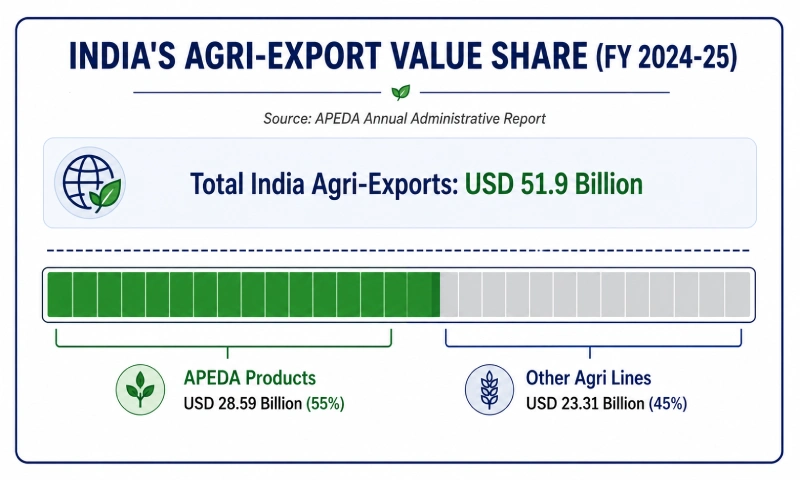
We are talking about a dominant 55% share of the country’s entire agricultural export value. Because of that heavy concentration, any trade desk moving mainstream lines—think long-grain Basmati, parboiled rice, groundnuts, lentils, fresh onions, or value-added frozen snacks—constantly interacts with this specific regulatory ecosystem. Operating without a valid APEDA certificate India isn't an option if your long-term goal is capturing steady revenue from institutional Western or Middle Eastern supermarket networks.
Products Covered Under APEDA Registration
The statutory mandate covers an extensive list of agricultural derivatives. Sourcing teams must verify where their specific cargo sits on this scheduled grid to align their compliance schedules before booking ocean container space.
| Product Category Covered by APEDA | Primary Technical Sub-Classifications |
|---|---|
| Fruits & Vegetables | Fresh premium mango varieties, table grapes, dehydrating onions, and exotic farm greens |
| Processed Foods | Ready-to-eat packages, aseptic fruit pulps, breakfast preserves, and shelf-stable confectionery |
| Cereals & Pulses | Bulk wheat, commercial maize, grain millets, whole lentils, and dried peas |
| Basmati & Non-Basmati Rice | Aromatic long-grain selections, raw broken fragments, and parboiled bulk shipments |
| Groundnuts | Hand-picked selected (HPS) kernels, crushing stocks, and processed peanut oil feedstocks |
| Guar Gum | Refined splits, industrial-grade processing powders, and food texture stabilizers |
| Meat & Dairy Products | Frozen buffalo primal cuts, poultry items, skimmed milk powders, and anhydrous milk fats |
| Floriculture & Organic Lines | Fresh cut flowers, tissue culture micro-propagations, and verified organic food ingredients |
Eligibility Criteria for APEDA Registration India
The onboarding pipeline is structurally straightforward, intentionally designed to loop in diverse business structures rather than just elite trading conglomerates. Obtaining an APEDA registration India fits the business models of multiple market actors:
- Merchant Exporters: Traditional trading entities that buy finished lots from domestic oil mills or open wholesale mandis to flip overseas.
- Manufacturer Exporters: Processing houses that operate their own sorting lines, milling plants, or commercial blast-freezing facilities.
- Farmer Producer Organizations (FPOs): Rural farming blocks merging resources to bypass domestic commission agents and pocket the direct global margins themselves.
- Agri Startups & Food Exporters: Digital-first brands and premium clean-label merchants executing niche consumer deliveries.
The operational sequence matters immensely here. This entire onboarding run only becomes achievable after your firm holds a verified, active Import Export Code issued by the central government.
APEDA Registration Process: Step-by-Step Guide for Exporters
The online APEDA registration process functions as an automated, highly deliberate compliance ledger. Precision during initial data input is essential; a mismatched character can trigger an immediate manual review.
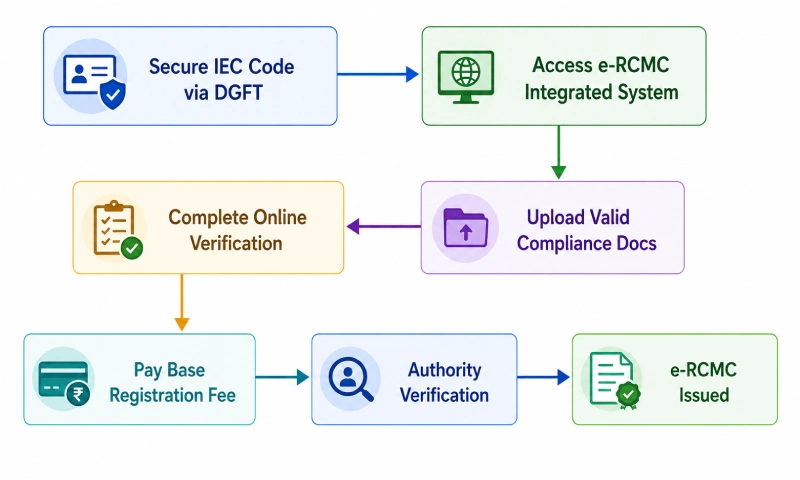
1. Secure Your Base Exit Code
First, navigate the DGFT portal to secure an active Import Export Code. Without this legal identifier, no commercial freight can legally pass past an Indian customs checkpoint.
2. Enter the Integrated Portal
Applicants must log directly into the unified e-RCMC module. This digital interface syncs data across the DGFT and APEDA networks, connecting agricultural trade filings directly with national border databases.
3. Initialize the User Profile
Type in your active IEC number. The platform automatically mirrors your baseline corporate registration data across the screen. From there, run instantaneous mobile and email checks via automated one-time password loops.
4. Provide Your Corporate Credentials
The trade desk uploads clean, high-resolution digital scans of your foundational tax, entity, and banking records.
Step 5: Remit the Base Processing Tariff
Submit the mandatory APEDA fees India through the secure corporate payment gateway.
6. Regional Desk Review
A designated officer at the corresponding regional office reviews the documentation attachments. If they spot blurred files or address discrepancies, they flag the file for immediate text amendments.
7. Digital e-RCMC Issuance
Once the auditing officer signs off, the integrated system builds a secure, verifiable Registration-Cum-Membership Certificate for immediate download.
| Stage | Action | Operational Target |
|---|---|---|
| 1 | Obtain IEC | Establishing legal export capability via central DGFT channels |
| 2 | Apply Online | Opening the formal digital file on the e-RCMC registry portal |
| 3 | Upload Documents | Backing your application with certified corporate tax and banking files |
| 4 | Pay Fee | Cleaving through processing steps by remitting base charges online |
| 5 | Verification | Undergoing a hands-on document audit by regional desk officers |
| 6 | Approval | Validating company credentials for formal agricultural trade status |
| 7 | RCMC Issued | Downloading the authentic, active digital certificate to clear port customs |

Documents Required for APEDA Registration
The regional evaluation desk uses your attached files to verify corporate legitimacy. To keep the exporter onboarding process moving without friction, construct a clean digital repository containing these baseline documents:
| Document | Operational Purpose | Operational Parameter |
|---|---|---|
| IEC Certificate | Export Identification | Must match current operational addresses letter for letter. |
| PAN Card | Tax Identity | Validates the core structural identity of the firm or managing proprietor. |
| GST Registration | Business Compliance | Non-negotiable for interstate tracking and formal commercial origin audits. |
| Cancelled Cheque | Bank Verification | Proves the existence of an active corporate bank line with clear IFSC details. |
| Bank Certificate | Business Validation | An official, signed statement confirming your corporate financial standing. |
| Incorporation Docs | Entity Verification | Certified partnership deeds or MoA copies outlining company leadership. |
What Is the APEDA Certificate (RCMC)?
The Registration-Cum-Membership Certificate isn't an ornamental corporate seal. It is a statutory instrument required under the rules of India’s Foreign Trade Policy. Think of it as a mandatory operational pass for clearing agricultural cargo past port custom teams.
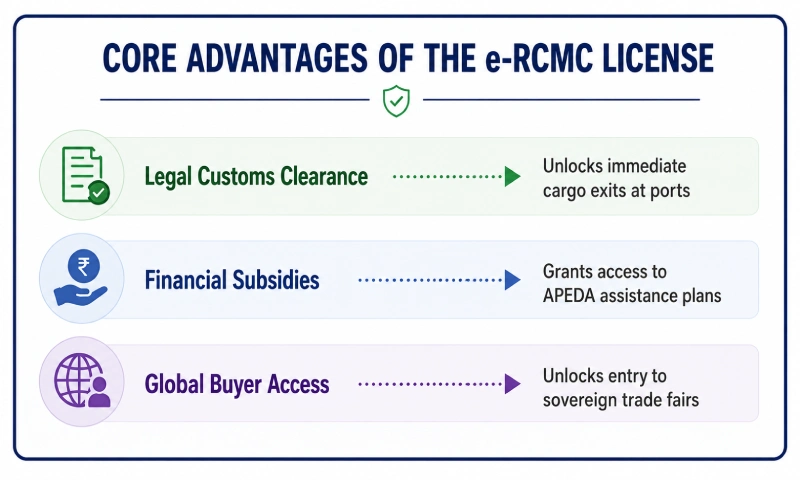
By transitioning the traditional paper certificate into an automated e-RCMC engine linked directly with the DGFT, the state has eliminated major bottlenecks. Holding this active validation allows your firm to tap into central export subsidy programs, claim financial grants for laboratory upgrades, and secure formal placement at state-sponsored buyer-seller meets. This institutional clearance tells international buyers that your mill operates under vetted national guidelines.
APEDA Registration Fees and Validity
Exporters need to bake the fixed processing cost straight into their preliminary operational overhead calculations. The base fee remains standard across all states, though trading desks should periodically review official portals for updated administrative adjustments.
| Particular | Details |
|---|---|
| Registration Fee | Set at a baseline of INR 5,000 (excluding standard statutory GST additions). |
| Validity | Remains fully active for a block of 5 financial years from the initial date of issue. |
| Renewal | Managed entirely online through the digital registry by submitting updated tax files. |
Key Benefits of APEDA Registration for Exporters
The true upside of completing your APEDA registration India goes far beyond basic legal box-ticking. It plugs your enterprise directly into an institutional support grid designed to de-risk long-distance commodity trade.
Take the Financial Assistance Scheme as an example. The authority offers targeted financial offsets across three separate operational zones:
- Infrastructure Development: Direct capital subsidies to help build mechanized cold storages, packing installations, and automated optical sortex lines.
- Quality Development: Financial help to cover third-party laboratory testing invoices, implement HACCP principles, and clear premium ISO or FSSC 22000 audits.
- Market Development: Subsidies aimed at reducing container transport costs for test crops and checking performance in new foreign markets.
Furthermore, registered merchants gain direct entry to elite global export promotion platforms, including private buyer-seller meets and massive trade expos like Gulfood in Dubai or SIAL in Paris. This visibility allows family-owned mills to present their products face-to-face with corporate retail buyers, cutting out the middle-tier brokers who traditionally extract the bulk of the margin.
APEDA's Digital Platforms for Exporters
The authority runs several advanced digital networks built to manage traceability and verify product safety. These trace systems remove quality uncertainties, helping Indian shipments pass strict foreign border inspections smoothly.
- TraceNet: An online tracking architecture that monitors the entire supply chain for organic lines, ensuring zero chemical cross-contamination from farm to vessel.
- HortiNet: An integrated app that maps out farm plots, monitors localized pests, and tracks residue assays for premium fresh fruits like grapes and mangoes.
- MeatNet: An online management portal that handles health certifications and animal welfare audits for livestock processing.
- AgriExchange: A comprehensive data intelligence engine providing real-time international price fluctuations, global tariff changes, and direct importer leads to Indian exporters.
Common APEDA Registration Mistakes New Exporters Make
A smooth digital registration can quickly stall if your initial submission features careless typos. Avoid administrative delays by vetting your files for these frequent errors:
- Mismatched Corporate Data: Double-checking that your company name and operating address read identically across your IEC, GST sheet, and corporate bank line.
- Blurred Bank Scans: Attaching low-resolution cancelled cheques or personal bank details where the corporate name or IFSC lines are unreadable.
- Wrong Scheduled Category: Selecting an incorrect product group, which can trigger custom delays later if your shipped container doesn't align with your RCMC profile.
- Incomplete Partnership Records: Uploading unsigned corporate deeds or outdated memoranda, forcing the regional office to bounce the file back for corrections.
APEDA Registration Growth Reflects Rising Export Interest
The growing interest in agricultural exports can also be seen through APEDA's registration numbers. During FY 2024-25, more than 9,500 new registrations were processed, taking the total active RCMC roster beyond 42,740 exporters.
This steady increase reflects accelerating participation from modern food processors, rural FPOs, agri startups, and traditional merchants across the country. The authority's training focus is equally extensive; they managed 879 structured capacity-building workshops that educated over 78,000 export participants on packaging innovations, pesticide residue limits, and international customs rules. This expanding pool of vetted merchants proves that global food markets are moving away from informal trading and demanding highly disciplined, trace-verified agricultural partnerships.
Conclusion
Completing your APEDA registration India remains the single most important compliance milestone for an emerging agricultural trade desk. The authority supplies much more than simple legal clearance; it opens a direct path to a unified system of digital trace logs, infrastructure development grants, and international corporate buyers.
By helping you turn raw farm fields into premium, internationally compliant food shipments, the authority insulates your enterprise from sudden port rejections and steep margin drops. Preparing a clean document folder and executing the step-by-step registration process allows your firm to enter the global trade lane cleanly. This establishes a highly reliable path to harvesting sustainable, high-margin returns across the global food matrix.
Want to export agriculture commodities globally after APEDA registration? Register as a seller on Tradologie.
Disclaimer
The information provided is for educational and informational purposes only. APEDA regulations, registration procedures, fees, documentation requirements, and export policies may change from time to time. Exporters should verify the latest requirements through official government channels before applying for registration or undertaking export activities.




.webp "Agro Export Documentation Checklist (IEC, GST, FSSAI)")


.webp "Rabi Crops List 2026 — Complete Guide with Producing States, Season and Examples")