Key Highlights
- Policy Shifts: The government eliminated the 20% export tax and Minimum Export Price (MEP) in April 2025.
- Pricing & Timing: FOB prices sit between $0.50–$0.75/kg; the Rabi harvest (March–June) guarantees the lowest rates.
- Top Destinations: Bangladesh, Malaysia, Sri Lanka, and the UAE drive the highest import volumes.
- Export Codes: Trade relies on HS 0703 10 for fresh onions and HS 0712 2000 for dehydrated flakes.
- Mandatory Compliance: You must secure an IEC, an APEDA RCMC, and a Phytosanitary Certificate to clear customs.
- Freight Strategy: Heavy Gulf shipping surcharges are pushing smart exporters toward processed, high-value goods like dehydrated flakes.
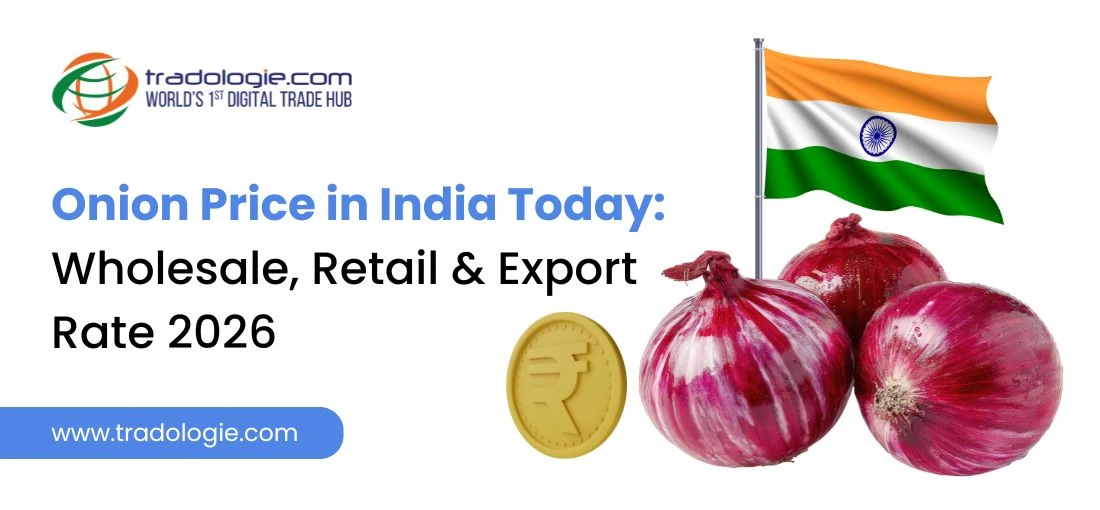
The farming world in 2026 shows a complex picture for Indian trade. You must look past the local news panic to truly understand the dynamics behind the onion price today in India. You need a deep look at bulk buying, export options, and basic farming facts. India usually supplies about 20% of the world's exported onions. Because of this, even small changes in India's supply chain can shake the global market.
This guide looks closely at the huge gap between farm-gate rates and city store prices. We track the true onion wholesale price India. We will break down key numbers for you. We will look at the standard Nashik onion price and specific market changes. This gives bulk buyers, local traders, and exporters the exact data they need. You can use this guide to plan your steps in this year's highly shifting market.

1. Farming Overview: The State of Onion Crops in 2026
The onion market is a major part of India's farming economy. India produces about 31 million metric tons each year. We know this from the 2026 IndexBox Market Analysis. The supply chain is huge. However, it can break easily.
India's top rank depends on a careful balance. This balance is between the late monsoon Kharif crop and the winter Rabi crop. Farmers store the Rabi crop for long periods. Bad weather hurts this crop badly. When that happens, the baseline pyaz price India sees all year will change. Old storage methods do not work well. Right now, farmers often lose up to 30% of their onions after harvest.
2. Wholesale Trends: Onion Wholesale Price India
We must look past retail prices to grasp the true onion wholesale price India is currently experiencing. Farm-gate realities matter much more. The wholesale market jumps up and down quickly. Traders guessing on price drops cause some of this. Supply chain jams also play a big role.
- Market Arrivals: Fewer onions arrive in key states like Maharashtra, Madhya Pradesh, and Karnataka. This drop directly pushes wholesale prices up.
- Weather Risks: Unseasonal rains can delay the fresh Kharif crop. This forces buyers to rely heavily on old Rabi stock.
- Middlemen Effects: The supply chain has too many steps. Regional buyers add their own costs. This makes onions more expensive before they even reach city markets.
Maharashtra cold storage levels act as a major warning sign. They show us where prices will go next. Sometimes, traders hold large amounts of Rabi onions. They wait for higher prices. This lowers the visible supply. Spot rates then go up. Later, traders release these stored onions. They do this at price peaks or right before a new crop arrives. When they release the stock, spot prices can drop fast in just a few days. Smart buyers watch daily arrival data. They also check Maharashtra cold storage reports. This gives them a strong two-week to three-week hint on price direction.
3. The Main Hub: Nashik Onion Price
Nashik is the true heart of India's bulk onion trade. The Nashik onion price sets the standard for the whole country. It guides both local sales and global exports. Quality is very important at these auctions. Buyers look closely at the size. They want 45mm or 55mm onions. They also look for a long shelf life. The Garwa variety is highly praised for this. Better quality brings higher auction prices.
| Grade/Destination | Size Specification | Spot Rate (INR/kg) - March 2026 |
|---|---|---|
| Export (Gulf/Dubai) | 55mm+ | ₹14.50 - ₹16.00 |
| Export (Sri Lanka) | 45mm+ | ₹13.50 - ₹15.00 |
| Domestic Super Golta | 30mm - 35mm | ₹9.50 |
| Domestic Premium | 55mm+ | ₹13.50 - ₹15.00 |
Source context: 2026 Spot Bilty rates from Nashik APMC exporting entities.
Bulk B2B buyers must pick the right time to buy. The best window for Rabi onion procurement is March to June. This happens right after peak Rabi harvest arrivals at the market. During this time, onion prices hit their lowest point of the year. The supply is simply at its highest.
The months of December and January are quite different. This gap between the Kharif and Rabi crops is the tightest supply period. It carries the highest price risk. Smart buyers secure contracts during the March to April Rabi arrivals. They then put these onions in cold storage. They sell them later in the year. This approach always secures the best landed costs.

4. Mandi Rates: Regional Market Checks and Buying Signals
To accurately gauge the onion mandi rate today, bulk traders must continuously monitor regional Agricultural Produce Market Committees (APMCs). City mandis like Delhi's Ghazipur act differently than farm mandis. City prices have jumped to ₹70 per kg. A lack of transport caused this spike. However, the main sourcing mandis in Maharashtra have much lower rates.
Buyers must track the Lasalgaon APMC onion rate closely. This helps them avoid sudden price shocks. Research from 2026 proves this market is very risky. The Lasalgaon APMC onion rate serves as the main guide. Buyers use it to plan their national buying steps.
5. Trade and Exports: The Global Supply Chain
Exporting helps clear out extra onions in India. The country usually exports 1 to 2 million tons every year. Selling to other nations requires care. Traders must follow strict health rules. They must also know what foreign buyers want. People globally want onions that last a long time. Organic onions are also very popular.
Exporters who buy straight from Nashik get a strong product. These onions survive long trips. They reach Southeast Asia and the Middle East in great shape. A smart Rabi onion procurement plan feeds this export chain. It keeps the global supply steady.
6. Retail Reality: The Wholesale-to-Retail Price Gap in Cities
Bulk buying is our main focus. Still, we cannot ignore the retail side. Retail prices cause political actions. When city consumers search for the pyaz ka rate today, they see a number that looks very different from farm-gate prices. In big cities, the gap is huge. Premium retail prices have hit ₹90 per kg in some places.
This big difference shows a broken supply chain. Transport costs are high. Cities lack good storage. Retailers add large markups. These issues make onions costly for regular buyers. The final cost is far away from the true pyaz price India records at the wholesale level.
7. Future Fixes: Better Setup and Lower Price Risks
India must change how it trades onions to secure the future. Old habits will not work anymore. We need modern farming ideas. Fixing market swings takes big, real changes. Quick, small reactions will fail.
- Better Storage: Farmers must stop using old bamboo sheds. They need modern, cool silos. This will cut the 30% crop loss.
- Smart Data: The market needs future trading systems. Data models can predict trends. This helps farmers plan before they plant.
- Stronger Seeds: We must use better seeds. Hybrid seeds fight disease well. They also survive bad weather. This keeps crop sizes steady.