Key Highlights
- Pricing Benchmark: The Lasalgaon APMC in Nashik serves as the primary gauge for India's wholesale onion pricing and global export rates.
- Current Wholesale Rates: Premium export-grade onions (55mm+) are trading at spot rates between ₹13.50 and ₹16.00/kg.
- Procurement Window: B2B buyers should secure bulk contracts between March and June, taking advantage of the peak Rabi harvest supply.
- Price Forecasting: Monitoring Maharashtra's daily mandi arrivals and cold storage levels provides a reliable two-to-three-week indicator for future price movements.
- Supply Chain Gaps: Significant crop losses (up to 30%) and high middleman margins create a massive gap between farm-gate wholesale rates and city retail prices.
The farming world is seeing a big shift in 2026. For years, bulk traders faced many problems. They dealt with broken data. They jumped between changing rules and shipping delays. They had no clear plan to guide them.
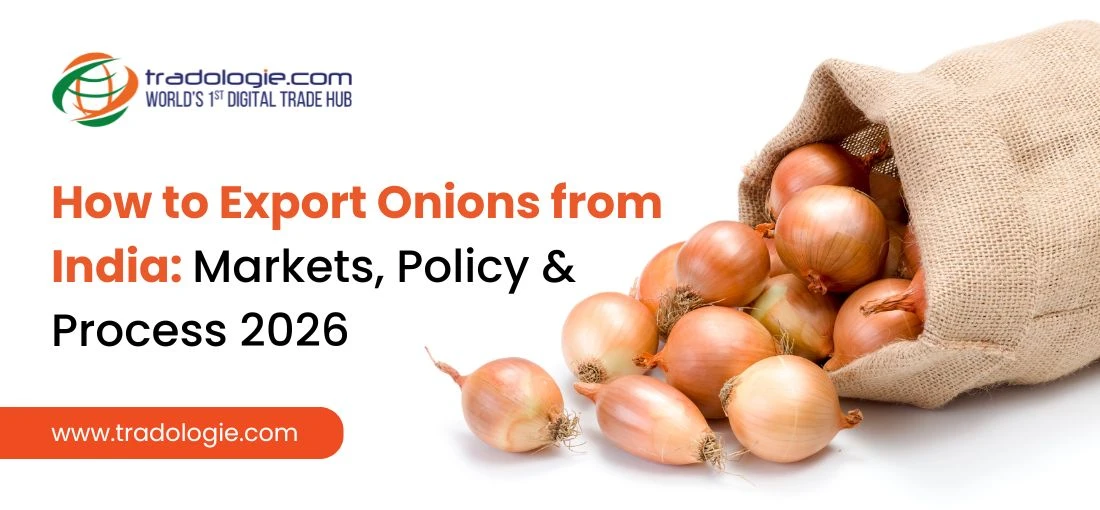
To succeed in onion export from India today, traders need more than basic steps. They must understand the big picture. They need to track local farm supplies. They must also know about shipping costs and health rules. This guide acts as a complete plan for bulk farm trade. It uses real-time prices and rule changes. It is designed to help traders win in the global market.

1. The State of Pyaz Export India: 2026 Market Overview
India is a top player in farming. It is always one of the top five sellers in the world. The Observatory of Economic Complexity (OEC) and TradeImeX share recent numbers. They show India holds 4.7% to 8.4% of the global market. The yearly sales value is large. It stays between $422.6 million and $459 million.
The pyaz export India market is special. This is because the country has many different climates. Farmers can grow crops at different times. These times are called Rabi, Kharif, and Late Kharif. This cycle keeps the supply very steady. Countries like Egypt or China cannot always do this.
However, traders must plan carefully around these crop times. The Indian Council of Agricultural Research (ICAR) shares a warning. If traders do not use climate-controlled warehouses, Rabi onions can rot quickly. Storage losses can reach 30–40%.
2. Unpacking the Onion Export Ban India & 2026 Policy Shifts
Government rules always change farm trade. In the past, the government used the onion export ban India tool often. They did this to stop local prices from rising too high. This ban caused a lot of stress. It made things very hard for foreign buyers.
Things changed a lot on April 1, 2025. The Indian government made a huge rule change. They removed the strict 20% export tax. They also stopped the Minimum Export Price (MEP) rule. This change makes exporting much easier today. Now, traders save about $100 to $150 per tonne in business costs.
Still, traders need to be careful. They must watch local mandi (market) prices. They also need to track the weather. The Southwest Monsoon is very important. If the local supply drops suddenly, the government might react. They could bring back strict rules.
3. Analyzing the India Onion Export Price Per Kg
Setting prices in 2026 requires fast thinking. The onion export price per kg is not fixed. It changes based on the size of the onion. It also depends on the buyer's country and port space. Now that the MEP is gone, Indian sellers can offer great deals. This helps them win long-term bulk orders.
Indian onion FOB prices in 2025-26 have varied. They mostly stayed between USD 500 and USD 750 per metric tonne. This is for standard red onions leaving Indian ports. The season changes the price a lot. The Kharif season (October–November) costs more. These prices are usually 40–80% higher than the Rabi season for the same quality. Smart buyers plan their purchases for the Rabi season. Shipments from March to June always get the best FOB rates.
| Grade / Size | Target Market | Estimated 2026 FOB Price (USD/kg) |
|---|---|---|
| Jumbo (60–90mm) | Gulf / Middle East hospitality | $0.60 – $0.75 |
| Medium (40–60mm) | Asian retail / general bulk | $0.50 – $0.65 |
| Small (25–30mm) | Domestic and niche export | $0.35 – $0.50 |
| Kharif Season Premium | All grades (Oct–Nov) | Add 40–80% to Rabi base |
Note: Prices are a rough guide for the Rabi season. This is the main supply time. You should check current prices with Nashik sellers. Also, look at the Lasalgaon APMC daily arrivals. This is the best way to know the local price.

Seasonal Procurement Strategy: When to Buy Indian Onions
India has three main onion seasons. The Rabi crop is the biggest. Farmers harvest it from February to May. This crop is the main source for exports. When Rabi onions arrive in large amounts, prices drop. This makes March to June the best time to ship. Buyers get very good prices then.
The Kharif crop is smaller. Farmers harvest it in October and November. Because it is smaller, it costs more. It usually has a 40–80% price markup over Rabi onions.
There is a gap between the Kharif and Rabi seasons. This happens around December to January. Supplies are very low then. Prices are at their highest risk for buyers.
Expert buyers watch two main signs for price changes:
- Daily Market Arrivals: They look at daily onion arrivals at Lasalgaon APMC. This is the largest onion market in Maharashtra.
- Storage Levels: They check the cold storage levels in Maharashtra. If storage is full, sellers might release onions quickly. This causes prices to drop fast. If storage is low, future prices will likely go up.
Ready to Take Your Onion Trade Global?
You have the market knowledge and the supply. Now, get direct access to international B2B buyers without the traditional intermediary hurdles. Scale your agricultural export business on your own terms.
[ Start Exporting Now ]
Set up your export profile in minutes.
4. Top India Onion Export Countries & Destinations
Finding the right buyers is vital for growth. Success comes from using known trade routes. It also helps to sell to nearby countries. Global trade data shows a clear trend. India sells mostly to a few partners in Asia and the Middle East.
Here are the top India onion export countries by amount and value:
- Bangladesh: They buy the most. Their imports reach about $187 million. Sharing land borders makes shipping easy and fast.
- Malaysia: They buy a huge amount of Indian red onions. They spend roughly $72.1 million every year on this crop.
- Sri Lanka: They import about $69.1 million. This is strong because both countries cook similar foods.
- United Arab Emirates (UAE): They spend $45.6 million. They mostly buy large, high-quality onions. These go to fancy hotels and restaurants.
- New Markets: The Maldives and Vietnam are buying more every year. These countries are great new spots for smart sellers.
5. The Step-by-Step Process for Onion Exporters in India
Moving onions from local farms to global ships is a big task. You must follow strict rules and health checks. Here is the exact checklist for onion exporters in India in 2026:
- Get the IEC: You need an Importer Exporter Code. The Directorate General of Foreign Trade (DGFT) gives this out.
- APEDA Registration: You must get a Registration-cum-Membership Certificate (RCMC). This comes from APEDA. You cannot export farm goods without it.
- Lab Tests & Health Papers: Send onion samples to an NABL-approved lab. After they pass, get a Phytosanitary Certificate. This comes from Plant Quarantine officials. It proves the onions have no bugs or pests.
- Customs & Papers: Get your Commercial Invoice and Packing List ready. Also prepare the Certificate of Origin and Bill of Lading. Hire a Custom House Agent (CHA). They will help clear the port quickly.
HS Codes for Onion Export from India
| Product | HS Code | Notes |
|---|---|---|
| Fresh/chilled onions | 0703 10 | Primary export category; subject to export duty/MEP policy notifications |
| Dehydrated onion flakes | 0712 2000 | Value-added; different buyer profile and freight economics |
| Onion powder | 0712 9090 | Processed; typically lower policy intervention risk |
Compliance Note: All DGFT rules use HS 0703 10 for fresh onions. This includes the duty removal in April 2025. It also covers old MEP and ban rules. You must watch the DGFT for changes to this exact code. Dried and powdered onions use 0712 codes. The government changes the rules for these processed items much less often.
6. Quality Standards, Grading, & Logistics in Bulk Agri-Trade
Global buyers want top quality. Buying from good farms is just the start. You must sort the onions by machine. This makes them all the same size and shape.
A normal "Grade B" export needs good red color. The onions must be firm. A few small marks are okay. They must also pass the European Union rules for safe pesticide limits (MRL).
How you pack them changes how long they last. Do not dump them in a big pile on the ship. Use special bags with tiny holes. People use mesh or jute bags. These usually hold 25kg or 50kg. The holes let air move around. This stops the onions from rotting.
If the ship trip is long, cool the onions first. Bring them down to 15-20°C within a day of picking. Then, put them in cooling containers. This keeps them hard and fresh for the whole trip.
7. Addressing the 2026 Freight Crisis & Strategic Outlook
Even with good rules, global money issues cause trouble. Problems in the Middle East have messed up shipping lines. This hurts exporters out of Maharashtra and Karnataka. These are India's primary onion producing states. The Nashik district alone supplies a huge amount of export-grade red onions. They sell these through the Lasalgaon APMC. This is Asia's largest onion wholesale market.
Containers going to the Gulf face extra costs. These are called Emergency Conflict Surcharges (ECS). The extra fees range between USD 2,000 and USD 4,000 per container. It depends on the gear and the shipping company. CMA CGM and other big lines added these fees just for Gulf trips. Freightos data shows a huge jump. Rates from Indian ports to Jebel Ali (Dubai) went over USD 4,000/FEU. This happened during bad times in early 2026. This is much higher than normal. However, it is lower than the worst Red Sea rates in 2024.
The biggest shipping risk in 2026 for the Gulf market is the Strait of Hormuz. About 20% of the world's oil goes through there. Freightos shared news in March 2026. Big ships added an ECS of USD 3,000/FEU for Gulf trips. Sellers must add extra money to their Gulf contracts. They must prepare for shipping delays. They should also add a force majeure clause for ocean route problems.
Smart sellers are changing their plans. They are moving to processed goods. This helps them skip the shipping problems of fresh food. They make dehydrated onion flakes (HS 0712 2000). They also make onion powder and frozen diced pieces. These items are worth more per kilo. This means shipping costs are a smaller part of the total price.
These processed foods also last much longer. They do not rot like fresh onions. They attract a different type of buyer. These buyers include food factories, ready-meal makers, and big catering chains in Europe and North America.