Key Highlights
- Vietnam supplies over 40% of the world's pepper.
- VPSA is a useful source for finding licensed pepper processors.
- Buyers should check ISO 22000/HACCP, ASTA/ESA, and phytosanitary documents.
- Steam sterilization helps control E. coli and Salmonella.
- Independent SGS or Cafecontrol inspection can reduce quality and payment risks.
- Very low prices, delayed samples, and 100% advance payment are major red flags.
Introduction:
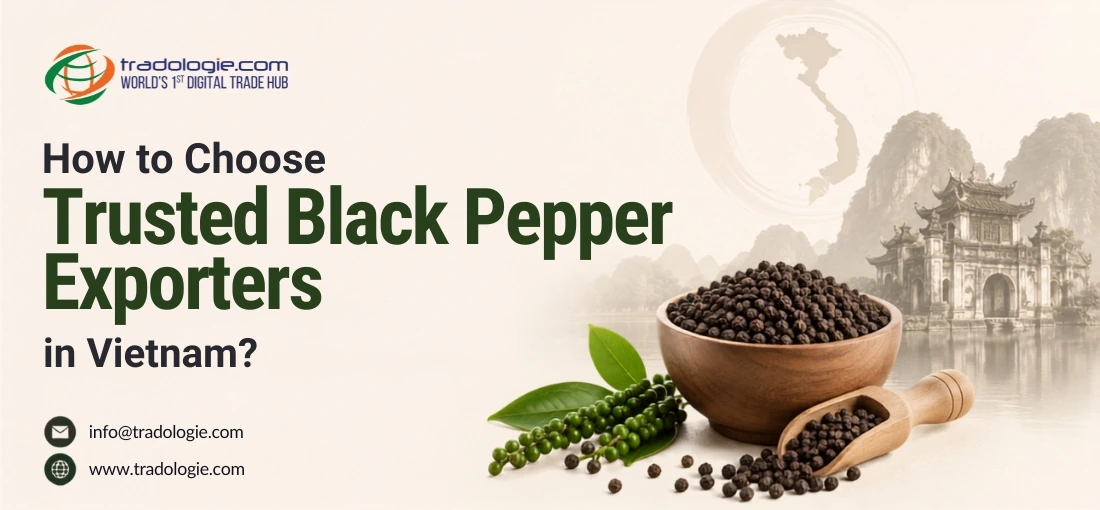
Vietnam is the undisputed monster of the global pepper market. They grow and export over 40% of the world's supply, mostly coming out of regions like Dak Lak and Gia Lai.
So if you're looking to import black pepper from Vietnam , the volume is definitely there. You can get pretty much whatever grade you want—whether that's basic FAQ stuff, clean 500 or 570 g/l density berries, or high-end ASTA grade.
The tricky part isn't finding pepper. It's knowing how to connect with black pepper suppliers in Vietnam who won't send you a container full of moldy, under-dried berries that get seized by customs the second the ship docks in your home port. Reading this informative piece of blog will tell you how to find trusted black pepper exporters in Vietnam.

Where To Find Genuine Black Pepper Exporters In Vietnam?
Forget sending cold messages to random addresses off the internet. Most serious black pepper supplies in Vietnam aren't scrolling through open inquiry boards anyway.
Start with the Vietnam Pepper and Spice Association (VPSA) . Their directory lists the actual licensed processors tied directly to farming regions. If a black pepper exporter in Vietnam isn't listed with VPSA, that's your first sign to slow down and ask questions.
For digital platforms, transaction-focused sites like Tradologie let you set exact specs—density, moisture, steam treatment—and have verified processing plants bid directly. If you're on general sites like Alibaba or Tridge, be very careful and only talk to the suppliers who agree on LC payments and provide all the certifications.
Another option on how to connect with black pepper suppliers in Vietnam? Buy customs data off portals like Volza. Looking up real shipment records shows you exactly which Vietnamese factories are currently shipping 20-foot containers to major buyers in Europe or the US.
And if you can travel, head to Foodex Vietnam in Ho Chi Minh City, or catch their pavilions at Gulfood or Anuga . Meeting factory owners face-to-face cuts through a lot of middleman nonsense.
Certifications You Need to Ask For Black Pepper Suppliers In Vietnam
You can't just take the word of black pepper exporters in Vietnam on quality. If your shipment fails lab tests for mold or chemical residues, you're the one losing money.
For the US market, insist on ASTA standards. If you're selling into Europe, you need ESA compliance—European buyers are notoriously strict about pesticide limits and mycotoxins like Aflatoxin.
At the processing level, look for ISO 22000 or HACCP as the bare minimum. If you deal with major supermarket chains, ask if they have BRCGS or IFS.
And pay close attention to steam sterilization. Raw sun-dried pepper picked straight off a farm carries natural dirt and bacteria. Good processors run the berries through steam sterilization towers to kill E. coli and Salmonella without destroying the essential oils. Always ask if they have their own in-house steam plant, or if they outsource it.
Before any container leaves Vietnam, you'll also need a Phytosanitary Certificate from Vietna's Plant Protection Department to prove the cargo is pest-free.
Here is how the mandatory stuff compares to the market-specific requirements if you want a quick cheat sheet for what paper trail you need.

Required vs. Optional Certifications for Vietnam Spice Imports
| Certification / Document | Issuing Body / Focus Area | Mandatory or Optional? |
|---|---|---|
| Phytosanitary Certificate | Sub-Plant Protection Department (Vietnam) | Mandatory (Required by customs globally) |
| Certificate of Origin (Form A/E/VSTP) | Ministry of Industry and Trade (MoIT) | Mandatory (For tariff concessions) |
| ISO 22000 / HACCP | Accredited Testing Agencies | Highly Recommended (Proves factory safety) |
| ASTA / ESA Compliance | Trade Associations (US/Europe specs) | Market Specific (Essential for US & EU buyers) |
| SGS / Cafecontrol Report | Independent Pre-Shipment Inspectors | Strongly Recommended (Protects your payment) |
Here is a breakdown of what you'll see on spec sheets to give you a quick idea of how those density grades actually compare.
Vietnam Black Pepper Density & Quality Specs at a Glance
| Pepper Grade / Density | Key Characteristics | Best Used For |
|---|---|---|
| FAQ (Fair Average Quality) | Sun-dried, unwashed, minimal machine sorting (500-550 g/l) | Bulk grinding, lower-tier commercial spice processing |
| Clean / Machine Cleaned | Destoned, spiral sorted, dust removed (500-570 g/l) | Standard wholesale distribution, retail packing |
| Steam Sterilized | Thermally treated to eliminate E. coli/Salmonella while retaining essential oils | High-end food processing, direct supermarket retail |
| ASTA Grade | Highest density (570+ g/l), near-zero foreign matter, strict microbial limits | Premium spice brands, US & EU strict regulatory imports |
Red Flags That Mean You Should Walk Away
Spotting bad suppliers before you send a wire deposit comes down to watching out for weird behavior.
If three factories quote you $6,500 per ton FOB Ho Chi Minh for 550 g/l pepper, and some random trading company pops up quoting $5,600... run. Nobody is discounting real pepper by $900 a ton out of the goodness of their heart. They're almost certainly mixing light, low-density berries into the batch or skipping the cleaning phase.
The same goes for samples. A legitimate exporter won't hesitate to DHL you a 500-gram sealed sample for testing. If they start making excuses about sample fees or delay things for weeks, move on.
Also, never skip third-party inspection. You want an independent testing agency—like SGS or Cafecontrol —to draw samples, check moisture, and seal the container doors at the factory before you release the final payment. If a supplier refuses to let SGS onto their factory floor? That' s an immediate dealbreaker.
Watch the packaging too. Pepper soaks up humidity like a sponge on long sea voyages. If they aren't using double-layered woven PP bags with PE liners or multi-wall paper bags, your pepper is going to arrive clumpy or moldy.
Quick Red Flag vs. Green Flag Supplier Matrix
| Operational Area | Red Flag (Walk Away) | Green Flag (Trustworthy Supplier) |
|---|---|---|
| Pricing | Unreasonably cheap ($500+ below market average) | Aligned with current VPSA market rates |
| Sampling | Refuses DHL samples or delays for weeks | Sends sealed 500g lot samples promptly |
| Factory Access | Won't allow third-party (SGS) factory entry | Open to full loading-port inspection by SGS/Cafecontrol |
| Sterilization | Vague about pathogen controls | Owns or contracts an in-house steam sterilization tower |
| Payment | Demands 100% advance wire transfer | Accepts 20-30% deposit against B/L + SGS, or LC at Sight |
A Quick Vetting Routine
Before you sign a contract or transfer a deposit, run through these basic checks:
Make sure they're on the VPSA registry. Get copies of their ISO or HACCP certificates and check the expiration dates. Ask point-blank if they handle cleaning and steam treatment in their own facility or contract it out.
And make sure they agree to SGS testing at the port of loading, along with standard trade terms—something like a 20-30% deposit with the rest paid after you inspect the scanned Bill of Lading and SGS report. Or better yet, an LC at sight.
Do that groundwork upfront, and you'll end up with clean, bold Vietnamese pepper instead of a massive headache at customs.
Disclaimer
The information provided in this article is for educational and informational purposes only. Supplier certifications, quality standards, prices, import requirements, and trade terms may change over time. Buyers should independently verify exporter credentials, certificates, product quality, and destination-country requirements before entering into a transaction.