Key Highlights
- Transaction-based B2B marketplaces are best suited for fresh vegetable exports.
- Verified buyers reduce payment and fraud risks.
- APEDA registration is required before exporting fresh vegetables.
- Escrow and Letters of Credit improve payment security.
- Pre-shipment testing and cold-chain monitoring protect cargo quality.
- Digital trade platforms help exporters secure long-term global buyers.
Introduction:
If you are already an agricultural exporter who exports fresh vegetables, then you definitely know that fresh vegetables are arguably one of the most challenging exports. They aren't like non-perishable agricultural commodities that don't perish easily. Commodities like fresh onion and tomatoes can easily perish if there is the slightest leniency in packaging and delays delivery timelines. And not to mention that the window right from the harvest to the port landing is quite short.
Historically, finding agro commodity buyers meant flying to Dubai or Rotterdam for trade shows, taking calls from unverified brokers sitting at port fences, or trusting cold-calling contacts. Today, digital trade ecosystems handle buyer matching online.
However, not every trade site works the same way for Agro Commodity Exporters . Choosing where to list your packhouse capacity dictates whether you spend your days chasing ghost inquiries or booking actual reefer space.
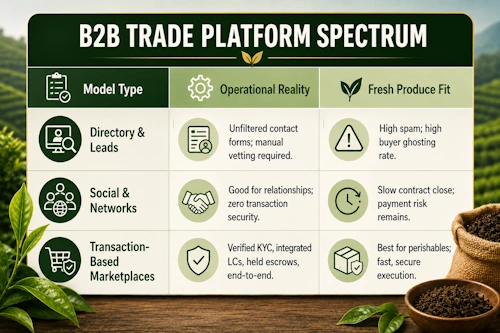
Digital trade platforms come in several distinct flavors, and understanding their operational limits saves you time and capital.
Some channels operate purely as digital directories or simple lead portals. They let you post product photos and company details, acting as online yellow pages. The challenge with basic contact directories is noise—you end up fielding dozens of vague WhatsApp messages from unvetted middlemen asking for "lowest price per kilo C&F" without supplying target port specs or payment terms.
Other portals focus entirely on industrial procurement or corporate supply chain tenders. These purchasing systems work well for processed frozen goods or canned pulps, but their rigid approval cycles can be too slow for quick-turnaround fresh vegetable deals. Similarly, financial commodity exchanges handle standardized paper contracts for dry crops like sugar or wheat, but they rarely suit fresh, perishable horticultural lines.
You also find professional networking hubs and standard consumer-style marketplaces. Networking spaces excel at long-term relationship building, yet they lack built-in trade finance tools. Basic online marketplaces handle small retail volumes but fall short when you need to load eight tonnes of fresh green chillies into air-cargo containers under strict temperature controls.

Why Transaction-Oriented Platforms Win for Fresh Produce
For fresh vegetable trade, transaction-focused platforms sit at the top of the hierarchy.
Rather than stopping at contact forms, a dedicated B2B Marketplace for Vegetable Exporters built around transaction execution handles buyer identity checks, bank-backed Letters of Credit (LCs), escrow payment holds, and mandatory lab test clearances right inside the workspace.
When dealing with a highly perishable shipment, you cannot afford payment disputes three weeks after the cargo leaves your packhouse. Transactional systems lock in trade parameters—moisture limits, box counts, temperature logging requirements, and payment releases—before cargo moves to the airport or sea terminal. That structure turns high-risk spot deals into secure, repeatable trade runs. If you want to export vegetables in bulk, you can register as an exporter on these platforms.
How Digital Ecosystems Verify Foreign Buying Desks
The biggest fear for any new merchant is shipping fresh produce on credit terms, only to have the importer vanish when the vessel arrives at Jebel Ali or Dammam. Modern digital trade networks solve buyer verification through three primary layers:
- Corporate and Banking KYC: Importers must submit official business registrations, tax filings, and bank reference letters before submitting trade inquiries.
- Historical Performance Tracking: Buyer accounts track past shipment volumes, payment timelines, and dispute records. You instantly see if an importer has a habit of filing frivolous quality claims upon cargo arrival.
- Escrow and LC Integration: Transaction-oriented networks require buyers to lock funds into escrow accounts or open confirmed, irrevocable Letters of Credit from Tier-1 banks before you book reefer slots.
Operational Steps: Setting Up Your Export Desk
Connecting with global buyers requires getting your domestic documentation cleared first. Customs officials will not allow fresh produce out of Indian air terminals or sea ports without complete regulatory compliance.
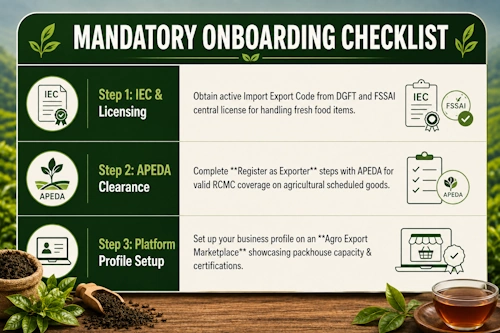
The onboarding process starts at the official level. Before you list produce online, you must complete your Register as Exporter requirements through APEDA (Agricultural and Processed Food Products Export Development Authority). APEDA registration gives you the mandatory RCMC certificate required for customs clearance on fresh produce consignments.
Once your official credentials are active, you set up your trade account on a specialized Agro Export Marketplace . Uploading your APEDA registration, packhouse photos, cold storage specs, and recent phytosanitary test results directly to your trade profile builds trust with foreign procurement officers looking for reliable, long-term suppliers.
Mitigating Quality Claims on Fresh Shipments
Even with verified buyers, fresh vegetable exports bring physical logistics risks. A single broken reefer unit during ocean transit or a day's delay on the tarmac ruins fresh produce fast.
Transaction-focused platforms mitigate destination disputes through standardized pre-shipment inspections:
Pre-Loading Phytosanitary and MRL Checks
European and Gulf markets enforce strict Maximum Residue Limits (MRLs) on agricultural chemicals. Draw composite samples straight from the packing line and upload NABL-accredited lab assays to your digital trade file before cargo moves to port.
Temperature Logging Data
Install USB temperature dataloggers for sea-freight shipments inside reefer containers during stuffing. If a buyer claims cargo arrived damaged due to heat, the recorded logger data proves whether ambient temperatures spiked on the road or while under the ocean carrier's care.

Taking Advantage of Digital Trade Channels
Global demand for fresh, high-quality vegetables stays active year-round, particularly across the Middle East, Southeast Asia, and European diaspora hubs. Using dedicated, transaction-backed trade portals allows agro commodity exporters to move away from high-risk spot deals and build secure supply contracts with vetted global buyers. Exporters who complete their regulatory compliance early, maintain strict cold-chain discipline, and run trade contracts through verified transactional platforms will secure the best-paying long-term buyers season after season.
Conclusion:
Capitalizing on global demand for fresh produce requires moving past traditional, informal trade channels and embracing digital execution. While listing portals, directory networks, and procurement platforms serve basic networking functions, transaction-oriented platforms stand out as the definitive choice for fresh vegetable exporters. By integrating bank-backed payment protection, verified buyer credentials, and structured escrow mechanisms, these platforms effectively eliminate the risk of late payment and post-transit disputes.
Disclaimer
The information provided in this article is for educational and informational purposes only. Export regulations, APEDA requirements, phytosanitary standards, Maximum Residue Limits (MRLs), and import procedures vary by country and may change over time. Exporters should verify the latest government regulations and destination-country requirements before shipping fresh vegetables internationally.