
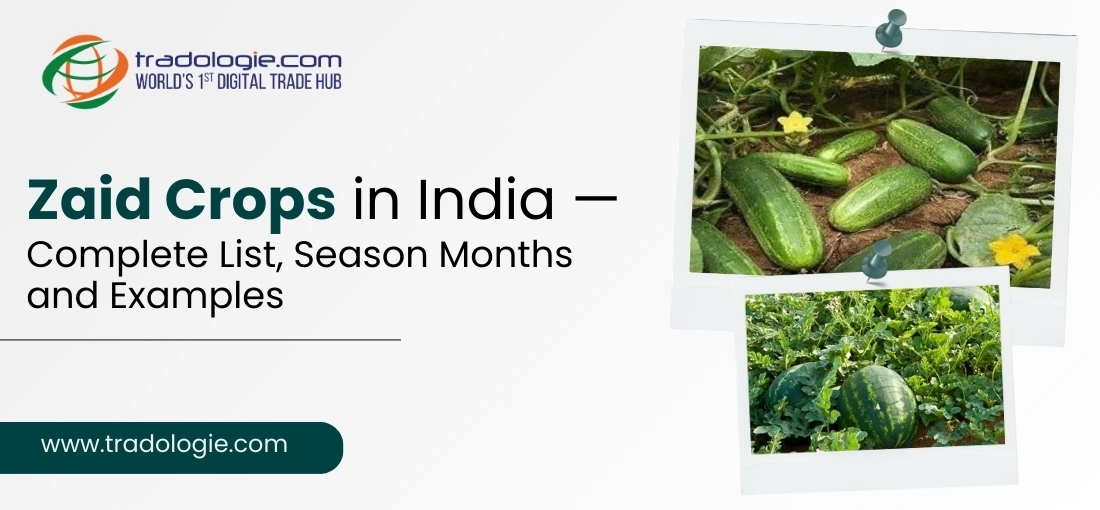
India's agricultural calendar is built around three cropping seasons. While Kharif and Rabi are the two primary seasons, there is a third shorter season called the Zaid season that allows farmers to grow an additional crop between the two main cycles.
Zaid crops are short-duration summer crops grown between March and June using irrigation. They complete their lifecycle in just 60-90 days and contribute significantly to farmer income during the agricultural off-season.
Quick Answer
Zaid crops are short-duration summer crops grown in India between March and June. They are sown after the Rabi harvest ends and harvested before Kharif sowing begins. Major Zaid crops include watermelon, muskmelon, cucumber, pumpkin, bitter gourd, and bottle gourd. Zaid crops depend entirely on irrigation as they are grown during dry summer months.
What is the Zaid Season?
The Zaid season is India's summer cropping season — the shortest of India's three agricultural seasons. It fills the gap between the Rabi harvest in March-April and the Kharif sowing in June-July.
The word "Zaid" means additional or extra in Arabic — reflecting its role as a supplementary cropping season beyond the two main seasons.
Why Farmers Grow Zaid Crops
- Earns additional income during the agricultural gap between Rabi and Kharif
- Utilises idle farmland that would otherwise remain fallow during summer
- Takes advantage of residual soil moisture after Rabi harvest
- Meets high summer demand for vegetables and fruits
- Short crop duration means quick returns within 60-90 days

Zaid Season Months in India
| Stage | Months |
|---|---|
| Field Preparation | February - March |
| Sowing | March |
| Growing Period | April - May |
| Harvesting | June |
| Market Arrival | June - July |
Zaid crops must be harvested by June before the monsoon arrives and Kharif sowing begins. This tight window means farmers must choose fast-maturing varieties that complete their lifecycle within the available time.
Complete Zaid Crops List with Details
1. Fruit Vegetables — Zaid Crops
Fruit vegetables are the most important and widely grown category of Zaid crops in India. They have high summer market demand and good commercial value.
| Crop | Duration | Top Producing States | Market Value |
|---|---|---|---|
| Watermelon | 70-90 days | UP, Karnataka, AP, Rajasthan | High |
| Muskmelon | 75-90 days | UP, Rajasthan, Maharashtra, Punjab | High |
| Cucumber | 55-65 days | UP, Haryana, Punjab, Karnataka | Medium |
| Pumpkin | 70-85 days | UP, Bihar, West Bengal, Odisha | Medium |
| Bitter Gourd | 55-70 days | UP, Bihar, West Bengal, Kerala | Medium |
| Bottle Gourd | 55-65 days | UP, Bihar, Haryana, Punjab | Medium |
| Ridge Gourd | 60-70 days | UP, Bihar, Andhra Pradesh | Medium |
| Tinda (Round Gourd) | 55-65 days | UP, Haryana, Punjab, Rajasthan | Medium |
| Snake Gourd | 60-75 days | Kerala, Tamil Nadu, AP | Medium |
| Pointed Gourd | 60-75 days | UP, Bihar, West Bengal | Medium |
Watermelon and muskmelon are the highest-value Zaid crops. Summer demand for these cooling fruits is extremely high across India, and well-irrigated farms near urban markets can generate excellent returns from Zaid cultivation.
Leafy and Other Vegetables — Zaid Crops
| Crop | Duration | Top Producing States |
|---|---|---|
| Spinach | 30-45 days | UP, Haryana, Delhi, Punjab |
| Fenugreek Leaves | 25-35 days | Rajasthan, Gujarat, UP |
| Cowpea (Vegetable) | 55-65 days | UP, Bihar, Karnataka |
| Cluster Beans | 55-65 days | Rajasthan, Gujarat, Haryana |
| French Beans | 55-65 days | HP, Uttarakhand, Punjab |

3. Fodder Zaid Crops
Fodder crops grown in the Zaid season help bridge the gap in green fodder availability during summer — a critical period for India's dairy industry.
| Crop | Duration | Top Producing States |
|---|---|---|
| Maize (Fodder) | 55-65 days | Punjab, Haryana, UP |
| Cowpea (Fodder) | 50-60 days | Punjab, Haryana, Rajasthan |
| Jowar (Fodder) | 55-65 days | Maharashtra, Karnataka, UP |
| Berseem (Summer) | 45-55 days | Punjab, Haryana, UP |
| Sunhemp | 60-75 days | UP, Bihar, West Bengal |
Fodder Zaid crops are essential for maintaining milk production in dairy cattle during the lean summer months when perennial pastures dry up.
4. Oilseed and Grain Zaid Crops
Some oilseed and grain crops can also be grown during the Zaid season in irrigated areas.
| Crop | Duration | Top Producing States |
|---|---|---|
| Moong Dal (Summer) | 60-65 days | Rajasthan, Haryana, Punjab, UP |
| Sunflower (Summer) | 85-95 days | Karnataka, AP, Maharashtra |
| Groundnut (Summer) | 100-110 days | Gujarat, AP, Tamil Nadu |
Summer Moong Dal is one of the most profitable Zaid crops in recent years. It has a short duration of just 60-65 days, fixes nitrogen in the soil improving fertility for the next Kharif crop, and commands good market prices due to strong demand.
State-Wise Major Zaid Crops
| State | Major Zaid Crops |
|---|---|
| Uttar Pradesh | Watermelon, Muskmelon, Cucumber, Moong, Bottle Gourd |
| Rajasthan | Muskmelon, Watermelon, Moong, Cluster Beans |
| Punjab | Cucumber, Fodder Maize, Muskmelon, French Beans |
| Haryana | Watermelon, Cucumber, Tinda, Fodder Cowpea |
| Bihar | Pumpkin, Bitter Gourd, Pointed Gourd, Watermelon |
| West Bengal | Pumpkin, Snake Gourd, Pointed Gourd, Spinach |
| Maharashtra | Muskmelon, Sunflower, Bitter Gourd |
| Karnataka | Watermelon, Sunflower, Snake Gourd |
| Andhra Pradesh | Watermelon, Bitter Gourd, Groundnut |
| Gujarat | Muskmelon, Summer Groundnut, Cluster Beans |
Zaid vs Kharif vs Rabi — Complete Season Comparison
| Feature | Zaid | Kharif | Rabi |
|---|---|---|---|
| Season | Summer | Monsoon | Winter |
| Months | March-June | June-October | October-April |
| Water Source | Irrigation only | Rainfall | Irrigation |
| Temperature | 30°C-45°C | 25°C-35°C | 10°C-25°C |
| Crop Duration | 60-90 days | 90-150 days | 120-180 days |
| Importance | Supplementary | Primary | Primary |
| Major Crops | Watermelon, Cucumber | Rice, Cotton | Wheat, Gram |
| Farmer Benefit | Additional income | Main income | Main income |
For a complete guide to all three seasons, read our detailed article on Indian agriculture seasons — Kharif, Rabi and Zaid.
Importance of Zaid Crops in Indian Agriculture
- Additional Farmer Income
Zaid crops give farmers a third income opportunity within the same year. A farmer growing wheat in Rabi and rice in Kharif can add watermelon or moong dal as a Zaid crop — significantly improving annual household income without acquiring additional land. - Soil Health Improvement
Several Zaid crops — particularly moong dal, cowpea, and sunhemp — are leguminous crops that fix atmospheric nitrogen in the soil. This natural nitrogen enrichment reduces fertilizer requirements for the subsequent Kharif crop, lowering input costs and improving soil health. - Summer Food Supply
India's summer months — April to June — are a lean period for fresh vegetable supply. Zaid crops like cucumber, bitter gourd, bottle gourd, and pumpkin fill this supply gap, keeping vegetable prices stable and ensuring nutritional diversity in summer diets. - Employment Generation
Zaid crop cultivation, harvesting, and marketing generates significant agricultural employment during the summer months — a period when farm work is otherwise limited between the two main seasons. - Water Utilisation
In canal-irrigated areas, water flows continue through summer even after Rabi harvest. Zaid crops allow productive utilisation of this irrigation water that would otherwise go unused.
Cultivation Tips for Zaid Crops
- Timely Sowing
Zaid crops must be sown in March to ensure harvest before monsoon arrival in June. Delayed sowing compresses the growing period and reduces yields significantly.
- Irrigation Management
Zaid crops are grown during the hottest months of the year. Frequent irrigation — every 5-7 days — is essential to prevent moisture stress. Drip irrigation is ideal for water efficiency.
- Variety Selection
Always choose short-duration, heat-tolerant varieties specifically developed for summer cultivation. Standard Kharif varieties of the same crop may not perform well under summer temperatures.
- Mulching
Applying plastic or organic mulch around plants conserves soil moisture, reduces irrigation frequency, controls weeds, and keeps soil temperature lower — all critical benefits during summer cultivation.
- Pest and Disease Management
Summer heat accelerates pest cycles. Regular scouting for red spider mites, aphids, and fruit flies is essential. Early intervention prevents yield losses that can be severe in short-duration Zaid crops.
- Harvesting on Time
Zaid vegetables have a narrow harvesting window. Over-mature fruits lose market value rapidly. Regular picking every 2-3 days at the right maturity stage maximises both yield and price realisation.
Zaid Crops and Market Opportunity
Zaid crops — particularly watermelon, muskmelon, and summer vegetables — command premium prices in April-June when fresh produce supply is naturally limited. Farmers located near urban markets or with access to cold storage can achieve excellent returns.
Summer moong dal in particular has emerged as a high-value Zaid crop. India's domestic pulse demand consistently outpaces production, and summer moong contributes meaningfully to annual pulse availability.
For farmers growing Zaid crops at commercial scale, selling agricultural commodities online connects them directly with verified bulk buyers, processors, and exporters — eliminating intermediaries and improving farm gate returns during the peak summer market window.
Zaid Crops — Production Snapshot 2025-26
| Crop | Estimated Production | Key Consuming Markets |
|---|---|---|
| Watermelon | 3.2 million tonnes | Domestic fresh market |
| Muskmelon | 1.8 million tonnes | Domestic fresh market |
| Summer Moong | 1.5 million tonnes | Domestic pulse market |
| Cucumber | 1.2 million tonnes | Domestic fresh and processing |
| Summer Vegetables (All) | 8.5 million tonnes | Domestic markets |
Conclusion
Zaid crops may be the shortest and least celebrated of India's three agricultural seasons, but their contribution to farmer income, soil health, summer food supply, and agricultural employment is substantial.
For farmers with access to irrigation, the Zaid season represents a valuable third income opportunity every year — filling the gap between Rabi harvest and Kharif sowing with fast-maturing, high-demand crops like watermelon, moong dal, and summer vegetables.
As irrigation infrastructure expands across India and farmers seek ways to maximise returns from their land, Zaid crop cultivation is set to grow in importance across the agricultural calendar.
Understanding all three of India's agricultural seasons — and the crops that define each one — is the foundation of smart farming, effective agricultural planning, and successful commodity trade in one of the world's largest and most diverse farming economies.
Frequently Asked Questions
What are Zaid crops?
Zaid crops are short-duration summer crops grown in India between March and June. They are cultivated in the gap between the Rabi harvest and Kharif sowing using irrigation. Examples include watermelon, muskmelon, cucumber, pumpkin, and bitter gourd.
What are examples of Zaid crops?
Major Zaid crop examples include watermelon, muskmelon, cucumber, pumpkin, bitter gourd, bottle gourd, ridge gourd, tinda, summer moong dal, fodder maize, and sunflower.
When are Zaid crops sown and harvested?
Zaid crops are sown in March and harvested in June. Their growing period of 60-90 days fits within the summer window between the Rabi harvest and Kharif sowing season.
Do Zaid crops need rainfall?
No. Zaid crops are grown entirely using irrigation. They are cultivated during the dry summer months when there is no rainfall and depend completely on canal water, groundwater, or other irrigation sources.
What is the difference between Zaid and Kharif crops?
Zaid crops are short-duration summer crops grown between March and June using irrigation. Kharif crops are monsoon season crops grown between June and October dependent on rainfall. See our complete guide on Rabi and Kharif crops for a detailed comparison.
Which is the most profitable Zaid crop?
Watermelon and muskmelon are among the most profitable Zaid crops due to high summer demand and good market prices. Summer moong dal has also emerged as a highly profitable Zaid crop due to strong pulse market demand and its soil-enriching benefits.
Can all farmers grow Zaid crops?
Zaid crops require assured irrigation as they are grown during dry summer months. Farmers with access to canal irrigation, tube wells, or other reliable water sources can grow Zaid crops profitably. Rain-dependent farmers in unirrigated areas cannot reliably grow Zaid crops.
How do Zaid crops improve soil health?
Leguminous Zaid crops like moong dal, cowpea, and sunhemp fix atmospheric nitrogen in the soil through root nodule bacteria. This natural fertilization improves soil nitrogen levels and reduces the need for chemical fertilizers in the subsequent Kharif season.