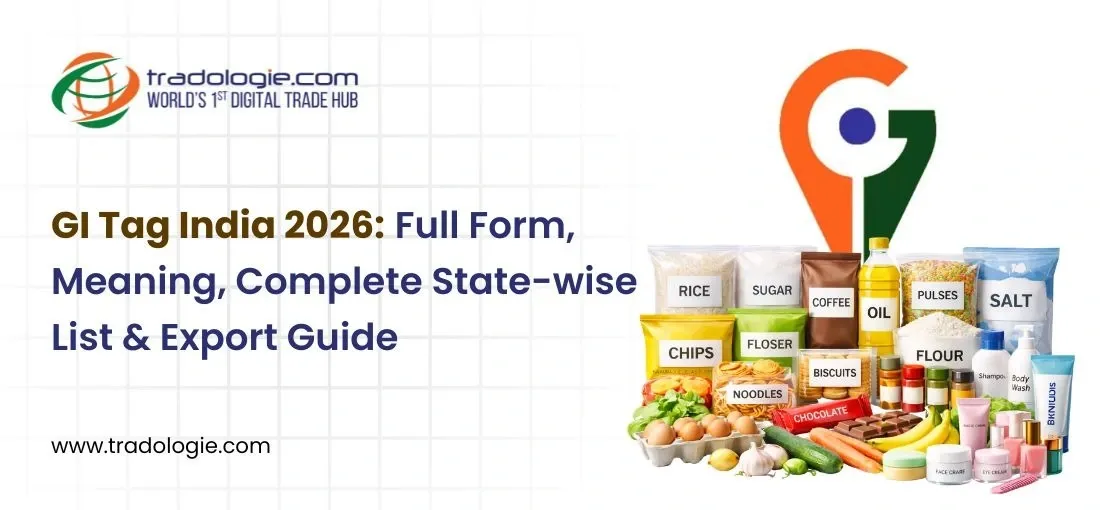
What is GI Tag?
GI Tag full form is Geographical Indication Tag. It is a special certification given to products that originate from a specific geographical region and possess qualities, reputation, or characteristics essentially linked to that place of origin.
In simple words: a GI tag is a government-backed guarantee that a product is genuinely from the place it claims to be from — and that it meets the quality standards of that region.
For example: Darjeeling Tea can only be called "Darjeeling Tea" if it is actually grown in the Darjeeling hills of West Bengal. Any tea grown elsewhere cannot legally use this name.
For importers and exporters, GI tags are not just a legal label — they are a commercial premium. GI-tagged products typically command 20% to 40% higher prices in international markets compared to non-GI versions of the same product.

GI Tag: Governing Law & Legal Framework
India enacted the Geographical Indications of Goods (Registration and Protection) Act, 1999, which came into effect on 15 September 2003. This law is administered by the Controller General of Patents, Designs and Trade Marks (CGPDTM) under the Department for Promotion of Industry and Internal Trade (DPIIT), Ministry of Commerce and Industry.
| Legal Aspect | Details |
|---|---|
| Governing Act | GI of Goods (Registration & Protection) Act, 1999 |
| Effective Date | 15 September 2003 |
| Administered By | GI Registry, Chennai (under DPIIT) |
| International Framework | TRIPS Agreement (WTO) — Article 22(1) |
| Registration Validity | 10 years (renewable indefinitely) |
| First GI Tag Awarded | Darjeeling Tea — 2004-05 |
| Total Tags (2026) | 600+ registered GI tags |

How Does the GI Tag Registration Process Work?
Any producer, organization, or authority representing producers from a specific geographical area can apply for a GI tag. Here is the complete 7-step process:
- Application filed with GI Registry, Chennai by an association of producers or a government authority
- Application includes: product description, geographical area map, proof of origin, quality standards
- GI Registry examines the application for completeness and compliance with the GI Act
- Application published in the GI Journal for public review — any objections can be filed within 3 months
- If no objection or after resolving objections, the GI is registered
- Authorised users are registered separately — they are the actual producers allowed to use the GI mark
- GI registration is valid for 10 years and can be renewed indefinitely by paying renewal fees
Application Fee: Rs. 5,000 per class. Renewal Fee: Rs. 5,000 per class for 10 years.
GI Tag in India: Key Facts & Numbers (2026)
India has 600+ registered GI tags as of 2026, making it one of the world's largest holders of geographical indication certifications. The number has grown from just 1 in 2004 to over 600 in two decades.
| Fact | Data |
|---|---|
| Total GI Tags in India (2026) | 600+ (official count from IP India / DPIIT) |
| First GI Tag | Darjeeling Tea (2004-05) |
| State with Most GI Tags | Uttar Pradesh — 70+ GI tags |
| Second Highest State | Tamil Nadu — 65+ GI tags |
| Third Highest State | Karnataka — 50+ GI tags |
| Governing Ministry | Ministry of Commerce & Industry (DPIIT) |
| GI Registry Location | Chennai, Tamil Nadu |
| Top Export Destinations | UK, Italy, UAE, USA, Bahrain, Qatar, South Korea |
| Categories Covered | Handicrafts, Textiles, Agriculture, Foodstuff, Manufactured Goods |
| Year-on-Year Growth | ~30-40 new GI tags registered each year |

State-wise GI Tag Count — Top 15 States (2026)
Below is the state-wise breakdown of GI tags in India, showing which states lead in registered geographical indications and their commercial importance for exports.
| Rank | State | No. of GI Tags | Top GI Products | Key Export Market |
|---|---|---|---|---|
| 1 | Uttar Pradesh | 70+ | Banarasi Saree, Lucknow Chikankari, Agra Petha | UK, USA, Middle East |
| 2 | Tamil Nadu | 65+ | Kanchipuram Silk, Thanjavur Painting, Madurai Sungudi | USA, Europe, Japan |
| 3 | Karnataka | 50+ | Coorg Arabica Coffee, Mysore Silk, Udupi Saree | Europe, Middle East |
| 4 | Maharashtra | 50+ | Alphonso Mango, Nagpur Orange, Kolhapuri Chappal | Middle East, Europe |
| 5 | Odisha | 35+ | Odisha Rasagola, Sambalpuri Fabric, Pattachitra | Europe, USA |
| 6 | West Bengal | 25+ | Darjeeling Tea, Muslin, Baluchari Saree | UK, Germany, Japan |
| 7 | Rajasthan | 25+ | Blue Pottery, Kota Doria, Sanganer Print | Europe, USA, Japan |
| 8 | Gujarat | 22+ | Gir Kesar Mango, Kutch Embroidery, Patola Saree | USA, UK, Middle East |
| 9 | Assam | 15+ | Muga Silk, Assam Tea, Joha Rice | Japan, Europe |
| 10 | Jammu & Kashmir | 15+ | Kashmir Pashmina, Saffron, Khatamband | Europe, USA, Middle East |
| 11 | Andhra Pradesh | 19+ | Araku Coffee, Kondapalli Toy, Etikoppaka Toy | Europe, USA |
| 12 | Kerala | 12+ | Alleppey Coir, Malabar Pepper, Navara Rice | Europe, Middle East |
| 13 | Madhya Pradesh | 12+ | Chanderi Fabric, Maheshwar Saree, Bastar Dhokra | USA, Europe |
| 14 | Haryana | 6+ | Bawal Handloom, Phulkari Embroidery, Rohtak Khurja | Middle East |
| 15 | Jharkhand | 7+ | Sohrai Khovar Painting, Dokra Craft, Tussar Silk | Europe, Japan |
Top 20 Famous GI-Tagged Products in India
These products represent India's most recognized and commercially valuable geographical indications. Many of these are actively exported and command premium pricing in international markets.
| Product | State | Category | Export Value | Why Famous |
|---|---|---|---|---|
| Darjeeling Tea | West Bengal | Agriculture | Very High | World's finest tea; 1st Indian GI tag (2004) |
| Basmati Rice | Multiple states | Agriculture | Very High | India's biggest agricultural export; $4B+ annually |
| Kashmir Saffron | J&K | Agriculture | High | World's most expensive spice; unique aroma |
| Alphonso Mango | Maharashtra | Agriculture | High | King of mangoes; huge Middle East & UK demand |
| Banarasi Silk Saree | Uttar Pradesh | Handicraft | High | UNESCO heritage; centuries-old weaving tradition |
| Kanchipuram Silk | Tamil Nadu | Textile | High | Premium silk for weddings; Japan & USA buyers |
| Kashmir Pashmina | J&K | Textile | Very High | Ultra-fine wool; luxury European market |
| Coorg Arabica Coffee | Karnataka | Agriculture | High | Premium specialty coffee; Europe & USA demand |
| Lucknow Chikankari | Uttar Pradesh | Handicraft | High | Hand embroidery; global fashion market |
| Kolhapuri Chappal | Maharashtra | Handicraft | Medium | Prada controversy 2025; global fashion interest |
| Muga Silk | Assam | Textile | High | Naturally golden silk; only produced in Assam |
| Tirupati Laddu | Andhra Pradesh | Foodstuff | Medium | Most famous temple sweet; religious significance |
| Madhubani Painting | Bihar | Handicraft | Medium | Folk art; European collectors' market |
| Thanjavur Painting | Tamil Nadu | Handicraft | Medium | Gold-embossed religious art; global collectors |
| Mysore Silk | Karnataka | Textile | High | Royal silk; premium Indian & global market |
| Araku Valley Coffee | Andhra Pradesh | Agriculture | High | India's tribal coffee; growing European demand |
| Nagpur Orange | Maharashtra | Agriculture | Medium | India's orange capital; domestic & export use |
| Darjeeling Tea (Muscatel) | West Bengal | Agriculture | Very High | Second flush; premium German & Japanese buyers |
| Gir Kesar Mango | Gujarat | Agriculture | High | GI-protected premium mango; Middle East export |
| Assam Tea | Assam | Agriculture | Very High | CTC & Orthodox; UK, Europe, Russia markets |
GI Tag & Export Business: Why It Matters for Indian Traders
This section is specifically relevant to importers, exporters, and trade professionals who deal in Indian products internationally. GI tags are not just a cultural certification — they are a powerful commercial instrument.

Price Premium: What GI Tags Mean for Export Value
Products with GI certification consistently achieve higher export prices than their non-GI equivalents. This is because the GI mark provides the international buyer with a verified guarantee of authenticity and quality.
| GI Product | Non-GI Price (approx.) | GI-Certified Price (approx.) | Premium % |
|---|---|---|---|
| Darjeeling Tea (1st flush) | Rs. 400-600/kg | Rs. 1,500-3,000/kg | 150-400% |
| Kashmir Saffron | Rs. 100-200/gram | Rs. 300-500/gram | 150-200% |
| Banarasi Silk Saree | Rs. 2,000-5,000 | Rs. 8,000-25,000 | 200-400% |
| Alphonso Mango (export) | $2-3/kg | $5-8/kg | 100-160% |
| Kashmir Pashmina Shawl | Rs. 2,000-4,000 | Rs. 15,000-80,000 | 500-1000% |
| Coorg Arabica Coffee | Rs. 300-400/kg | Rs. 700-1,200/kg | 100-200% |
Top Export Destinations for Indian GI Products
India's GI-tagged products are exported to markets globally. The leading import countries are:
- United Kingdom: Darjeeling Tea, Basmati Rice, Banarasi Saree, Kashmir Pashmina
- United Arab Emirates: Alphonso Mango, Basmati Rice, Kesar Mango, Kerala Pepper
- United States: Darjeeling Tea, Basmati Rice, Assam Tea, GI handicrafts
- Italy & France: Kashmir Pashmina, Darjeeling Tea, artisanal GI textiles
- Japan & South Korea: Darjeeling Tea (Muscatel), Assam Tea, Muga Silk
- Germany & Netherlands: Darjeeling Tea, specialty coffees, organic GI spices
- Bahrain & Qatar: Basmati Rice, spices, dates, premium mangoes
How Exporters Can Leverage GI Tags Commercially
If you are in the import-export business, here is how GI tags directly benefit your operations:
- Use GI certification as a marketing differentiator — buyers in premium markets pay more for certified authenticity
- Access APEDA export promotion support specifically designed for GI product exporters
- Register as an 'Authorised User' under the GI Act to legally use the GI mark on your exports
- GI tags provide protection against counterfeit products in destination countries
- European Union and UK specifically recognize Indian GI tags — simplifies customs and premium retail entry
- GI products qualify for specific export schemes and incentives under India's FTP (Foreign Trade Policy)
- Bilateral agreements between India and the EU are expanding mutual GI recognition — this directly increases market access
GI Tag Categories in India: Complete Breakdown
India's 600+ GI tags are spread across multiple product categories. Understanding the category distribution helps identify the best export opportunities.
| Category | Approx. No. of GI Tags | Key Products | Export Opportunity |
|---|---|---|---|
| Handicrafts | 200+ | Banarasi Saree, Madhubani Art, Blue Pottery | Very High — global art & craft collectors |
| Agricultural Products | 150+ | Darjeeling Tea, Alphonso Mango, Basmati Rice | Very High — food import markets worldwide |
| Textiles & Fabrics | 100+ | Kanchipuram Silk, Pashmina, Muga Silk | High — premium fashion & luxury segment |
| Foodstuffs | 80+ | Tirupati Laddu, Odisha Rasagola, Agra Petha | Medium — diaspora markets, specialty food stores |
| Manufactured Goods | 50+ | Kolhapuri Chappal, Condapalli Toys, Metal Craft | Medium — lifestyle and décor buyers |
| Natural Products | 20+ | Kashmir Saffron, Coorg Coffee, Kerala Pepper | High — specialty food & spice import markets |
GI Tag vs Trademark vs Patent: Key Differences
Many business owners confuse GI tags with trademarks or patents. Here is a clear comparison to understand each one's scope and purpose.
| Feature | GI Tag | Trademark | Patent |
|---|---|---|---|
| What it protects | Region-specific product identity | Brand name or logo | New invention or technology |
| Who owns it | Collective producers of a region | Individual company or person | Inventor or company |
| Duration | 10 years (renewable indefinitely) | 10 years (renewable indefinitely) | 20 years (not renewable) |
| Exclusivity | All producers in the region can use | Only the trademark owner can use | Only the patent holder can use |
| Purpose | Preserve regional heritage + quality | Build brand identity | Protect innovation |
| Governed by | GI Act 1999 (India) + TRIPS | Trade Marks Act 1999 | Patents Act 1970 |
| Examples | Darjeeling Tea, Banarasi Saree | Tata Tea logo, Amul brand | A new machine component |
| Export benefit | Premium pricing + market access | Brand protection globally | Licensing revenue abroad |
Latest GI Tags in India — 2026 Updates
India continues to add new GI tags every year. Below are some of the most recent additions to India's geographical indication registry in 2025-2026:
| Product | State | Category | Year Registered |
|---|---|---|---|
| Woraiyur Cotton Saree | Tamil Nadu | Textile | 2026 |
| Kavindapadi Nattu Sakkarai | Tamil Nadu | Foodstuff | 2026 |
| Thooyamalli Rice | Tamil Nadu | Agriculture | 2026 |
| Ponduru Khadi | Andhra Pradesh | Textile | 2026 |
| Mathura Zari Dress | Uttar Pradesh | Handicraft | 2026 |
| Kumbakonam Betel Leaf | Tamil Nadu | Agriculture | 2025 |
| Arunachal Yak Churpi | Arunachal Pradesh | Foodstuff | 2024-25 |
| Khaw Tai (Khamti Rice) | Arunachal Pradesh | Agriculture | 2024-25 |
| Tangsa Textile | Arunachal Pradesh | Textile | 2024-25 |
| Lanjia Saura Painting | Odisha | Handicraft | 2024 |
| Dungaria Kondh Shawl | Odisha | Textile | 2024 |
| Dhenkanal Magji | Odisha | Foodstuff | 2024 |
| Koraput Kalajeera Rice | Odisha | Agriculture | 2024 |
| Similipal Kai Chutney | Odisha | Foodstuff | 2024 |
| Basohli Pashmina | J&K | Textile | 2024 |
| Malda Mango | West Bengal | Agriculture | 2024 |
| Kutch Rogan Art | Gujarat | Handicraft | 2024 |
For the complete official list of all registered GI tags, refer to the IP India website (ipindia.gov.in) which maintains the official GI registry.
Benefits of GI Tag: For Producers, Exporters & Buyers
For Producers & Artisans
- Legal protection against imitation and misuse of their product's name
- Higher market price due to certified authenticity and premium positioning
- Access to government support schemes under DPIIT and state handicraft boards
- Collective marketing advantage — the GI brand benefits all registered producers in the region
- Protection of traditional knowledge and generational craft techniques
For Exporters & Traders
- Easier access to premium international markets that specifically seek certified products
- Reduced risk of counterfeit disputes in destination countries
- APEDA (Agricultural and Processed Food Products Export Development Authority) support for GI product exports
- Price premium of 20-400% depending on the product and market
- Bilateral trade agreement benefits — EU, UK, and GCC countries formally recognize India's GI tags
For Buyers & Importers
- Guaranteed product authenticity and geographical origin
- Consistent quality standards as defined in the GI registration
- Legal recourse against fraudulent products using a GI name
- Confidence in sourcing from verified, authorized producers
In today’s global trade environment, exporters increasingly rely on structured platforms that enable direct interaction with verified buyers across multiple countries. These systems streamline bulk trade by ensuring transparency in pricing, quantity, and payment processes, making it easier for suppliers to scale internationally.Close Bulk Export Deals Faster
Conclusion: GI Tags Are India's Competitive Edge in Global Trade
India's 600+ GI tags represent a massive, underutilized asset in international trade. While UPSC exam takers see GI tags as a topic for revision, savvy traders and exporters see them as a commercial opportunity — a certification that unlocks premium pricing, builds buyer trust, and opens doors to international markets that pay top dollar for authenticity.
Whether you are a producer looking to protect your craft, an exporter building a premium portfolio, or an importer seeking verified Indian products, GI tags are the foundation of a credible, authentic supply chain.
India's GI ecosystem will continue growing — the government has set a target of certifying thousands more products in the coming years, especially from tribal communities, northeast states, and niche agricultural regions. Staying ahead of this curve — knowing which products are newly certified, which states are growing, and which markets are buying — is a genuine competitive advantage in the import-export business.




.webp "Coffee Export from India: Arabica, Robusta & Top Global Markets")