Key Highlights
- India exported 111.76 thousand MT of guava in FY 2023–24.
- Guava exports generated around USD 154.23 million in trade value.
- GCC and European markets are major buyers of Indian guava.
- Allahabad Safeda and L 49 dominate bulk export shipments.
- Ideal export storage temperature ranges between 8°C and 10°C.
- Aseptic guava pulp is emerging as a high value export category.
- Cold chain management is critical for export profitability.
- Digital B2B trade platforms are streamlining guava exports globally.
Introduction:
Bay leaf are aromatic leaves used as a spice in cooking. They are usually dried and added to dishes like curries, soups, rice, sauces, and stews to enhance flavor and aroma. In India, bay leaves are commonly known as Tej Patta and are widely used in Indian cuisine.
Getting your footing in the bay leaf export India sector takes a lot more than just throwing some dried foliage into a gunny sack and waiting for a wire transfer. You are stepping straight into a complex, high-stakes global commodity market. Out here, success belongs to those who look past the surface, mastering everything from moisture control at the farm level to the intricate shifting patterns of international trade policy.

For centuries, Indian households treated tej patta as a basic culinary background note, an affordable component for curries. The global market, however, views things quite differently now. From the cosmetic labs of Western Europe to the grinding mills of Southeast Asia, a massive appetite for premium botanical ingredients is completely redefining this niche.
But entering this arena means learning how to navigate volatile pricing, rigid phytosanitary barriers, and the relentless demands of corporate sourcing agents. If you want to grow a sustainable business from shipping dried bay leaf export containers across oceans, you have to throw away the generic trading scripts.
Keep reading this informative piece of blog, as it will provide some of the vital information on the dried bay leaf export.
The Macro Picture: Decoding the Global Tonnage
Understanding the layout of the land requires looking at hard, objective numbers. This isn't a trade built on casual guesswork. The international movement of this aromatic crop is a highly structured, data-driven system.
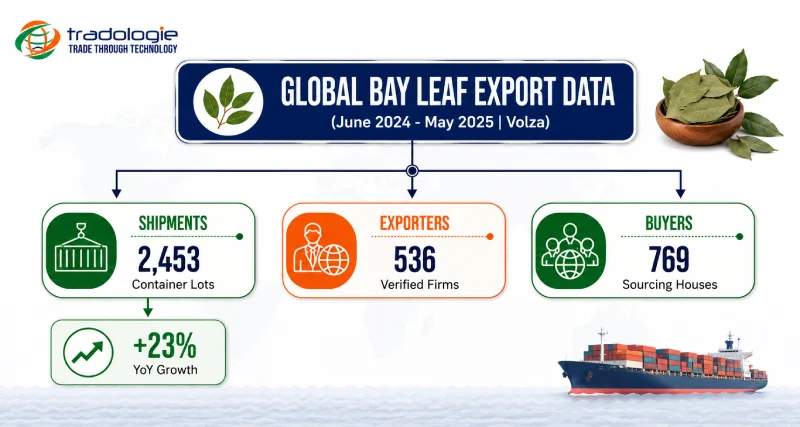
According to global trade tracking analytics provided by Volza’s Global Export Data, the international landscape for this aromatic spice reveals some fascinating shifts:
- The Global Volume: Between June 2024 and May 2025, the world moved exactly 2,453 shipments of bay leaf categorized under HSN Code 0910.
- The Player Base: This entire trade volume was driven by a verified network of 536 exporters supplying 769 institutional buyers globally.
- The Growth Curve: This sector marked a striking 23% Year-on-Year (YoY) increase during that twelve-month period. This demonstrates that global industrial interest in this spice is actively accelerating rather than stagnating.
When you look at who is actually driving the global supply, the competitive landscape gets narrow. Turkey leads the pack, logging 1,636 shipments, mostly dealing in the Laurus nobilis or Mediterranean variant, known across international networks as the bay laurel export India firms frequently compete against.
Right on their heels, however, stands India with 1,066 shipments, followed closely by Bangladesh with 1,045 shipments.
On the receiving end of these shipping routes, three distinct nations command the heaviest import volumes: Singapore, Russia, and Malaysia. For an Indian business planning its next big trade loop, targeting these core corridors is the logical starting point for securing steady, repeating container orders.

Two Sides of a Coin: Indian Cassia vs. Mediterranean Laurel
A major point of confusion for new traders is failing to realize that "bay leaf" is not a single, uniform product. The global market separates these leaves based on intense botanical differences. If you send the wrong leaf to a buyer who expects the other, your entire container gets rejected at the destination dock.
| Botanical Classification | Common Market Name | Core Flavor & Structural Profile | Primary Global Demand Hubs |
|---|---|---|---|
| Cinnamomum tamala | Indian Cassia Leaf / Tej Patta | Strong, clove-like aroma with distinct cinnamon undertones. Three prominent veins running vertically up the leaf. | High-volume spice mills, ethnic grocery chains, and extract firms across Southeast Asia and Russia. |
| Laurus nobilis | True Bay Leaf / Mediterranean Laurel | Delicately herbal, slightly floral scent. Single main vein running down the center with a matte, oval structure. | Fine-dining supply networks, European pharmaceutical houses, and Western snack manufacturers. |
The tej patta export India sector dominates the market for Cinnamomum tamala. This leaf contains a heavy concentration of eugenol, giving it that familiar, fiery punch necessary for industrial garam masala blends.
On the flip side, the bay laurel export India merchants handle deals with buyers looking for the milder, true bay leaf, which is heavily cultivated in the Mediterranean but sourced through specialized Indian trade channels to feed Western culinary grids. Knowing your leaf type inside out is your first step toward real operational security.
Market Dynamics: Unpacking the Bay Leaf Price per KG India
Out on the mandis of Khari Baoli in Delhi or the trading floors of Unjha, pricing is never pinned to a static chart. It breathes. It shifts based on visual grading, moisture content, and the sudden moves of international supply chains.
Currently, the market reflects a wide, tiered layout:
- Low-Grade/Broken Volume Leaves: These usually fetch anywhere between ₹70 to ₹120 per kg. This material goes straight into industrial spice grinding mills where visual aesthetics do not matter.
- Premium Whole Green Leaves: Clean, unbroken leaves that have been shaded-dried to retain their color command a heavy premium, sitting between ₹180 to ₹350 per kg.
- Organic/Certified Premium Lots: If you can back your cargo with verified pesticide-free laboratory certificates, the bay leaf price per kg India index can jump past ₹450 to ₹600 per kg in high-end European retail spaces.
The real challenge for an exporter is managing the margin squeeze. You buy from farmers by weight, but if your drying process is sloppy, the leaves will continue to lose water weight while sitting inside a dark ocean container. You could easily lose 5% of your invoice value to simple evaporation before the ship ever completes its run.
Operational Excellence: The Sorter's Playbook
Moving a multi-ton lot of dried herbs across oceans requires absolute process discipline. You can't just throw things into a box and hope for the best. Dried foliage is highly vulnerable to mold, pest infestation, and volatile oil loss.
1. The Shaded Drying Protocol
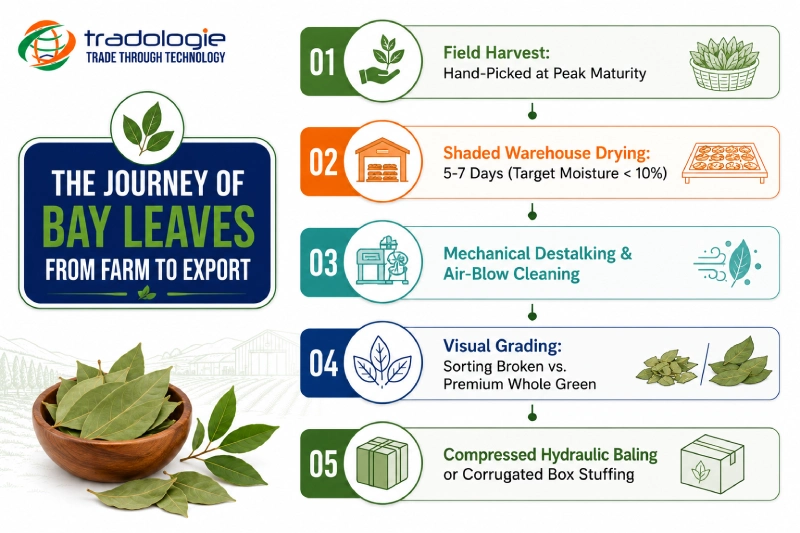
The value of your leaf is entirely in its color and its oil content. Direct sunlight bleaches the chlorophyll out of the leaf, turning it a dull, dusty brown that global buyers will reject on sight. The leaves must be spread out over clean bamboo mats inside ventilated, shaded warehouses. This slow dehydration process preserves the vibrant green hue and locks the aromatic volatile oils inside the cell walls of the plant.
2. Moisture Control: The Ultimate Metric
Moisture is the single biggest killer of an agri-export deal. If you pack leaves with a moisture level above 10% to 12%, the heat inside a shipping container traveling through tropical trade lanes will turn the box into an incubator for white mold.
Before loading your cargo, every lot must clear a digital moisture-meter verification. If the numbers creep too high, the entire batch goes right back onto the drying floor.
3. Smart Packaging Engineering
Dried leaves are incredibly brittle. If you loose-pack them into standard gunny bags, the shifting movement of the container during rough sea transits will grind your premium whole leaves into worthless dust.
To prevent this, advanced bay leaf exporters India companies use hydraulic presses to compact the leaves into high-density, uniform bales wrapped in protective jute liners. Alternatively, they use multi-walled corrugated fiberboard boxes fitted with internal moisture-barrier films. This ensures the leaves arrive at the destination port completely intact.
Clearing the Regulatory Hurdles: The Paper Trail
The international border checks do not care about your verbal promises. They want data and everything as per the regulatory norms. Clearing customs in places like Singapore or Rotterdam requires a truly uncompromising set of strict documents.
- The Phytosanitary Certificate: Issued by the Directorate of Plant Protection, Quarantine & Storage, this document proves your batch has been officially inspected and is completely free from live pests, chemical contaminants, and toxic molds.
- The Certificate of Origin: Sourced through agencies like APEDA or local Chambers of Commerce, this proves the spice was genuinely grown and processed within India, an essential requirement for unlocking lower tariff benefits under regional trade pacts.
- Spices Board Registration: You cannot legally ship even a single kilo of spice out of India without a valid CRES which is Certificate of Registration as an Exporter of Spices. This registration keeps your business compliant well within the national quality control guidelines.
The Digital Edge: B2B Procurement Optimization
Managing traditional agricultural paperwork across multiple international time zones can easily bottleneck your cash conversion cycle. A single clerical error on an export declaration or a mismatch on a bank collection file can leave a container stuck at a foreign port. For a sensitive leaf shipment, even a short customs delay can cause moisture changes that alter your product quality.
To eliminate this manual tracking friction, modern agricultural export houses are abandoning old-school brokerage chains. Traders are plugging directly into automated B2B networks like Tradologie.com to orchestrate their international transactions.
Using these digital trade channels forces absolute visibility into the quality assurance loop, links Indian suppliers directly with vetted global buyers, and streamlines the document presentation process. This structural shift ensures your shipping data matches buyer requirements perfectly, accelerating your payment release long before the vessel ever anchors.
Summary Verdict for Agri-Traders
In the hyper-competitive environment of global spice logistics, running a bay leaf export India enterprise functions as a high-reward, precision-driven operation. Treating it like a simple bulk commodity play is a shortcut to major losses via port rejections or transit spoilage.
True profitability belongs to those who maintain complete transparency over their supply chain. Every single link matters—from the handling techniques used on the drying floor to the precise moisture calibrations checked right before container locking. By focusing on high-demand global destinations, matching your quality grading to the strict expectations of elite distributors, and utilizing verified B2B trade platforms to buffer your financial risks, you can turn India’s vast agricultural yields into an exceptionally stable, highly scalable international revenue engine.
Disclaimer
The export data, market insights, logistics practices, and trade recommendations mentioned are for informational purposes only and may vary depending on destination country regulations, seasonal crop conditions, freight rates, and international trade policies. Exporters should verify compliance and market requirements before shipment.




.webp "Why Castor Oil Export from India Holds Global Importance")
.webp "Guar Gum Export from India: Industrial Uses, Grades & Trade Guide")