
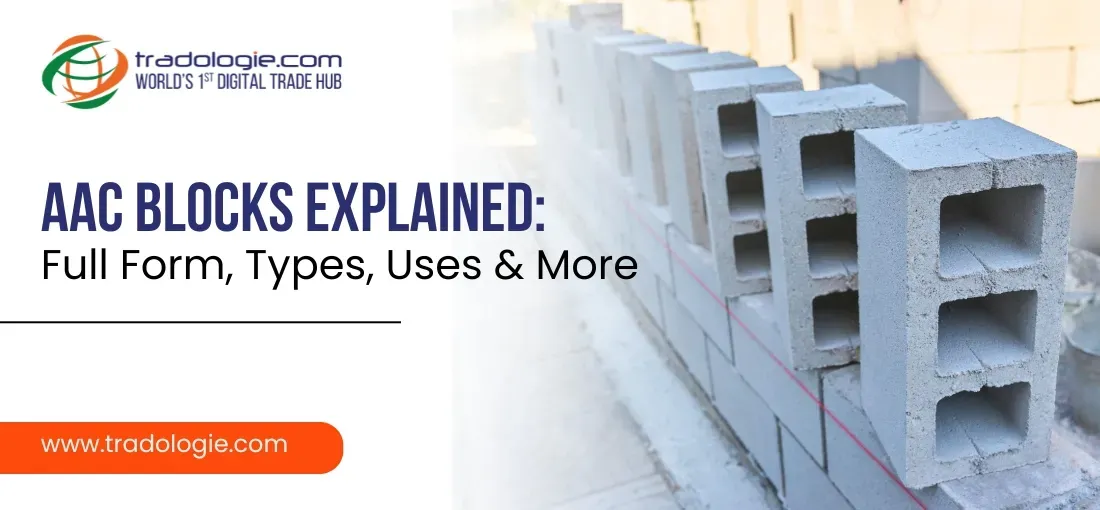
What Are AAC Blocks?
So what are AAC blocks?. Well, the AAC block full form is Autoclaved Aerated Concrete. In simple terms, AAC blocks are lightweight masonry units used widely in modern construction. Builders use them for walls, partitions, and different types of structural work where speed and efficiency matter.
These blocks are made from a mix of fairly common raw materials - sand or fly ash, cement, lime, water, and a small amount of aluminium powder. Nothing unusual there. But the chemistry that happens during production is what makes the material different.
It is a type of chemical reaction that eventually releases hydrogen gas when aluminium powder reacts with calcium hydroxide and water. That gas results in the formation of millions of tiny air pockets inside the mixture. And that’s exactly what gives autoclaved aerated concrete blocks their characteristic porous structure.
The result is a block that is surprisingly light. Much lighter than traditional clay bricks. Yet strong enough for most wall applications. That balance between weight and strength is one of the main reasons AAC bricks have become popular in construction projects.
In practice, you’ll hear the material called by several names. On construction sites and in supplier catalogs, AAC blocks are also referred to as:
- ACC blocks
- Aerated blocks
- Autoclaved aerated cement blocks
- AAC bricks
Different names. Same basic material.
Quick recap, because this often causes confusion:
AAC full form — Autoclaved Aerated Concrete.
ACC block full form usually refers to the same material, with the second “C” interpreted as Concrete or sometimes Cement depending on how people describe it.

History of Autoclaved Aerated Concrete
The story of autoclaved aerated concrete actually stretches back almost a century. It was around 1924 when a Swedish architect named Johan Axel Eriksson began experimenting with a different kind of building material. The thinking at that time was fairly practical — could construction blocks be made lighter, easier to work with, and still strong enough for real buildings? That early curiosity eventually set the stage for what we now know as AAC blocks.
Not alone though. He worked closely with Professor Henrik Kreüger during those early trials.
The thinking was simple, really. Could a construction block be made lighter… easier to handle… and still strong enough for real buildings? That question pushed a series of experiments forward. And slowly, piece by piece, the concept that would later become AAC blocks began to take shape.
The idea was quite practical. They wanted something that behaved a little like wood in construction — light, easy to cut and shape, and capable of providing good insulation. But wood had its own problems. It burns. It rots over time. Termites love it. So the search was for a material that could offer similar advantages without those drawbacks.
That’s where AAC blocks started to take shape.
The technology had already begun spreading across Europe by the 1940s. In fact, builders realised that these aerated blocks could reduce building weight while still maintaining the structural stability that is needed. And once that advantage became clear, adoption followed.
Fast forward to today, and autoclaved aerated concrete blocks are used in construction projects across many parts of the world. India is a good example. Over the last two decades, AAC block construction has gained serious momentum here, with manufacturers and brands such as Ultratech AAC blocks helping bring the material into mainstream building practices. It is an AAC block company that is famous across India.
How Are AAC Blocks Made?
If you look closely at AAC block manufacturing, the interesting part is how ordinary raw materials end up becoming these light autoclaved aerated concrete blocks. The ingredients themselves are simple. What changes everything is the process.
Step 1 — Raw Material Mixing:
It starts with the base mix. Usually fly ash or sand, along with cement, lime, gypsum, and water. Everything goes into a mixer and turns into a thick slurry. Nothing fancy yet. Just the raw base that will eventually become aac blocks.
Step 2 — Aerating:
Now comes the step where things start getting interesting. A small amount of aluminium powder is added. That triggers a chemical reaction. Gas bubbles begin forming inside the mixture. Slowly the slurry starts expanding. If you’ve ever seen bread dough rise, it’s a bit like that. The volume increases and millions of tiny air pockets appear inside the material.
Step 3 — Pre-curing:
Once the mixture expands, it is poured into large moulds. Then it simply sits there for a while. A few hours usually. The material begins to stiffen, but it’s still soft enough to cut.
Step 4 — Wire Cutting:
This is where the big mould gets turned into individual aac blocks. Steel wires pass through the semi-solid mass and slice it into precise shapes. That’s why builders often say aac blocks have much better dimensional accuracy compared to traditional bricks
Step 5 — Autoclaving:
Finally comes the step that gives autoclaved aerated concrete its real strength. The cut blocks are placed inside an autoclave — basically a high-pressure steam chamber. Heat and pressure do the rest. The blocks cure there for several hours, and that’s what locks in their strength and stability.
Once they come out, the blocks are ready for use. Light in weight. Strong enough for walls. Easy to handle during aac block construction.

Types of AAC Blocks
If you spend some time around construction sites, you’ll notice something quickly. Not every aac block is the same. The size changes. Thickness changes. Sometimes even the composition. The reason is simple — different parts of a building demand different kinds of blocks for construction.
Manufacturers produce several variants so builders can pick what suits the wall design, load conditions, and insulation requirements.
1. Standard AAC Blocks (600mm x 200mm x 100mm to 300mm)
These are the ones you’ll see most often on site. Standard aac blocks are widely used for both residential and commercial wall construction. The length and height generally stay around 600mm by 200mm, while thickness can vary — usually 75mm, 100mm, 150mm, 200mm, 225mm, or 300mm. The thing is, that flexibility in thickness makes them suitable for different wall systems.
2. 100mm AAC Block
Now this size is usually chosen for internal partition walls. Builders like it because the block is light and easy to move around. Workers can install them quickly, and that’s where you’ll notice the speed advantage of aac block construction during interior work.
3. 200mm AAC Block
External walls need something stronger and thicker. That’s where 200mm aac blocks come in. The extra thickness improves thermal insulation and provides better structural stability for outer wall sections.
4. Fire Resistant AAC Blocks
Some projects demand stricter fire safety standards. Industrial facilities, commercial complexes, even certain public buildings. In those cases, fire-resistant autoclaved aerated concrete blocks are used. These are designed to tolerate much higher temperatures without losing structural integrity.
5. Fly Ash AAC Blocks
Here’s where sustainability enters the picture. Instead of sand, these aac blocks use fly ash, which is a byproduct of coal combustion. The thing is, it helps recycle industrial waste while still maintaining the strength and insulation properties expected from autoclaved aerated cement blocks.
6. Rectangular AAC Blocks (Double AC Block)
Sometimes builders prefer larger format units. These are often referred to as double AC block or larger rectangular aerated blocks. Because each block covers more wall area, construction moves faster and fewer mortar joints are required.
7. Ultratech AAC Blocks
Then there are branded options. Ultratech AAC blocks, for example, are among the most recognized products in India. Builders often prefer them simply because the quality tends to remain consistent. The Ultratech AAC block range is manufactured under controlled conditions and usually comes with certified performance standards.
AAC Block Dimensions & Sizes (Standard)
| Length (mm) | Height (mm) | Width/Thickness (mm) | Common Use |
|---|---|---|---|
| 600 | 200 | 75 | Partition walls |
| 600 | 200 | 100 | Partition walls |
| 600 | 200 | 150 | External walls |
| 600 | 200 | 200 | External / Load bearing |
| 600 | 200 | 225 | High insulation walls |
| 600 | 200 | 300 | Industrial / Heavy duty |
Consistent dimensions are one of the key advantages of AAC blocks over traditional bricks, which often vary in size and require more mortar to compensate.
AAC Block vs Red Brick vs Fly Ash Brick — Full Comparison
| Feature | AAC Block | Red Brick | Fly Ash Brick |
|---|---|---|---|
| Weight | 550–650 kg/m³ | 1600–1900 kg/m³ | 1000–1200 kg/m³ |
| Thermal Insulation | Excellent | Poor | Moderate |
| Sound Insulation | High | Low | Moderate |
| Fire Resistance | Up to 6 hours | 2–3 hours | 2–3 hours |
| Water Absorption | Low (10–15%) | High (12–20%) | Moderate |
| Compressive Strength | 3–5 N/mm² | 3.5–5 N/mm² | 3–4 N/mm² |
| Eco-Friendly | Yes | No | Moderate |
| Construction Speed | Fast | Slow | Moderate |
| Cost per Unit | Higher | Lower | Moderate |
| Overall Project Cost | Lower | Higher | Moderate |
Advantages of AAC Blocks
If you talk to builders who regularly work with aac blocks, they’ll usually point out the same thing. The material solves several practical problems in construction. Weight, insulation, speed of work — all of it matters on a real project site. That’s where the advantages of autoclaved aerated concrete blocks start becoming clear.
1. Lightweight — Faster, Easier Construction
One of the first things contractors notice about aac blocks is the weight. Or rather, the lack of it. These blocks usually weigh about one-third of conventional red bricks. A typical 200mm aac block may weigh somewhere around 16–18 kg, which is significantly lighter than a similar brick masonry volume.
You’ll notice savings in several areas:
- Foundation size and depth
- Structural steel usage
- Overall construction cost
Another thing — each aac block is much larger than a traditional brick. Sometimes up to ten times the volume. So fewer units are needed to build a wall. Workers place blocks faster. And that’s where aac block construction really speeds up compared to traditional brick masonry.
2. Superior Thermal Insulation & Energy Efficiency
The thing that makes autoclaved aerated concrete different is its internal structure. Those tiny air pockets inside the block act like natural insulation.
What does that mean in real buildings? Walls made from aac blocks tend to maintain indoor temperatures more effectively than solid brick walls. Less heat enters during summer. Less warmth escapes during winter.
Over time, that translates into lower energy consumption. In fact, several studies suggest that buildings using aac block walls can reduce air conditioning costs by roughly 20–30% over the life of the building.
3. Excellent Fire Resistance
Another major advantage of aac blocks is fire safety. These blocks are non-combustible, which means they do not burn. Depending on thickness, aac block walls can provide fire resistance for up to six hours.
Temperatures of around 1,200°C can be tolerated without structural failure. That’s why autoclaved aerated cement blocks are often used in buildings where fire safety standards are strict — hospitals, hotels, schools, and high-rise apartments.
For example:
- A 100mm aac block wall can offer around 2 hours of fire resistance
- A 200mm wall may provide 4 to 6 hours
4. Soundproofing & Acoustic Insulation
The porous structure of aac blocks does something interesting with sound. Instead of reflecting sound waves like dense materials, it absorbs them.
As a result, aac block walls often achieve a Sound Transmission Class (STC) rating of about 40–45 dB. That level of sound insulation works well in environments where noise control matters.
You’ll often see aac block building systems used in places like:
- Hotels and resorts
- Recording studios and auditoriums
- Hospitals and clinics
- Residential apartments in busy cities
5. Seismic & Disaster Resistance
In earthquake zones, building weight becomes a serious factor. The heavier the structure, the greater the seismic force acting on it.
Since aac blocks are much lighter than traditional bricks, they reduce the total building weight by roughly 30–40%. And lighter structures experience lower seismic loads.
That’s one reason aac block buildings tend to perform better during earthquakes compared to conventional brick masonry structures.
6. Moisture and Pest Resistance
Another benefit comes from the material itself. Autoclaved aerated concrete is inorganic. That means termites, rodents, and other pests have no interest in it.
The pore structure also keeps water absorption relatively low — generally around 10%. That helps reduce problems related to moisture, mold, and mildew in walls.
7. Environmentally Sustainable (Green Building Material)
Many developers now choose aac blocks for environmental reasons as well.
Several factors make autoclaved aerated concrete blocks a recognized green building material:
- Manufacturing waste is minimal and often recycled back into production
- Fly ash, an industrial waste product, can be used as a raw material
- The production process generates no toxic byproducts
- Accurate block dimensions reduce construction waste on site
- Buildings using aac blocks aoften qualify for aIGBC and LEED green certificationsa
8. Easy to Work With — Cuttable, Nailable, Shapeable
One practical advantage that workers appreciate on site is how easy aac blocks are to handle.
Unlike dense acc concrete blocks, aac blocks can be cut using a standard hand saw. They can be drilled, nailed, and shaped to create channels for electrical wiring, plumbing pipes, and service lines.
This flexibility reduces the need for specialized equipment and speeds up installation work during aac block construction.
9. Cost-Effective Over the Full Project Lifecycle
Now here’s something many builders initially misunderstand. The aac block price per unit is usually higher than a regular brick. But that doesn’t tell the full story.
When the entire project is considered, aac blocks often reduce total construction cost because:
- Thin-bed mortar joints require less cement
- Construction moves faster, reducing labour hours
- Foundations and structural members can be lighter
- Energy costs drop due to thermal insulation
- Maintenance requirements remain minimal over time
So while the unit price may appear higher at first glance, the overall lifecycle cost of an aac block building is often equal — or sometimes lower — than traditional brick construction.
Disadvantages of AAC Blocks
Now, to be fair, AAC blocks are not perfect either. Every building material has trade-offs. A realistic conversation about aac block construction has to include the limitations as well.
1. Brittle Nature Requires Careful Handling
The first thing builders usually notice is that aac blocks are more brittle than traditional clay bricks. They are strong once installed in a wall, but during transport or handling they can chip or crack if dropped.
So the thing is, handling matters.
Contractors usually follow a few basic precautions:
- Blocks should be transported carefully
- On-site storage needs to be flat and raised off the ground
- Stacks are often covered to prevent moisture exposure
On large construction projects, especially for upper floors, mechanical lifting or cranes may also be used to move aac blocks safely.
2. Higher Unit Cost
Another point that often comes up is the aac block price. If you look only at the per-block cost, aac blocks are usually more expensive than conventional red bricks or fly ash bricks.
For smaller projects with tight budgets, that initial cost can feel like a disadvantage.
That said, the full picture looks a bit different. Once labour savings, reduced mortar usage, and faster wall construction are considered, the overall masonry cost often ends up comparable. Sometimes even lower.
Still, the higher upfront cost is something builders have to consider.
3. Requires Specialized Thin-Bed Mortar
Traditional brick masonry uses thick cement mortar joints. That method doesn’t work well with aac blocks.
Instead, aac block construction typically requires a thin-bed adhesive mortar, often called AAC block jointing compound. The joint thickness is usually just 3–5 mm.
Using ordinary cement mortar can reduce dimensional accuracy and affect the thermal performance of the wall. That’s why builders usually stick with the recommended adhesive.
4. High Water Absorption if Unprotected
The internal pores inside autoclaved aerated concrete help with insulation, but they also mean the blocks can absorb water quickly when exposed to rain.
If aac block walls remain unfinished for too long, several issues can appear:
- Temporary swelling
- Surface cracking after drying
- Potential loss of wall strength in extreme cases
Because of this, exterior walls made from aac blocks should be plastered or rendered within a reasonable time. Especially in regions that receive heavy rainfall.
5. Limited Availability in Remote Areas
In major cities and large construction markets, aac block companies and suppliers are easy to find. Branded products like Ultratech AAC blocks are widely available.
But the situation can be different in smaller towns or rural areas. Supply networks may be limited, and locally produced blocks might not always match the same quality standards.
So availability can sometimes influence the decision
6. Not Suitable for Below-Ground Applications
Finally, aac blocks are not designed for every structural use.
They should not be used for foundations, retaining walls, or other below-ground structures where continuous soil moisture is present. For those applications, conventional reinforced concrete or other masonry materials are more appropriate.
AAC Block Uses in Construction
Despite those limitations, aac blocks are used across a surprisingly wide range of construction projects. Once builders understand how the material behaves, they often apply it in several different types of structures.
Residential Construction
In housing projects, aac block walls are commonly used for:
- External load-bearing and non-load-bearing walls
- Internal partition walls
- Full aac block house construction
- Boundary walls and compound walls
The lighter weight helps reduce structural load, which is one reason developers prefer aerated blocks in multi-storey residential projects.
Commercial Construction
Commercial buildings use aac blocks for several reasons — insulation, sound control, and fire resistance.
Typical applications include:
- Office buildings with partition walls and external cladding
- Hotels where acoustic separation between rooms matters
- Hospitals where fire-rated walls and sound insulation are critical
- Shopping malls and retail spaces
Industrial Construction
Factories and industrial facilities also rely on autoclaved aerated concrete blocks in certain areas.
Common uses include
- Factory walls and warehouse structures
- Clean rooms and controlled-environment facilities
- Fire-rated enclosures around machinery and equipment
Infrastructure
Even public infrastructure projects use aac blocks
You’ll often find them in:
- Schools and educational institutions
- Government buildings
- Multi-storey residential complexes
The thing is, once contractors become comfortable working with aac block construction, the material tends to appear across many different types of buildings.
AAC Block Construction — Key Tips
Working with AAC blocks is fairly straightforward once you understand how the material behaves on site. The thing is, aac block construction is a little different from traditional brickwork. Not complicated. Just a few habits that contractors usually follow so the wall performs properly in the long run.
1. Surface Preparation:
Before applying mortar, the surface of the aac blocks should be clean and slightly damp. Not soaked. Just a light sprinkle of water usually does the job. The reason is simple — if the blocks are completely dry, they may pull moisture from the mortar too quickly. But if they’re saturated, adhesion can fail. So the balance matters.
2. Use Correct Mortar:
This is something experienced builders insist on. Regular cement mortar that works for bricks is usually too thick for aac blocks. Instead, thin-bed AAC jointing adhesive is used, typically with joints around 3–5 mm. That small joint thickness keeps the wall aligned and also preserves the insulation benefits of autoclaved aerated concrete blocks.
3. First Course Levelling:
You’ll notice that masons pay extra attention to the very first row of blocks. That’s because everything above it depends on that base level. Usually, conventional mortar is used just for the first course. It helps adjust small floor-level variations. After that, construction continues with thin-bed adhesive for the remaining aac block walls.
4. Cutting and Shaping:
Another thing contractors appreciate is how easy aac blocks are to modify. They can be cut with a hand saw or a small power saw designed for aerated blocks. The thing is, cutting produces fine dust. So workers usually wear basic protective gear — masks, eye protection — especially during longer cutting work.
5. Plastering:
Exterior aac block walls shouldn’t stay exposed to weather for too long. Once the wall is finished, plastering or rendering should follow within a reasonable time. Builders typically use breathable, weather-resistant plaster. That way moisture vapour can escape while rainwater stays out.
6. Reinforcement in Long Walls:
For longer wall stretches, reinforcement becomes important. If a wall extends beyond about 6 metres without returns, small cracks may develop due to thermal movement. So contractors usually insert horizontal reinforcement — steel mesh or rebar — every third course. It’s a small step, but it helps keep aac block walls stable.
7. Lintel Beams Over Openings:
Door and window openings need structural support above them. The thing is, aac blocks themselves shouldn’t carry that span. So builders install reinforced concrete or steel lintel beams over openings. That distributes the load properly and prevents cracking around doors and windows.
When these small practices are followed, aac block construction usually moves faster and the finished walls perform much better over time. Nothing complicated really. Just the kind of site discipline that experienced builders rely on.
AAC Block Price in India (2025 Guide)
AAC block prices vary by brand, region, size, and quantity ordered. General price ranges:
| Block Size | Price Range (per block) | Price per Cubic Meter |
|---|---|---|
| 600x200x100mm | ₹28–₹38 | ₹2,800–₹3,800 |
| 600x200x150mm | ₹40–₹55 | ₹2,700–₹3,700 |
| 600x200x200mm | ₹52–₹72 | ₹2,600–₹3,600 |
| 600x200x225mm | ₹58–₹80 | ₹2,500–₹3,500 |
Ultratech AAC block price is generally at the premium end of the market, reflecting the brand's quality consistency and widespread distribution network. Prices fluctuate based on fuel costs, raw material prices, and delivery distance.
Note: Always request prices from local suppliers for accurate current rates. Transport cost is a significant factor in AAC block pricing.
Conclusion: Are AAC Blocks Right for Your Construction Project?
Now if you step back for a moment and look at the bigger picture, aac blocks start to make a lot more sense. The thing is, construction materials don’t become popular for no reason. Contractors try them, engineers test them, and if the material solves real problems on site, it stays. That’s more or less what has happened with autoclaved aerated concrete blocks over the past few decades.
If you look at most modern construction projects today, the priorities are pretty clear. Builders want lighter wall systems. Faster masonry work. Better thermal insulation. And ideally something that helps reduce long-term energy costs as well. That’s exactly where aac block construction starts to stand out. The combination of insulation, fire resistance, acoustic performance, and lower structural weight makes these blocks for construction quite practical for both residential and commercial buildings.
Now yes, one concern usually comes up. The aac block price per unit is higher than traditional bricks. And that hesitation is understandable. But here’s where things get interesting. When developers actually calculate the total project economics, the equation changes. Foundations can be lighter. Structural load drops. Mortar usage is lower. Labour moves faster. Over the life of a building, even energy costs tend to fall because aac block walls hold temperature better.
So in many cases, the overall construction cost ends up being comparable — sometimes even lower — than traditional brick masonry.
For homebuilders and developers, the decision usually comes down to a few practical questions:
- Is there reliable supply of quality-certified aac blocks from trusted manufacturers or brands like Ultratech AAC blocks?
- Is the application suitable — mainly above-ground walls, since aac bricks are not meant for foundation work?
- And just as important, is the construction team following the correct practices for aac block construction?
Once those basics are handled properly, the material tends to perform exactly as expected.
So whether the plan is a small aac block house, a multi-storey apartment, or even a commercial complex, autoclaved aerated concrete blocks offer a solid, efficient, and increasingly popular solution for modern construction.
Frequently Asked Questions About AAC Blocks
Q: What does AAC stand for in construction?
AAC stands for Autoclaved Aerated Concrete. The full form of AAC block is Autoclaved Aerated Concrete block.
Q: What is ACC block full form?
ACC block full form is also Autoclaved Aerated Concrete (or Cement) block. ACC and AAC are used interchangeably in India for the same material.
Q: Are AAC blocks stronger than red bricks?
AAC blocks have a compressive strength of 3–5 N/mm², similar to red bricks. However, because they are significantly lighter, they impose less load on the structure — making the overall structural system more efficient.
Q: Can AAC blocks be used for load-bearing walls?
Yes. AAC blocks are suitable for load-bearing walls in low to medium-rise buildings (up to G+4 floors in most structural designs), subject to an engineer's approval based on the specific load requirements.
Q: What is the lifespan of an AAC block building?
AAC block buildings can last 60–100 years or more with proper construction and maintenance, comparable to conventional RCC and brick construction.
Q: Are AAC blocks waterproof?
AAC blocks are moisture-resistant but not fully waterproof. Unplastered AAC walls absorb water. Proper exterior plastering and waterproofing treatment is essential for long-term moisture protection.
What is the difference between AAC blocks and aerated blocks?
Aerated blocks is a generic term for any concrete block with an aerated (bubble-filled) structure. AAC blocks specifically refers to aerated concrete blocks that have been cured in an autoclave under high-pressure steam — this autoclaving process is what gives AAC blocks their superior strength and stability.
Q: What is a double AC block?
Double AC block refers to larger-format AAC blocks with double the standard thickness or length, used for applications requiring extra thermal mass or structural depth.
Q: What is AEC block?
AEC block is another regional variant name for autoclaved aerated concrete blocks, used in some markets as a brand or product designation.


-(1)converted.webp "Tradologie Reviews: Bridging Global Trade Gaps Through Technology")