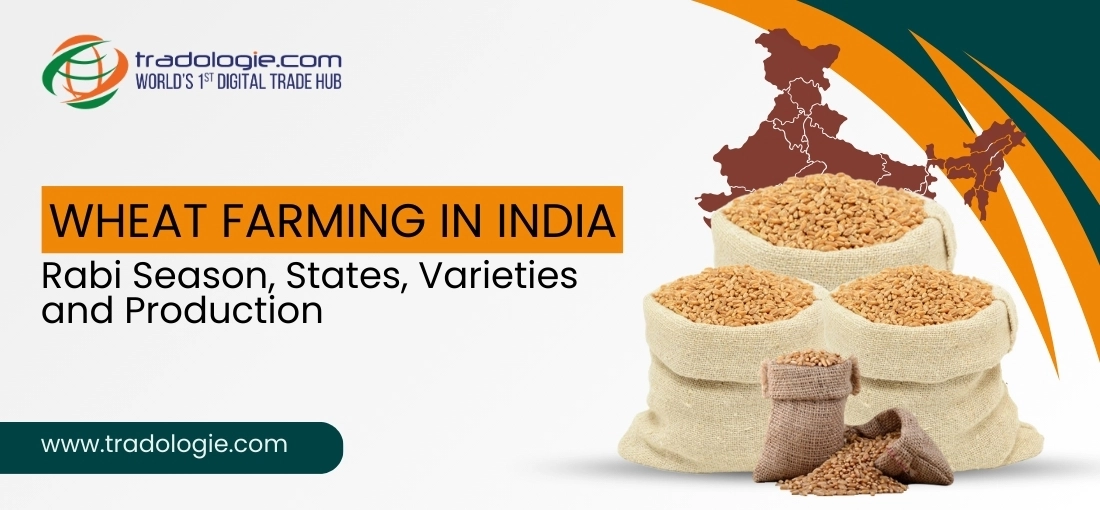
Wheat is India's second most important food crop after rice. It is the primary staple food for over 700 million people across northern, central, and western India.
India is among the world's top five wheat producers, growing approximately 115 million tonnes annually. Understanding wheat farming — when it is grown, where it thrives, and how it reaches markets — is essential for farmers, students, and agribusinesses across the country.

Quick Answer
Wheat is a Rabi crop in India, sown in October–November and harvested in March–April. It grows best in cool temperatures between 10°C and 25°C with assured irrigation. Uttar Pradesh, Punjab, Haryana, Madhya Pradesh, and Rajasthan are India's top wheat-producing states. India produced approximately 115 million tonnes of wheat in 2025-26.
Wheat Growing Season in India
Wheat is exclusively a Rabi season crop in India. It cannot be grown during the Kharif season because it requires cool temperatures that are only available during winter months.
Wheat requires:
- Cool temperature during germination — 10°C to 15°C
- Moderate temperature during grain filling — 15°C to 25°C
- Warm and dry conditions at harvest — above 25°C
- Assured irrigation — 4 to 6 irrigations during the crop cycle
- Well-drained fertile soil — alluvial soils of Indo-Gangetic plains are ideal
Wheat Crop Calendar
| Stage | Months |
|---|---|
| Field Preparation | September – October |
| Sowing | October – November |
| Tillering Stage | November – December |
| Jointing and Booting | December – January |
| Flowering | January – February |
| Grain Filling | February – March |
| Harvesting | March – April |
Top Wheat Producing States in India 2025-26
| State | Annual Production | Share of Total |
|---|---|---|
| Uttar Pradesh | 35 million tonnes | 30.4% |
| Punjab | 18 million tonnes | 15.6% |
| Haryana | 13 million tonnes | 11.3% |
| Madhya Pradesh | 20 million tonnes | 17.4% |
| Rajasthan | 12 million tonnes | 10.4% |
| Bihar | 6 million tonnes | 5.2% |
| Gujarat | 3.5 million tonnes | 3.0% |
| Uttarakhand | 1.0 million tonnes | 0.9% |
| Himachal Pradesh | 0.7 million tonnes | 0.6% |
| Other States | 5.8 million tonnes | 5.0% |
Source: Ministry of Agriculture & Farmers Welfare, 2025-26 Advance Estimates
Uttar Pradesh is by far India's largest wheat producer, contributing nearly one-third of national output. Punjab has the highest wheat yield per hectare — approximately 5.0 tonnes per hectare compared to the national average of 3.5 tonnes per hectare.
Popular Wheat Varieties Grown in India
India's wheat breeding programs have developed hundreds of high-yielding varieties suited to different agro-climatic zones.
High Yielding Wheat Varieties
| Variety | Key Feature | Growing Region |
|---|---|---|
| HD 3086 | High yield, disease resistant | North India |
| HD 2967 | Most widely grown variety | UP, Punjab, Haryana |
| PBW 550 | High yield, rust resistant | Punjab, Haryana |
| GW 496 | Drought tolerant | Gujarat, Rajasthan |
| K 307 | Heat tolerant | Eastern UP, Bihar |
| HI 8498 | Durum wheat, high protein | MP, Rajasthan |
| DBW 187 | Latest high-yield variety | North West India |
| WH 1105 | Water-efficient variety | Haryana |
Wheat Categories by Use
| Category | Use | Key Varieties |
|---|---|---|
| Bread Wheat | Chapati, bread making | HD 2967, PBW 550 |
| Durum Wheat | Pasta, semolina | HI 8498, PDW 314 |
| Sharbati Wheat | Premium quality, export | MP Sharbati varieties |
| Emmer Wheat | Traditional, tribal areas | Local varieties |
Wheat Cultivation Methods in India
1. Timely Sown Wheat
Sown between 1st November and 15th November — considered the optimal sowing window. Gives maximum yield as the crop gets full benefit of the cool winter period.
2. Late Sown Wheat
Sown after 25th November. Each week of delay after optimal sowing can reduce yield by 30–40 kg per hectare. Late sowing is common when farmers transition from Kharif paddy harvest to Rabi wheat sowing.
3. Zero Tillage Wheat
Seeds are directly drilled into the soil without ploughing. Saves fuel, time, and labour. Increasingly popular in Punjab and Haryana as it also reduces residue burning.
4. Bed Planting
Wheat is sown on raised beds with furrows in between for irrigation. Saves 20–25% water compared to flat sowing. Promoted in water-stressed areas.
5. Laser Land Levelling
Precision levelling of fields before sowing ensures uniform water distribution and better germination. Widely adopted in Punjab and Haryana.
Wheat Production Trend in India (2021–2026)
| Year | Production (Million Tonnes) | Yield (Tonnes/Hectare) | Area (Million Hectares) |
|---|---|---|---|
| 2021-22 | 107 | 3.17 | 33.8 |
| 2022-23 | 110 | 3.25 | 33.9 |
| 2023-24 | 113 | 3.35 | 33.7 |
| 2024-25 | 114 | 3.42 | 33.3 |
| 2025-26 | 115 | 3.50 | 32.9 |
Source: Ministry of Agriculture & Farmers Welfare, 2025-26 Advance Estimates
India's wheat yield per hectare has grown consistently, driven by adoption of high-yielding varieties and improved agronomic practices. However, area under wheat cultivation has marginally declined as farmers in some regions diversify into higher-value crops.
Wheat MSP in India 2025-26
The Government of India announces wheat MSP before each Rabi sowing season to guarantee minimum returns to farmers.
| Year | MSP (₹ per quintal) | Increase |
|---|---|---|
| 2021-22 | ₹1,975 | +₹40 |
| 2022-23 | ₹2,015 | +₹40 |
| 2023-24 | ₹2,125 | +₹110 |
| 2024-25 | ₹2,275 | +₹150 |
| 2025-26 | ₹2,425 | +₹150 |
Source: Cabinet Committee on Economic Affairs (CCEA), Government of India
Wheat MSP has increased by ₹450 per quintal over the last five years — a 23% increase reflecting both input cost rises and government commitment to farmer income support.
India's Role in Global Wheat Trade
India is a major wheat producer but historically consumes most of its production domestically through the Public Distribution System (PDS) and open market sales.
Key Facts on India Wheat Trade 2025-26
| Indicator | Value |
|---|---|
| Total Production | 115 million tonnes |
| Government Procurement | 26–30 million tonnes |
| Domestic Consumption | 105 million tonnes |
| Export Potential | 8–10 million tonnes |
| Major Export Destinations | Bangladesh, Nepal, Sri Lanka, UAE, Indonesia |
India emerged as a significant wheat exporter in 2021-22 when global wheat prices surged following supply disruptions. Export policy remains dynamic and is adjusted based on domestic stock levels and food security requirements.
Farmers with surplus wheat after Rabi harvest can sell agricultural commodities online to connect with verified buyers across India and internationally. Businesses and importers seeking Indian wheat can buy agricultural commodities online directly from producers at competitive post-harvest prices.
Challenges in Wheat Farming in India
1. Heat Stress at Grain Filling Stage Rising temperatures in February–March due to climate change are shortening the grain filling period, reducing wheat yields. Early-maturing and heat-tolerant varieties are being developed to address this.
2. Residue Burning After rice harvest in October, farmers in Punjab and Haryana burn paddy stubble to quickly prepare fields for wheat sowing. This causes severe air pollution and degrades soil health. Zero tillage adoption is gradually reducing this practice.
3. Groundwater Depletion The rice-wheat rotation system in Punjab and Haryana requires heavy irrigation for both crops, depleting groundwater at unsustainable rates. Diversification away from rice-wheat is a policy priority.
4. Wheat Blast Disease A fungal disease first detected in India in 2016, wheat blast can cause significant yield losses if not managed. Resistant varieties and fungicide treatments are the primary defenses.
5. Procurement and Storage India's Food Corporation of India (FCI) procures large volumes of wheat annually. Storage capacity and logistics remain challenges in efficiently moving grain from farms to storage depots and end consumers.
Wheat vs Rice — Key Farming Differences
| Feature | Wheat | Rice |
|---|---|---|
| Season | Rabi (Winter) | Kharif (Monsoon) |
| Sowing Time | October–November | June–July |
| Harvest Time | March–April | September–October |
| Water Requirement | Moderate (irrigation) | High (rainfall + irrigation) |
| Temperature | 10°C–25°C | 20°C–35°C |
| Primary Region | North and Central India | East and South India |
| Annual Production | 115 million tonnes | 137 million tonnes |
For a complete comparison of crop seasons, read our guide on Rabi and Kharif crops in India.
Conclusion
Wheat farming is central to India's food security, farmer livelihoods, and agricultural economy. As a Rabi crop dependent on winter temperatures and assured irrigation, wheat production is concentrated in the fertile Indo-Gangetic plains of northern and central India.
With consistent production growth, rising MSP support, and improving varieties, India's wheat sector is well positioned for continued expansion. For farmers, adopting water-efficient cultivation methods and timely sowing are the most impactful steps to improve yields. For traders and businesses, the March–April harvest window is the most important period for wheat procurement and trade planning.
Understanding wheat's place in India's Rabi season agricultural calendar is the foundation for anyone engaged with India's grain economy.
Data sources: Ministry of Agriculture & Farmers Welfare (2025-26), Food Corporation of India, ICAR-Indian Institute of Wheat and Barley Research, APEDA 2025
Frequently Asked Questions
Is wheat a Rabi or Kharif crop?
Wheat is a Rabi crop grown during the winter season in India. It is sown in October–November and harvested in March–April. Wheat cannot be grown during the Kharif season as it requires cool temperatures.
Which state produces the most wheat in India?
Uttar Pradesh is India's largest wheat-producing state, contributing approximately 30% of national production. Punjab has the highest yield per hectare.
How many times is wheat irrigated?
Wheat typically requires 4 to 6 irrigations during its growing cycle. The most critical irrigation is the first one — applied 20–25 days after sowing at the crown root initiation stage.
Uttar Pradesh is India's largest wheat-producing state, contributing approximately 30% of national production. Punjab has the highest yield per hectare.
What is the best wheat variety in India?
HD 2967 is India's most widely grown wheat variety due to its consistent high yield and disease resistance. DBW 187 is a newer variety showing excellent performance across north Indian states.
Uttar Pradesh is India's largest wheat-producing state, contributing approximately 30% of national production. Punjab has the highest yield per hectare.
When is wheat harvested in India?
Wheat is harvested between March and April across most of India. In higher altitude areas of Himachal Pradesh and Uttarakhand, harvesting may extend into May.
Uttar Pradesh is India's largest wheat-producing state, contributing approximately 30% of national production. Punjab has the highest yield per hectare.
What is the wheat MSP for 2025-26?
The wheat MSP for 2025-26 is ₹2,425 per quintal, an increase of ₹150 from the previous year.
How much wheat does India produce annually?
India produces approximately 115 million tonnes of wheat annually as of 2025-26, making it the second largest wheat producer in the world after China.