
Global agricultural trade is fundamentally an exercise of matching the demand and supply. For decades, the flow of perishable commodities and high-volume food matrices between the Indian subcontinent and the Arabian Peninsula has operated under the standard, middle-tier mechanics of Most Favored Nation (MFN) tariffs. On June 1, 2026, that traditional paradigm experienced a major structural shift. The entry into force of the India-Oman Comprehensive Economic Partnership Agreement (CEPA) has effectively dismantled the fiscal borders between these two contiguous trade zones, introducing a zero-duty corridor that covers 99.38% of India's exports by value.
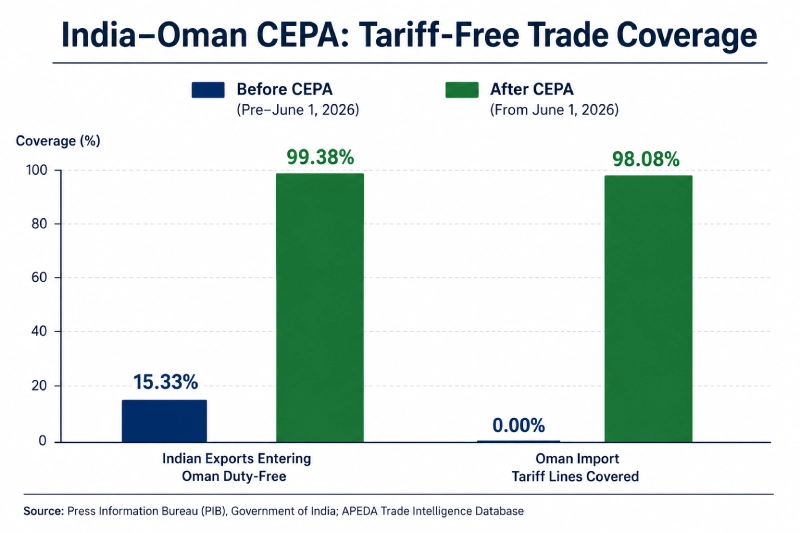
From an agrarian trade perspective, the transformation is stark. Prior to this operational activation, a mere 15.33% of Indian outbound shipments cleared Omani ports on a duty-free basis. The remainder confronted a steady, margin-eroding 5% ad valorem tariff baseline across the Gulf Cooperation Council (GCC) entry points. By engineering total tariff elimination across 98.08% of Oman's entire import nomenclature, the pact alters the spatial economics for South Asian agribusinesses. India now stands as only the second nation globally—and the absolute first in Asia—to secure a standalone, high-purity bilateral trade architecture with Muscat, following the United States.
While the agreement introduces immediate tariff erasure across the vast majority of core trading lines, the text incorporates a calibrated approach for specific sub-sectors. High-volume export pillars such as bovine meat and marine products receive zero-duty access on Day One, providing an instant competitive bounce. For certain secondary agricultural lines, the concessions are structured as phased reductions spanning a five-to-ten-year window, allowing regional distribution channels to adjust smoothly to the new trading volumes.
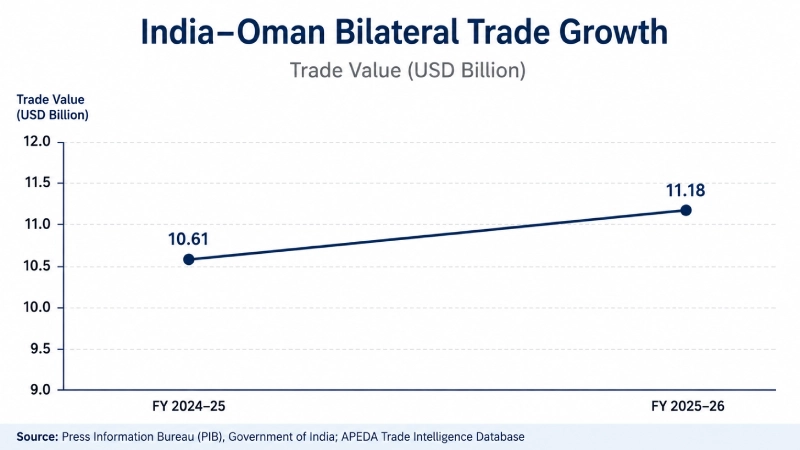
This trade corridor materializes at a highly critical macro moment. As Western and European supply channels grapple with logistical reconfigurations and volatile input inflation, the Indo-Omani trade lane has displayed a highly consistent upward trend, climbing from USD 10.61 billion in FY 2024-25 to USD 11.18 billion in FY 2025-26. What this agreement codifies is not just a seasonal discount on customs duties; it is a permanent infrastructure that integrates India's high-capacity farming belts straight into the primary consumption hubs of West Asia.
Sourcing Dominance and the Perishable Supply Chain
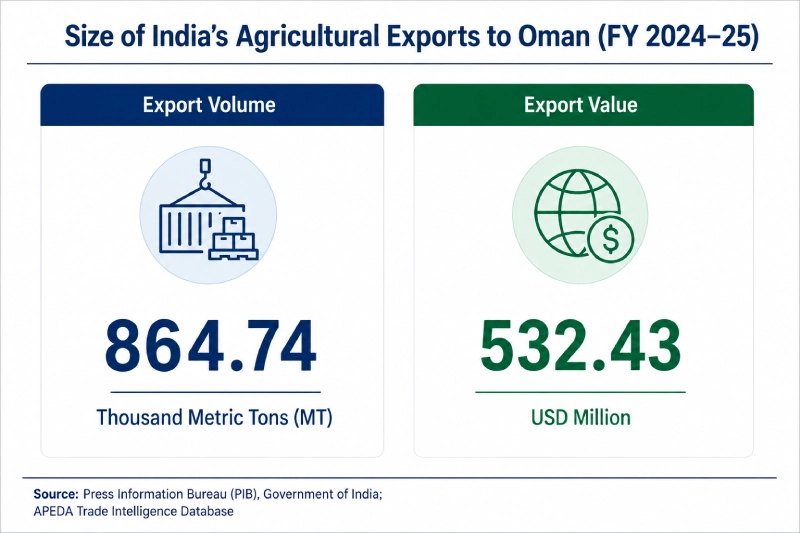
To understand the commercial gravity of this agreement, one must evaluate the baseline data managed by the Agricultural and Processed Food Products Export Development Authority (APEDA). During the FY 2024-25 cycle, Indian agri-exporters moved 864.74 thousand metric tons of scheduled products into Oman, tracking a financial value of USD 532.43 million.
The composition of these shipments highlights a deep institutional dependence on Indian farm yards:
APEDA Sourcing Footprint in Oman (FY 2024-25)
| Agricultural Commodity Type | Export Value Layer | Absolute Share of Sector | Strategic Advantage under CEPA |
|---|---|---|---|
| Basmati Rice | USD 144.73 Million | 27.18% | Solidifies baseline brand premium over regional grain alternatives |
| Frozen Boneless Buffalo Meat | USD 71.55 Million | 13.44% | Protects India's 94% dominant market share from alternative processing hubs |
| Eggs and Live Poultry | USD 45.30 Million | 8.51% | Accelerates daily logistics; India captures over 98% of current Omani egg imports |
| Non-Basmati Rice | USD 37.66 Million | 7.07% | Secures low-margin volume lanes against secondary Asian suppliers |
| Other Fresh Vegetables | USD 23.65 Million | 4.44% | Reduces transit time overheads across nearby sea lanes |
Source: APEDA Trade Intelligence Database & PIB Delhi
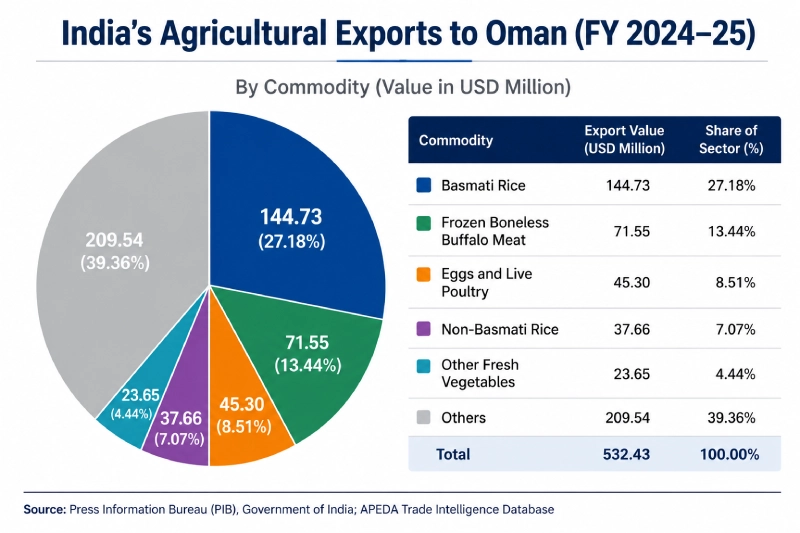
The elimination of the 5% tariff barrier across these primary lines alters the competitive landscape. In sectors like poultry and bovine meat, where corporate margins rarely exceed three to four per cent, a five per cent price adjustment represents an immediate commercial advantage. Indian poultry clusters in Tamil Nadu and Andhra Pradesh, alongside livestock processing hubs in Uttar Pradesh, can now outcompete suppliers from Brazil or the European Union who continue to operate under Oman's standard MFN tariff walls.
Furthermore, the immediate tariff elimination on premium horticultural assets—specifically geographical indication (GI) tagged mango varieties including Alphonso, Kesar, and Dasheri—redefines the seasonal valuation architecture. Instead of moving these high-value fruits through volatile spot brokerages, Indian agri-processors can lock down fixed-price, multi-season supply agreements directly with Omani supermarket conglomerates, capitalizing on immediate custom clearance protocols at the destination gate.
The Strategic Redoubts: Protecting the Indian Mandi
While the offensive gains for Indian agri-exporters are wide-ranging, the true analytical value of this CEPA sits in its defensive calibration. A common critique of comprehensive bilateral pacts is their tendency to expose domestic farming populations to cheap, subsidized import deluges that can destabilize local mandi pricing.
The negotiation teams addressed this structural vulnerability by drawing an absolute defensive line around India's sensitive rural livelihood sectors.
By placing dairy products, primary cereals, fresh domestic fruits, local vegetables, edible oils, oilseeds, rubber, and key spices squarely on the absolute exclusion list, the agreement prevents any erratic, unvetted inbound volume flows from impacting domestic farm gates. This means that while Indian engineering and processed food desks aggressively scale up their outbound capacities, the domestic production loops for sensitive field crops remain fully insulated behind Tariff Rate Quotas (TRQ) and Minimum Import Price (MIP) mechanisms. It is a balanced trade setup: maximizing industrial and processed food market access abroad while defending the baseline financial security of the Indian smallholder at home.
The Erasure of Non-Tariff Friction
In modern agricultural trade, non-tariff barriers (NTBs) frequently inflict more severe financial damage than actual customs duties. A container of fresh shrimp or pasteurized dairy components delayed for twelve days at a port terminal due to redundant laboratory assays is a total commercial loss.
The most significant operational breakthrough within the India–Oman CEPA is the systemic alignment of regulatory compliance frameworks.
Under the newly activated trade facilitation protocols, Oman will mandatorily accept inspection certificates issued directly by India’s Export Inspection Council (EIC). This simple administrative step completely eliminates duplicative testing and border inspections at West Asian maritime gates.
Simultaneously, Oman has extended formal, state-level recognition to India’s National Programme for Organic Production (NPOP) and domestic halal certification frameworks. By removing the need for secondary, third-party authentication agencies, the agreement strips significant compliance overheads from MSME food processors, ensuring standard cargo clearance timelines and fast-track clearance loops for highly perishable agricultural goods.
Logistics as a Force Multiplier: The Triple-Port Gateway
Securing tariff immunity is a hollow victory if the underlying physical supply chain is fractured. The geography of Oman provides Indian agribusinesses with a massive transport advantage, provided exporters align their logistics with Muscat’s massive oceanic investments. The agreement is explicitly engineered to utilize Oman’s deep-water triumvirate: the logistics hubs at Sohar, Duqm, and Salalah.
These three ports function as a powerful logistical conveyor for Indian cargo. Instead of routing vessels deep into the Persian Gulf—where maritime traffic faces constant geopolitical vulnerabilities and high insurance premiums—Indian container ships operating out of Mundra, JNPT, or Chennai can drop cargo directly along Oman's open-ocean coastline.
From these deep-water terminals, Indian processed foods, frozen meats, and marine shipments can be broken down and distributed via advanced road networks into the broader GCC marketplace. Furthermore, Salalah’s position as a premier transshipment gateway provides Indian agribusinesses with a direct, streamlined launching pad into the rapidly expanding consumer markets of East Africa, transforming this bilateral pact into a multi-continental strategic economic corridor.
Market Outlook and Strategic Sourcing Recommendations
The long-term trajectory for Indo-Omani agricultural trade looks exceptionally robust. Driven by expanding urban populations across the Gulf, an increasing reliance on institutional food security networks, and India's unparalleled geographical proximity, outbound agricultural volumes are positioned for multi-year expansion.
For forward-looking Indian food processors and export desks, the operational roadmap requires a rapid transition toward value-added production. Relying entirely on bulk, unrefined grain drops leaves an enterprise exposed to localized policy adjustments and global commodity price swings. True commercial longevity under this CEPA belongs to agribusinesses that invest in advanced processing lines—converting raw basmati into branded, retail-ready consumer packages, and fresh marine catches into trace-verified, vacuum-insulated seafood units tailored for West Asian supermarket shelves. By combining structural tariff immunity with complete document precision and strict compliance with global safety parameters, Indian agricultural enterprises can secure a premium, dominant position across one of the world's most lucrative economic corridors.
Want to export agriculture products to Oman? Register as a seller on Tradologie and connect with genuine buyers.



.webp "Navigating the Basmati Export Disruptions: Diversifying to Africa and Non-Gulf Premium Rice Markets")