.webp "Navigating the Basmati Export Disruptions")
Putting all your eggs in one basket is a risky strategy in commodity trade, and right now, India’s premium aromatic rice desks are learning that lesson the hard way. For decades, the West Asian corridor has been the undisputed goldmine for basmati shipments. But as regional crisis lines tighten across the Gulf, the traditional pipeline is choking.
The latest transaction ledgers from the Commerce and Industry Ministry paint an uncompromising picture. Total basmati rice exports took a severe 24% tumble across March and April, sliding down to $838.34 million from last year's $1105.36 million cushion.
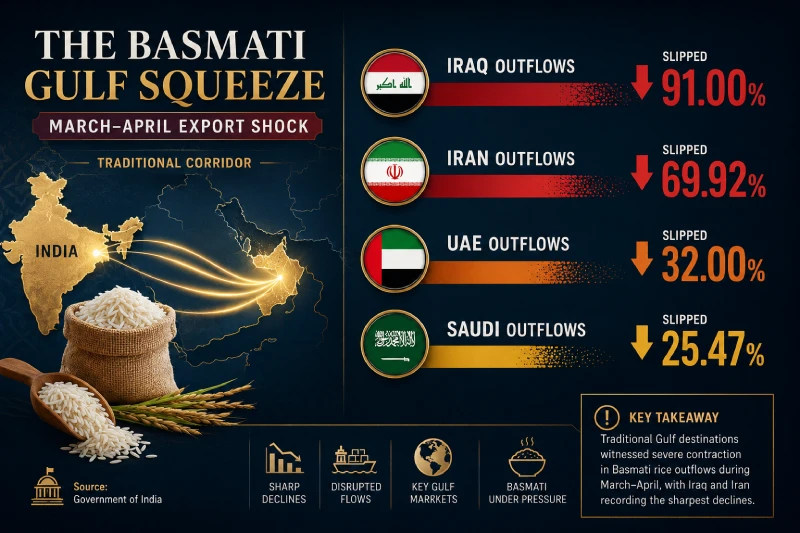
Out of the 60 lakh tonnes of premium basmati India clears annually, a massive 40 lakh tonnes routinely heads straight into the Gulf. With core destinations like Iraq collapsing by 91% (dropping from $70.10 million to a meager $6.28 million) and Iran shrinking by nearly 70%, trading floors are facing a sudden, massive supply glut.
To survive this cycle, merchant exporters need a structural pivot. It is time to look past the volatile West Asian obsession and build parallel, high-volume channels elsewhere.
The Western Hemisphere & European Basmati Anchors
If your milling lines are completely geared for premium Basmati and cannot easily adjust to rough non-basmati milling, you do not have to let your machinery sit idle. The data from the export registries shows steady, multi-year volume growth in non-Gulf destinations. These are mature retail markets with stable currencies and consistent consumer demand.

When you look at the macro numbers for the Americas and Western Europe, the long-term expansion is clear:
1. The Americas Corridor
The total volume crossing the Atlantic into the Americas has grown consistently year-over-year:
- The Tonnage Leap: Total shipments to the region climbed from 221,195 MT in 21-22, up to 319,061 MT in 23-24, and hit a strong 359,563 MT in the 24-25 cycle. That is an impressive 62.5% increase in bulk intake over a four-year period.
- The US Market Engine: The United States acts as the primary driver here, expanding its bulk Basmati intake from 161,005 MT to 274,213 MT across that same span. Canada follows a similar upward line, growing from 59,307 MT to 83,497 MT.
2. Non-EU European Buffers
Looking at the "Other Europe" registry, total volumes climbed from 147,877 MT in 21-22 to 239,099 MT in the 24-25 block—a massive 61.6% growth vector.
- The UK Anchor: While the UK remains a steady high-volume buyer holding firm around 180,955 MT, the real surprise breakout is Turkey. Turkey’s bulk Basmati procurement skyrocketed from 14,174 MT to 55,703 MT, showing a massive 292% volume expansion as it establishes itself as a major regional distribution hub.
The African Non-Basmati Pivot: Mapping the Real Volume Corridors
While you re-route your premium long-grain to stable Western buyers, your high-volume desks should look toward the African continent. Africa is currently operating as the largest mass-volume consumer of Indian non-basmati rice. West and East African port locations do not care about premium aromatic elongation ratios; they run on parboiled lots, medium grains, and 100% broken white rice segments.
Shifting your desk into these corridors isn't just an alternative strategy—it is a logical hedge against regional disruptions. Exporters can tap into highly specific Indian non-basmati varieties that align perfectly with African culinary and economic preferences:
- Sona Masoori (Medium Grain): This lightweight, aromatic medium-grain variety is incredibly popular across West African urban centers. It carries lower starch levels, making it a premium alternative to standard white rice for the rising middle-class consumer segments in Nigeria and Ghana.
- PR 11 / PR 14 (Long Grain Non-Basmati): Grown heavily in Punjab and Haryana, these varieties offer an excellent structural pivot for basmati millers. They have a long kernel profile that mimics the look of premium basmati but can be exported at a fraction of the cost, making them highly competitive in East African ports like Mombasa.
- IR 64 (Long Grain Parboiled): The absolute workhorse of global rice trade. West African markets—specifically Benin, Togo, and Guinea—absorb massive tonnages of IR 64 parboiled rice. The parboiling process gelatinizes the starch, making the grain tough enough to survive long-haul coastal storage without rotting.
- 100% Broken White Rice: Far from being a waste product, broken rice is a staple volume driver in Senegal and parts of the Sahel. It cooks fast, absorbs flavors deeply for traditional one-pot dishes, and moves in massive, multi-thousand-ton vessel charters because of its low entry price.

Executing Trade via Digital Live Negotiations
The traditional way of exporting—spending weeks traveling to international trade fairs, waiting days for overseas banks to verify letters of credit, and haggling with distant brokers over WhatsApp—is too slow for a fast-moving market crisis. When a primary corridor drops 90% in sixty days, you cannot afford a slow sales cycle.
This is where the Tradologie digital marketplace completely changes the game for Indian merchant exporters.
Instead of cold-calling unknown importers in Nairobi, Lagos, or New York, exporters can log directly into Tradologie’s AI enabled global trade ecosystem. The platform maps out active, verified purchase inquiries from authenticated international buying houses.
The core operational advantage comes through its proprietary digital live negotiation framework. During a scheduled live negotiation window, you can view the buyer's exact target requirement, analyze competing origin quotes in real time, and adjust your quotes dynamically. Whether you are quoting a load of IR 64 Parboiled for Benin or premium Basmati for a US supermarket chain, there are no opaque middleman margins or hidden broker fees.
The platform handles the cross-border friction by providing secure escrow and LC payment setups and verifying buyer credentials up front. This gives merchant desks the agility to divert hundreds of container slots from troubled Gulf ports straight to verified buyers in alternative global markets within 48 hours.
Technical Verdict
The disruption across West Asia isn't a temporary market dip; it is a clear structural warning. Relying entirely on a single premium grain line sent to a single geographic corridor leaves your business vulnerable to external shocks. Lasting commercial margins belong to flexible trade desks that use modern digital infrastructure to diversify their product mix and geography. By expanding your portfolio into alternative varieties like Sona Masoori, routing your long-grain basmati to growing markets in the US and Turkey, and utilizing Tradologie's live negotiation arena, you can transform a regional shipping crisis into a resilient global enterprise



.webp "Beyond the Ban: Why a New \"Urgency Window\" Is Reopening for Indian Wheat Exports")