India's rice market is entering an unusual season.
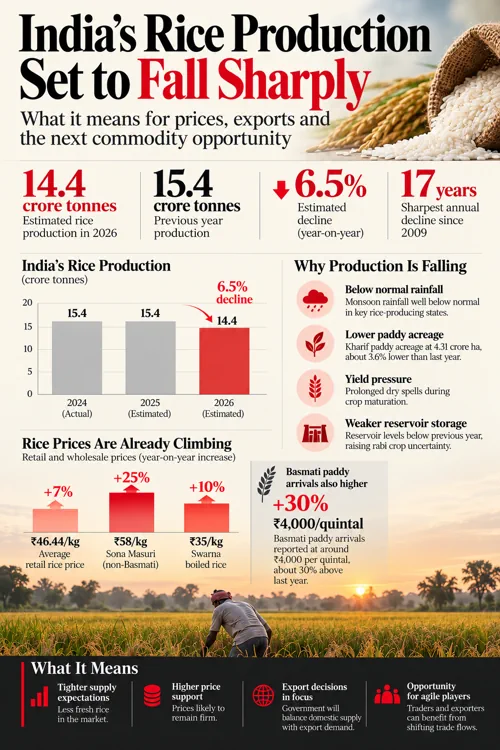
The latest estimates suggest that rice production could fall to around 14.4 crore tonnes in 2026, roughly 6.5% below the previous year's 15.4 crore tonnes. If that estimate holds, it would be the sharpest annual decline in about 17 years, bringing memories of the 2009 production shock back into the conversation. Contemporary reporting has already linked the expected decline to deficient rainfall, lower paddy acreage and weaker yield prospects.
For an industry that has spent the last few years dealing with export restrictions, large government stocks and shifting international demand, this is more than another crop estimate.
It changes the equation.
India is not suddenly running out of rice. Government stocks remain substantial, and the previous year's bumper procurement gives policymakers some room to absorb a production shock. But the market is beginning to price in something different: less fresh rice coming from the fields at a time when domestic and international buyers are still watching Indian supplies closely.
That distinction could become important for exporters.
The Rice Production Decline Is Starting in the Field
The immediate explanation is fairly straightforward, although the consequences are not.
Rainfall has been below normal, and the weakness has been particularly visible across several important rice-producing states. Current reporting puts India's monsoon rainfall well below normal, while industry participants have also pointed to prolonged dry spells during crop maturation.
Paddy acreage has also fallen.
According to the figures cited in the current market assessment, kharif paddy acreage was around 4.31 crore hectares, about 3.6% below the previous year's 4.47 crore hectares. The problem, therefore, is not confined to the amount of land planted.
If the crop receives less water while the grain is developing, the second pressure comes through yield.
And this is where the 2026 rice story becomes more complicated than a simple “production is down” headline.
| Factor | Current Indication | Likely Market Effect |
|---|---|---|
| Estimated 2026 rice production | 14.4 crore tonnes | Lower overall availability |
| Previous-year production | 15.4 crore tonnes | High comparison base |
| Estimated decline | ~6.5% | Tighter supply expectations |
| Kharif paddy acreage | ~4.31 crore ha | Lower planted area |
| Rainfall | Below normal in key regions | Yield pressure |
| Reservoir storage | Below previous-year level | Rabi crop uncertainty |
Attribution: Current industry estimates and government-linked data cited in reporting; the 2026 production figure remains an estimate because harvesting is still underway.
The last point may prove particularly important.
If reservoir levels remain weaker and rabi paddy acreage or yields also suffer, the market will not be looking at one poor kharif crop anymore. It will start looking at the availability of rice over a longer period.
That is when procurement strategies can change.

Rice Prices Are Already Responding Before the Harvest Picture Is Complete
Commodity markets rarely wait for the final production number.
They respond to expectations.
Retail rice prices have already moved higher, with recent reports putting the average price at around ₹46.44 per kg , about 7% higher year on year. Premium non-Basmati varieties have moved considerably more: Sona Masuri was reported at around ₹58 per kg , up 25%, while Swarna boiled rice was around ₹35 per kg , up 10%. Basmati paddy arrivals have also begun at prices reported around ₹4,000 per quintal , approximately 30% above last year at the same point.
The market is therefore sending two messages at once.
There is enough rice available today.
But buyers are increasingly paying attention to what might be available tomorrow.
That is a very different market psychology from a genuine shortage.
Will India Actually Face a Rice Shortage?
Probably the more useful question is not whether India has enough rice in its warehouses.
It is how much of that stock is commercially available, what form it is in and how quickly it can be brought into the market if required.
Government stocks provide an important cushion. The previous year's strong production and procurement left India with substantial foodgrain reserves, and recent RBI commentary also noted that strong procurement had helped maintain comfortable foodgrain stocks despite the weak monsoon.
But not every tonne sitting in a government warehouse is equivalent to a tonne of retail-ready rice.
Stocks can include paddy that still needs milling, different grades and varieties, and rice allocated for government programmes. Some rice has also been allocated to ethanol production.
That makes the headline stock number less straightforward than it first appears.
For the domestic market, the government's ability to release appropriate stocks will therefore matter almost as much as the headline quantity held.

The Export Market Is Where the Story Gets Interesting
India is not just another rice-producing country.
It is the world's largest rice exporter and has remained at the top of global rice trade for more than a decade. In 2025-26, India exported 15.01 million tonnes of non-Basmati rice worth $5.82 billion , while Basmati exports reached 6.52 million tonnes worth $5.67 billion.
That gives India a combined rice export volume of more than 21 million tonnes across these two categories.
So even a moderate change in India's exportable surplus can have consequences well beyond Indian mandis.
This is particularly relevant for countries that have become accustomed to Indian non-Basmati rice as a competitively priced staple. Benin, Bangladesh, Guinea, Togo and Côte d’Ivoire were among the largest destinations for Indian non-Basmati rice in 2025-26.
If domestic prices continue rising, Indian exporters will have to balance two competing realities.
The international buyer wants a competitive landed price.
The Indian supplier is looking at a more expensive paddy market.
That tension does not necessarily stop exports. It can, however, change which grades remain attractive to export.
The Bigger Risk Is Not Necessarily a Rice Shortage. It Is a Price Recalibration.
This is where I think the current news deserves more attention than the production number itself.
A 6.5% decline in production does not automatically mean rice prices will rise by 6.5%. Commodity markets do not work that neatly.
Government stocks, procurement, domestic consumption, export policy, crop arrivals, freight and currency movements will all influence the final price.
But when a market moves from comfortable supply towards tighter availability, the risk premium begins to change.
Importers may start booking earlier. Millers may become more cautious about inventories.
Exporters may hold stocks rather than immediately quote. Buyers who normally negotiate aggressively may become more concerned about securing the next shipment.
And once enough buyers behave that way at the same time, the physical market can tighten faster than the production figures alone would suggest.
Basmati and Non-Basmati May Behave Differently
It would also be a mistake to treat Indian rice as one commodity.
Basmati operates in a different market from non-Basmati rice.
The premium variety is driven by aroma, grain length, ageing, processing and destination-specific demand. Saudi Arabia, Iran, Iraq, the UAE, Yemen and the United States were the principal destinations for Indian Basmati exports in 2025-26.
Non-Basmati rice, meanwhile, serves a much wider range of staple-food markets.
That means a production decline could affect varieties differently.
Premium Basmati prices may continue to be shaped by the new-season paddy arrivals and export demand, while non-Basmati prices could become more closely linked to domestic food-security considerations and government policy.
The next few months will therefore be important for exporters trying to determine which varieties actually offer sustainable export margins.
What Should Indian Exporters Do If Rice Becomes More Expensive?
This is where the story moves beyond rice.
Indian exporters should not necessarily interpret a tighter rice market as a reason to leave rice altogether. For exporters with established overseas buyers, processing infrastructure and strong procurement networks, higher prices can create opportunities as well as challenges.
But it is also a good moment to look sideways.
India's agricultural export basket is much broader than rice.
| Commodity | India's FY2025-26 Exports | Why Exporters May Examine It |
|---|---|---|
| Maize | 1.25 million MT / US$374.70m | Feed, starch and industrial demand |
| Pulses | 1.00 million MT / US$969.53m | Strong staple-food demand |
| Groundnuts | 663,810 MT / US$690.93m | Food, oil and snack markets |
| Other cereals | 1.43 million MT / US$445.67m | Rye, barley, oats and other cereal niches |
| Processed foods | US$8.03bn | Higher-value alternatives to raw commodity trade |
| Spices and other agri products | Significant established export base | Lower dependence on a single cereal |
Attribution: APEDA/DGCIS, FY2025-26 export data.
Maize is particularly interesting because India exported 1.25 million tonnes worth US$374.70 million in 2025-26, with Bangladesh, Nepal and Vietnam among the principal destinations.
Pulses offer another route. India exported about 1 million tonnes of pulses worth US$969.53 million during the same year, with China, the UAE, Bangladesh, the US and Sri Lanka among the major markets.
Groundnuts are another established export business, with 663,810 tonnes shipped in 2025-26 for about US$690.93 million. Indonesia, Vietnam, Malaysia, China and the Philippines were the leading destinations.
These are not substitutes for rice in a literal sense.
They are alternatives in an exporter's portfolio.
The More Interesting Opportunity May Be in Value Addition
There is another lesson in the current rice situation. When a commodity becomes more expensive, buyers often begin looking more carefully at what they are actually purchasing.
That can create space for processed foods.
India exported about US$8.03 billion of processed food products in 2025-26 , including miscellaneous preparations, cereal preparations, processed vegetables, pulses, groundnuts and processed fruits and juices.
A rice exporter with established international buyers could therefore explore adjacent products rather than simply chasing another bulk grain.
A distributor buying Indian rice may also buy pulses.
A food manufacturer sourcing cereals may have requirements for maize or cereal preparations.
A South Asian food distributor may be interested in spices, groundnuts, ready-to-cook products or processed vegetables.
The relationship with the buyer can sometimes be more valuable than the individual commodity.
Indian Exporters Should Watch the Next Few Months Very Closely
The immediate rice story is still developing.
Harvesting has not finished, the final production number is not known, and the government still has a substantial stock buffer. Current market reporting also suggests that new Basmati arrivals could moderate prices as October progresses, meaning the present price spike should not automatically be extrapolated through the entire season.
But there is enough happening to justify caution.
Lower rainfall has already affected crop expectations. Paddy acreage is down. Prices of some premium non-Basmati varieties have moved sharply. Reservoir levels are creating questions around the next crop. And India remains too important to global rice trade for an extended supply squeeze to remain a purely domestic affair.
For exporters, the sensible response is not to panic and abandon rice.
It is to broaden the book.
Keep watching Basmati and non-Basmati arrivals. Track government procurement and stock releases. Follow export-policy notifications closely. Revisit contracts where margins are becoming too thin. And, alongside rice, start developing buyer relationships for maize, pulses, groundnuts, spices and processed food products where Indian supply remains commercially competitive.
India's strength in agricultural trade has never been that it produces only one thing.
The present rice market is simply reminding exporters of that fact.
If the coming months bring tighter rice availability and firmer prices, the exporters who have already diversified their commodity portfolio will have more room to manoeuvre. Those who depend entirely on one crop may find that a production shock in the field eventually becomes a margin shock in the export office.
And in commodity trade, that distinction can be worth a great deal.





.webp "India’s Rising Rice Export Momentum: A New Wave of Opportunities for Global B2B Trade")