India's rice exporters are beginning to look beyond the traditional destinations that have dominated the country's export map, with markets such as Jordan and Turkey emerging as new areas of commercial interest.
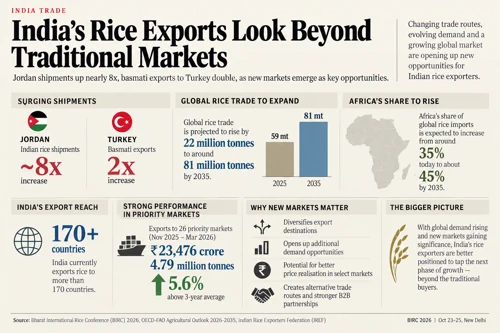
Indian rice shipments to Jordan have increased nearly eight-fold, while India's basmati exports to Turkey have doubled, according to the Bharat International Rice Conference (BIRC) 2026. The developments are drawing attention because neither country would normally be the first name on a list of the world's biggest rice-importing markets.
And that may be exactly the point.
The latest trade movement suggests that the next phase of Rice exports from India may not come only from chasing the largest buyers. Changes in trade routes, regional sourcing patterns and demand for particular varieties are creating opportunities in markets that previously received much less attention.

The timing is interesting. The OECD-FAO Agricultural Outlook 2026-2035 expects global rice trade to expand by around 22 million tonnes over the next decade, reaching roughly 81 million tonnes by 2035. Africa's share of global rice imports is projected to rise from around 35% today to about 45%.
That is a very large market taking shape.
The more difficult question is where India's next export growth will actually come from.
Jordan and Turkey are already changing the conversation
The jump in shipments to Jordan needs a little more context.
An eight-fold increase does not necessarily mean Jordanian consumers are suddenly consuming eight times more Indian rice. Part of the increase is connected with changes in regional trade routes and redistribution of trade following disruption to direct trade with Iran.
That distinction matters.
A country can become important to an exporter because its domestic demand is rising. It can also become important because it could turn into a useful distribution point, an alternative sourcing market or a new route into a region.
Jordan appears to be showing the second side of that equation.
Turkey presents a somewhat different opportunity. The doubling of Indian basmati exports could point towards a market where Indian suppliers can potentially earn more through product positioning rather than simply competing for commodity volumes.
Dev Garg, Vice-President of the Indian Rice Exporters Federation, put the issue quite directly at the BIRC 2026 discussion. Exporters, he said, need to move away from assuming that the largest import markets are automatically the best opportunities.
That is an important shift in thinking for rice exporters in India.

The next market does not always have to be the biggest market
For years, the easiest way to identify an export market was to look at import volumes.
It still makes sense as a starting point. A country importing several million tonnes of rice obviously has demand. But the size of the market tells only part of the commercial story.
Consider two markets.
One may import enormous quantities but have fierce competition, low margins and high freight costs for Indian suppliers. Another may import considerably less, but Indian rice may have a better product fit, the competition may be less intense and buyers may be willing to pay more.
The second market could turn out to be the better business.
This is particularly relevant now because the global rice trade itself is expanding. The additional 22 million tonnes projected by 2035 will not simply appear in the markets that are already buying the most rice today.
Demand will develop alongside population growth, food consumption, domestic production gaps, trade policies and regional supply chains.
Africa is perhaps the clearest example.
Africa could become the bigger story over the next decade
Africa's projected rise from roughly 35% to 45% of global rice imports is a significant change in the geography of the rice business.
For India, the opportunity is obvious enough, but capturing it will require more than simply shipping additional tonnes.
Different African markets have different preferences, price points, freight economics and competing suppliers. Indian exporters will have to work out where particular varieties and grades make commercial sense rather than treating the continent as one large market.
That is where India's existing export network becomes useful.
India already exports rice to more than 170 countries. There is therefore a substantial base of trading relationships from which new markets could be developed.
The opportunity is to deepen that network rather than constantly start from scratch.
Turkey also points towards higher-value exports
Turkish development is particularly interesting for the basmati trade.
India is already a major global supplier of basmati rice, and premium varieties give exporters another way of increasing export value without depending entirely on higher physical volumes.
If a new market begins buying more basmati, the impact can be different from an increase in low-priced commodity rice exports. The exporter is competing on characteristics of the product as well as price, which could improve the value generated from each tonne.
Turkey's recent growth does not necessarily mean it will become India's next giant rice market.
It does show, however, that a market does not have to be enormous before it becomes commercially relevant.
Jordan shows another side of international rice trade
The Jordan story is perhaps even more useful for understanding B2B trade.
Commodity flows do not always follow the most obvious route. When geopolitical conditions disrupt one corridor, traders look for alternatives. Importers change suppliers. Cargo gets redirected. Distribution networks adjust.
Those changes can create business for exporters that were not previously major suppliers to a particular market.
For India, this means trade-route intelligence can become just as important as conventional demand data.
A market with modest domestic consumption can still matter if it could provide access to surrounding markets or become part of a new regional supply chain.
That is a very different way of looking at export potential.
India's existing numbers show there is room to go further
India's export network is already broad, and recent trade data shows that demand is not restricted to the traditional destinations.
Between November 2025 and March 2026, India's rice exports to 26 priority markets identified around BIRC 2025 reached approximately ₹23,476 crore and 4.79 million tonnes. Volumes were 5.6% above the corresponding three-year average.
That matters because it gives exporters something to build on.
The country does not need to discover international rice demand. It needs to identify where additional demand is emerging and where Indian supply has a commercial advantage.
This is also why simply producing another list of the world's largest rice importers is not particularly useful.
Anyone can identify the biggest markets.
The harder question is what an Indian exporter can actually sell there, at what price, against which competitors, and with what freight and payment economics.
The next $10 billion could come from several markets
The most interesting possibility is that India's next major increase in rice exports may not come from one new destination.
It could potentially be a combination of markets. More basmati going to Turkey. Increased flows through Jordan. Growing demand across Africa. Deeper penetration into existing destinations. New markets become commercially viable as freight routes and global sourcing patterns change.
Taken together, these smaller shifts could become a very large export opportunity.
There is another advantage to this kind of diversification. It reduces India's dependence on any one destination. For bulk rice exporters , that matters enormously. A change in import policy or demand in one major market can have a much smaller effect when sales are spread across a wider group of buyers and regions.
A diversified market base also gives mills and exporters greater flexibility in placing different varieties and grades.
What this means for rice exporters in India
The next phase of Rice exports from India may therefore be less about asking where the biggest rice importer is and more about asking where the trade is moving.
Jordan is showing how a disruption in one regional corridor can create new sourcing and distribution patterns.
Turkey is showing how a market outside the conventional list can develop quickly for a premium Indian product.
Africa could become a much larger structural opportunity as its share of global rice imports rises towards 45% by 2035.
And India's existing presence in more than 170 countries means exporters already have a strong platform from which to explore these changes.
For rice exporters in India, the commercial calculation will increasingly involve several things at once: demand, competition, freight, achievable price, import dependence, payment risk and the suitability of a particular Indian variety.
The biggest importer will always attract attention.
But the market that is growing quietly, changing its sourcing pattern or suddenly becoming important because of a shift in regional trade can sometimes be far more interesting.
India's rice export story has largely been built on scale. The next chapter could be about something slightly different: seeing where the trade is heading before those markets become obvious to everyone else.